Preview
 Send
Send Share
Share
 Details
 Guide
Guide

 Download
 Similars
 X-Ray
X-Ray Diaporama
 Stats
StatsTriptych


 Read More
Hand Made Oil Reproduction
Hand-painted oil on canvas in your size and frame, made to order by our artists. ( Switch to Print Switch to Digital Image)




P118B $10

P118H $10

P118W $10

P438Z $10

P508JH $12

P508YH $12

P805H $10

P805Z $10

P919BZ $10

P919G $10

P919XJ $10

P959ZH $10

P968JZ $12

W106C $8

W218G $10

W218JH $8

W218Y $10

W307PJ $10

W316G $10

W316PJ $8

W316Y $10

W398PJ $8

W4111J $10

W500HY $15

W500JH $15

W692G $12

W849H $8

W940BG $15

W953PJ $8




Pick from our preset sizes that match the artwork's original proportions.

Type the width and the height you need, to fit your frame or your wall. This is hand-painted, so for a size with a different shape the artist can paint a bit more around the picture, or cut a bit — you choose. We send you a digital mockup to approve before the painting starts. The picture shown on this page does not show the real result — only the mockup does.
After order, OriginalUniqueArt.com team will email client for instructions and provide a mockup preview
Worldwide Delivery () in 3/4 weeks instead of standard 5 weeks. (22 October). No compromise on quality.

Free Worldwide Express Shipping

High-Quality Linen Canvas

Full Shipping Insurance

Customs Tax Refund Guarantee

True Color Matching Guarantee

100-Day Return Policy (Defects Only)

100% Money-Back Guarantee

Bulk Discount Offer
 Glass option is only available in size under 110 CM

Triptych
Reproduction Medium
Reproduction Size
-


Total Price
$ 300
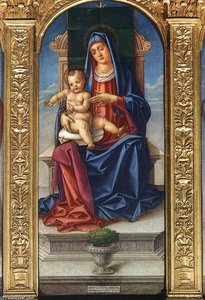
A Vision in Wood: The Devotional Splendor of the Triptych
To stand before this magnificent triptych is to step directly into the hushed, sacred atmosphere of a late Gothic chapel. This work, dating from 1460, is not merely a painting; it is a devotional portal, crafted with painstaking reverence for the divine narrative. The structure itself—the three hinged panels—invites an intimate viewing experience, suggesting that the viewer must physically open the piece to reveal its full spiritual scope. At its heart lies the central panel, where the Virgin Mary cradles the infant Jesus Christ, surrounded by celestial attendants and saints whose gazes seem to follow the eye across centuries of faith.
Mastery in Tempera: Technique and Detail
The technical brilliance evident in this piece speaks volumes about the skill of its creator. Executed in tempera on wood panels, the medium lends a characteristic luminosity and permanence to the colors. One can almost feel the subtle texture of the aged wood beneath the vibrant pigments. Observe the meticulous rendering of the drapery; the folds of the garments are not simply painted but seem to possess weight and life, catching the light as if they were woven from silk and prayer. The attention paid to every detail, from the delicate wings of the surrounding angels to the rich embroidery on the saints' vestments, speaks to an era where art was considered a form of sacred labor.
Symbolism Woven into Sacred Scenes
The narrative complexity is breathtaking. On the left wing, St. John the Baptist stands in contemplative repose, his traditional attire and the presence of the lamb serving as potent symbols of innocence and prophecy. The right panel offers a contrasting scene, perhaps within the cool embrace of a cloister, where another saint engages in deep study from a manuscript, suggesting the enduring power of scripture and contemplation. These flanking scenes do not merely decorate; they frame the central mystery—the Incarnation—with supporting pillars of Christian virtue: prophecy, devotion, and wisdom. The pointed Gothic arches framing each section further anchor the piece within an architectural vocabulary that speaks of heavenly aspiration.
Historical Echoes and Enduring Piety
This triptych belongs to a period when religious art served as both high art and essential teaching tool for the faithful. It captures the profound piety characteristic of the late Gothic era, a time deeply invested in personal spiritual experience. While the artist's hand may have been guided by the traditions of masters like Bartolomeo Vivarini, the emotional resonance is universal. For the modern collector or designer, owning such a reproduction offers more than mere decoration; it provides an immediate connection to the deep currents of European spirituality and artisanal excellence.
Questions & Answers
Who made "Triptych", and when?
The author of "Triptych" is Bartolomeo Vivarini, and the work is dated 1460.
In which movement and which era is "Triptych" by Bartolomeo Vivarini placed?
In "Triptych" by Bartolomeo Vivarini, the Late Gothic movement meets the Renaissance era.
What kind of piece is "Triptych"?
In the catalog, "Triptych" by Bartolomeo Vivarini is filed as wall art. The category helps find similar works.
Artist Biography
A Legacy of Venetian Light and Devotion
In the vibrant, shimmering atmosphere of the Quattrocento, Bartolomeo Vivarini emerged as a pivotal figure in the evolution of Venetian painting. Born in the storied glassmaking hub of Murano, Italy, he was part of an influential dynasty of artists that helped shape the visual identity of the Republic of Venice. As a member of the Vivarini family, his life and work were deeply intertwined with the artistic pulse of his homeland, bridging the transition from the ornate, gilded traditions of the late Gothic period to the burgeoning humanism of the early Renaissance.
The artistry of Vivarini is characterized by a profound sense of spiritual depth and technical precision. While he was a master of tempera, often utilizing gold leaf to imbue his compositions with a celestial luxury, he was also an innovator in the use of new mediums. It is noted that he learned the art of oil painting from Antonello da Messina, and he is credited with producing what is believed to be the first oil painting in Venice around 1473. This mastery allowed him to manipulate light and texture in ways that brought a new level of intimacy and serenity to his religious subjects.
Mastery of Form and Symbolism
Vivarini’s work often presents a striking balance between hard, defined outlines and a rich, emotive color palette. His figures frequently possess a dignified and devout expression, capturing the solemnity required for the altarpieces that adorned Venetian basilicas. This ability to convey human emotion through structured forms made him a sought-after painter for significant religious commissions. A notable example of his skill is found in his Madonna and Child, where he uses light entering through windows and deep red drapery to create a sense of sacred space.
Beyond the figures themselves, Vivarini’s paintings are often layered with symbolic meaning:
- The use of gold: His frequent application of gold leaf serves not only as decoration but as a medium to represent divine light.
- Natural motifs: In a charming nod to his name—as vivarino translates to goldfinch in Italian—he occasionally included the small bird as a subtle signature within his works.
- Architectural depth: His compositions, such as the Conversano Polyptych, demonstrate a sophisticated understanding of perspective and the integration of sacred figures into complex, multi-paneled structures.
Historical Significance and Artistic Influence
The historical importance of Bartolomeo Vivarini lies in his role as a bridge between eras. He stood at the crossroads of the Byzantine-influenced traditions of his predecessors and the revolutionary Renaissance styles brought by artists like Fra Angelico and Giovanni Bellini. By blending these diverse influences, he helped establish a unique Venetian visual language—one that prioritized luminous color and emotional resonance.
His influence extended through his family lineage, notably impacting the work of his nephew, Alvise Vivarini, who would become a leading artist in Venice before the rise of Bellini. Through his meticulous detail and his pioneering adoption of oil techniques, Bartolomeo Vivarini left an indelible mark on the history of Italian art, ensuring that the spiritual and aesthetic grandeur of Murano and Venice would be preserved for generations to come.

Bartolomeo Vivarini
1440 - 1499 , Italy
Quick Facts
- Artistic Movement Or Style: Venetian Renaissance
- Artists Or Movements Influenced By This Artist: ['Alvise Vivarini']
- Artists Who Influenced This Artist:
- Antonello da Messina
- Fra Angelico
- Full Name: Bartolomeo Vivarini
- Nationality: Italian
- Notable Artworks:
- Madonna and Child
- Conversano Polyptych
- Triptych (detail)
- Place Of Birth: Murano, Italy
- Date Of Birth: 1440
- Date Of Death: 1499
Related Articles

The Beauty of Late Gothic Art: Elegance, Intricate Detail, and the Dawn of the Renaissance
Explore the exquisite elegance of Late Gothic art. Discover how masters like Carlo Crivelli and Stefan Lochner blended intricate detail and religious devotion to bridge the Middle Ages and the Renaissance in this expert art history guide for true connoisseurs.

The Radiant Dusk of Medieval Vision: Exploring Late Gothic Art's Synthesis of Faith, Form & Emotionality (c. 1300-1500)
Explore the exquisite beauty & spiritual depth of Late Gothic art (c. 1300-1500). Discover key artists, symbolism, and its lasting influence on the Renaissance. Expert insights at OriginalUniqueArt.
Late Gothic Art: The Divine Transition from Medieval Symbolism to Renaissance Naturalism
Explore the profound transition of Late Gothic art from medieval symbolism to Renaissance naturalism. Discover the elegance of International Gothic, the legacy of Master Theodoric, and the evolution of European courtly masterpieces through an expert art-historical lens.

Giclée Prints: Archival Quality & Aesthetic Nuances for the Discerning Collector
Explore the world of giclée prints with OriginalUniqueArt. Learn about archival quality, aesthetic nuances & investment potential. Expert guidance for discerning art collectors seeking museum-quality reproductions and lasting value.

Gothic Glamour Reimagined: How Late Medieval Aesthetics are Driving the Next Big Interior Design Trend
Discover how Late Medieval art is revolutionizing modern interiors. From Gothic drama to Renaissance naturalism, learn to integrate high-impact, historical aesthetics into your urban space with expert trend forecasts and design inspiration.