() ·

A painting made for you, by hand

Self-Portrait

Hand Made Oil Reproduction

Hand-painted oil on canvas in your size and frame, made to order by our artists. ( Switch to Print Switch to Digital Image)

Collectible Description

Admire Murillo’s ‘Self-Portrait,’ a Baroque masterpiece showcasing Spanish elegance & realism. Explore this 1650 oil painting's unique stone setting & Latin inscription. A timeless work of art!

Artist Biography

A master of Spanish Baroque, Murillo is famed for his Immaculate Conception. Discover his luminous and tender masterpieces today.

from ·

Chapter 1

How large should it be?

Slide to change the size; the picture on the left shows the frame at its real width. The proportions of the original are kept.

Standard
custom
CM
INCH

Pick from our preset sizes that match the artwork's original proportions.

width
height

Type the width and the height you need, to fit your frame or your wall. This is hand-painted, so for a size with a different shape the artist can paint a bit more around the picture, or cut a bit — you choose. We send you a digital mockup to approve before the painting starts. The picture shown on this page does not show the real result — only the mockup does.

Chapter 2

How should it arrive?

Choose the edges of the stretched canvas

Choose your frame

Corner sample of the WhiteWrap canvas edge finish, stretched on solid wood bars
White $1
Corner sample of the BlurSideWrap canvas edge finish, stretched on solid wood bars
Blurside $1
Corner sample of the ExtendedWrap canvas edge finish, stretched on solid wood bars
Extended $1
Corner sample of the P118B picture frame: moulded polystyrene, 5 cm wide and 3 cm thick
P118B $10
Corner sample of the P118H picture frame: moulded polystyrene, 5 cm wide and 3 cm thick
P118H $10
Corner sample of the P118W picture frame: moulded polystyrene, 5 cm wide and 3 cm thick
P118W $10
Corner sample of the P438Z picture frame: moulded polystyrene, 5.5 cm wide and 3.5 cm thick
P438Z $10
Corner sample of the P508JH picture frame: moulded polystyrene, 7 cm wide and 3.5 cm thick
P508JH $12
Corner sample of the P508YH picture frame: moulded polystyrene, 7 cm wide and 3.5 cm thick
P508YH $12
Corner sample of the P805H picture frame: moulded polystyrene, 5 cm wide and 3.5 cm thick
P805H $10
Corner sample of the P805Z picture frame: moulded polystyrene, 5 cm wide and 3.5 cm thick
P805Z $10
Corner sample of the P919BZ picture frame: moulded polystyrene, 7 cm wide and 3.5 cm thick
P919BZ $10
Corner sample of the P919G picture frame: moulded polystyrene, 7 cm wide and 3.5 cm thick
P919G $10
Corner sample of the P919XJ picture frame: moulded polystyrene, 7 cm wide and 3.5 cm thick
P919XJ $10
Corner sample of the P959ZH picture frame: moulded polystyrene, 5 cm wide and 3 cm thick
P959ZH $10
Corner sample of the P968JZ picture frame: moulded polystyrene, 6 cm wide and 4 cm thick
P968JZ $12
Corner sample of the W106C picture frame: solid wood, 5 cm wide and 3 cm thick
W106C $8
Corner sample of the W218G picture frame: solid wood, 5 cm wide and 3 cm thick
W218G $10
Corner sample of the W218JH picture frame: solid wood, 5 cm wide and 3 cm thick
W218JH $8
Corner sample of the W218Y picture frame: solid wood, 5 cm wide and 3 cm thick
W218Y $10
Corner sample of the W307PJ picture frame: solid wood, 6 cm wide and 3 cm thick
W307PJ $10
Corner sample of the W316G picture frame: solid wood, 6 cm wide and 3 cm thick
W316G $10
Corner sample of the W316PJ picture frame: solid wood, 6 cm wide and 3 cm thick
W316PJ $8
Corner sample of the W316Y picture frame: solid wood, 6 cm wide and 3 cm thick
W316Y $10
Corner sample of the W398PJ picture frame: solid wood, 5 cm wide and 3 cm thick
W398PJ $8
Corner sample of the W4111J picture frame: solid wood, 6.5 cm wide and 3.5 cm thick
W4111J $10
Corner sample of the W500HY picture frame: solid wood, 7 cm wide and 5 cm thick
W500HY $15
Corner sample of the W500JH picture frame: solid wood, 7 cm wide and 5 cm thick
W500JH $15
Corner sample of the W692G picture frame: solid wood, 8 cm wide and 4 cm thick
W692G $12
Corner sample of the W849H picture frame: solid wood, 5 cm wide and 3 cm thick
W849H $8
Corner sample of the W940BG picture frame: solid wood, 7.5 cm wide and 4.5 cm thick
W940BG $15
Corner sample of the W953PJ picture frame: solid wood, 6 cm wide and 3.5 cm thick
W953PJ $8
Corner sample of the H24-GOLD picture frame: carved wood with gesso, 10 cm wide and 6 cm thick
H24-GOLD $30
Corner sample of the H24-SILVER picture frame: carved wood with gesso, 10 cm wide and 6 cm thick
H24-SILVER $30
Corner sample of the H36-GOLD picture frame: carved wood with gesso, 15 cm wide and 6.5 cm thick
H36-GOLD $45
Corner sample of the H36-SILVER picture frame: carved wood with gesso, 15 cm wide and 6.5 cm thick
H36-SILVER $45
Frame preview
Framed

Moulding: . Overall size with the frame: .

Chapter 3

Who paints it, and should anything change?

Examples of what can be changed: Replace face with customer photo; Add pet (e.g., replace cat with dog); Include hidden message in background; Change background landscape or elements.
After order, OriginalUniqueArt.com team will email client for instructions and provide a mockup preview

Worldwide Delivery () in 3/4 weeks instead of standard 5 weeks. (9 November). No compromise on quality.

Chapter 4

The finishing touches

A nameplate, as in a museum?

Engraved Bronze Plaque Details

This elegant plaque features the artist's name and the title of the artwork, finely engraved for a timeless presentation.

It is made from bronze with a refined, elegant finish. The text is precisely laser-engraved for a sharp and permanent result. Measuring 9x2 cm, the plaque is compact yet easy to read. It's built to be durable and scratch-resistant, offering a professional, museum-quality look. Mounting is simple thanks to the included adhesive backing.

Transparent Acrylic Plaque Details

The plaque includes essential engraved details such as the artist's name, the title of the artwork, the date it was created, the type of media used-like oil on canvas or watercolor-a brief description of the piece, and a QR code that links to the complete artwork information.

It is crafted from clear acrylic, offering a sleek, modern appearance. The text is UV-engraved in black to ensure strong visual contrast. With a size of 10x15 cm, it ensures optimal readability. It comes equipped with two metal hooks for secure wall mounting. The plaque is designed to be weather-resistant, making it suitable for various environments, and it includes interactive features that work seamlessly with smartphone scanning.

Black Acrylic Plaque Details

This elegant plaque includes engraved information such as the artist's name, the title of the artwork, the date it was created, the type of media used (like oil on canvas or watercolor), a short description of the artwork, and a QR code for quick access to more information.

The plaque itself is made from refined black acrylic with a premium finish. The text is laser-engraved in white for high contrast and readability. Its size is 10x15 cm, designed to be easy to read. It comes with two metal hooks for professional mounting. The design is sleek and fits any interior style. It is also weather-resistant and durable, with built-in digital integration for mobile compatibility.

A protective varnish?

When do you need it?

Chapter 5

Your painting, as you ordered it

Self-Portrait

Reproduction Medium

Reproduction Size

-

Elite Senior Artist

More detail, finesse, and extra production time

-

Reproduction Frame

-

-

For artworks or reproductions larger than 105 cm (approximately 41 inches) on any side, the frame will be shipped as a kit, disassembled. This method ensures safe delivery and prevents damage during transport.

Professional assembly required - this is not a DIY product.
The kit must be assembled and the canvas stretched by an experienced professional framer, using wood glue (not supplied), a canvas stretching plier and clamps to hold the bars square while the glue dries. Incorrect assembly or uneven canvas tension can permanently damage the artwork and is not covered by our warranty.

  • All solid wood bars are included, precisely cut to size.

  • Assembled with the screws provided, plus wood glue for the corner joints, which is not supplied and must be sourced by your framer.

  • Professional tools are required and not included: a canvas stretching plier (tensioner) and clamps to hold the bars square while the glue dries.

Important:
The corner joints require wood glue, the bars must be held with clamps until the glue is fully dry, and tightening the canvas on the assembled frame requires a canvas stretching plier. None of these are included in the kit. Please arrange an experienced professional framer before ordering this size.

Nameplate

-

-

Protective Varnish

Glossy Varnish (enhances colors, protects against light/moisture)

-

Customize My Artwork

Examples of what can be changed: Replace face with customer photo; Add pet (e.g., replace cat with dog); Include hidden message in background; Change background landscape or elements.

-

Urgent

Worldwide Delivery () in 3/4 weeks instead of standard 5 weeks. (9 November). No compromise on quality.

-

Express Shipping

Worldwide Delivery () in 5 weeks. (16 November).

Included

Total Price

$ 300

Total Price $ 300

Glass option is only available in size under 110 CM

Included with every order

  • Free Worldwide Express Shipping
  • High-Quality Linen Canvas
  • Full Shipping Insurance
  • Customs Tax Refund Guarantee
  • True Color Matching Guarantee
  • 100-Day Return Policy (Defects Only)
  • 100% Money-Back Guarantee
  • Bulk Discount Offer

Bartolomé Esteban Murillo’s Self-Portrait: A Window Into Baroque Dignity

Painted during his formative years in Seville—around 1650–55—Bartolomé Esteban Murillo's self-portrait transcends mere likeness; it embodies the spirit of the Spanish Baroque, capturing a profound sense of aristocratic composure and intellectual contemplation. More than just an image of a man, it’s a meticulously crafted meditation on artistic identity within a broader cultural landscape.

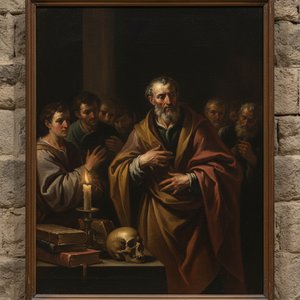
  • Subject Matter: Murillo presents himself in a contemplative pose against a backdrop of weathered stone—a deliberate choice that speaks to the passage of time and imbues the portrait with an aura of solemn dignity. His gaze is direct, yet inward-looking, suggesting a preoccupation with artistic principles and philosophical inquiry.
  • Style: The painting exemplifies Murillo’s signature Baroque style—characterized by dramatic chiaroscuro (the interplay of light and shadow)—which lends depth and realism to the depiction. Unlike many contemporaries who favored flamboyant ornamentation, Murillo opted for restraint, prioritizing clarity of form and tonal gradation.
  • Technique: Murillo employed a masterful oil painting technique, layering pigments with painstaking precision to achieve smooth transitions and subtle gradations of tone. The artist skillfully modeled the flesh tones, capturing the nuances of light and shadow—a hallmark of Baroque realism that distinguishes Murillo’s work from earlier artistic traditions.
  • Historical Context: Seville in Murillo's time was a vibrant center of artistic patronage and intellectual ferment—the seat of the Habsburg monarchy and a hub for commerce and cultural exchange. The portrait reflects the prevailing ethos of the era, which valued erudition, piety, and refined aesthetic sensibilities.

Symbolism: Stone, Light, and Artistic Reflection

The stone ledge upon which Murillo’s hand rests is laden with symbolic significance—representing permanence, stability, and the enduring legacy of artistic endeavor. The weathered surface suggests that time has etched its mark on both the artist and his craft, reminding viewers of the ephemeral nature of human existence alongside the timeless beauty of art. Simultaneously, the directional lighting casts strong shadows that accentuate Murillo’s facial features and clothing—a technique employed to heighten dramatic effect and convey a sense of three-dimensionality.
  • Stone: Symbolizing permanence and stability, mirroring the artist's desire for lasting recognition
  • Light: Used dramatically to illuminate Murillo’s face and clothing, enhancing depth and realism—a cornerstone of Baroque artistic expression

Emotional Impact: Dignity Amidst Imperfection

Despite the subtle signs of aging—the receding hairline and graying moustache—Murillo conveys an unwavering sense of dignity and self-assurance. The artist’s gaze is serene, yet imbued with intellectual curiosity—suggesting a profound engagement with artistic principles and philosophical contemplation. Ultimately, Murillo's Self Portrait invites viewers to contemplate the complexities of human experience—embracing both beauty and imperfection as integral components of life’s journey. It stands as a testament to Murillo’s ability to capture not only physical likeness but also the inner spirit of his subject—a feat that cemented his place among the most revered artists of the Baroque period.

Conclusion: A Legacy Illuminated

Murillo's Self Portrait remains an enduring emblem of Baroque artistic achievement—a masterpiece that continues to inspire admiration and contemplation centuries after its creation. Its meticulous technique, symbolic richness, and profound emotional impact solidify Murillo’s reputation as one of Spain’s greatest painters—a figure whose legacy shines brightly through the lens of art history.

Questions & Answers

Where can I find statistics about "Self-Portrait" by Bartolomé Esteban Murillo?

Statistics about "Self-Portrait" by Bartolomé Esteban Murillo are on the artwork's Stats page: monthly visits of the artwork, visits of the artist's works, and country and language breakdowns of recent visitors.

What is the luminance of "Self-Portrait" by Bartolomé Esteban Murillo?

The colors of "Self-Portrait" show a dark luminance.

What color palette is used in "Self-Portrait" by Bartolomé Esteban Murillo?

"Self-Portrait" by Bartolomé Esteban Murillo uses an earthy color palette. The palette summarizes the work's overall color character.

More about this painting

Preview AR preview Switch to Print Switch to Digital Image Send
Details Guide Add to favorites Download Similars X-Ray Diaporama Q&A Stats

In numbers

  • 1650the year it was painted
  • 29frames to choose from
  • standard sizes, in its own proportions
  • 5weeks to paint and deliver it
Bartolomé Esteban Murillo

Bartolomé Esteban Murillo

1618 - 1682, Spain

Quick facts about Bartolomé Esteban Murillo

  • Artistic Movement Or Style: Spanish Baroque
  • Artists Or Movements Influenced By This Artist:
    • Gainsborough
    • Greuze
  • Artists Who Influenced This Artist:
    • Zurbarán
    • Ribera
    • Cano
    • Velázquez
  • Full Name: Bartolomé Esteban Murillo
  • Nationality: Spanish
  • Notable Artworks:
    • The Holy Family with the Little Bird
    • A Knight of Alcántara
    • Saint Francis Receiving the Stigmata
    • Self-Portrait
    • The Young Beggar
    • Baking of Flat Cakes
    • Four Figures on a Step
    • Adoration of the Magi
    • Madonna in the Clouds
    • An Old Woman Holding a Distaff and Spindle
    • Two Women at a Window
    • A Girl with Fruits
    • Baptism of Christ
    • The Story of the Foundation of Santa Maria
    • Liberation of St. Peter
    • Return of the Prodigal Son
    • The Annunciation
    • The Assumption of the Virgin
    • The Flight into Egypt
    • The Virgin and Child with St. Rosalina
    • The Holy Family with the Infant Baptist
    • Portrait of Nicolas Omasur
    • Virgin and Child in Glory
    • The Little Fruit-Seller
    • Immaculate Conception of Soult
    • The Two Trinities
  • Place Of Birth: Seville, Spain
  • Date Of Birth: 1618
  • Date Of Death: 1682

Artist Biography

Early Life, Family and Training

The story of Bartolomé Esteban Murillo begins in the heart of Seville, where he was born in late December 1617. He was baptized on 1 January 1618, entering a world that would soon demand much of him. His father, Gaspar Esteban, worked as a barber surgeon, and his mother was María Pérez Murillo. Life for the young boy was marked by early loss, as he was orphaned during his childhood. Following the deaths of his parents, he was taken in by his sister, Ana, and her husband, Juan Agustín Lagares. His stepfather was also a barber, and it was within this family circle that the boy found stability and a sense of belonging.

Artistic training for Bartolomé Esteban Murillo likely began when he was between twelve and fifteen years old. He entered the workshop of Juan del Castillo, a painter who was both his uncle and his godfather. Under Castillo’s guidance, he learned the foundational skills of his craft. This early apprenticeship provided the technical grounding that would support his later development. He eventually moved beyond the workshop of his mentor, having gained the necessary skills to pursue his own path as a Spanish Baroque painter.

Technique and Style

Murillo’s hand changed as he grew, moving away from the heavy, somber realism of his early years toward a more idealized way of seeing. In his youth, his work carried the weight and gravity of the Baroque tradition, but he eventually found a way to soften those edges. This evolution led him toward a lighter, more vaporous style in his later years. He had a way of building up forms through a layered approach, using delicate glazes and subtle brushwork to create depth. His use of color was particularly effective, producing luminous effects that seemed to emanate from within the canvas itself.

Despite the complexity of these layers, he was a prolific painter who often worked alla prima. This allowed him to complete paintings in relatively short periods, capturing a sense of immediacy. He did not rely on the dark, heavy palettes of some of his contemporaries; instead, his technique focused on a masterful manipulation of light and shadow. This approach gave his subjects a sense of warmth and accessibility, making the divine feel close and the everyday feel significant.

Key Works and Subject Matter

Murillo’s brush often turned toward the spiritual, finding a particular calling in his depictions of the Immaculate Conception. These religious works became a central part of his output, reflecting the deep devotion of his era. He also found profound meaning in the faces of the people around him, producing many paintings of contemporary women and children. These subjects were often rendered with a sense of warmth that made the sacred feel accessible and the everyday feel significant.

Beyond the quietude of religious devotion, he looked directly at the social realities of Seville. His genre scenes captured the lives of those often overlooked by history, such as flower girls, street urchins, and beggars. In these works, he did not shy away from the presence of poverty, yet he approached his subjects with a steady, empathetic gaze. This interest in the human condition is visible in works like The Young Beggar, which is held in the Musée du Louvre, and his Self-Portrait, currently in The Frick Collection, New York City.

His ability to balance the divine with the earthly allowed him to move seamlessly between different worlds. He could paint the celestial grace of The Annunciation, found in the Wallace Collection, London, with the same sincerity he used to document a child's play or a beggar's plea. This range ensured his work spoke to both the high altars of churches and the crowded streets of the city.

Legacy and Influence

Murillo’s reach stretched far beyond the streets of Seville, leaving a mark on the artistic landscape of Europe. His ability to blend religious devotion with a sense of human warmth meant that his influence traveled across borders, reaching painters who would come long after his time. Later artists, including Gainsborough and Greuze, acknowledged the impact of his luminous style on their own approach to light and form. He did not merely paint for the immediate needs of his era; he created a visual language that continued to speak to people across different centuries.

The endurance of his work is evident in the way his paintings are preserved and studied today. His canvases have found homes in prestigious museums across the globe, ensuring that his perspective on the human condition remains accessible. From the quiet dignity of his portraits to the soft light of his religious scenes, his art continues to offer something meaningful to those who encounter it. Even centuries after his death in 1682, his work remains a source of inspiration for those drawn to the intersection of grace and everyday reality.

Where to See the Works Today

To encounter the quiet grace of Murillo’s brushwork, one must travel through the great halls of Europe and beyond. In Spain, the Museo del Prado in Madrid holds several of his paintings, offering a direct connection to the spirit of the Golden Age. For those visiting the southern coast, the Museum of Cádiz in Cadiz also preserves his hand. These collections allow us to see how his style evolved from the heavy realism of his youth toward the softer, more luminous approach that defined his later years.

His reach extended far across borders, leaving a presence in many of the most significant institutions in the world. In France, the Louvre in Paris houses works that reflect his ability to capture human emotion. The Hermitage Museum in Saint Petersburg also maintains a collection of his paintings, while the Wallace Collection in London provides a space to observe his skill in detail. Even in the United States, his influence remains visible at the Timken Museum of Art in San Diego.

Quick Facts

  • Artistic style: Classical
  • Location: The Frick Collection
  • Title: Self-Portrait
  • Subject or theme: Portraiture
  • Artist: Bartolomé Esteban Murillo
  • Notable elements or techniques: trompe l'oeil; realistic rendering

Art Quiz

There is only one correct answer for each question.

Question 1:
What is Murillo primarily known for?
Question 2:
The Latin inscription at the bottom of the canvas refers to:
Question 3:
What stylistic element is prominently featured in Murillo’s self-portrait?
Question 4:
Approximately when was this self-portrait painted?
Question 5:
What is the significance of Murillo placing his hand on the stone ledge?