Expressionism · 1907
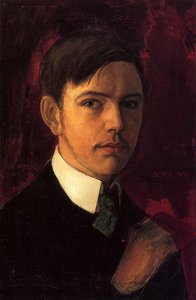
Stroller (August Macke, 1907)
August Macke (1887–1914) made Stroller. It dates from 1907. It belongs to the Expressionism movement. It measures 35 × 21 cm.
- 1907
- 35 × 21 cm

 Preview

 Hand Made Oil Painting
 Send
 Share
 Fact sheet


 Download
 Similars
 X-Ray
 Diaporama
 Q&A

 Stats
Stroller, in brief
- Title
- Stroller
- Artist
- August Macke (1887–1914)
- Artist born in
- Meschede, Germany
- Date
- 1907
- Dimensions
- 35 × 21 cm
- Movement
- Expressionism
- Subject
- forests
High-resolution images of Stroller
August Macke, Stroller (1907). Public domain.
Questions on Stroller, answered
What is the creation date of "Stroller" by August Macke?
The creation of "Stroller" by August Macke is dated 1907.
What size is "Stroller" by August Macke in real life?
The recorded dimensions of "Stroller" by August Macke are 35 x 21 cm. Reproductions can be ordered in other sizes while keeping the same proportions.
What is "Stroller" about?
The subjects of "Stroller" are forests.
Is "Stroller" free of copyright?
Regarding copyright, "Stroller" is in the public domain - its copyright has expired.
Who created "Stroller"?
The artist behind "Stroller" is August Macke. The work is catalogued under August Macke's name.
Which artistic current is "Stroller" by August Macke part of?
"Stroller" by August Macke belongs to the Expressionism movement. This movement provides the stylistic context of the work.
What was August Macke's age when "Stroller" was created?
August Macke was 20 years old when creating "Stroller" in 1907. The age is computed from the artist's birth year, 1887.
Is "Stroller" by August Macke in the public domain, and why?
"Stroller" by August Macke is in the public domain - its copyright has expired. Copyright duration runs from the artist's death, which occurred in 1914.
About the artist, August Macke
1887–1914, Germany
August Macke
Early Life, Family and Training The story of August Macke begins in the town of Meschede, Germany, where he was born on January 3, 1887. He was the only son born to August Friedrich Hermann Macke, a building contractor and amateur artist, and Maria Florentine. His childhood was shaped by the shifting fortunes of his father’s company, which brought the family to Cologne and later to Bonn. Even as a young boy, the pull of visual expression was evident; he spent his early years sketching and designing sets for school plays, finding a way to translate his surroundings onto paper long before he ever stepped into a formal academy.
Also by August Macke
 Woman in a Green Jacket1913
 Bathing girls with town in the backgraund1913
 The Hat Shop1913
 Portrait of the Artist's Wife with Hat1909
Essays around Stroller
 Impressionism vs. Expressionism: Capturing Light and EmotionMaster the technical differences between Impressionism and Expressionism. Discover the art of light and emotion now.
 Comparing Der Blaue Reiter and Die Brücke: Two Paths of German ExpressionismMaster the differences between Die Brücke and Der Blaue Reiter. Explore the roots of German Expressionism now.
 German artworks of the 1910sGerman Expressionism in the 1910s features powerful works by Franz Marc, Max Beckmann, and Ernst Ludwig Kirchner. View the collection at Or…