

 Preview
 Send
Send Share
Share
 Details
 Guide
Guide

 Download
 Similars
 X-Ray
X-Ray Diaporama
 Stats
StatsTruck Announcement


 Read More
The artwork displayed on this page is protected by copyright law, which means we cannot legally create or sell an identical reproduction. This protection is enforced under international agreements such as the Berne Convention and by national laws, including those outlined by the U.S. Copyright Law - Title 17.
This method fully complies with copyright regulations because it does not involve copying or duplicating the protected artwork. Instead, it is a creative reinterpretation - a new painting that is influenced by the original but not identical to it.
Giclée / Art Print
Museum-quality giclée or canvas print with fast production and flexible finish options. ( Buy Hand Made Painting Switch to Digital Image)




P118B $10

P118H $10

P118W $10

P438Z $10

P508JH $12

P508YH $12

P805H $10

P805Z $10

P919BZ $10

P919G $10

P919XJ $10

P959ZH $10

P968JZ $12

W106C $8

W218G $10

W218JH $8

W218Y $10

W307PJ $10

W316G $10

W316PJ $8

W316Y $10

W398PJ $8

W4111J $10

W500HY $15

W500JH $15

W692G $12

W849H $8

W940BG $15

W953PJ $8




Pick from our preset sizes that match the artwork's original proportions.

Type the width and the height you need, to fit your frame or your wall. A print can only be cut, never made bigger than the picture, so a size with a different shape loses a part of the image. We send you a digital mockup to approve before we print anything. The picture shown on this page does not show the real cut — only the mockup does.
Worldwide Delivery () in 2 weeks instead of standard 4/5 weeks. (25 October)

Free Worldwide Express Shipping

High-Quality Linen Canvas

Full Shipping Insurance

Customs Tax Refund Guarantee

True Color Matching Guarantee

100-Day Return Policy (Defects Only)

100% Money-Back Guarantee

Bulk Discount Offer
 Glass option is only available in size under 110 CM

Truck Announcement
Giclée / Art Print
Reproduction Size
-


Total Price
$ 81
A Stark Announcement in the Night: Decoding Andy Warhol’s ‘Truck’
Andy Warhol's *Truck Announcement* is a compelling example of his enduring fascination with the mundane elevated to iconic status. Painted in 1985, this work isn’t merely a depiction of a commercial vehicle; it’s a distillation of American culture, commerce, and the very idea of communication itself. The painting presents a large truck, rendered in stark blues and whites, parked against an ambiguous, dark backdrop suggesting nightfall. The simple addition of the word “Announcement” emblazoned on its side transforms this everyday object into something laden with potential meaning. It’s as if the truck isn't simply *carrying* a message, but *is* the message – a mobile billboard in the heartland of American industry. Warhol, ever attuned to the visual language of advertising and mass production, recognized the inherent power of these symbols, stripping them down to their essential forms and presenting them with an almost unsettling directness.Pop Art and the Cult of the Everyday
To understand *Truck Announcement*, one must consider its place within the broader context of Warhol’s Pop Art practice. Emerging in the 1950s as a reaction against the perceived elitism of Abstract Expressionism, Pop Art embraced popular culture – advertising, comic books, celebrity imagery – as legitimate subjects for artistic exploration. Warhol was arguably its most prominent figure, and his work consistently blurred the lines between “high” art and commercial design. He didn’t seek to critique these elements necessarily, but rather to observe them with a cool detachment, presenting them without judgment. *Truck Announcement* exemplifies this approach; it doesn't offer commentary on trucking or advertising, but simply presents the image itself, forcing us to confront its visual impact and consider its cultural significance. The technique employed – reminiscent of his famous silkscreen prints – lends a mechanical quality to the work, further emphasizing the themes of mass production and reproducibility that were central to Warhol’s artistic vision.Symbolism on the Road: Commerce, Mobility, and the American Dream
The truck itself is a potent symbol. It represents transportation, commerce, and the relentless movement of goods across the vast American landscape. It evokes images of highways stretching into the distance, of drivers traversing the country, and of the economic engine that drives modern life. The “Announcement” adds another layer of intrigue. What is being announced? A sale? A new product? Or perhaps something more abstract – a declaration of progress, or even a warning about the relentless pace of consumerism? Warhol deliberately leaves this ambiguous, allowing viewers to project their own interpretations onto the image. The darkness surrounding the truck further enhances its symbolic weight; it suggests a sense of mystery and isolation, hinting at the hidden costs and complexities that lie beneath the surface of American prosperity. The work subtly touches upon the romanticized notion of the open road, contrasting it with the cold reality of commercial enterprise.A Lasting Legacy: Warhol’s Influence on Contemporary Art
Andy Warhol's impact on art history is undeniable. He not only redefined the boundaries of what constituted “art” but also anticipated many of the concerns that would dominate contemporary artistic practice in the decades to come. *Truck Announcement*, while seemingly simple, encapsulates his key themes and stylistic innovations. It’s a work that continues to resonate with audiences today, prompting us to question our relationship with consumer culture, mass media, and the very nature of representation. For collectors and interior designers alike, a reproduction of this piece offers not just an aesthetic statement but also a conversation starter – a reminder of Warhol's enduring legacy and his ability to transform the ordinary into something extraordinary. It’s a bold, graphic image that can add a touch of Pop Art sophistication to any space, inviting viewers to contemplate the hidden meanings embedded within its seemingly straightforward composition.Questions & Answers
What type of artwork is "Truck Announcement" by Andy Warhol?
"Truck Announcement" is a wall art piece.
Where can I buy a print of "Truck Announcement" by Andy Warhol?
"Truck Announcement" is available as a fine art print on cotton canvas or archival canvas paper. Orders are placed on its Fine Art Print page, in the size of your choice.
What level of contrast does "Truck Announcement" by Andy Warhol show?
"Truck Announcement" by Andy Warhol shows a statement contrast between its light and dark areas.
Artist Biography
The Industrial Roots of a Visual Language
Born Andrew Warhola Jr. in 1928 within the industrial landscape of Pittsburgh, Pennsylvania, the man who would become Andy Warhol spent much of his early years shaped by confinement and quiet observation. A childhood bout with Sydenham's chorea, or St. Vitus’ Dance, kept him indoors for long stretches. During these periods, he turned to the imagery provided by his mother: comic books and movie magazines. These were the first seeds of a visual vocabulary that would later embrace the mass-produced. He eventually moved toward formal training at the Carnegie Institute of Technology, earning a degree in Pictorial Design in 1949.
His arrival in New York City marked a transition from the private world of sketches to the public sphere of commercial illustration. Working for names such as Tiffany & Co., Vogue, and Harper's Bazaar, he mastered the precision required by advertising. This period of professional service instilled in him an understanding of how images are manufactured and distributed. He learned the mechanics of the brand before he ever attempted to deconstruct it.
The Factory and the Mechanics of Fame
By the 1960s, his focus shifted from illustrating products to treating the products themselves as subjects. Through the adoption of the silkscreen printing process, he introduced a method that mirrored the repetitive nature of consumer culture. This technique allowed for a detachment from the hand of the artist, favoring a flattened, mechanical aesthetic. His studio, known as The Factory, became a central point for a specific New York social circle. It was a space where musicians, poets, and film personalities gathered, often blurring the lines between their private lives and their public personas.
His work during these years explored several distinct themes:
- The commodification of everyday objects, such as his 1962 depictions of Campbell’s Soup Cans.
- The construction of celebrity through portraits of figures like Marilyn Monroe and Elizabeth Taylor.
- The darker side of the American experience, including his series on car crashes and electric chairs.
This era was not without physical consequence. In 1968, a radical feminist writer named Valerie Solanas entered his Manhattan studio and shot him, leaving him with lasting injuries. This event altered the trajectory of his studio life, moving it toward a more business-oriented enterprise.
Cinema and the Expanded Image
Beyond the canvas, Warhol was an active filmmaker who produced over 600 films between 1963 and 1968. Many of these were experimental or static in nature. He utilized long, unblinking takes in works like Sleep and Empire to challenge how an audience consumes moving images. His filmic output often featured his "superstars," a group of personalities from the Factory scene who became part of the cultural fabric of the time.
His influence reached into the music industry through his management of The Velvet Underground. He even designed the famous banana cover for their debut album, further merging the boundaries between fine art and popular media. By the time of his death in 1987, he had moved through various media—photography, publishing, and television—leaving behind a body of work that interrogated the very nature of what it means to be seen in a media-saturated age.

Andy Warhol
1928 - 1987 , United States of America
Quick Facts
- Artistic Movement Or Style: Pop Art
- Artists Or Movements Influenced By This Artist:
- Conceptualism
- Performance Art
- Full Name: Andrew Warhola Jr.
- Notable Artworks:
- Campbell's Soup Cans
- Marilyn Diptych
- Coca-Cola (3)
- Gold Marilyn
- Brillo Box sculptures
- Place Of Birth: Pittsburgh, United States of America
- Date Of Birth: 1928
- Date Of Death: 1987
Related Articles

Andy Warhol's Masterpieces: Explore 25 Iconic Artworks for Your Home | OriginalUniqueArt
Dive into the vibrant world of Andy Warhol! Explore 25 iconic Pop Art masterpieces – from Marilyn Monroe to Campbell's Soup Cans. Discover the stories behind these timeless paintings & find museum-quality art reproductions for your home at OriginalUniqueArt.com.

Slate Blue Masterpieces: 10 Iconic Paintings & Timeless Home Decor Ideas
Immerse yourself in the captivating world of slate blue! Explore 10 iconic paintings by Monet, Van Gogh & Renoir. Discover their stories, techniques & find museum-quality art reproductions for your home at .

White on Canvas: 10 Masterpieces & Timeless Elegance for Your Home Decor
Explore 10 iconic white paintings by Monet, Whistler & Rothko! Discover the stories behind these serene masterpieces and their impact on art history. Find museum-quality reproductions for your home decor at .
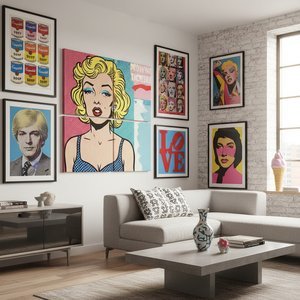
Pop Art Icons: 10 Masterpieces That Revolutionized Modern Decor |
Explore 10 defining Pop Art masterpieces – from Warhol’s iconic Marilyn to Lichtenstein's bold dots. Discover the stories behind these revolutionary artworks & find museum-quality reproductions for your home at .

Serene Blue Backgrounds: Discover Soulful Art to Transform Your Space with Timeless Elegance
Transform your home with soulful blue art. From serene Monet impressions to modern textured sculptures, discover curated masterpieces designed to inspire calm. Explore expert art consultations and bespoke hand-painted reproductions to create your personal sanctuary.


