Preview
 Send
Send Share
Share
 Details
 Guide
Guide

 Download
 Similars
 X-Ray
X-Ray Diaporama
 Q&A
Q&A Stats
StatsThe Earth


 Read More
The artwork displayed on this page is protected by copyright law, which means we cannot legally create or sell an identical reproduction. This protection is enforced under international agreements such as the Berne Convention and by national laws, including those outlined by the U.S. Copyright Law - Title 17.
This method fully complies with copyright regulations because it does not involve copying or duplicating the protected artwork. Instead, it is a creative reinterpretation - a new painting that is influenced by the original but not identical to it.
Giclée / Art Print
Museum-quality giclée or canvas print with fast production and flexible finish options. ( Buy Hand Made Painting Switch to Digital Image)




P118B $10

P118H $10

P118W $10

P438Z $10

P508JH $12

P508YH $12

P805H $10

P805Z $10

P919BZ $10

P919G $10

P919XJ $10

P959ZH $10

P968JZ $12

W106C $8

W218G $10

W218JH $8

W218Y $10

W307PJ $10

W316G $10

W316PJ $8

W316Y $10

W398PJ $8

W4111J $10

W500HY $15

W500JH $15

W692G $12

W849H $8

W940BG $15

W953PJ $8




Pick from our preset sizes that match the artwork's original proportions.

Type the width and the height you need, to fit your frame or your wall. A print can only be cut, never made bigger than the picture, so a size with a different shape loses a part of the image. We send you a digital mockup to approve before we print anything. The picture shown on this page does not show the real cut — only the mockup does.
Worldwide Delivery () in 2 weeks instead of standard 4/5 weeks. (16 November)

Free Worldwide Express Shipping

High-Quality Linen Canvas

Full Shipping Insurance

Customs Tax Refund Guarantee

True Color Matching Guarantee

100-Day Return Policy (Defects Only)

100% Money-Back Guarantee

Bulk Discount Offer
 Glass option is only available in size under 110 CM

The Earth
Giclée / Art Print
Reproduction Size
-


Total Price
$ 81
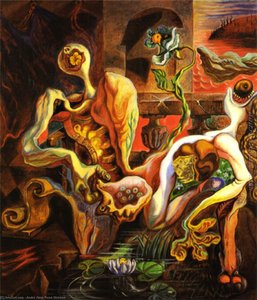
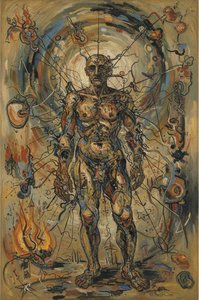
André Masson’s “The Earth”: A Descent Into Surrealist Automatism
André Masson's "The Earth," painted in 1939, stands as a quintessential example of Surrealist automatism—a technique championed by Masson and fellow artists to bypass conscious thought and tap into the subconscious realm. More than just an aesthetically striking composition, it’s a profound exploration of primal anxieties and a visual manifestation of the artist's confrontation with existential uncertainties during the turbulent years leading up to World War II.Composition and Visual Language
The artwork immediately captivates with its central oval form—a dominant presence that evokes imagery of amniotic sacs or embryonic beginnings. This organic shape isn’t merely decorative; it serves as a focal point for a dynamic network of radiating lines in shades of red, black, and white. These lines aren't meticulously drawn; rather, they erupt outwards from the center with an impulsive energy, creating a chaotic visual field that defies conventional perspective. The deliberate lack of spatial coherence underscores Masson’s rejection of rational representation, prioritizing instead the expressive power of gesture and emotion. It feels like witnessing a geological upheaval—a violent birth of form from amorphous darkness.Technique and Material Considerations
Masson employed oil paint on canvas – a medium chosen for its ability to capture subtle tonal variations and facilitate layering techniques. The artist’s approach leaned heavily into automatism, utilizing spontaneous brushstrokes and washes of color to generate the artwork's textural surface. Evidence suggests considerable reworking—a process characteristic of Surrealist practice where artists strive to liberate their creative impulses from intellectual constraints. The canvas itself appears to be lightly primed, allowing for a rich interplay between pigment and substrate, contributing to the overall impression of immediacy and visceral impact.Symbolism and Contextual Significance
Painted during the height of Surrealist fervor, “The Earth” reflects the movement’s preoccupation with Freudian psychoanalysis and its desire to delve into the unconscious mind. The oval form symbolizes fertility and rebirth—themes central to Surrealist mythology—but also carries a darker connotation of vulnerability and impending doom. The radiating lines represent forces of destruction and creation simultaneously, mirroring anxieties about societal upheaval and the looming threat of war. Masson’s work aligns with broader artistic explorations of primal instincts and fears, reflecting a collective apprehension regarding humanity's precarious position in the face of cosmic indifference.Emotional Resonance
Ultimately, “The Earth” succeeds in conveying a palpable sense of unease and mystery. The artwork doesn’t offer comforting illusions; instead, it confronts viewers with an unsettling depiction of chaos and ambiguity. It invites contemplation on themes of genesis, destruction, and the inherent instability of existence—questions that resonated deeply within Masson's own artistic vision and continue to captivate audiences today. Its raw energy and evocative imagery solidify its place as a cornerstone of Surrealist art history.Questions & Answers
Is "The Earth" held in the country of its creator?
Yes - the artwork is kept in the artist's home country. "The Earth" is held in France, while André Masson was born in France.
Can I examine "The Earth" in more detail?
The X-Ray page of "The Earth" by André Masson is an interactive viewer that lets you slide through eleven optical layers of the artwork's image, including an X-ray style view.
Which color stands out most in "The Earth"?
The color that stands out most in "The Earth" is celadon (#becfb0). The dominant color is useful when matching an artwork to an interior.
Artist Biography
André Masson: A Life in Art
- Born: Balagny-sur-Thérain, France (January 4, 1896)
- Died: 1987
Early Life and Artistic Training
- Masson began his artistic journey at the age of eleven, studying at the Académie Royale des Beaux-Arts in Brussels under Constant Montald. This early training provided a foundation for his later experimentation with various styles.
- His initial work showed an interest in Cubism, demonstrating an early engagement with modern art movements.
The Surrealist Period and Automatic Drawing
- Masson became a key figure within the Surrealist movement, enthusiastically embracing automatic drawing as a technique. This involved creating artwork without conscious control, allowing the subconscious to guide the hand.
- He collaborated with other prominent figures of the era like Antonin Artaud, Michel Leiris, Joan Miró, Georges Bataille, Jean Dubuffet, and Georges Malkine, fostering a vibrant artistic community.
- Notable Techniques:
- Automatic Drawings: Numerous pen-and-ink works showcasing his innovative approach to art.
- Sand and Glue on Canvas: Experimentation with throwing sand and glue onto canvas, creating unique oil paintings based on the resulting shapes.
- His work during this period often explored violent or erotic themes, reflecting a departure from traditional artistic conventions.
Evolution and Later Works
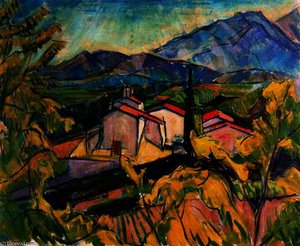
- By the late 1920s, Masson moved away from Surrealism, developing a more structured style influenced by artists like André Derain. This is evident in his landscape paintings.
- During World War II, his work was condemned as "degenerate" by the Nazis. He escaped to the United States with assistance from Varian Fry, significantly impacting American Abstract Expressionists like Jackson Pollock.
- After returning to France, Masson settled in Aix-en-Provence and focused on landscape painting, demonstrating a shift towards more naturalistic subjects.
Legacy and Influence
- André Masson's pioneering work in Surrealism and automatic drawing left an enduring legacy on the art world.
- His influence can be seen across various artistic movements, from Cubism to Abstract Expressionism, solidifying his position as a pivotal figure in modern art history.
- Masson’s exploration of subconscious imagery and innovative techniques continue to inspire artists today.

André Masson
1896 - 1987 , France
Quick Facts
- Full Name: André Aimé René Masson
- Nationality: French
- Date Of Birth: 1896
- Date Of Death: 1987
- Place Of Birth: Balagny-sur-Thérain, France
- Notable Artworks:
- Beyond
- Landscape with Rocks
- The metamorphosis of the lovers
- Pygmalion
- Artistic Movement Or Style:
- Surrealism
- Cubism
- Artists Who Influenced This Artist: ['André Derain']
- Artists Or Movements Influenced By This Artist:
- Jackson Pollock
- Abstract Expressionism
Related Articles
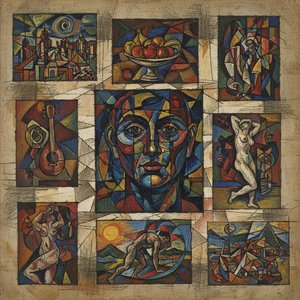
Cubist Expressionism's 10 Defining Masterpieces | Art for Your Home
Explore 10 defining Cubist Expressionism masterpieces by Picasso, Braque & more. Discover the stories behind these bold, geometric paintings and bring museum-quality art to your home with OriginalUniqueArt.com. Explore the full collection online.
Beyond the Canvas: A Definitive Guide to Abstract Expressionism, Action Painting, and Color Field Masters
Explore the profound history of Abstract Expressionism, from the visceral energy of Action Painting to the serene depth of Color Field masters. A definitive guide for art students and collectors on the New York School's seismic impact on modern art.

Finding Meaning in the Void: Capturing Existentialism Through Masterpiece Artworks
Explore the profound depths of Expressionism and existentialism through iconic masterpieces. Discover how artists like Edvard Munch capture raw human emotion and find meaning within the void through soulful, hand-painted art reproductions and custom commissions.
André Masson: Automatism, Surrealism & Primal Expression in 20th-Century Art
Explore the revolutionary art of André Masson – pioneer of automatism & Surrealist expression. Discover his powerful imagery, innovative techniques, and lasting influence on modern art. Learn more at OriginalUniqueArt.

Geometric Abstraction's 10 Defining Masterpieces | Art for Your Home - OriginalUniqueArt
Explore 10 defining masterpieces of Geometric Abstraction! Discover Kandinsky, Mondrian & Malevich’s iconic works. Find museum-quality art reproductions and curated decor ideas to elevate your home at OriginalUniqueArt.com.