Preview
 Send
Send Share
Share
 Details
 Guide
Guide

 Download
 Similars
 X-Ray
X-Ray Diaporama
 Q&A
Q&A Stats
StatsMrs. Mayer and Daughter

- 96.0 x 87.0 cm


 Read More
Giclée / Art Print
Museum-quality giclée or canvas print with fast production and flexible finish options. ( Buy Hand Made Painting Switch to Digital Image)




P118B $10

P118H $10

P118W $10

P438Z $10

P508JH $12

P508YH $12

P805H $10

P805Z $10

P919BZ $10

P919G $10

P919XJ $10

P959ZH $10

P968JZ $12

W106C $8

W218G $10

W218JH $8

W218Y $10

W307PJ $10

W316G $10

W316PJ $8

W316Y $10

W398PJ $8

W4111J $10

W500HY $15

W500JH $15

W692G $12

W849H $8

W940BG $15

W953PJ $8




Pick from our preset sizes that match the artwork's original proportions.

Type the width and the height you need, to fit your frame or your wall. A print can only be cut, never made bigger than the picture, so a size with a different shape loses a part of the image. We send you a digital mockup to approve before we print anything. The picture shown on this page does not show the real cut — only the mockup does.
Worldwide Delivery () in 2 weeks instead of standard 4/5 weeks. (4 November)

Free Worldwide Express Shipping

High-Quality Linen Canvas

Full Shipping Insurance

Customs Tax Refund Guarantee

True Color Matching Guarantee

100-Day Return Policy (Defects Only)

100% Money-Back Guarantee

Bulk Discount Offer
 Glass option is only available in size under 110 CM

Mrs. Mayer and Daughter
Giclée / Art Print
Reproduction Size
-


Total Price
$ 81
A Tender Encounter in American Folk Art
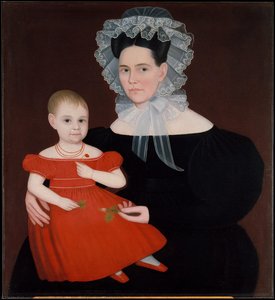
In the quiet realm of nineteenth-century American portraiture, few works capture the intimate essence of domestic devotion as poignantly as Ammi Phillips’ “Mrs. Mayer and Daughter.” Painted around 1835, this masterpiece serves as a window into a bygone era of familial tenderness and social grace. The composition centers on a seated woman, draped in the dignified black of formal attire, whose presence is anchored by a delicate white lace collar and a lustrous pearl necklace. Her gaze and posture are directed toward her young daughter, who rests upon her lap in a vibrant red dress—a splash of brilliant color that breathes life into the scene. As the mother holds her child, there is a palpable sense of connection, an unspoken dialogue of affection that transcends the canvas. The painting does not merely record faces; it preserves a moment of profound human intimacy, making it an irresistible centerpiece for any collection focused on the warmth of the human spirit.
The artistry of Ammi Phillips lies in his ability to transform the "primitive" into the profound. As an itinerant painter, Phillips traveled through Connecticut, Massachusetts, and New York, bringing the art of portraiture to various communities. His technique is characterized by a clean, linear precision that eschews the heavy shadows of academic realism in favor of clarity and luminous detail. In “Mrs. Mayer and Daughter,” this method manifests as a beautifully symmetrical arrangement where every element—from the soft curve of a shoulder to the meticulous rendering of lace—is presented with striking focus. This stylistic restraint allows the viewer to appreciate the saturated hues and the structural elegance of the figures, creating a sense of calm formality that is both sophisticated and accessible.
Symbolism and the Legacy of the Itinerant Master
Beyond its visual charm, the painting is rich with the symbolic language of the mid-1800s. The interplay between the dark, somber tones of the mother’s clothing and the bright, energetic red of the child’s dress serves as a metaphor for the continuity of life and the nurturing of the next generation. Phillips was a master of using color to guide the eye and evoke emotion, often utilizing brilliant pigments to highlight the most vital aspects of his subjects' identities. The inclusion of subtle details, such as the delicate textures of fabric and the soft light reflecting off jewelry, adds layers of prestige and character, suggesting a family of means and values. For the discerning collector or interior designer, this work offers more than just decoration; it provides a narrative of stability, heritage, and enduring love.
To possess a reproduction of such a significant piece is to invite a sense of historical depth into a modern space. Whether placed in a sunlit library or a formal dining room, “Mrs. Mayer and Daughter” acts as an anchor of elegance. It resonates with those who appreciate the "quiet genius" of American folk art—a style that finds extraordinary beauty in simplicity. This painting remains a testament to Phillips’s enduring legacy, proving that even within the constraints of a formulaic itinerant style, there exists an infinite capacity for capturing the soul of a subject and the timeless beauty of the domestic bond.
Questions & Answers
Are there works similar to "Mrs. Mayer and Daughter"?
Artworks similar to "Mrs. Mayer and Daughter" by Ammi Phillips are gathered on the artwork's Similars page.
What is "Mrs. Mayer and Daughter" made with, and in which style?
In "Mrs. Mayer and Daughter", the oil on canvas technique meets the American Folk Art movement.
Which room is "Mrs. Mayer and Daughter" by Ammi Phillips recommended for, given its colors?
With its earthy palette, "Mrs. Mayer and Daughter" by Ammi Phillips is recommended for a dining room. The colors are part of the reason for this suggestion.
Artist Biography
Ammi Phillips (1788–1865): The Quiet Genius of American Folk Art
Ammi Phillips (April 24, 1788 – July 11, 1865) was a prolific American itinerant portrait painter active from the mid 1810s to the early 1860s in Connecticut, Massachusetts, and New York. His artwork is identified as folk art, primitive art, provincial art, and itinerant art without consensus among scholars, pointing to the enigmatic nature of his work and life. He is attributed to over eight hundred paintings, although only eleven are signed. While his paintings are formulaic in nature, Phillips’s work was under constant construction, evolving as he added or discarded what he found successful, while taking care to add personal details that spoke to the identity of those who hired him. He is most famous for his portraits of children in red, although children only account for ten percent of his entire body of work. The most well known of this series, Girl in Red Dress with Cat and Dog, sold in 1985 for one million dollars, a first for folk art. His paintings hung mostly unidentified, spare for some recognition in the collections like those of Edward Duff Balken, for decades until his oeuvre was reconstructed by Barbara Holdridge and Larry Holdridge, collectors and students of American folk art, with the support of the art historian Mary Black. Ammi Phillip's body of work was expanded upon their discovery that the mysterious paintings of a “Kent Limner” and “Border Limner” were indeed his.- Early Life and Education
- Artistic Career
- Notable Works
- Legacy
Early Life and Education
Phillips’ early education remains obscure to history, although he is often considered a self-taught artist. He may have apprenticed with another artist, but it's clear that Phillips made up his mind to pursue a career as an artist while still young. He enters the documentary record as an artist in 1809, at the age of 21, with advertisements in both The Berkshire Reporter and a Pittsfield, Massachusetts tavern proclaiming his talent for painting “correct likenesses,” distinguished by “perfect shadows and elegantly dressed in the prevailing fashions of the day.” This early foray into artistic self-promotion reveals a man determined to establish himself as an artist—a characteristic that would define his entire life’s work.Artistic Career
Phillips soon specialized as a portraitist, and his work satisfied the local standard. Within two years, Phillips was receiving regular portrait commissions from community leaders in this area of western Massachusetts. Unlike his illustrious predecessors in American art, such as Benjamin west of philadelphia and john singleton copley of boston, Phillips lived and worked on the rural frontier—a difference which is key to understanding his career. Phillips’ itinerant lifestyle took him regularly between western massachusetts, connecticut, and the hudson river valley. The artist moved on as he exhausted the demand of the local community for painted “likenesses”. This wandering lifestyle is archetypically romantic, rather contrasting with the bourgeois domesticity of his portraits, which are almost always set within interiors. Phillips’s paintings were under constant construction, evolving as he added or discarded what he found successful, while taking care to add personal details that spoke to the identity of those who hired him. He was recorded in the diary of Dr. Samuel Barstow of Great Barrington, Massachusetts, dated October 6, 1811, mentioning small portraits he had commissioned of himself and his wife. Phillips’s work satisfied the local standard, and within two years he was receiving regular portrait commissions from community leaders in this area of western massachusetts.Notable Works
Some of Phillips' notable works include George C. Sunderland painted when at the age of 21 years by mr. Ammi Phillips, in the fall 1840, and mrs. Isaac Cox and deacon Benjamin Benedict, both painted around 1836. These portraits showcase Phillips’ superb quality and demonstrate his ability to capture the essence of his subjects. Phillips may have learned some of his skills from the portraits by john vanderlyn he saw hanging in the homes of his wealthy patrons. Some aspects of Phillips’ works are reminiscent of vanderlyn’s, such as The Course of Empire: The Savage State, painted by Thomas Cole in 1836. Girl in Red Dress with Cat and Dog sold in 1985 for one million dollars, a first for folk art. His paintings hung mostly unidentified, spare for some recognition in the collections like those of Edward Duff Balken, for decades until his oeuvre was reconstructed by Barbara Holdridge and Larry Holdridge, collectors and students of American folk art, with the support of Mary Black. Phillips’s body of work was expanded upon their discovery that the mysterious paintings of a “Kent Limner” and “Border Limner” were indeed his.Legacy
Phillips lived into the era of the daguerreotype, and his last portraits show this influence. He died on July 15, 1865, at the age of 72, in Curtisville (now Interlaken), Stockbridge, Massachusetts, just outside stockbridge, where his death certificate is filed in the town hall. Phillips was buried in Amenia, New York, where he had lived earlier in his life. Phillips’ legacy as an artist has been reconstructed by Barbara Holdridge and Larry Holdridge, collectors and students of American folk art, with the support of Mary Black, an art historian. His work provides posterity with a vast archive of early american self-fashioning, and his portraits continue to be admired for their clarity, precision, and sympathy. Visit Ammi Phillips page on OriginalUniqueArt to learn more about the artist and his works. Explore The Patricia - Phillip Frost Art Museum in Miami! Explore modern & contemporary art, plus a vibrant Latin American collection. Rotating exhibits & free admission!. Check out Thomas Cole's The Course of Empire: The Savage State and other notable works on OriginalUniqueArt. Important links: all popular artworks all popular artists Ammi Phillips
Ammi Phillips
1788 - 1865 , United States of America
Quick Facts
- Full Name: Ammi Phillips
- Nationality: American
- Date Of Birth: 1788
- Date Of Death: 1865
- Place Of Birth: Colebrook Borough, United States of America
- Notable Artworks:
- Girl in Red Dress with Cat and Dog
- Portrait of Cicero Hinds
- Artistic Movement Or Style: Folk Art
- Artists Who Influenced This Artist: ['John Vanderlyn']
- Artists Or Movements Influenced By This Artist: ['The Course of Empire']
Related Articles

American Realism's Defining Works: 10 Masterpieces for Your Home
Explore 10 defining American Realism masterpieces – Hopper, Homer & more. Discover the stories behind these iconic paintings and bring timeless art to your home with OriginalUniqueArt's museum-quality reproductions. Explore the full collection online.

Grant Wood & American Regionalism: Identity, Myth & the Rural Landscape
Explore the world of Grant Wood & American Regionalism with OriginalUniqueArt. Discover the symbolism behind 'American Gothic', recurring themes, and the movement's lasting impact on art history. High-quality reproductions available.

American Regionalism: The Soul of the Heartland and the Mastery of Grant Wood
Explore the profound legacy of American Regionalism. Discover how Grant Wood captured the soul of the Midwest through iconic works like American Gothic, blending Flemish precision with the resilience of the American Heartland during the Great Depression.
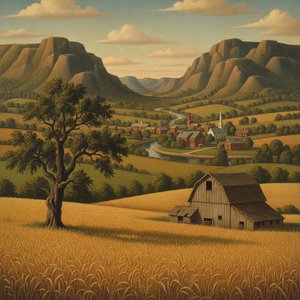
The Soul of the Heartland: A Reflective Journey Through American Regionalism and the Legacy of Grant Wood
Explore the profound beauty of American Regionalism. Discover how Grant Wood captured the resilient soul of the Midwest through masterful oil paintings that celebrate the enduring spirit of the American heartland.

Edward Hicks’ ‘Peaceable Kingdom’: American Folk Art & the Shaping of a National Identity
Explore the profound symbolism & historical context of Edward Hicks’ ‘Peaceable Kingdom.’ Discover how this iconic American folk art masterpiece reflects Quaker values and shaped a nation's identity. Learn more at OriginalUniqueArt.