Art Nouveau
Muse (Alphonse Mucha)
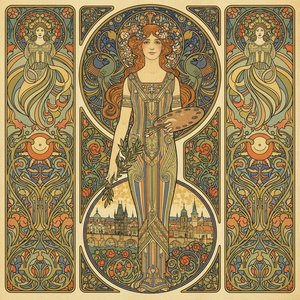
Alphonse Mucha (1860–1939) made Muse. It belongs to the Art Nouveau movement. It is made in oil on canvas.
- Oil On Canvas

 Preview

 Hand Made Oil Painting
 Send
 Share
 Fact sheet


 Download
 Similars
 X-Ray
 Diaporama
 Q&A

 Stats
Muse, in brief
- Title
- Muse
- Artist
- Alphonse Mucha (1860–1939)
- Artist born in
- Ivančice, Czech Republic
- Medium
- Oil On Canvas
- Movement
- Art Nouveau
- Period
- 19th Century
- Subject
- portrait, muse, artnouveau, floral, melancholy, woman
What does Muse depict?
A Whisper of Inspiration: Exploring Alphonse Mucha’s “Muse”
Alphonse Maria Mucha's "Muse" is more than just a portrait; it’s an immersion into the heart of Art Nouveau, a testament to the movement’s obsession with beauty, nature, and the idealized feminine form. Executed in Mucha’s signature style – characterized by sinuous lines, delicate ornamentation, and a profound sense of serenity – this artwork captures a moment of quiet contemplation, inviting the viewer to step into a world of graceful elegance and subtle emotion. The piece speaks volumes about Mucha's influence, his ability to translate decorative fantasy into enduring artistic statements.
Decoding the Visual Language: Composition & Technique
The composition immediately draws the eye towards the central figure, seated with an almost languid grace. Mucha employs a pyramidal structure, anchoring the viewer’s gaze to her head – framed by a breathtaking headdress overflowing with blossoms. This deliberate arrangement echoes classical portraiture while simultaneously embracing the Art Nouveau preference for organic forms. The artist's masterful technique is evident in the layering of colors and the seamless blending of tones, creating a luminous effect that seems to emanate from within. Notice the meticulous detail applied to her drapery and facial features – a hallmark of Mucha’s dedication to realism within his stylized aesthetic. The use of oil or pastel on canvas (or perhaps paper) allows for this incredible level of nuance, capturing both light and shadow with remarkable sensitivity.
A Symphony of Color & Symbolism
The color palette – a harmonious blend of creams, beiges, pale yellows, and muted oranges – evokes a sense of timelessness and tranquility. The strategic use of red-brown accents in the drapery adds depth and richness, while subtle blues and greens within the floral motifs subtly connect the figure to the natural world, a recurring theme in Mucha’s work. Beyond mere aesthetics, the headdress itself is laden with symbolism. Flowers have long represented beauty, fertility, and the influence of nature – concepts central to Art Nouveau's celebration of the organic. The woman’s direct gaze, imbued with a touch of melancholy, invites introspection and suggests a connection to the timeless themes explored by artists throughout history.
Contextualizing the Masterpiece: Mucha & the Art Nouveau Movement
Created during Mucha’s most prolific period (1887-1939), “Muse” exemplifies his pivotal role in shaping the Art Nouveau style. Born in Brno, Czech Republic, Mucha initially studied at the Academy of Fine Arts in Prague but quickly rejected its academic constraints, seeking a more expressive and decorative approach. He found success in Paris, creating iconic posters and illustrations for prominent clients like Sarah Bernhardt. His work reflects influences from artists such as Pierre-Auguste Renoir and Gustave Moreau, yet he forged his own distinct path – one defined by flowing lines, intricate patterns, and an unwavering commitment to portraying idealized female figures. “Muse” stands as a prime example of this legacy, solidifying Mucha’s place as one of the most significant artists of the Art Nouveau movement.
High-resolution images of Muse
Alphonse Mucha, Muse. Public domain.
Colours matched to the original by a digital expert, the file finely retouched, faithful to the artist's brushwork.
Own the high-resolution fileQuestions on Muse, answered
What is "Muse" made with?
Alphonse Mucha used the oil on canvas technique for "Muse". The technique defines the material nature of the original work.
What subjects appear in "Muse" by Alphonse Mucha?
"Muse" by Alphonse Mucha depicts: portrait, muse, artnouveau, floral, melancholy, woman, decorative.
Is "Muse" by Alphonse Mucha in the public domain?
"Muse" by Alphonse Mucha is in the public domain - its copyright has expired. This status governs how the image of the work may be reproduced.
Which artist is "Muse" attributed to?
The artist behind "Muse" is Alphonse Mucha. The work is catalogued under Alphonse Mucha's name.
Which artistic current is "Muse" by Alphonse Mucha part of?
"Muse" by Alphonse Mucha belongs to the Art Nouveau movement. This movement provides the stylistic context of the work.
Which period of Alphonse Mucha's career does "Muse" belong to?
Within Alphonse Mucha's career, "Muse" falls in the Mature Period. The phase helps compare it with the artist's other works.
Why is the copyright status of "Muse" what it is?
"Muse" by Alphonse Mucha is in the public domain - its copyright has expired. Copyright duration runs from the artist's death, which occurred in 1939.
How does "Muse" fit into Alphonse Mucha's themes and style?
Within Alphonse Mucha's output, "Muse" sits in the Art Nouveau style, alongside the themes of renoir, moreau influences, czech motifs, idealized beauty, feminine grace, symbolic nature, decorative art, mucha’s signature style established”.
How does the subject of "Muse" relate to Alphonse Mucha's usual themes?
Among Alphonse Mucha's recorded themes - renoir, moreau influences, czech motifs, idealized beauty, feminine grace, symbolic nature, decorative art, mucha’s signature style established” - "Muse" brings its own focus on portrait, muse, artnouveau, floral, melancholy, woman, decorative.
About the artist, Alphonse Mucha

1860–1939, Czech Republic
Alphonse Mucha
Early Life and EducationBorn: July 15, 1860, in Ivanačice, Moravia (now part of the Czech Republic)Showed artistic talent from a young age.Studied at the Academy of Fine Arts in Prague but became disillusioned with traditional approaches.Moved to Paris in 1887 to pursue his own style.Artistic Style and Notable WorksKnown for distinctive Art Nouveau style characterized by flowing lines, organic forms, and a sense of movement.Influenced by artists like Pierre-Auguste Renoir and Gustave Moreau.Notable Works:The Slavonic Uprising - Showcases blending traditional Czech motifs with modern Art Nouveau elements.Salon des CentPaintings inspired by works like The Daughters of Tespio by Gustave Moreau, and La Ribambelle des Gobelins by Piero Dorazio.Illustrations based on Young Farmers Breaking Flax by Sir Hubert von Herkomer.Frequently featured idealized women in flowing robes surrounded by lush flowers.Career Highlights and Major CommissionsSarah Bernhardt Collaboration: Created posters and designs for the actress Sarah Bernhardt, starting with the poster for Gismonda (1894), which launched his career.Universal Exhibition in Paris (1900): His Art Nouveau style gained international recognition at this exhibition. He decorated the Bosnia and Herzegovina Pavilion and collaborated on the Austrian Pavilion.Charles Richard Crane Patronage: Received support from Charles Richard Crane, which enabled him to create the monumental series The Slav Epic (1912-30).Post-Independence Czechoslovakia: Designed postage stamps, banknotes, and government documents for newly independent Czechoslovakia.Influences and LegacyInfluenced by Czech artistic traditions and modern European art movements.His unique style paved the way for future generations of artists in Art Nouveau and Secessionism.Inspired other artists like Eva Prokopcová.Legacy extends beyond his artwork to influence design and aesthetics.Later Life and DeathMarried Maruska (Marie/Maria) Chytilová in 1906.Visited the United States from 1906-1910, where their daughter Jaroslava was born.Died on July 14, 1939, in Prague, Czechoslovakia.
Also by Alphonse Mucha
 The Moon
 Nude
 The Apotheosis of the Slavs1926
 Stained-Glass Window in St. Vitus Cathedral
Essays around Muse
 Alphonse Mucha: A Comprehensive Exploration of Art Nouveau's Master of Decorative SymbolismExplore the life & art of Alphonse Mucha, master of Art Nouveau! Discover his iconic posters, stunning illustrations, and the monumental Sl…
 The Elegance of Art Nouveau: Embracing Nature's Fluid Beauty and the Belle Époque SpiritDiscover the enchanting world of Art Nouveau. Explore the organic beauty, flowing lines, and Belle Époque elegance that defined an era of u…
 The Language of Brushstrokes: How Texture and Technique Reveal the Soul of ArtDiscover the profound connection between texture and emotion in Impressionist art. Explore how masterful brushstrokes by Renoir and Monet c…