Portrait of Philip Guston

The 100 Most Famous Philip Guston Paintings, a Gallery Selection

Updated October 2026 · ranked by our popularity score (searches, visits and orders for each work) · 111 works by Philip Guston in our catalogue

In short

Of all the originals Philip Guston left, the most famous is The Pit (1976). Close behind it come The Room (1970) and Early Mail Service and Construction of Railroads (mural study, Commerce, Georgia Post Office) (1938). Our catalog holds 111 works by Philip Guston; the gallery has kept the 100 the world admires most, each shown with its date, its museum and its story.

1913 – 1980, Montreal Neo-expressionism Most works: Metropolitan Museum of Art

Philip Guston's top 10 paintings: the gallery's choice

1
The Pit (1976) by Philip Guston

The Pit

1976 · Oil On Canvas

We are looking at The Pit, a significant work by Philip Guston from 1976. This oil on canvas belongs to his Cyclops series, a period where his approach to the canvas underwent a profound transformation. It is a piece that marks a definitive departure from his earlier explorations, settling instead into a highly personal and direct mode of expression.

6
Ride (1969) by Philip Guston

Ride

1969 · Painting · Städel Museum, Frankfurt

The canvas presents two hooded figures seated within the interior of an automobile. These figures are rendered with thick, heavy outlines and a cartoonish quality, their faces obscured by the white fabric of their hoods. One figure holds a smoking cigar between its fingers, the grey smoke curling upward into the surrounding space. The vehicle itself is positioned against a background of serially arranged, white, sheep-like clouds that drift across…

9
Last Piece (1958) by Philip Guston

Last Piece

1958

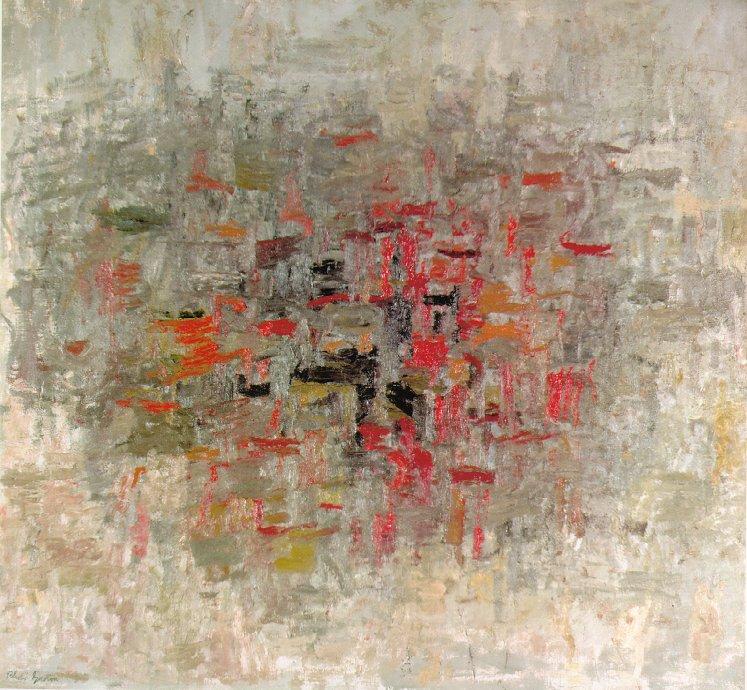
Last Piece is not Guston's last Abstract Expressionist painting, but it represents a transition away from the shimmering forms of the early 1950s towards the recognizable motifs of his later, more figurative works. If Buddhism, and concepts of nothingness, had informed his earlier abstractions, this represents a move away from those inspirations.

10
Untitled, #342 (1971) by Philip Guston

Untitled, #342

1971 · Oil On Paper · Georgia Museum of Art, Athens

The title, which references Rome, suggests a preoccupation with the classical world and the layers of history that settle upon a place. There is a tension here between the modern hand and the ancient subject. The work avoids the easy path of mere imitation, opting instead to engage with the essence of classical relief. It captures a sense of what remains after time has passed. The shadows are deep, and…

The Philip Guston selection continues, 11 to 100

11Gladiators (1940) by Philip GustonGladiators1940 12The Palette (1975) by Philip GustonThe Palette1975 13Bombardment (1937) by Philip GustonBombardment1937 14Monopoly (1964) by Philip GustonMonopoly1964 · Parrish Art Museum 15Martial Memory (1941) by Philip GustonMartial Memory1941 16The Young Mother (1944) by Philip GustonThe Young Mother1944 17Porch II (1947) by Philip GustonPorch II1947 18The Tormentors (1948) by Philip GustonThe Tormentors1948 19Study for Tormentors (1947) by Philip GustonStudy for Tormentors1947 20The Porch (1947) by Philip GustonThe Porch1947 21Painting No. 6 (1951) by Philip GustonPainting No. 61951 · Smithsonian American Art Museum 22Painting, Number 5 (1952) by Philip GustonPainting, Number 51952 · Metropolitan Museum of Art 23Painting No. 6 (1951) by Philip GustonPainting No. 61951 24Painting No. 9 (1952) by Philip GustonPainting No. 91952 25Ischia (1949) by Philip GustonIschia1949 26Untitled (1950) by Philip GustonUntitled1950 27Loft I (1950) by Philip GustonLoft I1950 28Review (1949) by Philip GustonReview1949 29Red Painting (1950) by Philip GustonRed Painting1950 30Three things are necessary for the salvation of man to know what he ought to believe to know what he ought to desire and to know what he ought to do. St. Thomas Aquinas, Two Precepts of Charity, 1273. From the series Great Ideas of Western Man (1952) by Philip GustonThree things are necessary for the salvation of man to know what he ought to believe to know what he ought to desire and to know what he ought to do. St. Thomas Aquinas, Two Precepts of Charity, 1273. From the series Great Ideas of Western Man1952 31Drawing Related to Zone (Drawing No. 19) (1954) by Philip GustonDrawing Related to Zone (Drawing No. 19)1954 32Late April (1961) by Philip GustonLate April1961 · Israel Museum 33Duo (1961) by Philip GustonDuo1961 34Role (1959) by Philip GustonRole1959 · Cleveland Museum of Art 35Rite (1958) by Philip GustonRite1958 · Art Institute of Chicago 36Drawing 1960 (1960) by Philip GustonDrawing 19601960 · Metropolitan Museum of Art 37Close-Up III (1961) by Philip GustonClose-Up III1961 · Metropolitan Museum of Art 38Close Up III (1961) by Philip GustonClose Up III1961 39To Fellini (1958) by Philip GustonTo Fellini1958 40Celebration (1961) by Philip GustonCelebration1961 41Inhabiter (1965) by Philip GustonInhabiter1965 42Open Washes (1966) by Philip GustonOpen Washes1966 43Untitled (Book) (1968) by Philip GustonUntitled (Book)1968 44Untitled (1968) by Philip GustonUntitled1968 45City (1968) by Philip GustonCity1968 46Brushes (1969) by Philip GustonBrushes1969 47Discussion I (1969) by Philip GustonDiscussion I1969 48Shoes (1968) by Philip GustonShoes1968 49Untitled (1973) by Philip GustonUntitled1973 50Untitled (Cup) (1973) by Philip GustonUntitled (Cup)1973 51Untitled (Wall) (1971) by Philip GustonUntitled (Wall)1971 52Painter in Bed (1973) by Philip GustonPainter in Bed1973 53Roma (1971) by Philip GustonRoma1971 54Painting, Smoking, Eating (1972) by Philip GustonPainting, Smoking, Eating1972 55Figure in Interior (1970) by Philip GustonFigure in Interior1970 56Daydreams (1970) by Philip GustonDaydreams1970 57The Street from Ten Lithographs by Ten Artists (1971) by Philip GustonThe Street from Ten Lithographs by Ten Artists1971 58Cerveteri (1972) by Philip GustonCerveteri1972 59Pantheon (1973) by Philip GustonPantheon1973 60The Lesson (1975) by Philip GustonThe Lesson1975 · The Phillips Collection 61Web (1975) by Philip GustonWeb1975 62The Street (1977) by Philip GustonThe Street1977 63Back View (1977) by Philip GustonBack View1977 64Couple in bed (1977) by Philip GustonCouple in bed1977 65Deluge II (1975) by Philip GustonDeluge II1975 66Ancient Wall (1976) by Philip GustonAncient Wall1976 67Midnight Pass Road (1975) by Philip GustonMidnight Pass Road1975 68Monument (1976) by Philip GustonMonument1976 69Inside - Outside (1977) by Philip GustonInside - Outside1977 70Head and Bottle (1975) by Philip GustonHead and Bottle1975 71Step (1979) by Philip GustonStep1979 · Museum of Fine Arts 72Summer (1980) by Philip GustonSummer1980 73Wheel (1980) by Philip GustonWheel1980 74Room (1980) by Philip GustonRoom1980 75East Side (1980) by Philip GustonEast Side1980 76Untitled (8) (1980) by Philip GustonUntitled (8)1980 77As It Goes (1978) by Philip GustonAs It Goes1978 78Painter's Forms No. 2 (1978) by Philip GustonPainter's Forms No. 21978 79Tomb (1978) by Philip GustonTomb1978 80Door (1981) by Philip GustonDoor1981 81Studio Corner (1981) by Philip GustonStudio Corner1981 82Remains from Eight Lithographs to Benefit the Foundation for Contemporary Performance Arts, Inc (1981) by Philip GustonRemains from Eight Lithographs to Benefit the Foundation for Contemporary Performance Arts, Inc1981 83Gulf (1983) by Philip GustonGulf1983 84Painter (1983) by Philip GustonPainter1983 85City Limits (1969) by Philip GustonCity Limits1969 86Drawing for Conspirators (1930) by Philip GustonDrawing for Conspirators1930 · Whitney Museum of American Art 87Curtain by Philip GustonCurtain 88Days Work by Philip GustonDays Work 89Untitled (9) by Philip GustonUntitled (9) 90Box Tree, Rome by Philip GustonBox Tree, Rome 91Clock by Philip GustonClock 92The return by Philip GustonThe return 93Room by Philip GustonRoom 94Entrance by Philip GustonEntrance 95Green Rug by Philip GustonGreen Rug 96Inscapes. Words and Images by Philip GustonInscapes. Words and Images 97Talking by Philip GustonTalking 98Sleeping by Philip GustonSleeping 99A Critical Study by Philip GustonA Critical Study 100The lesson by Philip GustonThe lesson

Philip Guston's famous paintings, period by period

The subjects that held Philip Guston's eye

The four subjects that come back most often in these originals, each with its finest example.

The museums that keep Philip Guston's originals

The 8 museums that hold the most of the paintings on this page.

Museum City Works by Philip Guston Paintings from this list
Metropolitan Museum of Art, New YorkMetropolitan Museum of Art New York 3 Painting, Number 5, Drawing 1960, Close-Up III
Smithsonian American Art Museum, Washington, D.C.Smithsonian American Art Museum Washington, D.C. 2 Early Mail Service and Construction of Railroads (mural study, Commerce, Georgia Post Office), Painting No. 6
Städel Museum, FrankfurtStädel Museum Frankfurt 1 Ride
Georgia Museum of Art, AthensGeorgia Museum of Art Athens 1 Untitled, #342
Parrish Art Museum, Water MillParrish Art Museum Water Mill 1 Monopoly
Israel Museum, JerusalemIsrael Museum Jerusalem 1 Late April
Cleveland Museum of Art, ClevelandCleveland Museum of Art Cleveland 1 Role
Art Institute of Chicago, ChicagoArt Institute of Chicago Chicago 1 Rite

Philip Guston decade by decade: the original that defines each

Works per decade

Pick a decade to see the original that defines it.

Collectors' questions about Philip Guston's paintings

Which work is Philip Guston most famous for?Reveal the answer

The Pit (1976). The Room (1970) and Early Mail Service and Construction of Railroads (mural study, Commerce, Georgia Post Office) (1938) come next.

What age was Philip Guston when The Pit was made?Reveal the answer

63 years old: The Pit dates from 1976, and Philip Guston was born in 1913.

What are the ten most famous Philip Guston paintings?Reveal the answer

The Pit, The Room, Early Mail Service and Construction of Railroads (mural study, Commerce, Georgia Post Office), Painter III, To B.W.T., Ride, The Studio, Agean, Last Piece and Untitled, #342. The ranking above gives each one's year and museum.

How many paintings did Philip Guston leave?Reveal the answer

Our catalog holds 111 works by Philip Guston, dated from 1930 to 1980.

In which museums do Philip Guston's masterpieces hang?Reveal the answer

Mostly in Metropolitan Museum of Art (New York), Smithsonian American Art Museum (Washington, D.C.) and Städel Museum (Frankfurt). The museum table above lists them all.

In which years did Philip Guston paint the most famous works?Reveal the answer

In 1970s: 30 of the 100 works on this page were made then, The Pit among them.

What are the first and the last famous originals of Philip Guston?Reveal the answer

On this page, the earliest is Drawing for Conspirators (1930) and the latest Agean (1980).

Which subjects did Philip Guston choose most often?Reveal the answer

Symbols (7), Buildings (4) and Arts (4), across the 100 works on this page.

Which technique did Philip Guston use most?Reveal the answer

Oil On Canvas, for 2 of the 100 works on this page.

To which art movement does Philip Guston belong?Reveal the answer

Neo-expressionism, judging by the originals on this page.

Which Philip Guston works hang at the Metropolitan Museum of Art?Reveal the answer

Painting, Number 5, Drawing 1960 and Close-Up III: the Metropolitan Museum of Art, New York holds 3 of the works on this page.

Philip Guston: life and work

Philip Guston: A Life in Art

  • Born: Montreal, Canada (June 27, 1913)
  • Died: June 7, 1980

Philip Guston was a renowned Canadian-American painter and printmaker whose career spanned over four decades. His artistic journey is marked by significant shifts in style and subject matter, blending elements of abstract expressionism and representational art to explore complex themes of racism, antisemitism, fascism, and American identity.

Early Life and Influences

Guston's early life was profoundly impacted by tragedy. His father, a Ukrainian Jewish immigrant, took his own life in 1923. This event deeply affected Guston’s artistic development. He began drawing at a young age and attended Los Angeles Manual Arts High School, where he started painting in 1927. Supported by his mother, he often created art in a small closet with a hanging bulb.

  • Education: Studied under Frederick John de St. Vrain Schwankovsky, who introduced him to European modern art, Eastern philosophy, Theosophy, and mystic literature.
  • Early Connections: Met Jackson Pollock, with whom he published a paper opposing the high school's policies.

Artistic Evolution: From Abstraction to Figurative Expression

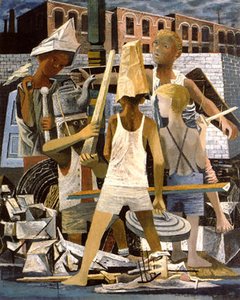
Guston’s artistic career can be broadly divided into two distinct phases. Initially, his work was figurative and representational, showcasing early influences from Renaissance masters like Piero della Francesca. He later embraced abstraction, becoming a prominent figure in the New York School alongside artists like Jackson Pollock and Willem de Kooning.

  • Abstract Expressionism: By the 1950s, Guston achieved recognition for his abstract expressionist paintings, characterized by dynamic compositions and gestural brushwork.
  • Shift to Figuration: In the mid-1960s, he dramatically renounced abstraction, pioneering a modified form of representational art known as neo-expressionism. This shift was accompanied by a critical reevaluation of his earlier work and a desire to engage with more direct social and political commentary.

The Late Period: Satire and Social Commentary

Guston’s later works are perhaps the most controversial and impactful of his career. These paintings often featured dark, satirical elements, including drawings of Richard Nixon and hooded Klansmen. He explored themes of racism, antisemitism, and American identity with a raw honesty that challenged conventional artistic norms.

  • Recurring Motifs: His late period is characterized by a limited palette and cartoonish renderings of various personal situations, symbols, and objects—often depicting figures with exaggerated features and unsettling expressions.
  • Influences & Themes: Influenced by his experiences with racism and antisemitism, as well as his interest in Eastern philosophy and mystic literature, Guston’s work became a powerful commentary on the darker aspects of American society.

Legacy and Significance

Philip Guston's legacy continues to inspire artists and art enthusiasts alike. His unique perspective and artistic style have left an indelible mark on the world of art.

  • Key Figure: A prominent figure in the abstract expressionist movement, Guston’s work challenged established conventions and paved the way for new forms of artistic expression.
  • Museum Presence: His works are featured in prestigious museums worldwide, including the Whitney Museum of American Art and the Tate Modern.
  • Ongoing Relevance: The postponement of his international retrospective in 2020 underscored the ongoing relevance of Guston’s work in addressing issues of social justice and racial equality.