


1


Updated November 2026 · ranked by our popularity score (searches, visits and orders for each work) · 48 works by Othon Friesz in our catalogue
In short
Scene in a Parisian Brasserie (1906) is the Othon Friesz painting that draws the most eyes; the original belongs to the Museum Barberini, Potsdam. After it, the eye goes to The Bathers of Andelys (1908) and Interior (1914). Among the 48 works of Othon Friesz in our catalog, these 48 are the most famous, each a unique original presented with its year, its museum and the reason it endures.


The oil on canvas titled Temptation (Adam and Eve) was painted by Othon Friesz in 1910. This work measures 73 x 60 cm. It captures a moment of profound weight through the figures of Adam and Eve. The scene is held within the permanent collection of the Hermitage Museum.


 Nude Reclining
12
 The CreekMuseum of Art
13
 The Harbour in Honfleur1907 · National Museum of Art, Architecture and Design
14
 Flowers (Tulips and Daisies)1910 · Hermitage Museum
15
 Vue du château Fallet1907 · Musée d'Unterlinden
16
 The Sunken Road in Winter1913 · Statens Museum For Kunst
17
 The Arbour in the Pine Wood1914 · Statens Museum For Kunst
18
 Still Life with Brioches1916 · Statens Museum For Kunst
19
 Still Life with Apples1915 · Statens Museum For Kunst
20
 Terrace with Palms1914 · Statens Museum For Kunst
21
 The Cliff at Sainte Marguerite1914 · Statens Museum For Kunst
22
 The Peaches1914 · Statens Museum For Kunst
23
 Spring1913 · Statens Museum For Kunst
24
 The Harbour of Le Havre1921 · Royal Museum of Fine Arts Antwerp
25
 Under the Fig1922 · Statens Museum For Kunst
26
 The Mountain Coudon Seen from Cap BrunRoyal Museum of Fine Arts Antwerp
27
 The ramparts of Saint-MaloMusée Toulouse-Lautrec
28
 Port
29
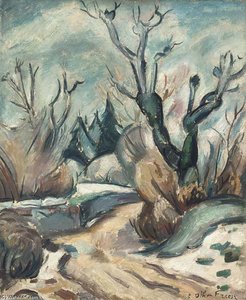 The Jura
30
 Landscape
31
 Port Of Toulon
32
 Baigneuses
33
 Flowers
34
 Construction Of Sheds At Istres
35
 Window On The Port Of Toulon
36
 Bateau Et Coquillages
37
 Seated Woman
38
 Nature Morte
39
 Landscape At Home
40
 A Village Street
41
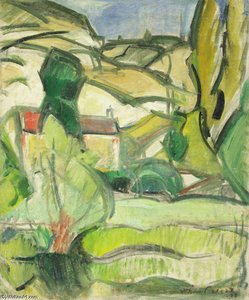 Landscape -
42
 A Still Life With Flowers In A Vase
43
 Drawings for ceramic platesMuseu do Caramulo
44
 Landscape of La Ciotat1907 · Centre Pompidou
45
 The Port of Anvers1906 · La Boverie
46
 Autumn Work1908 · National Museum of Art, Architecture and Design
47
 Roofs and Cathedral in Rouen1908 · Hermitage Museum
48
 Le Havre, Bassin du Roy1906
The four subjects that come back most often in these originals, each with its finest example.
The 8 museums that hold the most of the paintings on this page.
| Museum | City | Works by Othon Friesz | Paintings from this list |
|---|---|---|---|
 Statens Museum For Kunst |
Copenhagen | 13 | Interior, Mother's Love, The Lady on the Terrace |
 Hermitage Museum |
Saint Petersburg | 3 | Temptation (Adam and Eve), Flowers (Tulips and Daisies), Roofs and Cathedral in Rouen |
 National Museum of Art, Architecture and Design |
Oslo | 2 | The Harbour in Honfleur, Autumn Work |
 Royal Museum of Fine Arts Antwerp |
Antwerp | 2 | The Harbour of Le Havre, The Mountain Coudon Seen from Cap Brun |
 Museum Barberini |
Potsdam | 1 | Scene in a Parisian Brasserie |
 Musee du Petit Palais |
Geneva | 1 | The Bathers of Andelys |
 Israel Museum |
Jerusalem | 1 | The Decorated Cruiser, Antwerp |
 Museum of Art |
San Diego | 1 | The Creek |
Pick a decade to see the original that defines it.
Scene in a Parisian Brasserie (1906), Museum Barberini, Potsdam. The Bathers of Andelys (1908) and Interior (1914) come next.
27 years old: Scene in a Parisian Brasserie dates from 1906, and Othon Friesz was born in 1879.
Scene in a Parisian Brasserie, The Bathers of Andelys, Interior, Mother's Love, The Lady on the Terrace, Female Nude, Temptation (Adam and Eve), The Decorated Cruiser, Antwerp, Le Havre Port and Nude Lying in a Landscape. The ranking above gives each one's year and museum.
Our catalog holds 48 works by Othon Friesz, dated from 1903 to 1923.
Mostly in Statens Museum For Kunst (Copenhagen), Hermitage Museum (Saint Petersburg) and National Museum of Art, Architecture and Design (Oslo). The museum table above lists them all.
In 1910s: 13 of the 48 works on this page were made then, Interior among them.
On this page, the earliest is Le Havre Port (1903) and the latest Female Nude (1923).
Flowers (2) and Landscape (2), across the 48 works on this page.
Interior, Mother's Love and The Lady on the Terrace: the Statens Museum For Kunst, Copenhagen holds 13 of the works on this page.