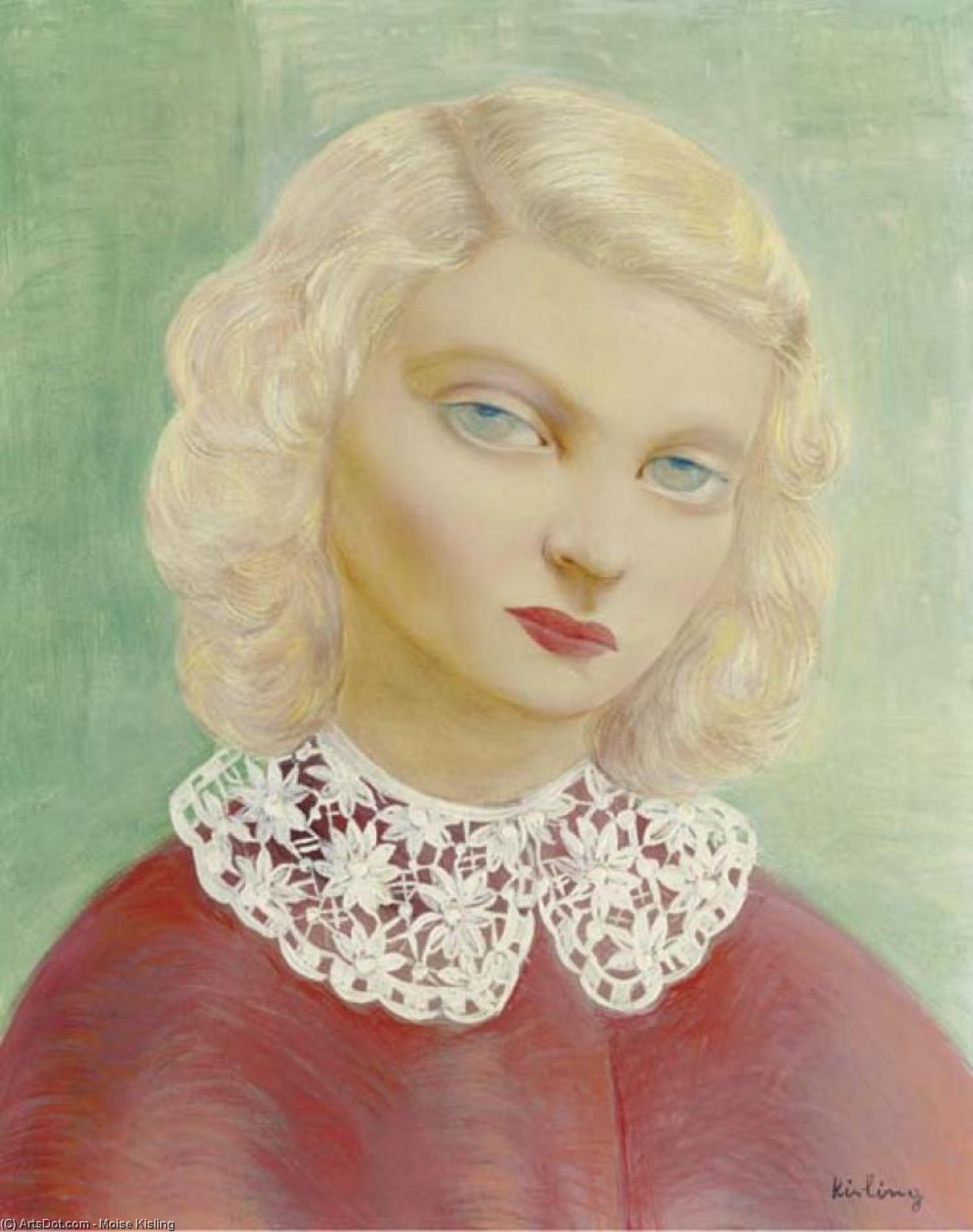
Portrait of Moïse Kisling

The 100 Most Famous Moïse Kisling Paintings, Each One of a Kind

Updated October 2026 · ranked by our popularity score (searches, visits and orders for each work) · 149 works by Moïse Kisling in our catalogue

In short

Portrait of Marcel Chantal (1935) is the Moïse Kisling painting that draws the most eyes; the original belongs to the Nagoya City Art Museum, Nagoya. After it, the eye goes to Large red nude (1949) and not identified. Among the 149 works of Moïse Kisling in our catalog, these 100 are the most famous, each a unique original presented with its year, its museum and the reason it endures.

1891 – 1953, Kraków Post-impressionism Most works: Nagoya City Art Museum

Top 10 paintings by Moïse Kisling, through the gallery's eye

1
Portrait of Marcel Chantal (1935) by Moïse Kisling

Portrait of Marcel Chantal

1935 · Oil On Canvas · Nagoya City Art Museum, Nagoya

The artwork titled Portrait of Marcel Chantal is a painting by the artist Moïse Kisling. Created in 1935, this oil on canvas work depicts a woman named Marcel Chantal. The subject is presented in a formal portrait format, capturing the figure of the woman as the central focus of the composition.

Moïse Kisling's famous paintings, numbers 11 to 100

11Portrait of Mrs. Renée Kisling [Portrait de Madame Renée Kisling] (1920) by Moïse KislingPortrait of Mrs. Renée Kisling [Portrait de Madame Renée Kisling]1920 · Nagoya City Art Museum 12Provence landscape (1918) by Moïse KislingProvence landscape1918 13not identified (38) by Moïse Kislingnot identified (38) 14not identified (40) by Moïse Kislingnot identified (40) 15not identified (18) by Moïse Kislingnot identified (18) 16not identified (17) by Moïse Kislingnot identified (17) 17untitled (32) by Moïse Kislinguntitled (32) 18untitled (8578) by Moïse Kislinguntitled (8578) 19untitled (717) by Moïse Kislinguntitled (717) 20untitled (1935) by Moïse Kislinguntitled (1935) 21untitled (2806) by Moïse Kislinguntitled (2806) 22untitled (5334) by Moïse Kislinguntitled (5334) 23untitled (3369) by Moïse Kislinguntitled (3369) 24untitled (9511) by Moïse Kislinguntitled (9511) 25untitled (5346) by Moïse Kislinguntitled (5346) 26not identified (36) by Moïse Kislingnot identified (36) 27Ofelia by Moïse KislingOfelia 28not identified (8) by Moïse Kislingnot identified (8) 29Female portrait by Moïse KislingFemale portrait 30Still Life (1915) by Moïse KislingStill Life1915 · Statens Museum For Kunst 31Waiting (1917) by Moïse KislingWaiting1917 32not identified (1913) by Moïse Kislingnot identified1913 33Portrait of Adolphe Basler (1914) by Moïse KislingPortrait of Adolphe Basler1914 34Still life with fruit (1913) by Moïse KislingStill life with fruit1913 35Tyniec (1912) by Moïse KislingTyniec1912 36Still Life with News Paper [Nature Morte au Journal] (1913) by Moïse KislingStill Life with News Paper [Nature Morte au Journal]1913 · Nagoya City Art Museum 37Mimosas (1952) by Moïse KislingMimosas1952 · Marubeni Gallery 38Kiki de Montparnasse (1924) by Moïse KislingKiki de Montparnasse1924 · Chimei Museum 39Large reclining nude, Kiki (1924) by Moïse KislingLarge reclining nude, Kiki1924 40Sitting nude (1923) by Moïse KislingSitting nude1923 41Reclining nude (1923) by Moïse KislingReclining nude1923 42Kiki de Montparnasse (1927) by Moïse KislingKiki de Montparnasse1927 43Sonia (1925) by Moïse KislingSonia1925 44Lying nude (1927) by Moïse KislingLying nude1927 45The castaway (1927) by Moïse KislingThe castaway1927 46Bouquet of various flowers (1927) by Moïse KislingBouquet of various flowers1927 47Renee Kisling (1928) by Moïse KislingRenee Kisling1928 48not identified (1933) by Moïse Kislingnot identified1933 49Sitting nude (1930) by Moïse KislingSitting nude1930 50Nude bust (1929) by Moïse KislingNude bust1929 51Eucalyptus and palm (1935) by Moïse KislingEucalyptus and palm1935 52Portrait of Madeleine Sologne (1936) by Moïse KislingPortrait of Madeleine Sologne1936 53Sanary landscape (1937) by Moïse KislingSanary landscape1937 54Nude woman with blonde hair (1942) by Moïse KislingNude woman with blonde hair1942 55Ms B.Dunn (1943) by Moïse KislingMs B.Dunn1943 56Grand bouquet of mimosa (1942) by Moïse KislingGrand bouquet of mimosa1942 57The boy (1948) by Moïse KislingThe boy1948 58not identified (1948) by Moïse Kislingnot identified1948 59Bust of blonde girl (1948) by Moïse KislingBust of blonde girl1948 60not identified (1952) by Moïse Kislingnot identified1952 61Vase of mimosa (1952) by Moïse KislingVase of mimosa1952 62Grand bouquet of tulips (1952) by Moïse KislingGrand bouquet of tulips1952 63An acrobat (1919) by Moïse KislingAn acrobat1919 64Portrait of Andre Salmon (1912) by Moïse KislingPortrait of Andre Salmon1912 65Bouquet of tulips by Moïse KislingBouquet of tulips 66Portrait of a girl by Moïse KislingPortrait of a girl 67untitled (9298) by Moïse Kislinguntitled (9298) 68untitled (560) by Moïse Kislinguntitled (560) 69untitled (4438) by Moïse Kislinguntitled (4438) 70untitled (2781) by Moïse Kislinguntitled (2781) 71untitled (4606) by Moïse Kislinguntitled (4606) 72untitled (1253) by Moïse Kislinguntitled (1253) 73not identified (14) by Moïse Kislingnot identified (14) 74untitled (4968) by Moïse Kislinguntitled (4968) 75le Port de Marseille by Moïse Kislingle Port de Marseille 76untitled (7844) by Moïse Kislinguntitled (7844) 77untitled (1140) by Moïse Kislinguntitled (1140) 78not identified (19) by Moïse Kislingnot identified (19) 79not identified (26) by Moïse Kislingnot identified (26) 80Fear by Moïse KislingFear 81not identified (13) by Moïse Kislingnot identified (13) 82not identified (34) by Moïse Kislingnot identified (34) 83untitled (4173) by Moïse Kislinguntitled (4173) 84not identified (30) by Moïse Kislingnot identified (30) 85not identified (27) by Moïse Kislingnot identified (27) 86not identified (31) by Moïse Kislingnot identified (31) 87untitled (1753) by Moïse Kislinguntitled (1753) 88not identified (22) by Moïse Kislingnot identified (22) 89Portrait of Renee Kisling by Moïse KislingPortrait of Renee Kisling 90not identified (25) by Moïse Kislingnot identified (25) 91Kiki de Montparnasse by Moïse KislingKiki de Montparnasse 92Grand bouquet by Moïse KislingGrand bouquet 93not identified (23) by Moïse Kislingnot identified (23) 94not identified (35) by Moïse Kislingnot identified (35) 95Marseille Port by Moïse KislingMarseille Port 96untitled (4955) by Moïse Kislinguntitled (4955) 97not identified (9) by Moïse Kislingnot identified (9) 98not identified (10) by Moïse Kislingnot identified (10) 99not identified (24) by Moïse Kislingnot identified (24) 100not identified (29) by Moïse Kislingnot identified (29)

Moïse Kisling's famous paintings, period by period

The subjects that held Moïse Kisling's eye

The four subjects that come back most often in these originals, each with its finest example.

The museums that keep Moïse Kisling's originals

The 8 museums that hold the most of the paintings on this page.

Museum City Works by Moïse Kisling Paintings from this list
Nagoya City Art Museum, NagoyaNagoya City Art Museum Nagoya 3 Portrait of Marcel Chantal, Portrait of Mrs. Renée Kisling [Portrait de Madame Renée Kisling], Still Life with News Paper [Nature Morte au Journal]
Museum Ludwig, CologneMuseum Ludwig Cologne 1 Portrait of Renee Kisling
Israel Museum, JerusalemIsrael Museum Jerusalem 1 Self Portrait with a Pipe
Finnish National Gallery, HelsinkiFinnish National Gallery Helsinki 1 Woman at the table
Murauchi Art Museum, TokyoMurauchi Art Museum Tokyo 1 Woman in green skirt
Statens Museum For Kunst, CopenhagenStatens Museum For Kunst Copenhagen 1 Still Life
Marubeni Gallery, TokyoMarubeni Gallery Tokyo 1 Mimosas
Chimei Museum, TainanChimei Museum Tainan 1 Kiki de Montparnasse

Moïse Kisling across the decades: one unique original for each

Works per decade

Pick a decade to see the original that defines it.

Moïse Kisling's paintings: questions for the gallery

What is the single most famous work of Moïse Kisling?Reveal the answer

Portrait of Marcel Chantal (1935), Nagoya City Art Museum, Nagoya. Large red nude (1949) and not identified come next.

At what age did Moïse Kisling create Portrait of Marcel Chantal?Reveal the answer

44 years old: Portrait of Marcel Chantal dates from 1935, and Moïse Kisling was born in 1891.

Which ten paintings by Moïse Kisling are the most famous?Reveal the answer

Portrait of Marcel Chantal, Large red nude, not identified, Portrait of Renee Kisling, Self Portrait with a Pipe, Woman at the table, Woman in green skirt, Boy in Blue, Children of Dr. Tas and Portrait with a collar. The ranking above gives each one's year and museum.

How many works by Moïse Kisling are known?Reveal the answer

Our catalog holds 149 works by Moïse Kisling, dated from 1912 to 1952.

Where can the most famous Moïse Kisling originals be seen?Reveal the answer

Mostly in Nagoya City Art Museum (Nagoya), Museum Ludwig (Cologne) and Israel Museum (Jerusalem). The museum table above lists them all.

During which period did Moïse Kisling create the best-known paintings?Reveal the answer

In 1920s: 15 of the 100 works on this page were made then, Portrait of Renee Kisling among them.

Which famous Moïse Kisling painting is the earliest, and which the latest?Reveal the answer

On this page, the earliest is Tyniec (1912) and the latest Mimosas (1952).

What subjects did Moïse Kisling favour?Reveal the answer

Women (23), Portrait (11) and Nudes (8), across the 100 works on this page.

What materials did Moïse Kisling paint with most?Reveal the answer

Oil On Canvas, for 6 of the 100 works on this page.

Which movement does the work of Moïse Kisling belong to?Reveal the answer

Post-impressionism, judging by the originals on this page.

What Moïse Kisling originals can I see at the Nagoya City Art Museum?Reveal the answer

Portrait of Marcel Chantal, Portrait of Mrs. Renée Kisling [Portrait de Madame Renée Kisling] and Still Life with News Paper [Nature Morte au Journal]: the Nagoya City Art Museum, Nagoya holds 3 of the works on this page.

Moïse Kisling: a portrait of the artist

A Life Forged in Transition

Moïse Kisling, born Mojżesz Kisling in 1891 Kraków, a city then pulsating within the Austro-Hungarian Empire, was an artist whose life mirrored the tumultuous currents of the early twentieth century. From his earliest days, a clear artistic sensibility bloomed, leading him to enroll at the Krakow Academy of Fine Arts at just fifteen years old. Mentored by Józef Pankiewicz, he received encouragement to seek inspiration in Paris – a city already establishing itself as the epicenter of modern art. In 1910, Kisling embarked on this pivotal journey, immersing himself within Montmartre’s vibrant artistic community and forging connections with fellow émigrés and avant-garde thinkers. This initial period was formative, exposing him to a multitude of styles that would subtly shape his own unique voice. He wasn't merely absorbing influences; he was beginning a lifelong process of synthesis and innovation. The bohemian atmosphere of Montmartre, with its shared studios and fervent debates, proved an ideal crucible for the young artist’s developing talent.

The Shaping of a Style: Between Cubism and Expression

Kisling’s artistic development wasn't defined by rigid adherence to any single school, but rather by a fluid exploration of diverse influences. Early works hinted at the structural innovations of Paul Cézanne and the bold chromaticism of André Derain, with subtle Cubist tendencies emerging – as evidenced in pieces like *Portrait of Andre Salmon* (1912). However, the outbreak of World War I proved a turning point. As Europe descended into chaos, Kisling’s style underwent a significant shift towards Expressionism. This manifested in bolder colors, more expressive brushwork, and an increasing focus on emotional intensity. He developed a distinctive approach that balanced precise draftsmanship with a vibrant palette, often depicting the human form with clarity and grace. The elegance of rounded forms became a hallmark of his work, frequently echoing the influence of Amedeo Modigliani – a close friend whose elongated necks, almond-shaped eyes, and delicately rendered lips resonated within Kisling’s own portraits. Yet, he infused these characteristics with a unique sensibility, mastering the manipulation of light and shadow to create intricate contrasts that brought his figures to life with remarkable depth and nuance. This period wasn't simply about adopting a new style; it was about finding a visual language capable of conveying the anxieties and uncertainties of a world at war.

Recognition Amidst War and Exile

Despite the disruptions of war, Kisling steadily gained recognition within the Parisian art world. A pivotal moment arrived in 1919 with an exhibition at Galerie Druet, which showcased his evolving style and garnered critical attention. His talent did not go unnoticed by collectors; in 1923, Albert Barnes acquired several of his paintings, a testament to their quality and artistic merit. Kisling became a central figure within the Parisian art scene, known for hosting weekly lunches that brought together a diverse array of creatives – writers, poets, painters, and sculptors – fostering an atmosphere of intellectual exchange and collaboration. His service in the French Foreign Legion during World War I, culminating in wounds sustained at the Battle of the Somme and subsequent French citizenship in 1915, underscored his commitment to his adopted homeland. This experience profoundly impacted him, shaping not only his personal identity but also informing the emotional depth present within his art. The looming shadow of World War II forced Kisling into exile. He emigrated to the United States, exhibiting his work in New York City and Washington D.C., seeking refuge from the escalating persecution in Europe. This period of displacement was undoubtedly challenging, yet it allowed him to connect with a new audience and further refine his artistic vision.

A Lasting Legacy: The School of Paris and Beyond

Following the war’s conclusion, Kisling returned to France in 1946, settling in Sanary-sur-Mer where he continued to paint until his death in 1953. A residential street in Sanary-sur-Mer now bears his name, a lasting tribute to his contribution to the local community and the art world at large. Kisling’s work embodies the spirit of Post-Impressionism and early Expressionism, contributing significantly to the vibrant tapestry of the School of Paris – a diverse collective of artists who collectively reshaped modern art. His innovative style, characterized by its unique blend of precision and emotional intensity, continues to inspire artists and captivate audiences today. Large Nude Josan on Red Couch, painted in 1953, stands as a powerful example of his mature style – a sensual masterpiece showcasing vibrant colors and expressive brushwork. The Musée du Petit Palais in Geneva holds the largest collection of his works, serving as a testament to his enduring legacy and artistic vision. Moïse Kisling’s paintings remain powerful reminders of a pivotal era in art history, reflecting both the beauty and the anxieties of a world in transition – a world he navigated with courage, sensitivity, and an unwavering dedication to his craft. His ability to synthesize diverse influences into a uniquely personal style ensures his place as a significant figure within the canon of modern art.

Key Characteristics & Influences