Portrait of Jacek Yerka

The 100 Most Famous Jacek Yerka Paintings, a Gallery Selection

Updated October 2026 · ranked by our popularity score (searches, visits and orders for each work) · 311 works by Jacek Yerka in our catalogue

In short

Of all the originals Jacek Yerka left, the most famous is Shelves of Books (also known as Bibliotama). Close behind it come Epitaph - Jacek Yerka (2026) and My Mokotowska. Our catalog holds 311 works by Jacek Yerka; the gallery has kept the 100 the world admires most, each shown with its date, its museum and its story.

born 1952, Toruń Surrealism

Jacek Yerka's top 10 paintings: the gallery's choice

1
Shelves of Books (also known as Bibliotama) by Jacek Yerka

Shelves of Books (also known as Bibliotama)

Oil On Canvas

The composition centers on a vast, multi-tiered bookcase that occupies the majority of the visual field. This structure creates a sense of interiority, placing the viewer within the confines of the shelving units. The books are not arranged in a standard, linear fashion; instead, they sit at various angles, some leaning precariously while others are stacked horizontally. The spines of these volumes vary in height and thickness, creating an irregular,…

2
Epitaph - Jacek Yerka (2026) by Jacek Yerka

Epitaph - Jacek Yerka

2026 · Acrylic

Jacek Yerka’s “Epitaph” transcends mere visual representation, plunging viewers into a realm where fantasy intertwines seamlessly with scientific contemplation and mythological echoes resonate. This striking acrylic painting on canvas embodies the core tenets of Surrealism—a deliberate disruption of logical order to unlock subconscious narratives.

6
Wegener's theory (2001) by Jacek Yerka

Wegener's theory

2001 · Acrylic On Canvas

Jacek Yerka's 'Wegener’s Theory': A Surreal Dive into Geological Imagination Subject Matter: Jacek Yerka’s ‘Wegener’s Theory’, painted in 2001, presents a strikingly surreal depiction of the ocean floor. It’s not merely an underwater scene; it's a meticulously constructed dreamscape populated with floating islands, diverse marine life, and enigmatic structures – a visual exploration of the controversial continental drift theory proposed by Alfred Wegener. Style & Technique: The painting exemplifies Yerka’s…

9
The Angels' Kitchen (2005) by Jacek Yerka

The Angels' Kitchen

2005 · Oil On Canvas

Jacek Yerka’s “The Angels’ Kitchen,” painted in 2005, is more than just a depiction of a domestic scene; it’s an immersive journey into a meticulously crafted surrealist dream. Measuring 59 x 47 cm, this artwork immediately captivates with its juxtaposition of the familiar – a kitchen brimming with everyday objects – and the extraordinary – a fully-fledged angel engaged in culinary activities amidst an orchard bursting with life.

The Jacek Yerka selection continues, 11 to 100

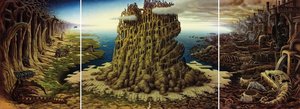
11Brontosaurus Civitas by Jacek YerkaBrontosaurus Civitas 12Epitaph by Jacek YerkaEpitaph 13Strawberries railway by Jacek YerkaStrawberries railway 14Enhabited oak by Jacek YerkaEnhabited oak 15The Creation Of Water by Jacek YerkaThe Creation Of Water 16Waiting for the tram by Jacek YerkaWaiting for the tram 17The Garden by Jacek YerkaThe Garden 18Loading cities by Jacek YerkaLoading cities 19Back To Nature (1983) by Jacek YerkaBack To Nature1983 20Ventimiglia (1992) by Jacek YerkaVentimiglia1992 21Room (1993) by Jacek YerkaRoom1993 22Back to Home by Jacek YerkaBack to Home 23Last Minute (2000) by Jacek YerkaLast Minute2000 24Sierra Telegraphic (2010) by Jacek YerkaSierra Telegraphic2010 25Polish cuisine (2012) by Jacek YerkaPolish cuisine2012 26Timegrovel (2004) by Jacek YerkaTimegrovel2004 27Trains of Mister Cat (2011) by Jacek YerkaTrains of Mister Cat2011 28Timebreaker by Jacek YerkaTimebreaker 29In Landscapes by Jacek YerkaIn Landscapes 30Private Wave by Jacek YerkaPrivate Wave 31Road by Jacek YerkaRoad 32I like the Sorrow by Jacek YerkaI like the Sorrow 33The Cider Recipe by Jacek YerkaThe Cider Recipe 34Ecumenical cat by Jacek YerkaEcumenical cat 35Paradise in the yard by Jacek YerkaParadise in the yard 36Think of the Weekend by Jacek YerkaThink of the Weekend 37Sonnet by Jacek YerkaSonnet 38There is peace in the Block by Jacek YerkaThere is peace in the Block 39Horsemen of Chaos by Jacek YerkaHorsemen of Chaos 40Vacancy lifetime by Jacek YerkaVacancy lifetime 41The Agitators by Jacek YerkaThe Agitators 42Please Don't Slam The Door by Jacek YerkaPlease Don't Slam The Door 43Tectonics by Jacek YerkaTectonics 44Express Delivery by Jacek YerkaExpress Delivery 45Orange grove by Jacek YerkaOrange grove 46Strawberry garden by Jacek YerkaStrawberry garden 47Personal Shelf by Jacek YerkaPersonal Shelf 48amok harvest by Jacek Yerkaamok harvest 49Party on the Island by Jacek YerkaParty on the Island 50King Boletus by Jacek YerkaKing Boletus 51Narrow Gauge train by Jacek YerkaNarrow Gauge train 52Weather under the lilac by Jacek YerkaWeather under the lilac 53Strawberry tree by Jacek YerkaStrawberry tree 54Dragon hunting by Jacek YerkaDragon hunting 55lockers by Jacek Yerkalockers 56In the Shadow of the Cathedral by Jacek YerkaIn the Shadow of the Cathedral 57Triptych - the middle part (1996) by Jacek YerkaTriptych - the middle part1996 58Fantastic composition by Jacek YerkaFantastic composition 59International Children's Day (1977) by Jacek YerkaInternational Children's Day1977 60WPHW Torun (1977) by Jacek YerkaWPHW Torun1977 61Festival of Polish theaters and reciters (1977) by Jacek YerkaFestival of Polish theaters and reciters1977 62Karnaway and Volkskunst Museum (1977) by Jacek YerkaKarnaway and Volkskunst Museum1977 63Palestine! (1979) by Jacek YerkaPalestine!1979 64Short firearms (1980) by Jacek YerkaShort firearms1980 65Homeland Denied (Return to Sender) (1979) by Jacek YerkaHomeland Denied (Return to Sender)1979 66Between Heaven And Hell (1989) by Jacek YerkaBetween Heaven And Hell1989 67Afternoon With The Bros Grimm (1990) by Jacek YerkaAfternoon With The Bros Grimm1990 68Clock Monster (1992) by Jacek YerkaClock Monster1992 69The snow is not permitted (1991) by Jacek YerkaThe snow is not permitted1991 70Ellison Wonderland (1993) by Jacek YerkaEllison Wonderland1993 71Life on stump (1994) by Jacek YerkaLife on stump1994 72The place of origin (1993) by Jacek YerkaThe place of origin1993 73Tsunami (1998) by Jacek YerkaTsunami1998 74Green room (1997) by Jacek YerkaGreen room1997 75Triptych (1996) by Jacek YerkaTriptych1996 76Triptych - the right part (1996) by Jacek YerkaTriptych - the right part1996 77Polish Bonsai (1996) by Jacek YerkaPolish Bonsai1996 78Polish Bonsai (1999) by Jacek YerkaPolish Bonsai1999 79Jurassic Parking (1999) by Jacek YerkaJurassic Parking1999 80Last Minute (2000) by Jacek YerkaLast Minute2000 81Fantastic Landscape (1999) by Jacek YerkaFantastic Landscape1999 82Peace Farm (1999) by Jacek YerkaPeace Farm1999 83Ecosystem (2002) by Jacek YerkaEcosystem2002 84Rainbow (2003) by Jacek YerkaRainbow2003 85Deserted Island (2003) by Jacek YerkaDeserted Island2003 86Castle with a certificate (2005) by Jacek YerkaCastle with a certificate2005 87Flight-Clock (2004) by Jacek YerkaFlight-Clock2004 88Chronozaurus (2004) by Jacek YerkaChronozaurus2004 89Alarm clock eater (2004) by Jacek YerkaAlarm clock eater2004 90Fly Alarmowka (2004) by Jacek YerkaFly Alarmowka2004 91Two snails (2004) by Jacek YerkaTwo snails2004 92Tectonics (2004) by Jacek YerkaTectonics2004 93Winter (2005) by Jacek YerkaWinter2005 94The Other Side of the Castle (2004) by Jacek YerkaThe Other Side of the Castle2004 95San Andrea (2004) by Jacek YerkaSan Andrea2004 96At Cosmos Bank (2004) by Jacek YerkaAt Cosmos Bank2004 97Stone and brick (2005) by Jacek YerkaStone and brick2005 98Two Snails (2004) by Jacek YerkaTwo Snails2004 99Alley (2004) by Jacek YerkaAlley2004 100Wheelbarrows-return (2006) by Jacek YerkaWheelbarrows-return2006

Jacek Yerka's famous paintings, period by period

The subjects that held Jacek Yerka's eye

The four subjects that come back most often in these originals, each with its finest example.

Jacek Yerka decade by decade: the original that defines each

Works per decade

Pick a decade to see the original that defines it.

Collectors' questions about Jacek Yerka's paintings

Which work is Jacek Yerka most famous for?Reveal the answer

Shelves of Books (also known as Bibliotama). Epitaph - Jacek Yerka (2026) and My Mokotowska come next.

What are the ten most famous Jacek Yerka paintings?Reveal the answer

Shelves of Books (also known as Bibliotama), Epitaph - Jacek Yerka, My Mokotowska, Swimming Lesson, Susan, Wegener's theory, Spring Labyrinth, Four seasons, The Angels' Kitchen and Jealousy. The ranking above gives each one's year and museum.

How many paintings did Jacek Yerka leave?Reveal the answer

Our catalog holds 311 works by Jacek Yerka, dated from 1977 to 2026.

In which years did Jacek Yerka paint the most famous works?Reveal the answer

In 2000s: 24 of the 100 works on this page were made then, Wegener's theory among them.

What are the first and the last famous originals of Jacek Yerka?Reveal the answer

On this page, the earliest is International Children's Day (1977) and the latest Epitaph - Jacek Yerka (2026).

Which subjects did Jacek Yerka choose most often?Reveal the answer

Buildings (15), Symbols (15) and Roads (13), across the 100 works on this page.

Which technique did Jacek Yerka use most?Reveal the answer

Oil On Canvas, for 3 of the 100 works on this page.

To which art movement does Jacek Yerka belong?Reveal the answer

Surrealism, judging by the originals on this page.

Jacek Yerka: life and work

Jacek Yerka: A Surrealist Visionary

Early Life and Artistic Beginnings

Born in 1952 in Toruń, Poland, Jacek Yerka emerged from a deeply artistic family. Both his parents were graduates of the local Fine Art Academy, immersing him in a world of paints, inks, and brushes from an early age. This formative environment profoundly shaped his future career path. As a child, Yerka preferred solitary creative pursuits – drawing and sculpting – over outdoor play, leading to social challenges during primary school which he described as a “grey, sometimes horrifying reality.” However, his talent for sketching earned him respect in high school.

Artistic Journey and Development

Initially considering careers in astronomy or medicine, Yerka ultimately chose to pursue fine art and graphic design. During his studies at Nicolaus Copernicus University in Toruń, he resisted pressure to adopt contemporary styles, steadfastly adhering to the classic Flemish technique that defines his work. This dedication to meticulous detail and traditional methods became a hallmark of his artistic identity.

Influences and Inspirations

Yerka’s artistic vision is deeply rooted in the works of masters past. He cites Hieronymus Bosch, Pieter Bruegel, Cagliostro, Jan van Eyck, and Hugo van der Goes as key influences. These artists instilled in him a fascination with intricate detail, symbolic imagery, and fantastical narratives. Beyond art history, Yerka draws inspiration from scientific concepts and his own childhood memories.

Key Characteristics of His Work

  • Surrealism: Yerka’s paintings are firmly rooted in the surrealist tradition, blending reality with dreamlike imagery.
  • Flemish Technique: He employs a meticulous and detailed painting style reminiscent of the Flemish masters.
  • Intricate Detail: His works are characterized by an astonishing level of detail, inviting viewers to explore hidden narratives within each composition.
  • Fantastical Worlds: Yerka creates imaginative landscapes populated with bizarre creatures and extraordinary architecture.
  • Scientific & Mythological Themes: He often merges scientific concepts with artistic expression and mythological references.

Notable Works and Achievements

Yerka’s portfolio includes numerous acclaimed works, such as “The Angels' Kitchen” and “Wegener's Theory.” His art has been exhibited internationally in Poland, Germany, Monaco, France, and the United States. He also collaborated with Hollywood producer Renee Daalder on designs for the science fiction film “Strawberry Fields,” further expanding his reach.

Historical Significance and Legacy

Jacek Yerka’s unique artistic vision has earned him a significant place in contemporary art. His ability to seamlessly blend the surreal, the scientific, and the mythological creates captivating works that resonate with audiences worldwide. He continues to inspire artists and captivate viewers with his meticulously crafted and imaginative paintings.