Portrait of Horace Vernet

Horace Vernet Paintings: The 100 Most Famous, Through a Gallery's Eye

Updated November 2026 · ranked by our popularity score (searches, visits and orders for each work) · 171 works by Horace Vernet in our catalogue

In short

To the gallery's eye, Horace Vernet's most famous painting is The Gate at Clichy (1820), whose original hangs in the The Louvre, Paris. Philippe Lenoir and Portrait of General Pablo Morillo (1820) complete the trio every eye recognises. Of the 171 works by Horace Vernet in our catalog, the gallery presents the 100 most famous below, each original with its year, its museum and what makes it unique.

1789 – 1863, Paris Romanticism Most works: Wallace Collection

The gallery's top 10 Horace Vernet paintings

1
The Gate at Clichy (1820) by Horace Vernet

The Gate at Clichy

1820 · Acrylic On Canvas · The Louvre, Paris

Émile Jean-Horace Vernet’s “The Gate at Clichy” isn't merely a depiction of a battlefield; it’s a visceral plunge into the heart of 19th-century France, a period grappling with the aftermath of revolution and the burgeoning spirit of nationalism. Painted in 1820, this oil-on-canvas masterpiece, currently residing within the hallowed halls of the Louvre, captures not just an event – the defense of Paris during the Battle of Clichy – but…

2
Philippe Lenoir by Horace Vernet

Philippe Lenoir

Oil On Canvas · The Louvre, Paris

A Portrait Steeped in Tradition: Horace Vernet’s “The Taking of an Entrenched Camp” Horace Vernet (1789 – 1863), a titan amongst French Romantic painters, stands as a singular figure—a master of capturing the visceral energy of battle and simultaneously grounding his canvases in meticulous observation. His monumental painting, "The Taking of an Entrenched Camp," exemplifies this duality perfectly, offering viewers not merely a depiction of military action but also a…

3
Portrait of General Pablo Morillo (1820) by Horace Vernet

Portrait of General Pablo Morillo

1820 · Oil On Canvas · Hermitage Museum, Saint Petersburg

The gaze of the sitter meets us in the Portrait of General Pablo Morillo, a work executed by the artist Emile Jean Horace Vernet. Created around 1820, the painting captures a man whose very presence commands the space around him. We find ourselves looking upon a figure of significant weight and history, a man whose life is defined by the rigid structures of military command and the heavy mantle of…

4
Blessing of soldiers (1812) by Horace Vernet

Blessing of soldiers

1812 · Oil On Canvas · National Museum in Warsaw, Warsaw

The work before us is titled Blessing of soldiers, a piece that captures a quiet, heavy moment of devotion amidst the realities of military life. It is also recognized by the title Priest blessing soldiers. This painting was executed by the French artist Horace Vernet, whose full name was Émile Jean-Horace Vernet. He was a man deeply attuned to the atmosphere of his era, often choosing to depict the lived…

5
Scene from the French Campaign of 1814 (1826) by Horace Vernet

Scene from the French Campaign of 1814

1826 · Oil On Canvas · Fine Arts Museums of San Francisco, San Francisco

In this work, titled Scene from the French Campaign of 1814, the artist Horace Vernet captures a moment of profound human distress. Painted in 1826, the canvas moves away from the idealized military triumphs often associated with the era to focus on the immediate, heavy consequences of conflict. It provides a window into the wartime chaos and the civilian suffering that characterized the French Campaign of 1814.

6
Bataille de las Navas de Tolosa, 1212 by Horace Vernet

Bataille de las Navas de Tolosa, 1212

Oil On Canvas

The oil on canvas painting titled Bataille de las Navas de Tolosa, 1212 is a work by the French artist Horace Vernet. This composition depicts a large-scale historical battle scene characterized by intense combat and a chaotic arrangement of figures. The subject matter focuses on the clash between Christian forces and Muslim adversaries during the medieval period. The central focus of the work is a knight mounted on a white…

8
Portrait of a Young Woman (1831) by Horace Vernet

Portrait of a Young Woman

1831 · Oil On Canvas · Toledo Museum of Art, Toledo

Portrait of a Young Woman is an oil on canvas painted by the French artist Horace Vernet. Executed in 1831, the work originated in France. The composition presents a formal and elegant three-quarter length portrait of a subject positioned centrally against a dark, naturalistic background.

9
Wounded Zouave (1858) by Horace Vernet

Wounded Zouave

1858 · Oil On Canvas · Hermitage Museum, Saint Petersburg

The oil on canvas titled Wounded Zouave was painted by Horace Vernet. This work emerged around 1858, capturing a solitary moment amidst the dust of conflict. The soldier rests against a stone, his blue tunic and red trousers a sharp presence against the pale sky.

10
Peace and War (1820) by Horace Vernet

Peace and War

1820 · Oil On Canvas · Wallace Collection, London

In the quiet, brooding atmosphere of Émile Jean-Horace Vernet’s 1820 masterpiece, "Peace and War," we encounter more than a mere historical tableau; we are invited into a profound meditation on the human condition. The painting captures a moment frozen in time, where a lone figure—perhaps a weary soldier or a resilient peasant—traverses a desolate, rocky landscape under a heavy, overcast sky. There is an immediate, visceral sense of solitude that…

Horace Vernet paintings, ranked 11 to 100

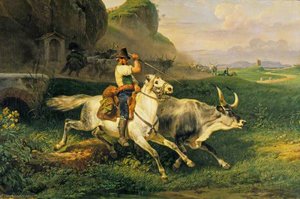
11A Bashi Bazouk (1860) by Horace VernetA Bashi Bazouk1860 · Wallace Collection 12Head of an Arab (1818) by Horace VernetHead of an Arab1818 · Hermitage Museum 13Illustrations from the Journal des Dames et des Modes (1810) by Horace VernetIllustrations from the Journal des Dames et des Modes1810 · Rhode Island School of Design Museum of Art 14The Abduction of Angélique (1820) by Horace VernetThe Abduction of Angélique1820 · The Art Museum RIGA BOURSE 15Ferdinand-Philippe-Louis, Duke of Chartres, as a child (1821) by Horace VernetFerdinand-Philippe-Louis, Duke of Chartres, as a child1821 · Grand Trianon 16Portrait of Filippo Agricola (1820) by Horace VernetPortrait of Filippo Agricola1820 · Galleria Nazionale d'Arte Antica 17The Siege of Saragossa (1819) by Horace VernetThe Siege of Saragossa1819 18The soldier on the field of battle (1818) by Horace VernetThe soldier on the field of battle1818 · Norton Simon Museum 19Portrait équestre du Colonel Clary (1815) by Horace VernetPortrait équestre du Colonel Clary1815 · Musée Massey 20Portrait of a Monk (1825) by Horace VernetPortrait of a Monk1825 · Hôtel Bertrand 21Portrait of Marshal Henri-Gatien Bertrand (Châteauroux, 1773-1844). Study. (1825) by Horace VernetPortrait of Marshal Henri-Gatien Bertrand (Châteauroux, 1773-1844). Study.1825 · Hôtel Bertrand 22Study of a Woman's Head (1825) by Horace VernetStudy of a Woman's Head1825 · Musee Baron Martin 23Mazeppa (1825) by Horace VernetMazeppa1825 · Palais Bourbon 24Pope Julius II orders the works of Vatican and Saint-Peter basilica (1827) by Horace VernetPope Julius II orders the works of Vatican and Saint-Peter basilica1827 25Judith and Holofernes (1828) by Horace VernetJudith and Holofernes1828 · Museum of Fine Arts 26Study of Olympe Pelissier as Judith (1831) by Horace VernetStudy of Olympe Pelissier as Judith1831 · Museum of Fine Arts 27Napoleon Meditating on a Military Map at Charleroi (1823) by Horace VernetNapoleon Meditating on a Military Map at Charleroi1823 · New York Historical Society 28Portrait of the Marchesa Cunegonda Misciattelli with Her Infant Son and His Nurse (1830) by Horace VernetPortrait of the Marchesa Cunegonda Misciattelli with Her Infant Son and His Nurse1830 · University of Arizona Museum of Art 29The barouche (1836) by Horace VernetThe barouche1836 · Musée Nissim de Camondo 30Self-Portrait in Rome (1832) by Horace VernetSelf-Portrait in Rome1832 · Cleveland Museum of Art 31Study of man's head. (1837) by Horace VernetStudy of man's head.1837 · National Museum in Warsaw 32Somosierra (1839) by Horace VernetSomosierra1839 · National Museum in Kraków 33Capture of the Fort of Saint-Jean d'Ulloa, November 27, 1838 (1848) by Horace VernetCapture of the Fort of Saint-Jean d'Ulloa, November 27, 18381848 34Jeremiah on the ruins of Jerusalem (1844) by Horace VernetJeremiah on the ruins of Jerusalem1844 · Amsterdam Museum 35Portrait of Étienne Arago (1854) by Horace VernetPortrait of Étienne Arago1854 · Carnavalet Museum 36Napoleon Bonaparte on Elba awaits the Arrival of the L´Inconstant (1863) by Horace VernetNapoleon Bonaparte on Elba awaits the Arrival of the L´Inconstant1863 37The scene of war (1861) by Horace VernetThe scene of war1861 · National Gallery of Armenia 38Zouaves at the Malakoff (1856) by Horace VernetZouaves at the Malakoff1856 · Royal Collection 39The Veteran at Home (1823) by Horace VernetThe Veteran at Home1823 · Wallace Collection 40Charles Bernard, baron de Ballainvilliers (1757-1835) by Horace VernetCharles Bernard, baron de Ballainvilliers (1757-1835)Nationalmuseum 41Mazeppa (1826) by Horace VernetMazeppa1826 · Кунстхалле Бремен 42Arab Chieftains in Council (The Negotiator) (1834) by Horace VernetArab Chieftains in Council (The Negotiator)1834 · Condé Museum 43Ceremonial Carrying of Pope Pius VIII into the St Peter Cathedral in 1829 by Horace VernetCeremonial Carrying of Pope Pius VIII into the St Peter Cathedral in 1829Hermitage Museum 44Soldier-Labourer (1820) by Horace VernetSoldier-Labourer1820 · Wallace Collection 45The arab tale-teller by Horace VernetThe arab tale-teller 46Raphaël au Vatican by Horace VernetRaphaël au VaticanThe Louvre 47Wanderers Pausing in the Alps (1825) by Horace VernetWanderers Pausing in the Alps1825 · Nationalmuseum 48Hunting in the Pontine Marshes (1833) by Horace VernetHunting in the Pontine Marshes1833 · National Gallery of Art 49A Grenadier of the Guard at Elba (1820) by Horace VernetA Grenadier of the Guard at Elba1820 · Wallace Collection 50Academic Study of Adolescent Boy, Seen from Behind (1807) by Horace VernetAcademic Study of Adolescent Boy, Seen from Behind1807 51Incroyables et Merveilleuses: plate 3: chevelure à la François 1er, chapeau en barque (1810) by Horace VernetIncroyables et Merveilleuses: plate 3: chevelure à la François 1er, chapeau en barque1810 52The Vesuvius Erupting, the Artist and His Father, Carle Vernet, in the Foreground (1822) by Horace VernetThe Vesuvius Erupting, the Artist and His Father, Carle Vernet, in the Foreground1822 · Museum of Fine Arts 53The Battle of Montmirail (1822) by Horace VernetThe Battle of Montmirail1822 54The Emperor Napoleon I (1815) by Horace VernetThe Emperor Napoleon I1815 55General Foy (1825) by Horace VernetGeneral Foy1825 · National Gallery of Canada 56The Battle of Valmy (1826) by Horace VernetThe Battle of Valmy1826 57A Saddled Race Horse Tied to a Fence (1828) by Horace VernetA Saddled Race Horse Tied to a Fence1828 58A Roman Herdsman Driving Cattle (1829) by Horace VernetA Roman Herdsman Driving Cattle1829 · Wallace Collection 59The Duke of Chartres on Horseback (1832) by Horace VernetThe Duke of Chartres on Horseback1832 60Painting (1843) by Horace VernetPainting1843 · National Museum of Art, Architecture and Design 61Wounded Arab Soldier (1845) by Horace VernetWounded Arab Soldier1845 · National Museum of Fine Arts 62First mass in Kabylie (1854) by Horace VernetFirst mass in Kabylie1854 · Musée cantonal des Beaux-Arts 63The battle of the Alma in 1854 (1856) by Horace VernetThe battle of the Alma in 18541856 · Musée Fesch 64The duc de Nemours Entering Constantine (1839) by Horace VernetThe duc de Nemours Entering Constantine1839 · Wallace Collection 65MADAME JOUSSERAND by Horace VernetMADAME JOUSSERANDThe Louvre 66General Dumouriez and his staff at the Battle of Jemmapes by Horace VernetGeneral Dumouriez and his staff at the Battle of Jemmapesmusée des Beaux-Arts de Valence 67evening landscape by Horace Vernetevening landscape 68Gulf by Horace VernetGulf 69Over the Fence by Horace VernetOver the Fence 70Bataille d'Isly, 14 août 1844 by Horace VernetBataille d'Isly, 14 août 1844Opera House 71Prise de Bougie, 2 octobre 1833 by Horace VernetPrise de Bougie, 2 octobre 1833 72Combat de l'Habrah, 3 decembre 1835 by Horace VernetCombat de l'Habrah, 3 decembre 1835 73Combat d'Affroum, 27 avril 1840 by Horace VernetCombat d'Affroum, 27 avril 1840 74Entrée de l'armée française en Belgique, 9 août 1831 by Horace VernetEntrée de l'armée française en Belgique, 9 août 1831 75Occupation d'Ancône par les troupes françaises, 23 février 1832 by Horace VernetOccupation d'Ancône par les troupes françaises, 23 février 1832 76Le Général en chef Bonaparte visitant les pestiférés de Jaffa by Horace VernetLe Général en chef Bonaparte visitant les pestiférés de Jaffa 77Combat de Somah, 24 novembre 1836 by Horace VernetCombat de Somah, 24 novembre 1836 78Siège de Constantine les colonnes d'assaut se mettent en mouvement, 13 octobre 1837 by Horace VernetSiège de Constantine les colonnes d'assaut se mettent en mouvement, 13 octobre 1837 79PRISE DE BONE.27 MARS 1832 by Horace VernetPRISE DE BONE.27 MARS 1832 80Combat de la Sickak, 6 juillet 1836 by Horace VernetCombat de la Sickak, 6 juillet 1836 81Prise de la smalah d'Abd el Kader à Taguin, 16 mai 1843 by Horace VernetPrise de la smalah d'Abd el Kader à Taguin, 16 mai 1843 82The Battle of Harba by Horace VernetThe Battle of Harba 83Le combat de Somah by Horace VernetLe combat de SomahMusée Rolin 84JACQUES LOUIS CESAR ALEXANDRE, COMTE DE RANDON, MARECHAL DE FRANCE (1795 1871) by Horace VernetJACQUES LOUIS CESAR ALEXANDRE, COMTE DE RANDON, MARECHAL DE FRANCE (1795 1871) 85GRAZIELLA, AMIE DE LAMARTINE by Horace VernetGRAZIELLA, AMIE DE LAMARTINEPalais des Beaux-Arts de Lille 86Le pape Léon XII porté dans la basilique de Saint Pierre à Rome, 1829 by Horace VernetLe pape Léon XII porté dans la basilique de Saint Pierre à Rome, 1829Opera House 87Prise du fort Saint Jean d'Ulloa, 27 novembre 1838 by Horace VernetPrise du fort Saint Jean d'Ulloa, 27 novembre 1838Château de Versailles 88L'ARMEE FRANCAISE OCCUPE LE TENIAH DE MOUZAIA.12 MAI 1840 by Horace VernetL'ARMEE FRANCAISE OCCUPE LE TENIAH DE MOUZAIA.12 MAI 1840 89Orage sur mer ou La tempête by Horace VernetOrage sur mer ou La tempête 90Une tombe en terre d'Afrique by Horace VernetUne tombe en terre d'AfriqueMusée National Magnin 91Casimir Perier offrant la lieutenance générale du royaume à Louis Philippe à l'hôtel de ville, 1830 by Horace VernetCasimir Perier offrant la lieutenance générale du royaume à Louis Philippe à l'hôtel de ville, 1830 92La flotte française force l'entrée du Tage, 11 juillet 1831 by Horace VernetLa flotte française force l'entrée du Tage, 11 juillet 1831Grand Trianon 93Le duc d'Orléans quitte le Palais Royal, pour se rendre à l'hôtel de ville, 31 juillet 1830 by Horace VernetLe duc d'Orléans quitte le Palais Royal, pour se rendre à l'hôtel de ville, 31 juillet 1830 94Siège de Constantine prise de la ville, 13 octobre 1837 by Horace VernetSiège de Constantine prise de la ville, 13 octobre 1837Château de Versailles 95Le parlementaire et le medjeles by Horace VernetLe parlementaire et le medjeles 96LECON DE VIOLON DU COMTE DE PARIS by Horace VernetLECON DE VIOLON DU COMTE DE PARIS 97Self-Portrait (1835) by Horace VernetSelf-Portrait1835 · Hermitage Museum 98Napoleon on a Rock in the Middle of the Sea (1800) by Horace VernetNapoleon on a Rock in the Middle of the Sea1800 99Joseph's Coat (1853) by Horace VernetJoseph's Coat1853 · Wallace Collection 100Jean Baptiste Isabey by Horace VernetJean Baptiste IsabeyThe Louvre

Horace Vernet's famous paintings, period by period

The subjects that held Horace Vernet's eye

The four subjects that come back most often in these originals, each with its finest example.

The museums that keep Horace Vernet's originals

The 8 museums that hold the most of the paintings on this page.

Museum City Works by Horace Vernet Paintings from this list
Wallace Collection, LondonWallace Collection London 23 Peace and War, A Bashi Bazouk, The Veteran at Home
The Louvre, ParisThe Louvre Paris 10 The Gate at Clichy, Philippe Lenoir, Raphaël au Vatican
Hermitage Museum, Saint PetersburgHermitage Museum Saint Petersburg 6 Portrait of General Pablo Morillo, Wounded Zouave, Head of an Arab
Opera House, VersaillesOpera House Versailles 5 Bataille d'Isly, 14 août 1844, Le pape Léon XII porté dans la basilique de Saint Pierre à Rome, 1829
National Museum in Warsaw, WarsawNational Museum in Warsaw Warsaw 3 Blessing of soldiers, Study of man's head.
Château de Versailles, VersaillesChâteau de Versailles Versailles 3 Prise du fort Saint Jean d'Ulloa, 27 novembre 1838, Siège de Constantine prise de la ville, 13 octobre 1837
Grand Trianon, VersaillesGrand Trianon Versailles 2 Ferdinand-Philippe-Louis, Duke of Chartres, as a child, La flotte française force l'entrée du Tage, 11 juillet 1831
Hôtel Bertrand, ChâteaurouxHôtel Bertrand Châteauroux 2 Portrait of a Monk, Portrait of Marshal Henri-Gatien Bertrand (Châteauroux, 1773-1844). Study.

Horace Vernet, one signature painting per decade

Works per decade

Pick a decade to see the original that defines it.

Horace Vernet's paintings: the gallery answers

Which Horace Vernet painting is the most famous of all?Reveal the answer

The Gate at Clichy (1820), The Louvre, Paris. Philippe Lenoir and Portrait of General Pablo Morillo (1820) come next.

How old was Horace Vernet on completing The Gate at Clichy?Reveal the answer

31 years old: The Gate at Clichy dates from 1820, and Horace Vernet was born in 1789.

Which are Horace Vernet's top 10 paintings?Reveal the answer

The Gate at Clichy, Philippe Lenoir, Portrait of General Pablo Morillo, Blessing of soldiers, Scene from the French Campaign of 1814, Bataille de las Navas de Tolosa, 1212, Portrait of a Lady (Possibly Mrs. Patrick Campbell, Neé Fitzgerald), Portrait of a Young Woman, Wounded Zouave and Peace and War. The ranking above gives each one's year and museum.

How many works did Horace Vernet create?Reveal the answer

Our catalog holds 171 works by Horace Vernet, dated from 1800 to 1863.

Where do Horace Vernet's most famous originals hang?Reveal the answer

Mostly in Wallace Collection (London), The Louvre (Paris) and Hermitage Museum (Saint Petersburg). The museum table above lists them all.

When did Horace Vernet create the most famous paintings?Reveal the answer

In 1820s: 25 of the 100 works on this page were made then, The Gate at Clichy among them.

Which are Horace Vernet's earliest and latest famous works?Reveal the answer

On this page, the earliest is Napoleon on a Rock in the Middle of the Sea (1800) and the latest Napoleon Bonaparte on Elba awaits the Arrival of the L´Inconstant (1863).

Which subjects did Horace Vernet return to most?Reveal the answer

Man (16), Sky (10) and People (9), across the 100 works on this page.

Which medium did Horace Vernet work in most?Reveal the answer

Oil On Canvas, for 38 of the 100 works on this page.

Which movement is Horace Vernet associated with?Reveal the answer

Romanticism, judging by the originals on this page.

Which Horace Vernet originals does the Wallace Collection hold?Reveal the answer

Peace and War, A Bashi Bazouk and The Veteran at Home: the Wallace Collection, London holds 8 of the works on this page.

Horace Vernet: the artist

Émile Jean-Horace Vernet: A Life in Paint

Early Life and Family Legacy

Émile Jean-Horace Vernet was born on June 30, 1789, in Paris, France – remarkably, within the Louvre Palace while his parents resided there during the French Revolution. He came from a distinguished artistic lineage; his father was Carle Vernet, also a renowned painter, and his grandfather was Claude Joseph Vernet, celebrated for his marine landscapes. This familial background profoundly shaped his early exposure to art and laid the foundation for his own career.

Artistic Development and Early Influences

Vernet quickly developed a preference for depicting contemporary life rather than adhering to the high-minded seriousness of academic Classicism. He rejected idealized representations, favoring a more realistic and vernacular style. During Napoleon Bonaparte’s reign, he began portraying French soldiers with a newfound familiarity, diverging from the grand, Davidian approach. Early works like “The Taking of an Entrenched Camp” showcased his developing character and directness. His artistic development was also influenced by observing the realities of war and military life firsthand.

Rise to Prominence During the Restoration

The Bourbon Restoration brought Vernet significant recognition. He secured a series of commissions from the Duc d'Orleans (the future King Louis-Philippe) for battle paintings. Critics were impressed by his speed and accuracy, noting that his works combined historical detail with compelling landscapes. His “Four Battles” series – including “The Battle of Jemappes,” “The Battle of Montmirail,” “The Battle of Hanau,” and “The Battle of Valmy” – established him as a leading battle painter of the era.

Director of the French Academy in Rome

Vernet’s talent and reputation led to his appointment as director of the French Academy in Rome from 1829 to 1835. This period allowed him to study classical art and architecture, further refining his skills and broadening his artistic horizons. However, he remained committed to representing contemporary subjects upon his return to France.

Patronage Under Louis-Philippe and the Second Empire

King Louis-Philippe became a prolific patron of Vernet, commissioning him to decorate the entire Constantine room at the Palace of Versailles within three years. These paintings depicted French colonization in Algeria, portraying scenes of military conquest and “civilizing” efforts. After the Revolution of 1848, Napoléon III also became a supporter, continuing Vernet’s commissions during the Second Empire. He continued to depict heroic representations of the French army, maintaining his commitment to realism.

The Crimean War and Later Years

Vernet accompanied the French army during the Crimean War, producing paintings such as “The Battle of the Alma.” While not as well-received as his earlier works, these pieces demonstrated his dedication to documenting contemporary events. He famously refused a request to remove an unpopular general from one of his paintings, stating his commitment to historical truth.

Major Achievements and Historical Significance

  • Vernet’s realistic depictions of soldiers and battle scenes revolutionized military painting in France.
  • His work provides valuable insights into 19th-century French society, politics, and colonial endeavors.
  • He skillfully blended historical accuracy with artistic flair, creating compelling and visually striking compositions.
  • His paintings served as powerful propaganda tools, shaping public perception of the French army and its campaigns.

Legacy

Émile Jean-Horace Vernet died in Paris on January 17, 1863. His work continues to be studied and admired for its historical significance and artistic merit. He is also a curious footnote in popular culture as the alleged relative of Sherlock Holmes (according to Arthur Conan Doyle’s story “The Adventure of the Greek Interpreter”). Vernet's legacy lies in his ability to capture the spirit of 19th-century France through vivid, realistic, and often dramatic depictions of war, colonialism, and everyday life.