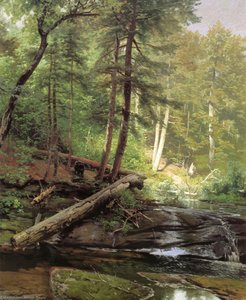
Portrait of Herman Herzog

The 96 Most Famous Herman Herzog Paintings, a Gallery Selection

Updated November 2026 · ranked by our popularity score (searches, visits and orders for each work) · 97 works by Herman Herzog in our catalogue

In short

Of all the originals Herman Herzog left, the most famous is Nature's Majesty (1872). Close behind it come West Coast Florida (also known as Landscape) (1880) and Norwegian Landscape (1857). Our catalog holds 97 works by Herman Herzog; the gallery has kept the 96 the world admires most, each shown with its date, its museum and its story.

1832 – 1932, Bremen Romanticism Most works: Metropolitan Museum of Art

Herman Herzog's top 10 paintings: the gallery's choice

1
Nature's Majesty (1872) by Herman Herzog

Nature's Majesty

1872 · Oil

The canvas presents a mountain range characterized by heavy snow accumulation on its upper elevations. Above these peaks, a dense layer of clouds occupies the sky, creating a muted light across the scene. In the foreground and middle ground, a body of water meets a shoreline, where several boats are positioned. Some vessels sit near the edge of the water, while others are situated further out toward the center of…

2
West Coast Florida (also known as Landscape) (1880) by Herman Herzog

West Coast Florida (also known as Landscape)

1880 · Oil On Canvas

The scene captures a quiet moment on the West Coast of Florida, where the sky meets the ocean under a heavy, cloud-filled expanse. Two figures walk in the foreground, their presence grounding the vastness of the coastal view. Scattered throughout the composition, smaller figures suggest a shared experience of the landscape, marking the location as a place of public repose. The light of the setting sun filters through the atmosphere,…

3
Norwegian Landscape (1857) by Herman Herzog

Norwegian Landscape

1857 · Oil On Canvas

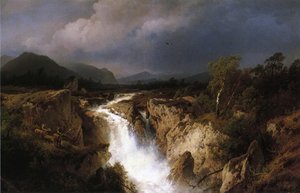
The oil on canvas depicts a mountainous river valley where a central waterfall descends through the middle ground. This vertical movement of water cuts through the horizontal lines of the river and the surrounding mountain ridges. A small village is situated among the trees, positioned near the base of the cliffs. Figures are placed within the landscape, providing a sense of scale against the geological formations. The lighting is diffused,…

4
Mountain Landscape with Watermill (1863) by Herman Herzog

Mountain Landscape with Watermill

1863 · Oil On Canvas

Mountain Landscape with Watermill is a work by Herman Herzog. Painted about 1863, this oil on canvas captures a picturesque landscape. The scene focuses on the raw power and beauty of nature through a dramatic mountain setting. A rushing waterfall dominates the view, its white foam cutting through the cool tones of the landscape.
5
Fishermans Village on an Alpine Lake (1859) by Herman Herzog

Fishermans Village on an Alpine Lake

1859 · Oil On Canvas

In Fishermans Village on an Alpine Lake, we encounter a quiet moment from the career of Herman Herzog. Painted about 1859, this work captures a picturesque fisherman's village settled along the edge of an alpine lake. The scene is framed by the presence of towering mountains that dominate the background, establishing a sense of scale that places human habitation within a much larger, more imposing natural context. The subject matter…

6
Fishing Village (1862) by Herman Herzog

Fishing Village

1862 · Oil On Canvas

In Fishing Village, Herman Herzog presents a quiet moment along the edge of a large lake or fjord. Painted about 1862, the scene captures a settlement nestled closely against the water's edge. Small wooden structures, perhaps used as boathouses or shelters for fishermen, sit near the shoreline. Several boats are scattered along the coast, some containing figures that suggest the steady rhythm of daily life in such a remote location.…

7
Moonlit Fishing Scene (1878) by Herman Herzog

Moonlit Fishing Scene

1878 · Oil On Canvas

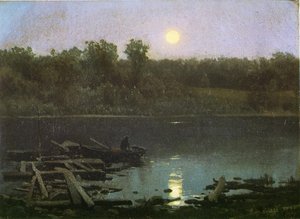
In this 1878 work, we find ourselves drawn to a nocturnal coastal scene, perhaps an estuary or a calm stretch of shoreline. The composition is anchored by a large, luminous moon positioned in the upper center, which casts a shimmering, fractured reflection across the dark water. Several small boats are scattered throughout the expanse, their forms simplified against the vastness of the sky and sea. Figures are visible within these…

8
Mountain Falls by the Mill (1878) by Herman Herzog

Mountain Falls by the Mill

1878 · Oil On Canvas

Mountain Falls by the Mill is a painting by Herman Herzog, created in 1878. This work captures a specific moment of quietude within a rugged landscape, focusing on the inherent beauty of the natural world. The scene centers on a cascading waterfall, a powerful element of movement that defines the character of the terrain.

9
Fishing in an Alpine Lake (1873) by Herman Herzog

Fishing in an Alpine Lake

1873 · Oil On Canvas

A serene alpine lake occupies the center of this 1873 landscape, its surface reflecting a soft, diffused light that suggests an overcast morning. Along the shoreline, small figures engage in fishing, their presence providing a sense of scale against the dramatic rise of the background mountains. The composition relies on horizontal planes—the water's edge, the mountain ranges, and the sky—to create a sense of expansive stillness. A small wooden structure…

10
Niagara from the Museum, the Brink of the Horseshoe (1872) by Herman Herzog

Niagara from the Museum, the Brink of the Horseshoe

1872 · Oil On Canvas

The scene unfolds at the edge of a great wonder in "Niagara from the Museum, the Brink of the Horseshoe" by Herman Herzog. Created about 1872, this work captures the raw, natural beauty of Niagara Falls and the sprawling landscape that surrounds it. The viewer finds themselves positioned near the museum, looking out toward the immense power of the water as it meets the horizon. It is a moment of…

The Herman Herzog selection continues, 11 to 96

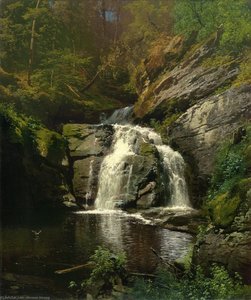
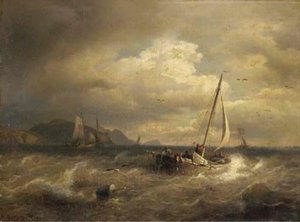
11Buck Hills Falls (Pennsylvania) by Herman HerzogBuck Hills Falls (Pennsylvania) 12Edge of the Everglades by Herman HerzogEdge of the Everglades 13Waterfall by Herman HerzogWaterfall 14The Old Water Mill (1871) by Herman HerzogThe Old Water Mill1871 15Mountain Lake Camp (1868) by Herman HerzogMountain Lake Camp1868 16Yosemite Valley - A Family of Deer (1874) by Herman HerzogYosemite Valley - A Family of Deer1874 17Elk in a Stormy Landscape (1878) by Herman HerzogElk in a Stormy Landscape1878 18Deer in the Wild Woods (1875) by Herman HerzogDeer in the Wild Woods1875 19The Horse Show (1872) by Herman HerzogThe Horse Show1872 20Landscape with Waterfall (1872) by Herman HerzogLandscape with Waterfall1872 21Nevada Fall, Yosemite (1875) by Herman HerzogNevada Fall, Yosemite1875 22The Old Watermill (1873) by Herman HerzogThe Old Watermill1873 23Mountain Landscape and Waterfall (1879) by Herman HerzogMountain Landscape and Waterfall1879 24Landscape with Lake and Mountains (1890) by Herman HerzogLandscape with Lake and Mountains1890 25Evening on the Susquehanna (1890) by Herman HerzogEvening on the Susquehanna1890 26On the Chesapeake, Oxford by Herman HerzogOn the Chesapeake, Oxford 27Fishing boats coming ashore by Herman HerzogFishing boats coming ashore 28Bears by Stream by Herman HerzogBears by Stream 29Harvest Scene in Flatbrookville by Herman HerzogHarvest Scene in Flatbrookville 30Winter Scene in the Alps by Herman HerzogWinter Scene in the Alps 31Fishermen by the shore of a stormy sea by Herman HerzogFishermen by the shore of a stormy sea 32Fishing boats off the coast by Herman HerzogFishing boats off the coast 33Sagne Fjord by Herman HerzogSagne Fjord 34Campfire in Moonlight by Herman HerzogCampfire in Moonlight 35Alpine Lake Scene by Herman HerzogAlpine Lake Scene 36Fishing for Supper by Herman HerzogFishing for Supper 37Fly Fishing by Herman HerzogFly Fishing 38By the Banks by Herman HerzogBy the Banks 39In the Alps by Herman HerzogIn the Alps 40The Catch by Herman HerzogThe Catch 41Landscape with Deer and Ducks by Herman HerzogLandscape with Deer and Ducks 42Sunset on the Coast of Maine by Herman HerzogSunset on the Coast of Maine 43The Waterfall by Herman HerzogThe Waterfall 44Gathering the Rye by Herman HerzogGathering the Rye 45Relaxation by Herman HerzogRelaxation 46Canal in Venice by Herman HerzogCanal in Venice 47Pennsylvania Scenery by Herman HerzogPennsylvania Scenery 48Cascade with a Fisherman by Herman HerzogCascade with a Fisherman 49Returning Home by Herman HerzogReturning Home 50Daybreak on a Snowy Morning by Herman HerzogDaybreak on a Snowy Morning 51St. John's River, Florida by Herman HerzogSt. John's River, Florida 52Sunset near Low Creek, Florida by Herman HerzogSunset near Low Creek, Florida 53Moss-Covered Log by Herman HerzogMoss-Covered LogMetropolitan Museum of Art 54Elk in a Snowy Landscape by Herman HerzogElk in a Snowy Landscape 55Elk by a Cascading River by Herman HerzogElk by a Cascading River 56Florida Landscape by Herman HerzogFlorida Landscape 57Cattle by a watermill by Herman HerzogCattle by a watermill 58Road by the Farm by Herman HerzogRoad by the Farm 59On a Glacier Lake by Herman HerzogOn a Glacier Lake 60Landscape with Watermill by Herman HerzogLandscape with Watermill 61Coast at Stonington, Maine by Herman HerzogCoast at Stonington, Maine 62An American schooner by Herman HerzogAn American schooner 63Landscape with Windmill by Herman HerzogLandscape with Windmill 64Fisherman by a Waterfall by Herman HerzogFisherman by a Waterfall 65Boating on a Cloudy Day by Herman HerzogBoating on a Cloudy Day 66Maine coast near bar harbor by Herman HerzogMaine coast near bar harbor 67The Old Water Mill 1 by Herman HerzogThe Old Water Mill 1 68Florida Landscape 1 by Herman HerzogFlorida Landscape 1 69Niagara Falls Nocturne by Herman HerzogNiagara Falls Nocturne 70Old Mexican Quarters by Herman HerzogOld Mexican Quarters 71Elk in the Moonlight by Herman HerzogElk in the Moonlight 72Western Waterfall by Herman HerzogWestern Waterfall 73Mill on a Torrent by Herman HerzogMill on a TorrentSmithsonian American Art Museum 74Western Landscape by Herman HerzogWestern Landscape 75n Fishing Scenes Pic by Herman Herzogn Fishing Scenes Pic 76Fishing Scenes No. 2 by Herman HerzogFishing Scenes No. 2 77Forest Brook by Herman HerzogForest Brook 78Seal Rocks by Herman HerzogSeal Rocks 79Florida Sunset by Herman HerzogFlorida Sunset 80A Country Home by Herman HerzogA Country Home 81Waterfall in the Mountains by Herman HerzogWaterfall in the Mountains 82Saddle Rock Lighthouse, Maine by Herman HerzogSaddle Rock Lighthouse, Maine 83Monterey Pines with Bears by Herman HerzogMonterey Pines with Bears 84Logging in the Mountains by Herman HerzogLogging in the Mountains 85Campfire by Herman HerzogCampfire 86Florida Live Oaks with Deer by Herman HerzogFlorida Live Oaks with Deer 87In the Yard by Herman HerzogIn the Yard 88A Mountain Torrrent by Herman HerzogA Mountain Torrrent 89Woodland Pool, Newry, Maine by Herman HerzogWoodland Pool, Newry, Maine 90Girl with Geese by Herman HerzogGirl with Geese 91In the Woods by Herman HerzogIn the Woods 92Landscape with Prancing Deer by Herman HerzogLandscape with Prancing Deer 93Western Landscape by Herman HerzogWestern Landscape 94Season's Greetings by Herman HerzogSeason's Greetings 95Summer by Herman HerzogSummer 96A Bear Approaching a Forest Stream by Herman HerzogA Bear Approaching a Forest Stream

Herman Herzog's famous paintings, period by period

The subjects that held Herman Herzog's eye

The four subjects that come back most often in these originals, each with its finest example.

The museums that keep Herman Herzog's originals

The 2 museums that hold the most of the paintings on this page.

Museum City Works by Herman Herzog Paintings from this list
Metropolitan Museum of Art, New YorkMetropolitan Museum of Art New York 1 Moss-Covered Log
Smithsonian American Art Museum, Washington, D.C.Smithsonian American Art Museum Washington, D.C. 1 Mill on a Torrent

Herman Herzog decade by decade: the original that defines each

Works per decade

Pick a decade to see the original that defines it.

Collectors' questions about Herman Herzog's paintings

Which work is Herman Herzog most famous for?Reveal the answer

Nature's Majesty (1872). West Coast Florida (also known as Landscape) (1880) and Norwegian Landscape (1857) come next.

What age was Herman Herzog when Nature's Majesty was made?Reveal the answer

40 years old: Nature's Majesty dates from 1872, and Herman Herzog was born in 1832.

What are the ten most famous Herman Herzog paintings?Reveal the answer

Nature's Majesty, West Coast Florida (also known as Landscape), Norwegian Landscape, Mountain Landscape with Watermill, Fishermans Village on an Alpine Lake, Fishing Village, Moonlit Fishing Scene, Mountain Falls by the Mill, Fishing in an Alpine Lake and Niagara from the Museum, the Brink of the Horseshoe. The ranking above gives each one's year and museum.

How many paintings did Herman Herzog leave?Reveal the answer

Our catalog holds 97 works by Herman Herzog, dated from 1857 to 1890.

In which museums do Herman Herzog's masterpieces hang?Reveal the answer

Mostly in Metropolitan Museum of Art (New York) and Smithsonian American Art Museum (Washington, D.C.). The museum table above lists them all.

In which years did Herman Herzog paint the most famous works?Reveal the answer

In 1870s: 14 of the 96 works on this page were made then, Nature's Majesty among them.

What are the first and the last famous originals of Herman Herzog?Reveal the answer

On this page, the earliest is Norwegian Landscape (1857) and the latest Landscape with Lake and Mountains (1890).

Which subjects did Herman Herzog choose most often?Reveal the answer

Landscape (15), Usa (12) and Mountains (10), across the 96 works on this page.

Which technique did Herman Herzog use most?Reveal the answer

Oil On Canvas, for 9 of the 96 works on this page.

To which art movement does Herman Herzog belong?Reveal the answer

Romanticism and Realism, judging by the originals on this page.

Herman Herzog: life and work

Herman Herzog: A Pioneer of American Landscape Painting

Hermann Ottomar Herzog (1832-1932) stands as a quietly significant figure in the history of American art, often overshadowed by his more flamboyant Hudson River School contemporaries but possessing a unique and compelling vision. Born in Bremen, Germany, into a family with strong artistic leanings—his father was a renowned watercolorist—Herzog’s journey led him from the rigorous training of the Düsseldorf Academy to a prolific career spanning Europe and ultimately establishing himself as a respected landscape painter in America. His work represents a fascinating synthesis of German Romanticism, American realism, and an enduring fascination with the natural world, particularly the wild beauty of the American West and the subtropical landscapes of Florida.

Herzog’s early artistic development was profoundly shaped by the Düsseldorf School, renowned for its emphasis on meticulous observation, tonal modeling, and a deep understanding of light and shadow. He studied under masters like J.W. Schirmer and Rudolph Wiegmann, absorbing their techniques while simultaneously cultivating an independent spirit. A pivotal experience occurred in 1855 when he traveled to Norway, a journey that ignited within him a lifelong appreciation for the sublime power of nature—a theme that would permeate his work throughout his career. This encounter instilled a desire to capture not just the outward appearance of landscapes but also their emotional resonance and spiritual quality.

Early Career and European Travels

Following his training in Düsseldorf, Herzog embarked on an extensive series of travels across Europe, honing his skills and expanding his artistic horizons. He exhibited his work with considerable success in Paris, Liège, and Brussels, garnering critical acclaim for his atmospheric landscapes and masterful use of color. These early European experiences provided him with a rich palette of influences—from the dramatic mountainscapes of Switzerland to the vibrant hues of Italy—which he skillfully integrated into his own distinctive style. Notably, Herzog’s time in Norway proved particularly formative, shaping his approach to depicting vast, open spaces and conveying a sense of awe and wonder.

In 1871, seeking new opportunities and perhaps escaping the political turmoil of Germany, Herzog immigrated to the United States, declaring his intention for naturalization in Philadelphia. This marked a significant turning point in his career. He quickly established himself as a respected artist, exhibiting at prestigious institutions like the National Academy of Design and the Pennsylvania Academy of Fine Arts. His early American works often reflected the landscapes he had encountered during his European travels, but they were increasingly informed by the unique character of the United States—the rugged beauty of the Appalachian Mountains, the vastness of the plains, and the dramatic vistas of the West.

The Yosemite Years and Florida’s Influence

Herzog's reputation soared in 1876 with his entry “Sentinel Rock, Yosemite” at the Philadelphia Centennial Exhibition. This monumental painting—a testament to his technical skill and artistic vision—earned him an award and cemented his place as a leading landscape painter of his time. The Yosemite trip proved transformative, inspiring a series of paintings that captured the grandeur and majesty of this iconic American wilderness. Herzog’s depictions of Yosemite are notable for their realism and attention to detail, yet they also convey a sense of reverence and respect for the natural world.

Following his success in California, Herzog continued to explore diverse landscapes across the United States and Mexico. However, it was his prolonged sojourns in Florida that profoundly shaped his artistic output during the late 19th and early 20th centuries. He spent many winters in Gainesville, captivated by the state’s subtropical wilderness—the palmetto hammocks, cypress swamps, and vibrant flora and fauna. Over three hundred paintings depicting Florida landscapes bear witness to his deep appreciation for this unique environment. His Florida works are characterized by a rich palette of greens, blues, and browns, as well as a masterful depiction of light and shadow—qualities that set them apart from the more dramatic styles favored by some of his contemporaries.

Style and Legacy

Herzog’s artistic style can be described as a synthesis of Düsseldorf School realism and Hudson River School romanticism. Like his Düsseldorf mentors, he possessed an exceptional ability to render light and shadow with meticulous detail, creating paintings that are both technically proficient and emotionally resonant. However, unlike the more dramatic compositions favored by artists like Church and Bierstadt, Herzog’s landscapes tend to be quieter and more contemplative—reflecting his own reserved personality and his deep appreciation for the subtle beauty of nature. His signature was almost always “H. Herzog,” a testament to his consistent artistic identity.

Despite often being overlooked in mainstream art historical narratives, Hermann Herzog's work deserves recognition as a significant contribution to American landscape painting. His meticulous observation, masterful technique, and profound connection with the natural world continue to resonate with viewers today. The Brandywine River Museum held a major exhibition of his work in 1992, and his paintings are now housed in numerous museums and private collections across the United States and Europe. Recent scholarship, as evidenced by Edward Pollack and Deborah Pollack’s 2023 biography, *Hermann Herzog: His Remarkable Life, Unrivaled Florida Work, and Rightful Place in American Art History*, is finally bringing this talented artist to the forefront of art historical discourse.