


1


Updated November 2026 · ranked by our popularity score (searches, visits and orders for each work) · 38 works by Edward Charles Williams in our catalogue
In short
To the gallery's eye, Edward Charles Williams's most famous painting is A Gypsy Encampment. A Tranquil Backwater and The Encampment complete the trio every eye recognises. Of the 38 works by Edward Charles Williams in our catalog, the gallery presents the 37 most famous below, each original with its year, its museum and what makes it unique.


Charles Williams (1942-1998) was born in Blue Diamond, Kentucky, a place he described as a “little old country hick town in coal mining territory, eight miles from Hazard, Kentucky, back up in the hollow where the blacks lived.” As a child, Williams taught himself to draw by copying comic book figures like Superman, Dick Tracy, and Captain Marvel. Shown here is a of an early issue of Williams’ first original…


 Figures On A Path In A Wooded Landscape
12
 Landscape -
13
 Landscape -
14
 A Gypsy Encampment In A Wooded Landscape
15
 Old mills on the thames
16
 The Approaching Storm
17
 A Country LaneAnglesey Abbey
18
 Figures On The Bank Of A River With A Cottage Beyond
19
 Barges on the thames at dusk, with windsor castle beyond
20
 Going To Market, View Near West Broughton
21
 The Venerable Thomas Thorp
22
 Figures Beside A Pool Before A Gate, A Cottage Beyond; And Another Similar
23
 Cattle Watering At The Stepping Stones
24
 The Meeting; And The Path From The Village Church, The Isle Of Wight
25
 The swan inn, bossington, somerset
26
 Landscape With A Lane And Figures
27
 Landscape -
28
 A Roadside Inn At Rushington, Sussex
29
 Figures Before A Cottage In A Wooded Landscape
30
 Figures in a punt with sheep watering in a wooded landscape
31
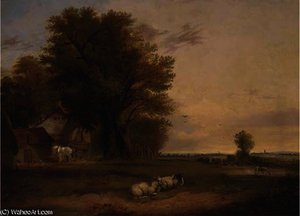 Sheep and cattle in a summer landscape
32
 Figures before a cottage in a wooded river landscape
33
 A Figure On A Track Before A Cottage
34
 Basket Of Roses With Fuschia
35
 Distant View Of Salisbury Cathedral, Wiltshire
36
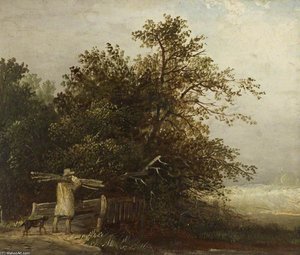 A Man Crossing A Bridge Carrying A Bundle Of SticksAnglesey Abbey
37
 Landscape With Sheep On A Road
The four subjects that come back most often in these originals, each with its finest example.
The 2 museums that hold the most of the paintings on this page.
| Museum | City | Works by Edward Charles Williams | Paintings from this list |
|---|---|---|---|
 Anglesey Abbey |
3 | Mother And Child On A Track By A Coppice, A Country Lane, A Man Crossing A Bridge Carrying A Bundle Of Sticks | |
 Atlanta Contemporary |
Atlanta | 1 | Spectacular Captain Soul: CAPTIVES OF THE COSMIC MAYFLOWER, Chapter 1 |
A Gypsy Encampment. A Tranquil Backwater and The Encampment come next.
A Gypsy Encampment, A Tranquil Backwater, The Encampment, Landscape -, Mother And Child On A Track By A Coppice, Spectacular Captain Soul: CAPTIVES OF THE COSMIC MAYFLOWER, Chapter 1, Noon Day Rest, Figures By A Cottage, Landscape and A Village In The New Forest. The ranking above gives each one's year and museum.
Our catalog holds 38 works by Edward Charles Williams.
Mostly in Anglesey Abbey and Atlanta Contemporary (Atlanta). The museum table above lists them all.
Landscape (12), Cottages (6) and Wood (5), across the 37 works on this page.
Mother And Child On A Track By A Coppice, A Country Lane and A Man Crossing A Bridge Carrying A Bundle Of Sticks: the Anglesey Abbey holds 3 of the works on this page.

