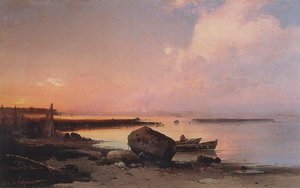
The Rooks Have Arrived
The painting titled The Rooks Have Arrived was created in 1871. It is a work by the Russian artist Alexei Savrasov. The artist was born in Moscow, Russia, in 1830 and remained in that city until his death in 1897.
In short
Of all the originals Alexei Savrasov left, the most famous is The Rooks Have Arrived (1871), in the collection of the Tretyakov Gallery, Moscow. Close behind it come Rooks come flying (1871) and Winter Night (1869). Our catalog holds 281 works by Alexei Savrasov; the gallery has kept the 100 the world admires most, each shown with its date, its museum and its story.
The painting titled The Rooks Have Arrived was created in 1871. It is a work by the Russian artist Alexei Savrasov. The artist was born in Moscow, Russia, in 1830 and remained in that city until his death in 1897.
To gaze upon Alexei Kondratyevich Savrasov's "Rooks Come Flying" is to step directly into a moment suspended between the quiet hush of deep winter and the sudden, vibrant burst of life. This masterpiece, painted in 1871, is far more than a mere depiction of a snowy landscape; it is an emotional resonance captured on oil canvas. Savrasov, celebrated as a pioneer of the lyrical landscape, possessed a rare gift for…
A small house sits nestled among trees, its form partially obscured by the surrounding landscape. The scene is set during a winter night, where a soft, orange tint warms the sky, providing a subtle contrast to the cold, snow-covered terrain. A river flows through the background, its surface reflecting the muted light of the moon. Near the center, a horse and two figures—one standing to the left and another further…
To gaze upon Alexei Kondratyevich Savrasov's View of the Kremlin from the Krimsky Bridge in Inclement Weather is to step directly into a moment suspended between grandeur and quiet contemplation. This 1851 masterpiece does more than merely depict a vista; it captures the very breath of a Russian day when nature’s drama—the interplay of light, cloud, and enduring stone—becomes the central character. Savrasov, who elevated landscape painting to an art…
The painting presents a landscape centered on a single tree with sparse branches positioned in the foreground. This tree grows from a rugged, rocky terrain. In the middle distance, two figures stand near a building, their presence suggesting a quiet human activity amidst the terrain. The background is composed of a sky filled with dense cloud formations. Several birds are scattered throughout the composition, appearing in flight or resting within…
The painting titled Sea is a work by the Russian artist Alexei Savrasov. Created in 1860, this piece reflects the artist's early development during a period when he was refining his unique approach to the natural world. Savrasov, who was born in Moscow, Russia, in 1830, spent much of his life capturing the specific atmosphere of the landscapes he encountered. He remained in Moscow until his death in 1897.
In this work, titled After the storm, Alexei Savrasov presents a quiet moment of transition within the natural world. Painted about 1870, the scene captures the immediate aftermath of a tempest, focusing on the stillness that settles over the land once the wind has subsided. It is a study of the atmosphere that follows a period of turbulence, where the elements find a temporary, fragile equilibrium.
The painting presents a wide view of a cityscape situated beside a large body of water. In the foreground, the water occupies a significant portion of the lower frame, its surface reflecting the light from a sky filled with scattered clouds. Above the urban horizon, the clouds create a heavy, dramatic atmosphere. In the distance, the silhouettes of various buildings rise, suggesting a dense and active urban environment. Small figures…
The sun hangs low in the sky, casting a warm, golden glow over the scene in Summer landscape with windmills. Painted by Alexei Savrasov in 1859, this work invites the viewer into a quiet moment of the Russian countryside. The landscape genre finds its expression here through a serene depiction of nature, where the air feels heavy with the stillness of a summer afternoon. One can almost feel the gentle…
The ocean churns with a violent, restless energy, its dark waters rising hungrily toward the mast of a struggling vessel. Every wave seems to possess a heavy, liquid weight, threatening to pull the wooden hull into the depths. Above the chaos, birds scatter through the salt-heavy air, their frantic flight mirroring the desperation of the scene below. A smaller boat drifts in the distance, a lonely silhouette against the turbulent…
The four subjects that come back most often in these originals, each with its finest example.
The 2 museums that hold the most of the paintings on this page.
| Museum | City | Works by Alexei Savrasov | Paintings from this list |
|---|---|---|---|
| Moscow | 16 | The Rooks Have Arrived, Rooks come flying, View of the Kremlin from the Krimsky Bridge in Inclement Weather | |
| Basel | 1 | Landscape with hut |
Pick a decade to see the original that defines it.
To gaze upon Alexei Kondratyevich Savrasov's View of the Kremlin from the Krimsky Bridge in Inclement Weather is to step directly into a moment suspended between grandeur and quiet contemplation. This 1851 masterpiece does more than merely depict a vista; it captures the very breath of a Russian day when nature’s drama—the interplay of light, cloud, and enduring stone—becomes the central character. Savrasov, who elevated landscape painting to an art…
A small house sits nestled among trees, its form partially obscured by the surrounding landscape. The scene is set during a winter night, where a soft, orange tint warms the sky, providing a subtle contrast to the cold, snow-covered terrain. A river flows through the background, its surface reflecting the muted light of the moon. Near the center, a horse and two figures—one standing to the left and another further…
The painting titled The Rooks Have Arrived was created in 1871. It is a work by the Russian artist Alexei Savrasov. The artist was born in Moscow, Russia, in 1830 and remained in that city until his death in 1897.
Early spring. Backwoods is a landscape painting by the Russian artist Alexei Savrasov. The work was executed in 1884. This piece captures a specific seasonal transition within a forest setting, focusing on the period when winter begins to recede.
A serene and melancholic landscape unfolds across a quiet stretch of the Volga River. The scene is dominated by muted earth tones, suggesting the damp, heavy atmosphere of autumn or winter. A small, dilapidated wooden structure sits near the riverbank, perhaps a fisherman’s hut or an abandoned dwelling, while a thin plume of smoke rises from a nearby fire. In the foreground, a few figures provide a sense of scale…
The Rooks Have Arrived (1871), Tretyakov Gallery, Moscow. Rooks come flying (1871) and Winter Night (1869) come next.
41 years old: The Rooks Have Arrived dates from 1871, and Alexei Savrasov was born in 1830.
The Rooks Have Arrived, Rooks come flying, Winter Night, View of the Kremlin from the Krimsky Bridge in Inclement Weather, Landscape with pine, Sea, After the storm, View of Moscow from Sparrow Hills, Summer landscape with windmills and The death of the ship at sea. The ranking above gives each one's year and museum.
Our catalog holds 281 works by Alexei Savrasov, dated from 1849 to 1893.
Mostly in Tretyakov Gallery (Moscow) and Kunstmuseum Basel (Basel). The museum table above lists them all.
In 1850s: 45 of the 100 works on this page were made then, View of the Kremlin from the Krimsky Bridge in Inclement Weather among them.
On this page, the earliest is Ukrainian landscape (1849) and the latest Spassky backwater on the Volga (1893).
Forests (34), Landscape (24) and Sky (16), across the 100 works on this page.
Oil On Canvas, for 18 of the 100 works on this page.
Realism, judging by the originals on this page.
The Rooks Have Arrived, Rooks come flying and View of the Kremlin from the Krimsky Bridge in Inclement Weather: the Tretyakov Gallery, Moscow holds 10 of the works on this page.
In the vast, sweeping expanse of nineteenth-century Russian art, few names evoke the quiet, melancholic beauty of the natural world as poignantly as Alexei Kondratyevich Savrasov. Born in Moscow in 1830, Savrasov did not merely paint landscapes; he captured the very breath of the Russian earth. His journey began within the hallowed halls of the Moscow School of Painting, Sculpture, and Architecture, where he studied under the guidance of masters such as Vasily Petrovich Verkhoff. It was during these formative years that Savrasov developed a profound sensitivity to his surroundings, learning to look past the surface of the terrain to find the emotional pulse beneath the frost and the foliage. His early training instilled in him a rigorous commitment to Realism, yet his spirit remained deeply tethered to the lyrical nuances of Romanticism, allowing him to transform topographical observations into profound psychological experiences.
The evolution of Savrasov’s style is most brilliantly illuminated by his ability to find grandeur in the humble and the overlooked. While many of his contemporaries sought the dramatic peaks of distant mountains, Savrasov turned his gaze toward the intimate, often somber realities of the Russian countryside. His breakthrough arrived with the monumental “Winter Landscape” in 1865, a work that would redefine the genre. In this masterpiece, he moved away from mere photographic accuracy to embrace an atmospheric perspective, utilizing muted palettes and subtle gradations of gray, white, and brown to evoke the biting chill and the heavy silence of a snow-covered world. This shift toward mood over literal detail established him as a pioneer of lyrical landscape art, proving that a painting could serve as a mirror to the human soul.
Savrasov’s technical prowess lay in his masterful command of light and tonal variation. He possessed an uncanny ability to render the dampness of melting snow, the heavy humidity following a storm, and the soft, diffused light of a spring afternoon. His works often feature a delicate interplay of textures—the rough bark of a birch tree against the smooth, glassy surface of a frozen river. This is perhaps most famously realized in his iconic “The Rooks Have Returned” (1871). In this painting, the sight of birds returning to a snow-dusted grove serves as a powerful symbol of hope and the cyclical nature of life, embodying a uniquely Russian brand of seasonal melancholy that resonates with viewers to this day.
Beyond the winter scenes, his repertoire included works of immense atmospheric depth, such as:
Through these works, Savrasov achieved a sense of communion between the observer and the observed. He did not treat nature as a backdrop for human drama, but as the protagonist itself. His paintings invite a state of contemplation and solitude, urging the viewer to find beauty in the austere, the quiet, and the transient. By elevating the Russian landscape to a subject of high emotional significance, Savrasov left an indelible mark on art history, ensuring that his vision of the soulful, breathing earth would endure long after his passing in 1897.