


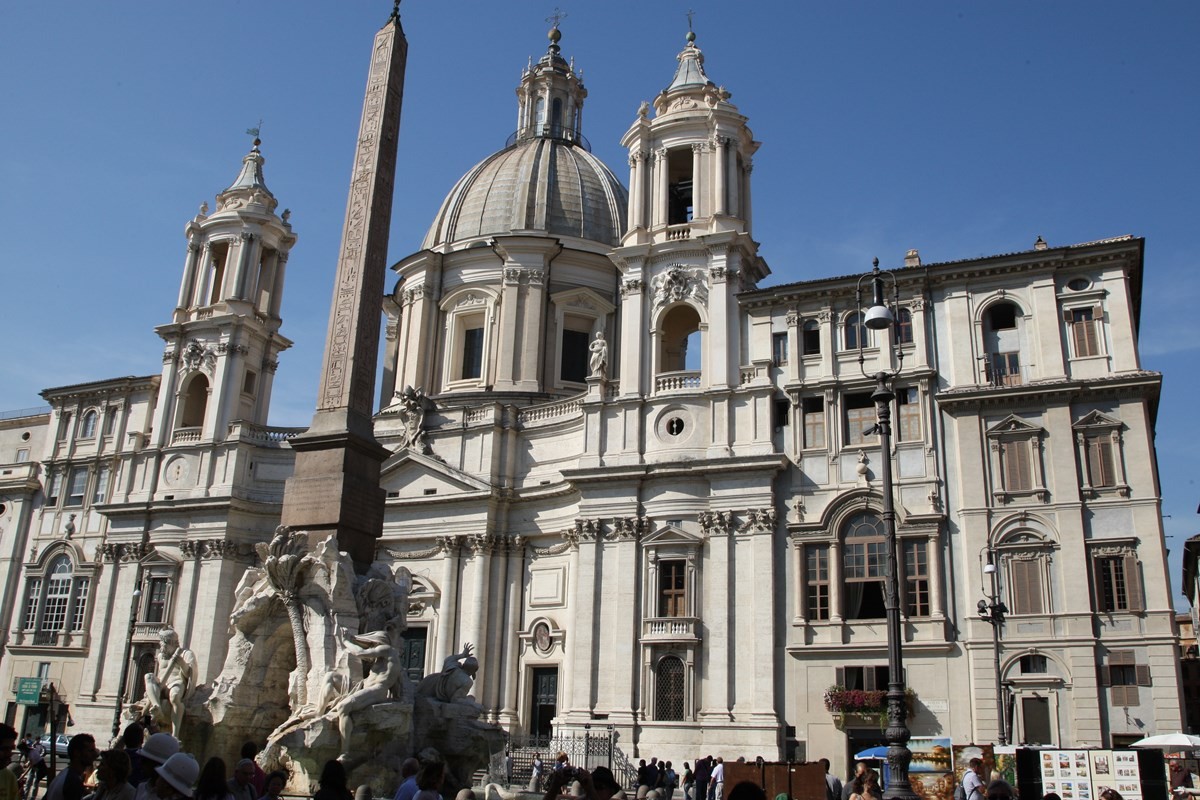
A Testament to Faith and Form: Sant'Agnese in Agone
Sant’Agnese in Agone, rising majestically on Rome’s Piazza Navona, is not simply a church; it’s a layered narrative etched in stone, fresco, and the very spirit of the Baroque. To stand before its façade is to be immediately enveloped by a sense of dramatic tension – a deliberate interplay between concave and convex forms designed to captivate and draw the eye into a world where earthly grandeur meets divine aspiration. The church's story begins not with its construction in the 17th century, but far earlier, rooted in the ancient Stadium of Domitian, a site steeped in Roman history and ultimately consecrated by the martyrdom of Saint Agnes herself.
The origins of this sacred space are powerfully evocative. In the early fourth century AD, Agnes, a young woman renowned for her unwavering faith, was executed within the stadium’s walls. Centuries later, Pope Innocent X Pamphilj envisioned a church that would not only honor her memory but also serve as a potent symbol of papal authority and Catholic renewal. He commissioned Girolamo Rainaldi to begin construction, initiating a project that would become a collaborative masterpiece, ultimately drawing in the genius of Carlo Rainaldi and, most significantly, Francesco Borromini.
Borromini’s Revolutionary Vision
While Carlo Rainaldi laid the groundwork with a façade cleverly designed to complement the piazza's curvature, it was Borromini who truly transformed Sant’Agnese into an icon of Baroque architecture. His dome is nothing short of breathtaking – a daring feat of structural engineering and aesthetic innovation. Eight columns radiate outwards from the central axis, creating a dynamic interplay of light and shadow that seems to defy gravity. This wasn't merely about building a beautiful structure; it was about manipulating space itself, elevating the interior to dizzying heights and evoking a sense of divine perfection.
Borromini’s commitment to pushing artistic boundaries is palpable in every detail. The complex geometry of the dome, meticulously calculated for both stability and visual impact, reflects his profound understanding of mathematics and optics. He sought not just symmetry but a dynamic equilibrium, a harmonious tension that draws the viewer upwards towards the heavens. This innovative approach established Sant’Agnese as a cornerstone of Baroque architectural excellence, influencing generations of architects to come.
An Interior Ablaze with Artistic Treasures
Stepping inside Sant'Agnese is akin to entering a celestial realm. The church’s interior is adorned with magnificent frescoes by Ciro Ferri, most notably the *Apotheosis of Saint Agnes*. These vibrant canvases depict the saint’s ascension to heaven amidst a swirling vortex of angels and saints, conveying a profound sense of spirituality and artistic virtuosity. Ferri's mastery of color and composition creates a dramatic spectacle that immerses the viewer in the theological significance of Agnes’ martyrdom and her triumphant glorification.
Complementing Ferri’s frescoes are sculptures by Bernini and other Baroque masters, enhancing the church’s aesthetic appeal and commemorating Saint Agnes’ sanctity. The altar itself is a testament to the period's artistic fervor, adorned with intricate carvings and precious materials. Below the main floor lies the crypt, a subterranean chapel housing the relics of Saint Agnes – a contemplative space for reflection and prayer, preserving the saint’s physical remains as a tangible symbol of faith.
A Living Legacy: Concerts and Continued Restoration
Sant'Agnese in Agone is not merely a relic of the past; it continues to thrive as a vibrant cultural center. Today, the Borromini Sacristy – renowned for its exceptional acoustics – hosts classical concerts that celebrate the church’s artistic legacy. These performances offer visitors an immersive experience, allowing them to connect with the space on a deeply emotional level.
Ongoing restoration efforts ensure that this Baroque masterpiece remains accessible to future generations, safeguarding its splendor and preserving its role as a symbol of Rome’s enduring cultural heritage. Visiting Sant'Agnese is not simply admiring art; it’s embarking on a journey through Roman history – a pilgrimage into the heart of Baroque grandeur, where faith, form, and artistic innovation converge in breathtaking harmony.


