

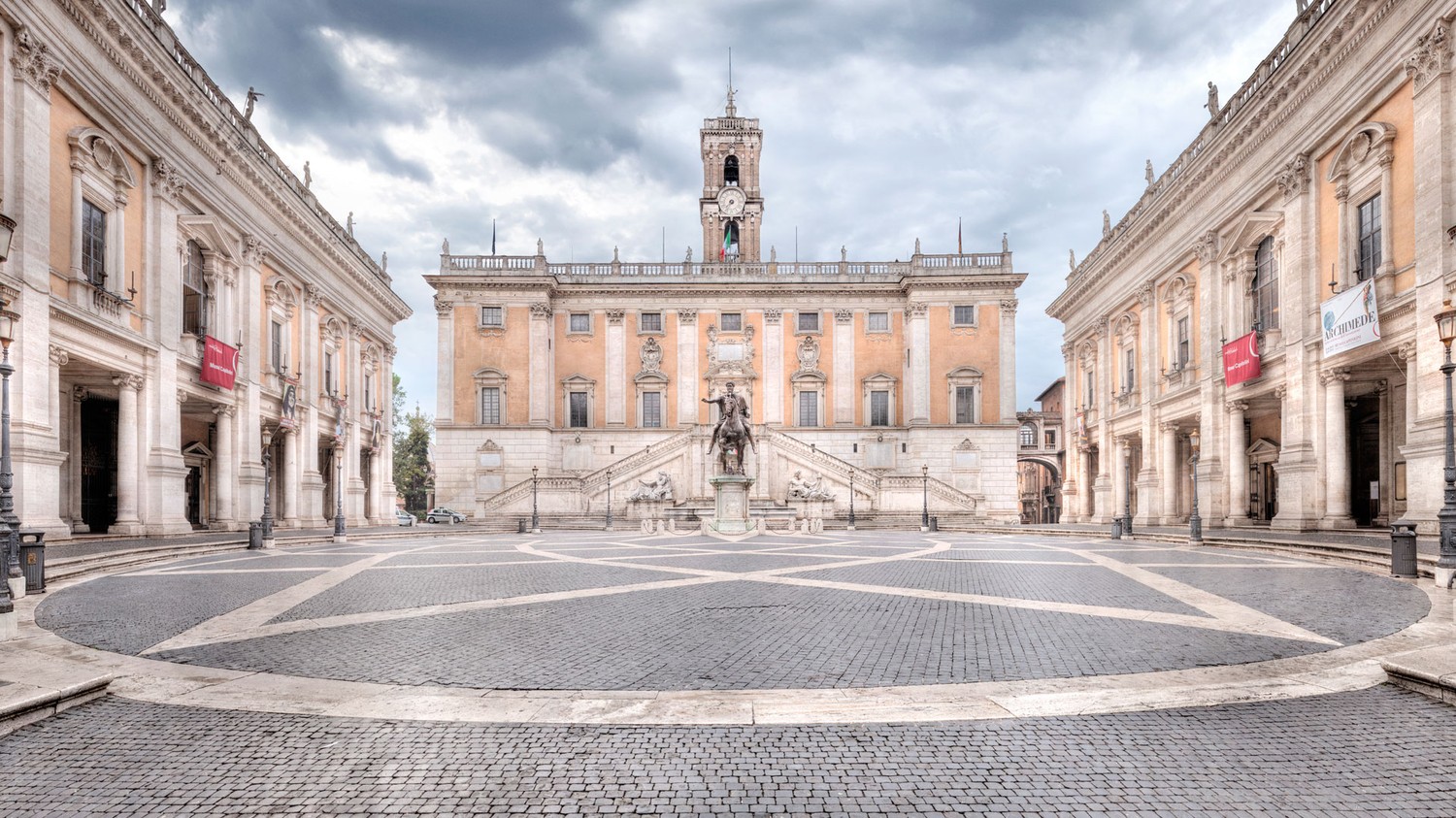
The History of Piazza Campidoglio
Perched upon the summit of the ancient Capitoline Hill in Rome, Italy, the Piazza Campidoglio occupies a significant position between the Roman Forum and the Campus Martius. This public square emerged from a necessity to transform a neglected hilltop into a space of imperial dignity. The impetus for this transformation arrived in 1536, when the Holy Roman Emperor Charles V organized a visit to Rome. To prepare for this arrival, Pope Paul III sought to revitalize the area, commissioning Michelangelo to design a layout that would impress the visiting Emperor.
The redesign of the square in 1536 marked a departure from the chaotic state of the hill. Michelangelo’s involvement ensured that the space would reflect a sense of order and purpose. The project was not merely a local renovation but a deliberate attempt to restore grandeur to the heart of the city. The square was deeply modified to meet these high expectations, establishing a new urban standard for the area. The presence of the square today remains a direct result of these sixteenth-century ambitions.
The historical development of the site is tied to the specific architectural interventions intended to frame the space. While the square was conceived to honor the presence of Charles V, its evolution continued through the work of various architects who followed the initial vision. The site remains a physical record of the transition from the ancient Roman hilltop to a Renaissance urban center.
Architectural Design and Harmony
The design of the square, conceived in the 16th century by Michelangelo Buonarroti, achieves a sense of order through a meticulous application of symmetry. The space is defined by three primary structures: the Palazzo Senatorio, the Palazzo dei Conservatori, and the Palazzo Nuovo. By redesigning the facade of the Palazzo Senatorio, the architect ensured that the buildings and the square itself functioned as a unified whole. This deliberate arrangement creates an admirable homogeneous style that governs the entire hilltop site.
Access to this elevated space is provided by the Cordonata, an imposing wide step staircase. This architectural feature was designed to allow knights to climb the hill with ease. The movement upward leads the eye toward the central arrangement of the square, where the geometry of the buildings provides a sense of balance. The interplay between the three palaces creates a structured environment that emphasizes architectural harmony over chaotic urban sprawl.
- Palazzo Senatorio, about 1560
- Palazzo Nuovo, about 1603
- Piazza Campidoglio, about 1548
The Capitoline Museums Collection
The collection began with a significant donation from Pope Sixtus IV in 1471. This act helped establish the institution as one of the oldest national museums. The holdings are distributed across three primary structures: the Palazzo dei Conservatori, the Palazzo Nuovo, and the Palazzo Caffarelli-Clementino. These buildings house a vast assembly of artifacts that trace the evolution of Roman history through physical remains.
Within the halls, one encounters the weight of antiquity through colossal heads of emperors and intricate mosaics. Portrait busts appear in various states of preservation, offering a direct connection to the faces of the past. The museums frequently host exhibitions that focus on specific periods or particular themes within Roman art and archaeology, allowing for a concentrated study of these eras.
- Capitoline Wolf
- Spinario
- Camillus
Masterpieces of the Capitoline Collection
The presence of the Capitoline Wolf offers a direct connection to the founding myth of Rome. This sculpture remains a central symbol of the city's origins. Nearby, the Spinario presents a more intimate moment in bronze, depicting a young boy focused on removing a thorn from his foot. These works exist as tangible remnants of the ancient world, preserved within the halls of the Palazzo dei Conservatori and the Palazzo Nuovo.
The equestrian statue of Marcus Aurelius once occupied the center of the square. While a replica now holds that position outdoors, the original bronze resides within the Palazzo dei Conservatori. This figure carries the weight of imperial history. The collection also includes the colossal head of the emperor Constantine, a massive fragment that speaks to the scale of Roman monumental sculpture.
- Capitoline Wolf
- Spinario
- Equestrian statue of Marcus Aurelius
- Colossal head of Constantine


