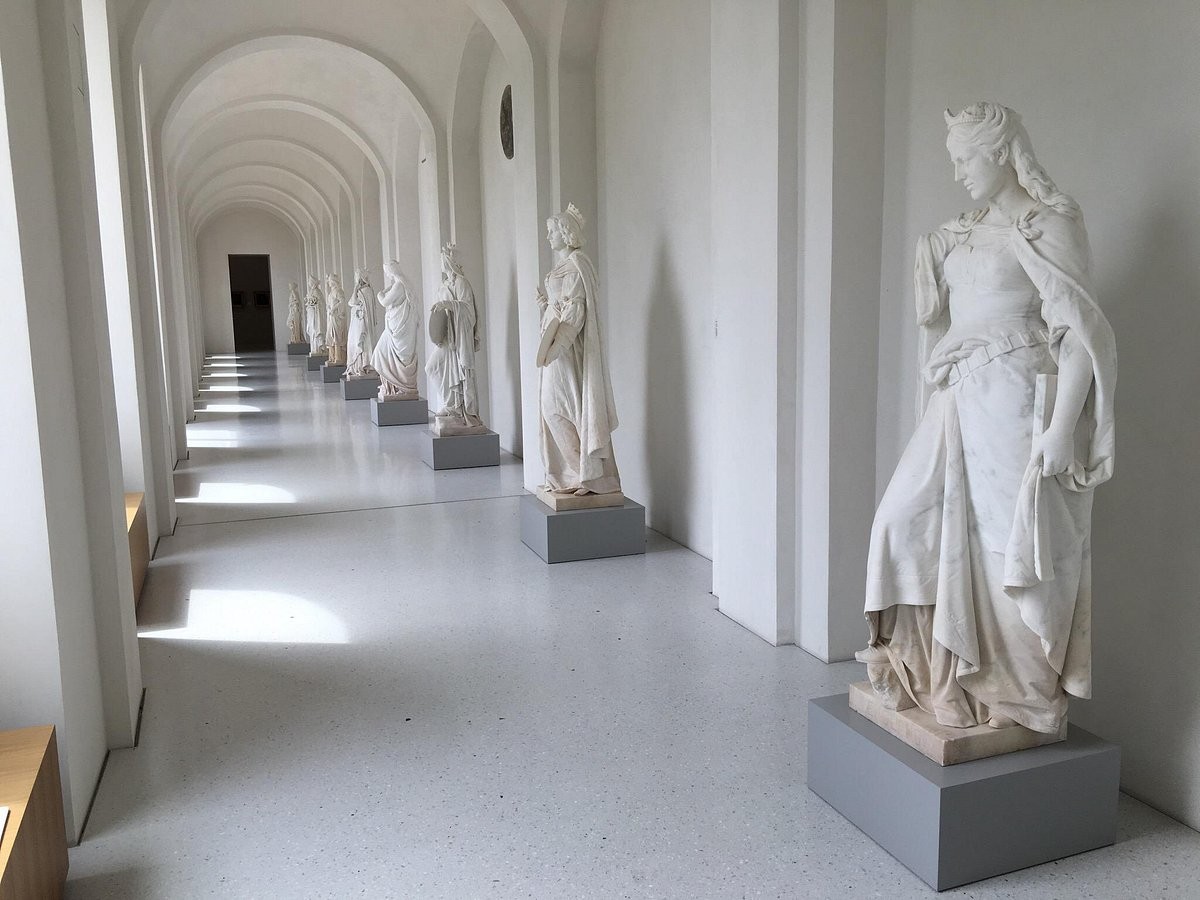
Wilhelm Von Kobell is the best-known artist with works in the New Gallery; next come Ludwig Knaus, Caroline Bardua and August von der Embde.
Below, the 8 best-known of the 28 artists with works of the New Gallery in our catalogue (44 works), each with what the museum holds of them.
The masters of the originals
The 8 masters whose originals hang in the New Gallery
For each master: where and when they were born, their movement, how many originals the museum keeps in our catalogue, a note from their life, and the originals to see.
-

Romanticism
1. Wilhelm Von Kobell 1766–1853
1766–1853 Born in Mannheim, Germany Romanticism 2 originals at the New Gallery
German Romantic painter of tranquil Bavarian landscapes and encounter pictures, blending Neoclassical precision with serene, sun-dappled scenes. Kobell's oeuvre is characterized by a remarkable ability to blend Neoclassical principles with a deep-seated Romantic idealism.
Originals at the New Gallery
-

Realism
2. Ludwig Knaus 1829–1910
1829–1910 Born in Wiesbaden, Germany Realism 2 originals at the New Gallery
He had a remarkable gift for weaving diverse figures into a single, breathless moment, creating compositions that feel less like static images and more like living tapestries of human connection.
Originals at the New Gallery
-

3. Caroline Bardua 1781–1864
1781–1864 Born in Ballenstedt, Germany 3 originals at the New Gallery
In the quiet corners of Ballenstedt, Anhalt-Bernburg, a girl named Caroline Bardua began a life that would defy the common expectations of her era. Born to the valet of a Duke and a woman named Sophie Sabine Kirchner, she did not possess the inherited wealth often required for an artistic career, yet she possessed a drive that led her toward the brush.
Originals at the New Gallery
-

4. August von der Embde 1780–1862
1780–1862 Born in Kassel, Germany 6 originals at the New Gallery
Born on December 2, 1780, in Kassel, his early years were rooted in the tactile reality of manual labor; as the son of a master carpenter, he initially learned the precision of the woodworking trade. His formal artistic odyssey began at the Kassel Academy, where from 1799 to 1804, he honed the technical foundations that would support a lifetime of exploration.
Originals at the New Gallery
-

5. Ferdinand Tellgmann 1811–1897
1811–1897 Born in Bischhausen (Waldkappel), Germany 4 originals at the New Gallery
To understand Ferdinand Tellgmann is to witness the intersection of traditional oil painting and the emerging mechanical eye of early photography. While his hands were skilled in the delicate application of oil on paper and canvas, his vision was equally shaped by the chemical processes of early light-capture. In works like Still Life from 1833, there is a clear commitment to the physical properties of objects.
Originals at the New Gallery
-

6. Sebastian Weygandt 1760–1836
1760–1836 Born in Bruchsal, Germany 3 originals at the New Gallery
Sebastian Weygandt enters the historical record in 1760, born in Bruchsal. The early years of Weygandt's career are marked by movement. Among those who study under his guidance is Johann Wilhelm Nahl, a pupil who would eventually go on to produce his own portrait of the master.
Originals at the New Gallery
-

7. Karl Christian Aubel 1796–1882
1796–1882 Born in Kassel, Germany 2 originals at the New Gallery
Born in Kassel on 9 November 1796, Karl Christian Aubel began his path toward the brush within the walls of the Kassel Art Academy. Between 1819 and 1823, he sought further refinement in Paris, where he studied at the École des Beaux-Arts. On 16 October 1831, he married Wilhelmine Goltz, a union that would see the growth of a family deeply connected to the arts.
Originals at the New Gallery
-

8. Friedrich Wilhelm Maul 1780–1852
1780–1852 Born in Lippstadt, Germany 2 originals at the New Gallery
By approximately 1795, his presence was felt in the courts of Arolsen and Waldeck, where he worked as a court artist. Maul’s hands were accustomed to the textures of oil on canvas and the soft, dusty touch of pastel. A gentleman in a tailcoat, painted in 1837.
Originals at the New Gallery


The house in figures
The masters of the New Gallery, in figures
The masters with the most originals at the New Gallery
Masters with two originals or more, by century of birth
Masters with two originals or more, by country of birth
Masters with two originals or more, by movement
Women masters
The women whose originals hang in the New Gallery
1 women masters, 3 originals, in our catalogue of the New Gallery.
-
Caroline Bardua
1781–1864 · born in Ballenstedt, Germany · 3 originals at the New Gallery
Asked of us
Questions on the masters of the New Gallery
Open a question to read the answer.
Who is the most famous artist in the New Gallery?
Wilhelm Von Kobell (1766–1853): our catalogue holds 2 works by Wilhelm Von Kobell at the New Gallery, among them A shepherdess with her cows and a goat in a crossing in a brook and Landscape with a Shepherd and his Herd. Ludwig Knaus and Caroline Bardua follow.
Which Wilhelm Von Kobell works are in the New Gallery?
Our catalogue lists 2 works by Wilhelm Von Kobell at the New Gallery, among them A shepherdess with her cows and a goat in a crossing in a brook (1798) and Landscape with a Shepherd and his Herd (1800).
How many Ludwig Knaus paintings are in the New Gallery?
Our catalogue lists 2 works by Ludwig Knaus at the New Gallery, among them Peasant in Hessian costume (1852) and Interior with green ceramic stove (1852).
Which Caroline Bardua works are in the New Gallery?
Our catalogue lists 3 works by Caroline Bardua at the New Gallery, among them Portrait of Dorothee van Herzeele (1817), Portrait of Pieter van Herzeele (1817) and Portrait of Oskar van Herzeele as a Boy (1817).
Which painter is most represented in the New Gallery?
August von der Embde (1780–1862), with 6 works in our catalogue of the New Gallery, ahead of Ferdinand Tellgmann (4), Caroline Bardua (3) and Sebastian Weygandt (3).
Are there Leonardo da Vinci works in the New Gallery?
No: the New Gallery holds no work by Leonardo da Vinci in our catalogue.
Is Pablo Picasso in the New Gallery?
No: the New Gallery holds no work by Pablo Picasso in our catalogue.
How many women artists are in the New Gallery?
Our catalogue lists 1 women artists with works at the New Gallery: Caroline Bardua (3).
Are the artists in the New Gallery mostly French, Italian or Dutch?
By country of birth, the artists with two works or more at the New Gallery are mostly from Germany (8).
Who is the earliest artist in the New Gallery?
The 18th century leads with 6 artists born then. In this ranking, Sebastian Weygandt (1760–1836) is the earliest born and Ludwig Knaus (1829–1910) the latest.
How many artists does the collection of the New Gallery cover?
Our catalogue lists 28 artists with at least one work at the New Gallery, 8 of them with two or more, born between 1760 and 1829 in 1 countries.
How is this ranking of artists made?
The artists with at least two works of the New Gallery in our catalogue are ranked by how widely each one is known: the number of Wikipedia language editions with an article on the artist, the visits to their page and our editors' manual ranking. Works are counted in our catalogue, one entry per work, without details, studies or copies.
The house
The New Gallery, Kassel, in a few lines
The Enduring Spirit of Kassel: Unveiling the New Gallery’s Story
Yet, from the ashes rose a renewed dedication, culminating in the museum's triumphant reopening in 1976 and subsequent restoration in 2011 – a remarkable feat that honors both the past and embraces the future. Situated within the historical region of Hesse-Kassel (later part of Germany), the gallery’s story is deeply intertwined with the state's rich past. From its roots as a center for Calvinism during the Reformation to its role in supporting the American Revolution through Hessian mercenaries, Kassel has always been a crossroads of European history.
A Kaleidoscope of Artistic Movements
A cornerstone of the museum is its impressive representation of Romanticism and Impressionism, showcasing works by artists like Carl Schuch, whose evocative landscapes capture the spirit of the era, Lovis Corinth’s bold brushstrokes, and Max Slevogt's luminous depictions of everyday life. However, it’s the gallery’s commitment to German Expressionism that truly sets it apart. Here, visitors encounter a raw and emotionally charged world—a space where artists like Kirchner and Heckel wrestled with themes of alienation, anxiety, and social critique. The museum also houses a significant collection of works by Joseph Beuys, whose provocative sculptures challenged conventional notions of art and explored the intersection of art, politics, and spirituality – a room dedicated to his legacy is a must-see.
The famous originals of the New GalleryThe New Gallery: the full page, 44 originalsThe museums of Kassel
How the masters of the originals are ranked
The masters with two originals or more of the New Gallery in our catalogue are ranked by fame: the Wikipedia language editions that describe them, the visits to their OriginalUniqueArt.com page and our studio's ranking. Originals are counted in our catalogue — one entry per work, without details, studies or copies — not in the museum's inventory. Every date, birthplace and movement is the catalogue's; the notes are drawn from the master's biography.
Go on