Portrait of William Fox

The 21 Most Famous William Fox Paintings, Each One of a Kind

Updated October 2026 · ranked by our popularity score (searches, visits and orders for each work) · 22 works by William Fox in our catalogue

In short

Iron and coal is the William Fox painting that draws the most eyes; the original belongs to the Wallington Hall. After it, the eye goes to The Eve of the Deluge (1865) and Seascape on the Northumbrian Coast. Among the 22 works of William Fox in our catalog, these 21 are the most famous, each a unique original presented with its year, its museum and the reason it endures.

1812 – 1893, South Shields Pre-raphaelite Most works: Wallington Hall

Top 10 paintings by William Fox, through the gallery's eye

2
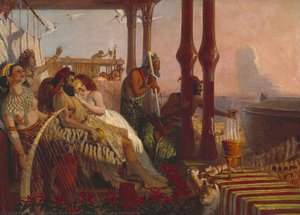
The Eve of the Deluge (1865) by William Fox

The Eve of the Deluge

1865 · Oil On Canvas · Tate Britain, London

William Bell Scott’s The Eve of the Deluge is not merely a depiction of biblical narrative; it is a profound meditation on choice, consequence, and the inescapable march of divine judgment. The canvas captures that exquisite, agonizing breath held just before catastrophe—the moment when humanity stands at a precipice, forced to confront the weight of their own actions against the backdrop of impending cosmic change. Scott masterfully juxtaposes two distinct…

William Fox's famous paintings, numbers 11 to 21

The subjects that held William Fox's eye

The four subjects that come back most often in these originals, each with its finest example.

The museums that keep William Fox's originals

The 6 museums that hold the most of the paintings on this page.

Museum City Works by William Fox Paintings from this list
Wallington HallWallington Hall 3 Iron and coal, King Egfrid and Bishop Trumwine Persuade Cuthbert to Be Made Bishop, The Romans Cause a Wall to be Built for the Protection of the South
Scottish National Gallery, EdinburghScottish National Gallery Edinburgh 2 Port na Curachan, Iona, The nativity
Tate Britain, LondonTate Britain London 1 The Eve of the Deluge
The Suter Te Aratoi o WhakatūThe Suter Te Aratoi o Whakatū 1 The Buller River Near Westport
Yale Center for British Art, New HavenYale Center for British Art New Haven 1 Ailsa craig
National Gallery of Scotland, EdinburghNational Gallery of Scotland Edinburgh 1 Albrecht Dürer on the Balcony of his House

William Fox across the years: the unique originals of each

12 years separate William Fox's first and last dated originals shown here, 1854 and 1865: each year has its place below.

Works per year

Pick a year to see its originals.

William Fox's paintings: questions for the gallery

What is the single most famous work of William Fox?Reveal the answer

Iron and coal, Wallington Hall. The Eve of the Deluge (1865) and Seascape on the Northumbrian Coast come next.

Which ten paintings by William Fox are the most famous?Reveal the answer

Iron and coal, The Eve of the Deluge, Seascape on the Northumbrian Coast, The poets harvest home, Fair Rosamund in her Bower, King Egfrid and Bishop Trumwine Persuade Cuthbert to Be Made Bishop, The Buller River Near Westport, Painting of a young Algernon Charles Swinburne, A leopard and A Picnic at Hanwell. The ranking above gives each one's year and museum.

How many works by William Fox are known?Reveal the answer

Our catalog holds 22 works by William Fox, dated from 1854 to 1865.

Where can the most famous William Fox originals be seen?Reveal the answer

Mostly in Wallington Hall, Scottish National Gallery (Edinburgh) and Tate Britain (London). The museum table above lists them all.

Which famous William Fox painting is the earliest, and which the latest?Reveal the answer

On this page, the earliest is Albrecht Dürer on the Balcony of his House (1854) and the latest The Eve of the Deluge (1865).

What subjects did William Fox favour?Reveal the answer

Scenes (2) and Leisure (2), across the 21 works on this page.

Which movement does the work of William Fox belong to?Reveal the answer

Pre-raphaelite, judging by the originals on this page.

What William Fox originals can I see at the Wallington Hall?Reveal the answer

Iron and coal, King Egfrid and Bishop Trumwine Persuade Cuthbert to Be Made Bishop and The Romans Cause a Wall to be Built for the Protection of the South: the Wallington Hall holds 3 of the works on this page.

William Fox: a portrait of the artist

A Scottish Visionary: The Life and Art of William Bell Scott

William Bell Scott, born in Edinburgh in 1811, was a figure deeply embedded within the artistic currents of 19th-century Britain. More than simply a painter, he was a poet, an educator, and a keen observer of his time—a multifaceted artist whose work reflected both the romantic spirit of his upbringing and the burgeoning realities of the Industrial Revolution. Coming from an artistic family – his father, Robert Scott, was an engraver, and his brother David also pursued painting – young William’s path seemed predetermined, yet he forged a unique trajectory that blended historical narrative with contemporary life. His early training in Edinburgh provided a solid foundation, but it was his move to London in 1837 that truly ignited his artistic ambitions, coinciding with his marriage to Letitia Margery Norquoy. This relocation marked the beginning of a period of increasing recognition and engagement within the vibrant art scene of the capital.

Newcastle, Industry, and the Pre-Raphaelite Circle

A pivotal moment in Scott’s career arrived in 1843 with his appointment as principal of the Government School of Art in Newcastle upon Tyne. This wasn't merely an administrative role; it was a twenty-year immersion into the heart of industrial England. Unlike many artists who shied away from depicting the changing landscape, Scott embraced it. He became one of the first British artists to systematically portray the processes and impact of the Industrial Revolution, recognizing its significance as a defining feature of his era. This fascination with industry wasn’t detached observation; it was interwoven with his personal life. His relationship with Alice Boyd, a student at the Newcastle School and sister to the Laird of Penkill Castle, began in 1860 with a visit to Penkill, blossoming into a long-lasting connection that profoundly influenced both his artistic output and his emotional landscape. Newcastle also brought him closer to the Pre-Raphaelite Brotherhood, particularly Dante Gabriel Rossetti, who famously painted Maria Leathart’s portrait at Scott's home, cementing their friendship and mutual influence.

Murals, Ballads, and Historical Visions

Scott’s most celebrated works are undoubtedly the magnificent murals he created for Wallington Hall in Northumberland, now under the care of the National Trust. These expansive paintings aren’t simply historical illustrations; they are immersive narratives brought to life with dramatic intensity. Eight large compositions depict scenes from border history, populated by figures rendered at life-size, creating a powerful sense of presence and immediacy. Complementing these grand historical visions are eighteen smaller panels illustrating the ballad of Chevy Chase within the hall's arches—a testament to Scott’s skill in blending epic storytelling with intricate detail. A similar historical cycle was undertaken for Penkill Castle in Scotland, where he illustrated James I’s allegorical poem *The Kingis Quair*. These projects demonstrate his ability to translate literary themes into visual form, imbuing them with a romantic sensibility and a meticulous attention to historical accuracy. While not primarily known as a portraitist, Scott's striking portrayal of Algernon Charles Swinburne remains an iconic image, capturing the poet’s complex character with remarkable insight.

Legacy and Literary Pursuits

After 1870, Scott divided his time between London and Penkill, deepening his friendship with Rossetti and gaining recognition as both an artist and a man of letters. He wasn't without artistic disagreements; he famously clashed with John Ruskin over aesthetic principles. However, this intellectual friction only served to sharpen his own artistic vision. Beyond painting, Scott was a prolific writer, publishing volumes of poetry – notably *Poems* in 1875, beautifully illustrated with his own etchings – and engaging in art and literary criticism. His poetic voice drew inspiration from the Romantic poets William Blake and Percy Bysshe Shelley, while also bearing the unmistakable influence of Rossetti’s lyrical style. In his later years, Scott dedicated himself to writing his *Autobiographical Notes*, published posthumously in 1892 with a memoir by Professor Minto. These reminiscences offer an invaluable glimpse into the world of Pre-Raphaelite artists and provide a candid account of his own artistic journey. William Bell Scott’s historical significance lies not only in his pioneering depictions of the Industrial Revolution but also in his role as a bridge between Romanticism, Pre-Raphaelitism, and the evolving artistic landscape of Victorian Britain. He remains a compelling figure—a Scottish visionary who captured the spirit of his age with both poetic grace and unflinching realism.
