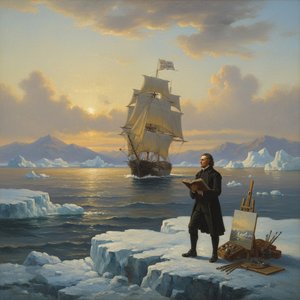
William Bradford, born around 1590 in Austerfield, England, occupies a unique and pivotal position in the narrative of American art. He wasn’t merely a painter; he was a chronicler of transition—a figure bridging the meticulous documentation demanded by scientific exploration with the burgeoning emotional currents of Romanticism. His life unfolded as a testament to resilience, an odyssey from humble rural beginnings to becoming a visual interpreter of both human endeavor and the sublime power of the natural world, particularly the icy majesty of the Arctic regions. Bradford’s journey wasn't simply about artistic skill; it was about a profound connection forged with the sea and the landscapes he would immortalize on canvas, driven by an innate desire to capture not just *what* he saw, but *how* it felt—the atmosphere, the light, the sheer immensity of nature’s grandeur. Initially focused on detailed depictions of ships within New Bedford Harbor, his artistic vision rapidly expanded, fueled by a yearning to convey the emotional resonance of these scenes.
From Maritime Scenes to Arctic Visions
Bradford's early work reveals a keen eye for detail and a mastery of maritime subjects. These paintings weren’t simply topographical records; they were imbued with a sense of realism that resonated deeply with the burgeoning commercial interests of New Bedford, a prominent whaling port. However, it was his association with Dr. Isaac Israel Hayes and subsequent Arctic expeditions that truly defined his artistic trajectory. Becoming the first American painter to venture into and depict the frozen regions of the North, Bradford entered uncharted territory—both geographically and artistically. These voyages weren't merely opportunities for scientific observation; they were immersive experiences that fundamentally altered his perception of light, color, and form. The Arctic presented a unique challenge: how to convey the ethereal beauty of icebergs under the midnight sun, the vastness of frozen floes, and the inherent dangers lurking beneath the surface? Bradford rose to this challenge with remarkable skill, translating his firsthand observations into paintings that were both scientifically accurate and emotionally evocative. He meticulously documented these expeditions, publishing “The Arctic Regions,” a detailed account accompanied by photographs, further solidifying his role as an explorer-artist. This publication wasn’t just a scientific report; it was a testament to the power of visual storytelling, bringing the remote Arctic to life for audiences back home.
Influences and Artistic Style
While not formally affiliated with the Hudson River School, William Bradford absorbed its core tenets—particularly the emphasis on depicting light’s interaction with water and atmospheric conditions. This influence is readily apparent in his work, where subtle gradations of color and masterful use of chiaroscuro create a sense of depth and realism. However, Bradford's style transcends mere imitation; he infused it with a unique sensibility shaped by his Arctic experiences. His compositions often balance subjects carefully, strategically employing light and shadow to draw the viewer’s eye and enhance the emotional impact. A characteristic feature of his paintings is the use of darker colors around the edges, framing the central subject and creating a sense of dramatic focus. Works like “Looking Out Battle Harbor” (1877) exemplify this technique, demonstrating a compositional balance that draws the viewer into the scene while simultaneously emphasizing its inherent isolation. His skill in depicting maritime activity within dramatic natural settings is showcased beautifully in "Whaler and Fishing Vessels near the Coast of Labrador" (c. 1880). He wasn’t simply painting what he saw; he was conveying a feeling—a sense of awe, vulnerability, and the sublime power of nature.
Legacy and Lasting Impact
William Bradford’s artistic legacy extends far beyond his stunning depictions of Arctic landscapes and maritime scenes. Elected an associate member of the National Academy of Design in 1874, he gained recognition for his contributions to American art. His paintings weren't simply aesthetic creations; they were visual records of a rapidly changing world—documenting scientific expeditions, capturing the spirit of exploration, and fostering a growing appreciation for the natural environment. Major works such as “New Bedford Harbor at Sunset” demonstrate his early mastery, while "Ice Floes under the Midnight Sun" encapsulates the ethereal beauty he discovered in the Arctic. Perhaps most powerfully, paintings like “The ‘Panther’ among the Icebergs in Melville Bay” convey both the grandeur and peril of polar exploration, reminding viewers of humanity's fragile relationship with nature. Bradford’s published account of his Arctic travels further popularized knowledge about these remote regions, inspiring future generations of artists and explorers. He remains a significant figure in American art history—a pioneer of Romanticism who dared to venture into the unknown and translate its wonders onto canvas, leaving behind a body of work that continues to captivate and inspire today.
Key Works
Icebergs in the Arctic (1882): A dramatic seascape capturing the beauty and danger of glacial formations.
Ice Floes under the Midnight Sun: Showcases the ethereal light and vastness of the Arctic landscape.
British Romanticism in the 1810s features masterpieces by J.M.W. Turner, John Constable, and Thomas Lawrence. View the full collection at OriginalUniqueArt.com.
Explore the captivating world of William Bradford, American Romanticist painter renowned for his dramatic Arctic seascapes & ship portraits. Discover his artistic evolution, influences, and lasting legacy with OriginalUniqueArt.