The Archive of Tides: Early Maritime Records and Ship Portraiture Surging Currents: Tracing Ocean Waves from Maritime Records to Impressionist Expression From Navigation to Narrative: The Era of Maritime Documentation National Maritime Museum of Kore...
Before the ocean became a subject for quiet contemplation, it functioned as a ledger of commerce, conquest, and survival. The history of maritime art did not begin with an aesthetic pursuit but with a functional necessity to document the tools of global expansion. During the 17th-century Dutch Golden Age, the ship portrait emerged as a vital genre, reflecting the burgeoning maritime power of cities like Amsterdam and Hamburg. Artists in this era acted more as chroniclers than poets; their task was to capture the structural integrity of vessels and the strategic precision of naval maneuvers for a mercantile class that viewed the sea through the lens of profit and prestige.
This impulse toward meticulous documentation finds a profound echo in the halls of the National Maritime Museum of Korea in Busan. Within this architectural tribute to the fluidity of the sea, one encounters the tangible reality of seafaring through artifacts like the half-sized replica of a Joseon Missional Ship. These vessels, alongside intricate navigational instruments and celestial globes, reveal an age where understanding the water was a matter of diplomacy and survival. Much like the works of Ludolf Backhuysen, which recorded the grandeur of naval strength, these museum collections preserve the scientific sophistication required to navigate uncertain horizons. The sea was a frontier to be mapped, and the art produced was a record of that mapping.
Navigational Precision: From Cartographic Charts to Curated Histories
John Hamilton Moore: A Life Dedicated to Navigation and Cartography Early Life and Education Born: 1738, Scotland. Details regarding John Hamilton Moore’s early life and formal education remain scarce. However, his later career clearly demonstrates a...
The transition from mere record-keeping to art began when the focus shifted from the vessel itself to the environment it inhabited. In the 18th century, figures like John Hamilton Moore bridged the gap between science and artistry. As a teacher of navigation and a maker of charts, Moore’s work was grounded in the mathematical rigors of astronomy and geography. His publications, such as The New Practical Navigator, provided the essential tools for mariners to traverse the globe, yet his engravings, such as the depiction of Vasco da Gama, demonstrated how technical skill could capture complex historical narratives.
This intersection of utility and aesthetic nuance is mirrored in the Hamgyeong-do Coastal Map, where cartographic precision meets cultural significance. Even in the realm of specialized instruments, such as the brass Mariner’s Altitude Quadrant by Juan San Martín Buceta, we see a dedication to the fine details of navigation that borders on the sculptural. These objects are not merely relics; they are embodiments of an era when the mastery of light and mathematics was the only way to command the vast, unpredictable reaches of the ocean.
Capturing the Ephemeral: The Impressionist Shift Toward Atmosphere
A Glimpse of Modern Life: Edouard Manet’s “Seascape” Edouard Manet's 1873 oil on canvas, "Seascape," is more than just a depiction of the ocean; it’s a pivotal work reflecting the artist’s transition and contribution to the burgeoning Impressionist m...
As the centuries progressed, the maritime gaze underwent a radical departure, moving away from the rigid documentation of hulls and rigging toward the ephemeral essence of the water itself. The Impressionist movement marked this shift, prioritizing the transient effects of light, weather, and atmosphere over precise realism. No longer was the goal to catalog a ship's dimensions; instead, artists sought to convey an impression of the scene—the shimmer of water, the movement of clouds, and the overall feeling of a breezy day at sea.
Édouard Manet’s 1873 work, Seascape, exemplifies this evolving style. Moving away from strict academic realism, Manet employed loose, visible brushwork and an asymmetrical arrangement to create a sense of naturalism and spontaneity. His palette, dominated by muted blues, graze, and whites, captures the atmospheric quality of contemporary life rather than a historical narrative. This approach directly influenced later explorations of light, where the subject was no longer the vessel, but the very air and water that surrounded it.
The Sublime Force: Navigating Storms and Emotional Resonance
Captivating Seascape of Nature’s Fury Immerse yourself in the raw power and majestic beauty of this evocative seascape, masterfully capturing a tumultuous ocean scene during a fierce storm. The painting vividly portrays the relentless energy of natur...
While some Impressionists sought serenity, others turned toward the raw energy of the sea. The maritime gaze eventually embraced the sublime—the point where the beauty of nature meets its formidable power. Claude Monet’s Storm on the Cote de Belle-Ile, created in 1886, illustrates this intensity. Through vigorous brushstrokes and textured impasto, the painting portrays a tumultuous ocean scene, where swirling waves and frothy surf suggest the relentless energy of a storm.
This fascination with nature's unpredictable power finds a parallel in the way collectors view the psychological depth of seascapes. The sea has long served as a dialogue between humanity and the eternal, acting simultaneously as a sanctuary of peace and a display of force. Whether it is the moody coastal scenes found in the sketches of Alfred Thompson Bricher or the heavy, textured waves of Charles-François Daubigny, these works invite the viewer to contemplate the human condition against the backdrop of an uncontrollable natural world. The ocean becomes a symbol of resilience, reflecting our own struggles and the inevitable march of time.
The Modern Collector: Integrating Maritime Narratives into Contemporary Space
The Allure of the Horizon: Finding Emotional Resonance in Seascape Art The Allure of the Horizon: A Comprehensive Exploration of Seascape Art Through History & Emotion The Genesis of Seascape: From Maritime Records to Artistic Expression For centurie...
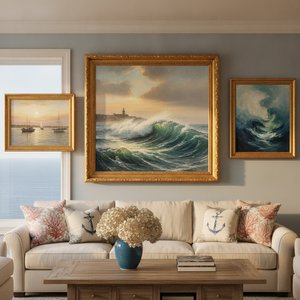
For the contemporary collector, maritime art offers far more than mere decoration; it provides a psychological anchor. In high-end residential and hospitality design, the rhythmic movement of waves and the subtle interplay of light upon water possess a rare ability to soften the sharp, modern architectural lines of a room. Integrating these themes is not simply about decorating a wall, but about establishing a deep sense of place and emotional depth.
Whether one chooses a large-format mural that recreates the expansive horizon or a meticulously crafted reproduction of an Old Master work, the presence of the sea can evoke the salt-kissed tranquility of a distant coastal retreat. At OriginalUniqueArt.com, we understand this desire for authenticity and atmosphere. We specialize in hand-painted oil reproductions on 100% cotton canvas, ensuring that the physical texture of the brushstrokes—the very soul of the Impressionist movement—is preserved for your collection. From custom commissions that transform personal memories into historical styles to professional consultations for large-scale architectural projects, we provide the expertise required to bring the profound narratives of the sea into the modern home.
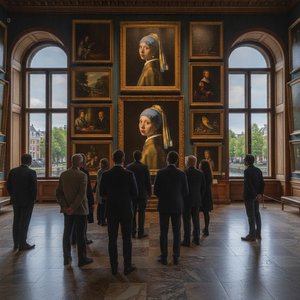
Step into the Dutch Golden Age with our curated guide to the 25 greatest masterpieces at the Mauritshuis. From Vermeer's luminous light to Rembrandt's drama, explore the stories behind these iconic works and find museum-quality art reproductions. Discover all masterpieces on OriginalUniqueArt.com.
Journey into the Dutch Golden Age! Explore 10 iconic paintings by Rembrandt, Vermeer & Hals. Discover the stories behind these Baroque masterpieces and find museum-quality art reproductions to elevate your home decor on .
Step into the Dutch Golden Age with our curated guide to 25 iconic masterpieces from the Mauritshuis. From Vermeer’s luminous light to Rembrandt’s drama, explore the stories behind these timeless works and find museum-quality art inspiration. Discover all masterpieces on OriginalUniqueArt.com.
Step into the Dutch Golden Age with our curated guide to the 25 greatest masterpieces at the Mauritshuis. From Vermeer’s luminous light to Rembrandt’s drama, explore the stories behind these iconic works and find museum-quality art reproductions. Discover all masterpieces on OriginalUniqueArt.com.
Explore the breathtaking mastery of Dutch Golden Age landscapes. Discover how 17th-century masters revolutionized light, atmosphere, and realism to create the foundation of modern visual impact. Dive into a journey of timeless beauty and artistic innovation.

 Salt, Light, and Provenance: A Collector’s Examination of Maritime and Impressionist Seascapes
 John Hamilton Moore
 Seascape
 Storm on the Cote de Belle-Ile
 Bring the Ocean Home: Captivating Maritime Paintings to Transform Your Space with Timeless Elegance