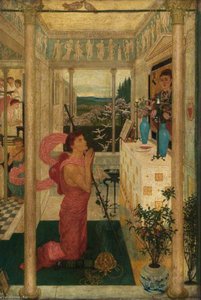
Portrait of Walter Crane

Walter Crane Paintings: The 100 Most Famous, Through a Gallery's Eye

Updated November 2026 · ranked by our popularity score (searches, visits and orders for each work) · 278 works by Walter Crane in our catalogue

In short

To the gallery's eye, Walter Crane's most famous painting is Ruth and Boaz (1863). Winter (1870) and A Herald of Spring (1872) complete the trio every eye recognises. Of the 278 works by Walter Crane in our catalog, the gallery presents the 100 most famous below, each original with its year, its museum and what makes it unique.

1845 – 1915, Liverpool Most works: Royal West of England Academy

The gallery's top 10 Walter Crane paintings

1
Ruth and Boaz (1863) by Walter Crane

Ruth and Boaz

1863 · Oil On Canvas

In this oil painting, Ruth and Boaz by Walter Crane, we find ourselves observing a quiet, narrative moment from a biblical scene. Painted about 1863, the work places the two central figures within the expanse of a sunlit field. There is a stillness to the encounter, a pause in the labor of the harvest that allows the viewer to focus on the personal connection between the two individuals.

2
Winter (1870) by Walter Crane

Winter

1870 · Oil

In "Winter," Walter Crane presents a somber and atmospheric scene that invites a quiet contemplation of the natural world. The composition is anchored by a large, central figure, heavily draped in dark, voluminous garments that command much of the vertical space. This solitary figure is positioned within a cold, wintry landscape, creating a sense of profound isolation. The perspective is a medium shot, placing the viewer at a similar level…

3
A Herald of Spring (1872) by Walter Crane

A Herald of Spring

1872 · Painting · Birmingham Museum and Art Gallery, Birmingham

In "A Herald of Spring" by Walter Crane, we find ourselves at a ground-level perspective, looking down a narrow, cobblestone European street. The composition is vertically oriented, drawing the eye through a quiet urban space. A central female figure moves through this setting, carrying a basket of flowers and spring blossoms. A white dove accompanies her, moving through the air as she walks. Together, these elements symbolize rebirth, purity, and…

4
The Advent of Spring (1873) by Walter Crane

The Advent of Spring

1873 · Oil On Canvas

The painting titled The Advent of Spring was executed by the artist Walter Crane. This work is an oil on canvas that dates to 1873. The piece is held within a private collection and features a monogram and date located in the bottom left corner of the composition.

5
La Primavera (1883) by Walter Crane

La Primavera

1883 · Painting

La Primavera is a painting by Walter Crane. The artist, born in Liverpool, United Kingdom, in 1845, captured this scene about 1883. His hand moved with the precision of a wood-engraver, a craft learned during his early apprenticeship. This work emerged from a life that spanned from the mid-nineteenth century until his death in 1915.

6
Laura Reading (1885) by Walter Crane

Laura Reading

1885 · Watercolor

In Laura Reading, Walter Crane centers the composition on a single female figure presented in a vertical, full-length profile. The subject is positioned against a warm, textured golden background that emphasizes her silhouette. To the left, a decorative architectural column featuring intricate blue and gold patterns provides a vertical counterpoint to the figure, while a dark blue ceramic pot containing a leafy green plant with small white flowers sits to…

7
The Roll of Fate (1882) by Walter Crane

The Roll of Fate

1882 · Oil

In The Roll of Fate, Walter Crane presents a heavy, silent drama. Painted about 1882, the work centers on a collision of ages. An elderly, bearded man anchors the scene, his presence weighted by large, black wings. He holds a quill and a scroll, tools of a predetermined script. His skin is weathered, marked by the passage of years.

8
George Howard, 9th Earl of Carlisle, and Rosalind, Countess of Carlisle (1879) by Walter Crane

George Howard, 9th Earl of Carlisle, and Rosalind, Countess of Carlisle

1879 · Oil On Canvas

A serene afternoon unfolds within a lush, manicured garden, where the heavy, architectural presence of a stone manor on the left provides a rigid contrast to the organic, leafy density on the right. The composition balances the permanence of stone against the ephemeral softness of nature. Three figures occupy this private enclosure: a man in white lounging in a chair, a woman reclining in a red dress, and a standing…

9
Neptune's Horses (1892) by Walter Crane

Neptune's Horses

1892 · Oil On Canvas · Bavarian State Painting Collections, Munich

The scene unfolds with a sudden surge of power as Neptune's Horses, painted by Walter Crane, captures a moment of mythic upheaval. Created about 1892, this work places the viewer directly before a churning, oceanic struggle. A deity, likely Neptune, surges through the salt spray, guiding a group of white horses as they charge through crashing ocean waves. The sheer force of the sea seems to pulse against the canvas,…

10
Neptune's Horses (1892) by Walter Crane

Neptune's Horses

1892 · Oil On Canvas

Neptune's Horses is an oil painting by Walter Crane, executed about 1892. The work belongs to the mythological genre, focusing on the deity Neptune and his hippocampi. This composition captures the movement of the sea through the figures of the god and his aquatic steeds.

Walter Crane paintings, ranked 11 to 100

11Morn; Noon; Eve; Night (1891) by Walter CraneMorn; Noon; Eve; Night1891 12Reaper Death (1900) by Walter CraneReaper Death1900 · Staatliche Kunsthalle Karlsruhe 13Young Percival Questions Sir Owen by Walter CraneYoung Percival Questions Sir Owen 14Robin Hood As The Potter by Walter CraneRobin Hood As The Potter 15The Bundle Of Sticks by Walter CraneThe Bundle Of Sticks 16Coverpage for the periodical Magyar Iparművészet (Hungarian Applied Art) 1900/4. (1900) by Walter CraneCoverpage for the periodical Magyar Iparművészet (Hungarian Applied Art) 1900/4.1900 · Museum of Applied Arts 17Neptune's Horses by Walter CraneNeptune's Horses 18Love's Altar (1870) by Walter CraneLove's Altar1870 19The Aventine from the Palatine (1873) by Walter CraneThe Aventine from the Palatine1873 · Brooklyn Museum 20The Renaissance of Venus (1877) by Walter CraneThe Renaissance of Venus1877 21The Renaissance of Venus (1877) by Walter CraneThe Renaissance of Venus1877 22The Angel of Peace (1900) by Walter CraneThe Angel of Peace1900 23The Briar Rose (triptych, right wing) (1905) by Walter CraneThe Briar Rose (triptych, right wing)1905 24Porte de France Tunis (1910) by Walter CranePorte de France Tunis1910 25The Three Ravens - by Walter CraneThe Three Ravens - 26The Tempation Of Eve by Walter CraneThe Tempation Of Eve 27The Mermaid by Walter CraneThe Mermaid 28Old Friends Who Have Piped To The Public For Years by Walter CraneOld Friends Who Have Piped To The Public For Years 29Trumpeters With Lilies by Walter CraneTrumpeters With Lilies 30End Paper Of 'the Fairy Ship by Walter CraneEnd Paper Of 'the Fairy Ship 31Then The Queen Of The Air Fluttered by Walter CraneThen The Queen Of The Air Fluttered 32Near Woodstock Town by Walter CraneNear Woodstock Town 33Barbara allen by Walter CraneBarbara allen 34The Ploughman by Walter CraneThe Ploughman 35The Happy Poor by Walter CraneThe Happy Poor 36A Belgian Warrior Battling With A German Eagle by Walter CraneA Belgian Warrior Battling With A German Eagle 37The Girl I've Left Behind Me by Walter CraneThe Girl I've Left Behind Me 38King Arthur Asks The Lady Of The Lake by Walter CraneKing Arthur Asks The Lady Of The Lake 39To All You Ladies Now On Land ` by Walter CraneTo All You Ladies Now On Land ` 40The Hunt Is Up And It Is Well Nigh Day And Harry - by Walter CraneThe Hunt Is Up And It Is Well Nigh Day And Harry - 41The Sweep by Walter CraneThe Sweep 42Poppy Heads by Walter CranePoppy Heads 43How Should I Your True Love Know by Walter CraneHow Should I Your True Love Know 44Frontispiece Design Of 'pan-pipes' by Walter CraneFrontispiece Design Of 'pan-pipes' 45Sir Bedivere Casts The Sword Excalibur by Walter CraneSir Bedivere Casts The Sword Excalibur 46Perseus And The Gorgons by Walter CranePerseus And The Gorgons 47The Wind God Sent A Gust From The South by Walter CraneThe Wind God Sent A Gust From The South 48Bellerophon At The Fountain by Walter CraneBellerophon At The Fountain 49The Remarkable Rocket by Walter CraneThe Remarkable Rocket 50Philemon And Baucis by Walter CranePhilemon And Baucis 51Lyttel John And The Knyghte by Walter CraneLyttel John And The Knyghte 52In The Beach House by Walter CraneIn The Beach House 53Percival Obtains The Shield Of The Beating Heart by Walter CranePercival Obtains The Shield Of The Beating Heart 54King Midas And His Daughter Turned To Gold by Walter CraneKing Midas And His Daughter Turned To Gold 55Costume Design For The Fairy Princess Ariella by Walter CraneCostume Design For The Fairy Princess Ariella 56Robin Hood And The Beggar-spy by Walter CraneRobin Hood And The Beggar-spy 57Robin Hood And Guy Of Gisborne by Walter CraneRobin Hood And Guy Of Gisborne 58Perseus Showing The Gorgon's Head by Walter CranePerseus Showing The Gorgon's Head 59Angel Offering A Wicker Cage With An Open Door by Walter CraneAngel Offering A Wicker Cage With An Open Door 60The Fairy Prince by Walter CraneThe Fairy Prince 61Sir Lancelot In The Chapel Perilous by Walter CraneSir Lancelot In The Chapel Perilous 62Robin Hood And His Men Kneel To The King by Walter CraneRobin Hood And His Men Kneel To The King 63Goody Two Shoes by Walter CraneGoody Two Shoes 64The Frightened Lion by Walter CraneThe Frightened Lion 65Sir Galahad Is Brought To The Court Of King Arthur by Walter CraneSir Galahad Is Brought To The Court Of King Arthur 66Brother And Sister by Walter CraneBrother And Sister 67Margery's New Shoes by Walter CraneMargery's New Shoes 68The Trumpeter Taken Prisoner by Walter CraneThe Trumpeter Taken Prisoner 69Craftsmanship by Walter CraneCraftsmanshipRoyal West of England Academy 70The Farmer's Treasure by Walter CraneThe Farmer's Treasure 71Painting by Walter CranePaintingRoyal West of England Academy 72MRS WALTER CRANE by Walter CraneMRS WALTER CRANE 73Architecture by Walter CraneArchitectureRoyal West of England Academy 74Race of Hero Spirits Pass (1909) by Walter CraneRace of Hero Spirits Pass1909 75So called (1900) by Walter CraneSo called1900 · Museum of Applied Arts 76Untitled (DD24F5) (1906) by Walter CraneUntitled (DD24F5)1906 · Royal Horticultural Society RHS Lindley Library 77I Am Here Dearest Little One by Walter CraneI Am Here Dearest Little One 78The Three Ravens by Walter CraneThe Three Ravens 79The Seeds Of Love by Walter CraneThe Seeds Of Love 80The Spanish Lady by Walter CraneThe Spanish Lady 81My Lady Greensleeves by Walter CraneMy Lady Greensleeves 82Derwent Water by Walter CraneDerwent Water 83At Home by Walter CraneAt Home 84O Willow, Willow by Walter CraneO Willow, Willow 85I Have Drink Here Worthier Of A Hero by Walter CraneI Have Drink Here Worthier Of A Hero 86Sir Simon De Montfort by Walter CraneSir Simon De Montfort 87Lilies of the Vale by Walter CraneLilies of the Vale 88Don Quixote by Walter CraneDon Quixote 89He Drank The Contents by Walter CraneHe Drank The Contents 90Daffodil Trumpet Blows by Walter CraneDaffodil Trumpet Blows 91Leather Bottel by Walter CraneLeather Bottel 92Fairy Ring by Walter CraneFairy Ring 93The Grave Of Shelley by Walter CraneThe Grave Of Shelley 94My Lodging Is On The Cold Ground by Walter CraneMy Lodging Is On The Cold Ground 95Here's Venus' Combe For Maidenhair by Walter CraneHere's Venus' Combe For Maidenhair 96Black-eyed Susan by Walter CraneBlack-eyed Susan 97Sally In Our Alley by Walter CraneSally In Our Alley 98Illustration Showing A Fairy As A Christmas Rose by Walter CraneIllustration Showing A Fairy As A Christmas Rose 99United Ireland by Walter CraneUnited Ireland 100The Rose From 'flora's Feast' by Walter CraneThe Rose From 'flora's Feast'

Walter Crane's famous paintings, period by period

The subjects that held Walter Crane's eye

The four subjects that come back most often in these originals, each with its finest example.

The museums that keep Walter Crane's originals

The 7 museums that hold the most of the paintings on this page.

Museum City Works by Walter Crane Paintings from this list
Royal West of England Academy, BristolRoyal West of England Academy Bristol 3 Craftsmanship, Painting, Architecture
Museum of Applied Arts, BudapestMuseum of Applied Arts Budapest 2 Coverpage for the periodical Magyar Iparművészet (Hungarian Applied Art) 1900/4., So called
Royal Horticultural Society RHS Lindley Library, ЛондонRoyal Horticultural Society RHS Lindley Library Лондон 2 Untitled (DD24F5)
Birmingham Museum and Art Gallery, BirminghamBirmingham Museum and Art Gallery Birmingham 1 A Herald of Spring
Bavarian State Painting Collections, MunichBavarian State Painting Collections Munich 1 Neptune's Horses
Staatliche Kunsthalle Karlsruhe, CarlsruheStaatliche Kunsthalle Karlsruhe Carlsruhe 1 Reaper Death
Brooklyn Museum, BrooklynBrooklyn Museum Brooklyn 1 The Aventine from the Palatine

Walter Crane, one signature painting per decade

Works per decade

Pick a decade to see the original that defines it.

Walter Crane's paintings: the gallery answers

Which Walter Crane painting is the most famous of all?Reveal the answer

Ruth and Boaz (1863). Winter (1870) and A Herald of Spring (1872) come next.

How old was Walter Crane on completing Ruth and Boaz?Reveal the answer

18 years old: Ruth and Boaz dates from 1863, and Walter Crane was born in 1845.

Which are Walter Crane's top 10 paintings?Reveal the answer

Ruth and Boaz, Winter, A Herald of Spring, The Advent of Spring, La Primavera, Laura Reading, The Roll of Fate, George Howard, 9th Earl of Carlisle, and Rosalind, Countess of Carlisle, Neptune's Horses and Neptune's Horses. The ranking above gives each one's year and museum.

How many works did Walter Crane create?Reveal the answer

Our catalog holds 278 works by Walter Crane, dated from 1863 to 1910.

Where do Walter Crane's most famous originals hang?Reveal the answer

Mostly in Royal West of England Academy (Bristol), Museum of Applied Arts (Budapest) and Royal Horticultural Society RHS Lindley Library (Лондон). The museum table above lists them all.

When did Walter Crane create the most famous paintings?Reveal the answer

In 1870s: 8 of the 100 works on this page were made then, Winter among them.

Which are Walter Crane's earliest and latest famous works?Reveal the answer

On this page, the earliest is Ruth and Boaz (1863) and the latest Porte de France Tunis (1910).

Which subjects did Walter Crane return to most?Reveal the answer

Flowers (11), Woman (8) and Man (6), across the 100 works on this page.

Which medium did Walter Crane work in most?Reveal the answer

Oil On Canvas, for 7 of the 100 works on this page.

Which Walter Crane originals does the Royal West of England Academy hold?Reveal the answer

Craftsmanship, Painting and Architecture: the Royal West of England Academy, Bristol holds 3 of the works on this page.

Walter Crane: the artist

Early Life and Artistic Foundations

Walter Crane, born in Liverpool on August 15th, 1845, emerged from a family deeply interwoven with the artistic fabric of Victorian England. His father, Thomas Crane, was a respected portrait painter and miniaturist, instilling within young Walter an early appreciation for form and detail. This familial atmosphere, further enriched by his brother Thomas’s own pursuit of illustration, fostered a creative environment where artistry wasn't merely a profession but a way of life. From the outset, Crane’s path seemed destined to follow a similar trajectory, yet he would ultimately forge a unique identity within the burgeoning world of British art. His initial training began not with oils or watercolors, but with the meticulous discipline of wood-engraving – an apprenticeship under William James Linton that proved foundational. This rigorous process honed his observational skills and instilled a deep understanding of line, texture, and composition, qualities that would become hallmarks of his distinctive style. The influence of the Pre-Raphaelite Brotherhood was also profoundly felt during these formative years; their commitment to narrative storytelling, vibrant color palettes, and meticulous detail resonated deeply with Crane’s developing aesthetic sensibilities. He became a dedicated student of John Ruskin, whose writings championed craftsmanship and the integration of art into everyday life – ideals that would shape Crane's artistic philosophy for decades to come.

A Blossoming Career: Illustration and the Arts & Crafts Movement

Crane’s artistic journey was remarkably versatile, encompassing painting, illustration, and decorative arts. However, it was in the realm of children’s book illustration that he truly distinguished himself, becoming a pivotal figure in shaping the genre as we know it today. His collaboration with Edmund Evans, beginning in 1865, proved particularly fruitful, leading to a series of beautifully illustrated books that captivated young audiences and redefined expectations for children's literature. These weren’t merely whimsical depictions; they were carefully crafted works of art, imbued with intricate detail, vibrant colors, and a palpable sense of imagination. A recurring motif in Crane’s illustrations was the “child-in-the-garden” theme – a romanticized vision of innocence and connection with nature that became emblematic of English children's literature during the Victorian era. Beyond his work for Evans, Crane extended his artistic reach into various decorative fields, creating ceramic tiles, wallpapers, and other designs that reflected the principles of the Arts and Crafts movement. This commitment to integrating art into everyday life aligned perfectly with Ruskin’s teachings and solidified Crane’s position as a leading figure in this influential aesthetic movement.

Key Works and Artistic Style

Among Crane's most celebrated works are “Walter Crane: W to Z,” a delightful collection showcasing his artistic range through alphabet illustrations, "The Sweep," a poignant depiction of a young boy’s life that subtly incorporates social commentary, and “Summer,” which perfectly embodies the idyllic “child-in-the-garden” motif with its vibrant depictions of nature and childhood joy. These pieces, along with countless others, reveal Crane's distinctive style – characterized by meticulous detail, flat planes of color, a strong sense of design, and an elegant simplicity. He frequently employed wood engraving and lithography techniques to achieve his unique visual effects, often incorporating elements of Japanese art into his compositions. This Japonisme influence, prevalent in Victorian England, is evident in his use of bold outlines, simplified forms, and decorative patterns.
  • His work wasn’t merely about aesthetic beauty; it was also imbued with a sense of social consciousness.
  • Crane believed that art should be accessible to all, not just the elite.
  • He actively used his artistic talents to promote socialist ideals and advocate for social reform.

Legacy and Enduring Influence

Walter Crane’s legacy extends far beyond his own prolific output. He is rightfully considered a pioneer of children's book illustration, significantly shaping the genre’s development and establishing it as a distinct field within the broader art world. His emphasis on design and detail helped elevate the status of illustrated books, transforming them from simple educational tools into cherished works of art. Crane influenced generations of artists and illustrators, including Randolph Caldecott and Kate Greenaway, who further popularized illustrated children’s books and carried forward his commitment to quality and innovation. His contributions to the Arts and Crafts movement were equally significant, championing the integration of art into everyday life and advocating for a more holistic approach to design. Even today, Crane's work continues to inspire artists, designers, and educators alike, demonstrating the enduring power of illustration to engage, educate, and uplift. His illustrations have been exhibited in museums worldwide, including Christ’s Hospital Museum in Horsham, United Kingdom, the British Museum, and the Victoria and Albert Museum – a testament to his lasting artistic impact. Walter Crane died on March 14th, 1915, leaving behind a rich and diverse body of work that continues to resonate with audiences around the globe.