Portrait of William Blake

The 100 Most Famous William Blake Paintings, a Gallery Selection

Updated October 2026 · ranked by our popularity score (searches, visits and orders for each work) · 324 works by William Blake in our catalogue

In short

Of all the originals William Blake left, the most famous is The Ancient of Days (1794), in the collection of the British Museum, London. Close behind it come Newton and The Ancient of Days (1794). Our catalog holds 324 works by William Blake; the gallery has kept the 100 the world admires most, each shown with its date, its museum and its story.

1757 – 1827, London Romanticism Most works: Tate Gallery

William Blake's top 10 paintings: the gallery's choice

1
The Ancient of Days (1794) by William Blake

The Ancient of Days

1794 · Etching · British Museum, London

Step closer to observe the way the light behaves within this composition. We find ourselves looking into a celestial orb, a glowing yellow circle that acts as a sun-like backdrop for the central figure. From this golden sphere, an aged, muscular man emerges in a dynamic, crouched pose. His long, flowing white hair and beard catch the light, creating a sense of movement against the deep blacks and dark browns…

2
Newton by William Blake

Newton

Acrylic On Canvas

William Blake's 1795 (and reworked in 1805) monotype, “Newton,” is far more than a portrait of the famed scientist; it’s a potent and layered statement on the boundaries of reason, the power of imagination, and the very nature of human perception. This artwork continues to captivate viewers today, sparking debate and offering fresh perspectives into Blake's unique artistic vision.

3
The Ancient of Days (1794) by William Blake

The Ancient of Days

1794 · Watercolor

A Masterpiece of Visionary Art William Blake's "The Ancient of Days" is a profound and captivating artwork that embodies the essence of Romanticism and visionary art. Created in 1794, this piece is a frontispiece to Blake's prophetic work "Europe a Prophecy." It draws its name from one of God's titles in the Book of Daniel, reflecting Blake's deep spiritual and mystical inclinations. Subject and Composition The artwork features a central…

4
The Great Red Dragon and the Woman Clothed with Sun by William Blake

The Great Red Dragon and the Woman Clothed with Sun

Acrylic On Canvas · National Gallery of Art, Washington

William Blake’s Great Red Dragon and the Woman Clothed with Sun stands as a monumental achievement in Romantic art—a series of watercolour paintings born from Blake’s fervent engagement with biblical prophecy. Created between 1805 and 1810, these canvases weren't merely decorative; they were meticulously crafted to illuminate the Book of Revelation, embodying Blake’s singular vision of spiritual struggle and divine triumph.

5
The Red Dragon and the Woman Clothed with the Sun (1805) by William Blake

The Red Dragon and the Woman Clothed with the Sun

1805 · Watercolor

A Vision of Cosmic Conflict: William Blake’s “The Red Dragon and the Woman Clothed with the Sun” William Blake's 1805 watercolour, *The Red Dragon and the Woman Clothed with the Sun*, is a powerful testament to the artist’s unique vision and his place within the Romantic movement. This work isn’t merely an illustration; it’s a vibrant embodiment of spiritual struggle and apocalyptic prophecy drawn directly from the Book of Revelation.…

6
Satan Exulting over Eve (1795) by William Blake

Satan Exulting over Eve

1795 · Acrylic On Paper

William Blake, a figure perpetually adrift from the conventional currents of his era, remains one of the most profoundly influential artists and poets of the Romantic Age. His work transcends mere representation; it's an immersive journey into realms of mysticism, symbolism, and deeply personal visions. “Satan Exulting over Eve,” created in 1795 as a pen drawing, stands as a potent emblem of this artistic philosophy – a meticulously crafted narrative…

7
Elohim Creating Adam (1795) by William Blake

Elohim Creating Adam

1795 · Acrylic On Canvas · Tate Gallery, London

William Blake's "Elohim Creating Adam," painted in 1795 and now residing within the hallowed halls of the Tate Gallery in London, is far more than a biblical illustration; it’s a profound meditation on creation, humanity’s nascent potential, and the very nature of divine power. This watercolor masterpiece transcends its subject matter to become a window into Blake's intensely personal and visionary worldview – a world where spirituality and artistic expression…

8
Satan Watching the Caresses of Adam and Eve (1808) by William Blake

Satan Watching the Caresses of Adam and Eve

1808 · Watercolor · Museum of Fine Arts, Boston

William Blake, a prominent British artist known for his engravings and paintings, created the masterpiece 'Satan Watching the Caresses of Adam and Eve'. This painting is currently housed in the Museum of Fine Arts (Boston, United States) and is an excellent example of Romanticism. At AllPaintingsStore.com, we offer a high-quality reproduction of this painting to add to your art collection.

9
The Lovers' Whirlwind, Francesca da Rimini and Paolo Malatesta (1824) by William Blake

The Lovers' Whirlwind, Francesca da Rimini and Paolo Malatesta

1824 · Acrylic On Canvas · Birmingham Museum and Art Gallery, Birmingham

William Blake's "The Lovers’ Whirlwind, Francesca da Rimini and Paolo Malatesta," painted in 1824-27, isn’t merely a depiction of a tragic love story; it’s a visceral exploration of passion, guilt, and the destructive power of desire. Housed within the Birmingham Museum and Art Gallery, this monumental canvas—measuring an impressive 374 x 530 cm—commands attention not just for its scale but for the turbulent energy radiating from its central figures. Blake…

10
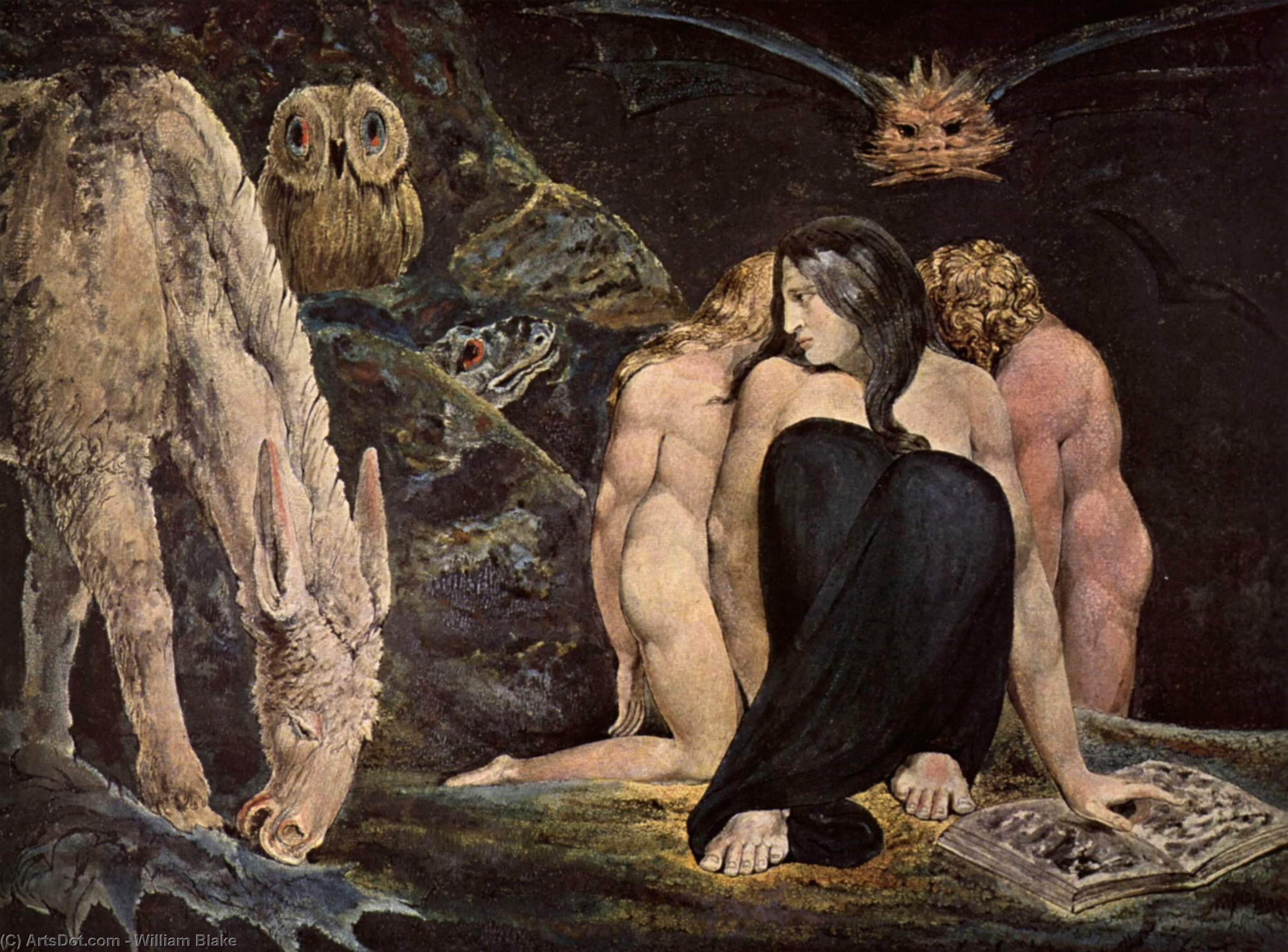
Hecate by William Blake

Hecate

Oil On Canvas

A Vision of the Mystical: William Blake’s Hecate William Blake (1757-1827), a titan of English Romanticism, wasn't merely a painter or poet; he was a visionary. His works transcend simple representation, delving into realms of mythology, spirituality, and the human psyche. This watercolor painting, *Hecate*, created between 1823-1825, exemplifies Blake’s unique artistic language and enduring fascination with ancient archetypes. Decoding the Goddess: Subject & Symbolism The artwork depicts Hecate, the…

The William Blake selection continues, 11 to 100

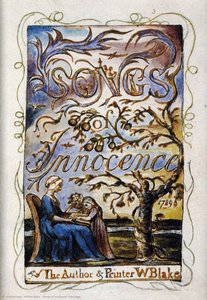
11The Ancient of Days (1827) by William BlakeThe Ancient of Days1827 · Whitworth Art Gallery 12The Sun at His Eastern Gate (1820) by William BlakeThe Sun at His Eastern Gate1820 13Songs of Innocence (Title page) (1825) by William BlakeSongs of Innocence (Title page)1825 · Metropolitan Museum of Art 14Milton`s Mysterious Dream (1820) by William BlakeMilton`s Mysterious Dream1820 15The Great Red Dragon and the Woman Clothed in Sun (1806) by William BlakeThe Great Red Dragon and the Woman Clothed in Sun1806 · Brooklyn Museum 16The Resurrection by William BlakeThe Resurrection 17El gran dragón rojo y la mujer vestida de sol by William BlakeEl gran dragón rojo y la mujer vestida de sol 18The Great Red Dragon and the Beast from the Sea (1805) by William BlakeThe Great Red Dragon and the Beast from the Sea1805 19Dante and Virgil at the Gates of Hell by William BlakeDante and Virgil at the Gates of Hell 20The Temptation and Fall of Eve (1808) by William BlakeThe Temptation and Fall of Eve1808 21Nebuchadnezzar (1795) by William BlakeNebuchadnezzar1795 · Tate Gallery 22Glad Day or The Dance of Albion (1794) by William BlakeGlad Day or The Dance of Albion1794 23Adam and Eve Sleeping (1808) by William BlakeAdam and Eve Sleeping1808 · Museum of Fine Arts 24The Descent of Christ (1804) by William BlakeThe Descent of Christ1804 · Yale Center for British Art 25Dante and Virgil at the Gates of Hell (Illustration to Dante's Inferno) by William BlakeDante and Virgil at the Gates of Hell (Illustration to Dante's Inferno) 26Antaeus setting down Dante and Virgil in the last circle of hell (1827) by William BlakeAntaeus setting down Dante and Virgil in the last circle of hell1827 · National Gallery of Victoria 27The-Blasphemer by William BlakeThe-Blasphemer 28Los Entering the Grave (1804) by William BlakeLos Entering the Grave1804 · Yale Center for British Art 29The Great Red Dragon and the Woman Clothed with the Sun (Rev. 12: 1-4) (1800) by William BlakeThe Great Red Dragon and the Woman Clothed with the Sun (Rev. 12: 1-4)1800 · Brooklyn Museum 30The Bard, from Gray (1809) by William BlakeThe Bard, from Gray1809 31The Last Supper (1799) by William BlakeThe Last Supper1799 · National Gallery of Art 32The Ghost of a Flea (1820) by William BlakeThe Ghost of a Flea1820 33Antaeus Setting Down Dante and Vergil by William BlakeAntaeus Setting Down Dante and Vergil 34The Sun in His Wrath (1820) by William BlakeThe Sun in His Wrath1820 35Satan before the throne of God by William BlakeSatan before the throne of God 36Inferno, Canto VII, 110-127, The Stygian Lake with angry sinners fighting by William BlakeInferno, Canto VII, 110-127, The Stygian Lake with angry sinners fighting 37Job and his Daughters (1823) by William BlakeJob and his Daughters1823 · Tate Gallery 38Angels Ministering to Christ (1820) by William BlakeAngels Ministering to Christ1820 39Elisha in the Chamber on the Wall (1820) by William BlakeElisha in the Chamber on the Wall1820 · Tate Gallery 40Isaac Newton (1795) by William BlakeIsaac Newton1795 · Tate Gallery 41The Angel Appearing to Zacharias (1800) by William BlakeThe Angel Appearing to Zacharias1800 · Metropolitan Museum of Art 42The Wandering Moon (1820) by William BlakeThe Wandering Moon1820 43Christ Nailed to the Cross The Third Hour (1803) by William BlakeChrist Nailed to the Cross The Third Hour1803 44Whirlwind of Lovers by William BlakeWhirlwind of Lovers 45Dante y Virgilio ante el ángel guardián de la puerta del purgatorio by William BlakeDante y Virgilio ante el ángel guardián de la puerta del purgatorio 46Illustration to Milton`s Comus (1820) by William BlakeIllustration to Milton`s Comus1820 47The number of the beast is 666 by William BlakeThe number of the beast is 666Brooklyn Museum 48The Casting of the Rebel Angels into Hell (1808) by William BlakeThe Casting of the Rebel Angels into Hell1808 49Untitled 8 by William BlakeUntitled 8 50The parable of the wise and foolish virgins (1822) by William BlakeThe parable of the wise and foolish virgins1822 51Andrew, Simon Peter Searching for Christ (1819) by William BlakeAndrew, Simon Peter Searching for Christ1819 52Oberon, Titania and Puck with Fairies Dancing (1786) by William BlakeOberon, Titania and Puck with Fairies Dancing1786 53Christ as the Redeemer of Man (1808) by William BlakeChrist as the Redeemer of Man1808 · Museum of Fine Arts 54Virgin and Child by William BlakeVirgin and ChildYale Center for British Art 55Job and his family restored to prosperity by William BlakeJob and his family restored to prosperity 56Satan smiting Job with boils (1826) by William BlakeSatan smiting Job with boils1826 57Glad Day by William BlakeGlad Day 58The Body of Abel Found by Adam and Eve by William BlakeThe Body of Abel Found by Adam and Eve 59Job´s evil dreams 2 by William BlakeJob´s evil dreams 2 60The Spirit of Plato (1820) by William BlakeThe Spirit of Plato1820 61Untitled 10 by William BlakeUntitled 10 62Virgilio arrojando a Felipe Argenti de la barca de Flegias by William BlakeVirgilio arrojando a Felipe Argenti de la barca de Flegias 63The fall of Satan by William BlakeThe fall of Satan 64Satan schüttet die Plagen über Hiob aus by William BlakeSatan schüttet die Plagen über Hiob aus 65Last Judgement (1808) by William BlakeLast Judgement1808 66Illustration to Milton`s Paradise Lost (1807) by William BlakeIllustration to Milton`s Paradise Lost1807 67Dante tropieza con Bocca degli Abbati by William BlakeDante tropieza con Bocca degli Abbati 68Ugolino tells his cruel history by William BlakeUgolino tells his cruel history 69Job and his daughters 2 by William BlakeJob and his daughters 2 70The vision of Eliphaz 2 by William BlakeThe vision of Eliphaz 2 71The centaurs and the River of Blood by William BlakeThe centaurs and the River of Blood 72Dante y Virgilio se disponen a tomar la barca hacia la ciudad de Dite by William BlakeDante y Virgilio se disponen a tomar la barca hacia la ciudad de Dite 73Behemoth and Leviathan by William BlakeBehemoth and Leviathan 74Job and his family 1 by William BlakeJob and his family 1 75El Ángel que conserva el gran libro de los actos buenos y los malos by William BlakeEl Ángel que conserva el gran libro de los actos buenos y los malos 76Job Confessing his Presumption to God who Answers from the Whirlwind (1803) by William BlakeJob Confessing his Presumption to God who Answers from the Whirlwind1803 · National Gallery of Scotland 77Job´s despair 1 by William BlakeJob´s despair 1 78The hypocrites with Caiaphas by William BlakeThe hypocrites with Caiaphas 79The Book of Job: When the Morning Stars Sang Together (1820) by William BlakeThe Book of Job: When the Morning Stars Sang Together1820 · The Morgan Library & Museum 80Job´s sonns and daughters destroyed by William BlakeJob´s sonns and daughters destroyed 81Satan going forth from the presence of the Lord 2 by William BlakeSatan going forth from the presence of the Lord 2 82Job´s evil dreams 1 by William BlakeJob´s evil dreams 1 83Untitled 11 by William BlakeUntitled 11 84Untitled 14 by William BlakeUntitled 14 85La serpiente de seis pies ataca a Agnelo dei Brunelleschi by William BlakeLa serpiente de seis pies ataca a Agnelo dei Brunelleschi 86The giant Nimrod by William BlakeThe giant Nimrod 87The Sea of Time and Space (1821) by William BlakeThe Sea of Time and Space1821 · Arlington Court 88San Pedro appears to Dante and Beatrice by William BlakeSan Pedro appears to Dante and Beatrice 89Wilson Lowry by William BlakeWilson Lowry 90A Sunshine Holiday (1820) by William BlakeA Sunshine Holiday1820 91Untitled 13 by William BlakeUntitled 13 92Satan before the throne of God 1 by William BlakeSatan before the throne of God 1 93David Hartley by William BlakeDavid Hartley 94Agnelo dei Brunelleschi metamorfoseado por la serpiente by William BlakeAgnelo dei Brunelleschi metamorfoseado por la serpiente 95La Ascensión al purgatorio by William BlakeLa Ascensión al purgatorio 96Satan smiting job with boils 1 by William BlakeSatan smiting job with boils 1 97La ciudad de Dite y el Ángel atravesando la Laguna Estigia by William BlakeLa ciudad de Dite y el Ángel atravesando la Laguna Estigia 98Mirth (1820) by William BlakeMirth1820 99An Allegory of the Spiritual Condition of Man (1811) by William BlakeAn Allegory of the Spiritual Condition of Man1811 · Fitzwilliam Museum 100The Spiritual Form of Nelson guiding Leviathan (1800) by William BlakeThe Spiritual Form of Nelson guiding Leviathan1800

William Blake's famous paintings, period by period

The subjects that held William Blake's eye

The four subjects that come back most often in these originals, each with its finest example.

The museums that keep William Blake's originals

The 8 museums that hold the most of the paintings on this page.

Museum City Works by William Blake Paintings from this list
Tate Gallery, LondonTate Gallery London 6 Elohim Creating Adam, Nebuchadnezzar, Job and his Daughters
Yale Center for British Art, New HavenYale Center for British Art New Haven 7 The Descent of Christ, Los Entering the Grave, Virgin and Child
Museum of Fine Arts, BostonMuseum of Fine Arts Boston 5 Satan Watching the Caresses of Adam and Eve, Adam and Eve Sleeping, Christ as the Redeemer of Man
National Gallery of Art, WashingtonNational Gallery of Art Washington 4 The Great Red Dragon and the Woman Clothed with Sun, The Last Supper
Metropolitan Museum of Art, New YorkMetropolitan Museum of Art New York 2 Songs of Innocence (Title page), The Angel Appearing to Zacharias
Brooklyn Museum, BrooklynBrooklyn Museum Brooklyn 2 The Great Red Dragon and the Woman Clothed with the Sun (Rev. 12: 1-4), The number of the beast is 666
Fitzwilliam MuseumFitzwilliam Museum 6 An Allegory of the Spiritual Condition of Man
British Museum, LondonBritish Museum London 3 The Ancient of Days

William Blake decade by decade: the original that defines each

Works per decade

Pick a decade to see the original that defines it.

Collectors' questions about William Blake's paintings

Which work is William Blake most famous for?Reveal the answer

The Ancient of Days (1794), British Museum, London. Newton and The Ancient of Days (1794) come next.

What age was William Blake when The Ancient of Days was made?Reveal the answer

37 years old: The Ancient of Days dates from 1794, and William Blake was born in 1757.

What are the ten most famous William Blake paintings?Reveal the answer

The Ancient of Days, Newton, The Ancient of Days, The Great Red Dragon and the Woman Clothed with Sun, The Red Dragon and the Woman Clothed with the Sun, Satan Exulting over Eve, Elohim Creating Adam, Satan Watching the Caresses of Adam and Eve, The Lovers' Whirlwind, Francesca da Rimini and Paolo Malatesta and Hecate. The ranking above gives each one's year and museum.

How many paintings did William Blake leave?Reveal the answer

Our catalog holds 324 works by William Blake, dated from 1786 to 1827.

In which museums do William Blake's masterpieces hang?Reveal the answer

Mostly in Tate Gallery (London), Yale Center for British Art (New Haven) and Museum of Fine Arts (Boston). The museum table above lists them all.

In which years did William Blake paint the most famous works?Reveal the answer

In 1820s: 20 of the 100 works on this page were made then, The Lovers' Whirlwind, Francesca da Rimini and Paolo Malatesta among them.

What are the first and the last famous originals of William Blake?Reveal the answer

On this page, the earliest is Oberon, Titania and Puck with Fairies Dancing (1786) and the latest The Ancient of Days (1827).

Which subjects did William Blake choose most often?Reveal the answer

Mythology (22), Spirituality (16) and Angels (10), across the 100 works on this page.

Which technique did William Blake use most?Reveal the answer

Acrylic On Canvas, for 51 of the 100 works on this page.

To which art movement does William Blake belong?Reveal the answer

Romanticism, judging by the originals on this page.

Which William Blake works hang at the Tate Gallery?Reveal the answer

Elohim Creating Adam, Nebuchadnezzar and Job and his Daughters: the Tate Gallery, London holds 5 of the works on this page.

Can I commission a reproduction of a William Blake painting?Reveal the answer

Yes, as a reproduction: the original stays in its museum, but any painting on this page can be painted by hand for you, made to order one at a time, from the painting's own page.

William Blake: life and work

Early Life, Family and Training

William Blake was born on November 28, 1757, in London, England. He was raised in a household above his father’s hosier shop at 28 Broad Street. His parents, James Blake and Catherine Wright Armitage Blake, provided a stable environment during a period of significant social change in the city. While his upbringing was marked by the modest means of a tradesman's family, his early years were defined by a singular, intense imagination that often manifested in visions, such as seeing angels in the branches of a tree during childhood walks.

Formal training began at the age of ten when he was enrolled at Henry Pars' drawing school. This early instruction provided the technical foundation for a career that would eventually move beyond simple sketching. By the age of 14, the necessity of practical work led him into a seven-year apprenticeship under the engraver James Basire. This period was essential to his development, as it introduced him to the rigorous mechanics of printmaking and the physical properties of metal and acid.

During his apprenticeship, Blake spent significant time sketching the tombs at Westminster Abbey. The Gothic architecture and the weathered stone of these monuments left a lasting impression on his aesthetic sensibilities. These studies allowed him to internalize the forms of the past, which he would later reinterpret through his own unique lens. His training was not merely a pursuit of craft, but a deep immersion into the visual language of history and structure.

Technique and Artistic Innovation

Blake’s creative process was defined by a restless desire to merge the written word with the visual image. He moved beyond the standard commercial engravings of his era to develop a unique method of relief etching for his illuminated books. This technique involved applying an acid-resistant varnish to copper plates, allowing him to etch both text and illustration into a single, integrated form. This method was not merely a technical choice but a spiritual one; he claimed the process was revealed to him through a visionary experience following the death of his brother, Robert. Working alongside his wife, Catherine, who assisted in the printing and coloring, he managed the entire production from the initial etching to the final stitching of the books.

His aesthetic was a deliberate departure from the rigid rules of his contemporaries. He rejected the traditional use of linear perspective, which sought to mimic the physical world, in favor of a more emotive and symbolic representation of space. This flattening of the visual field allowed him to prioritize the internal logic of his visions over the constraints of naturalism. To bring these visions to life, he frequently employed watercolors and tempera paints, applying color by hand to the printed sheets to achieve a specific, personal texture. His work was a labor of both hand and spirit, often produced in the quiet of his London home.

Key Works and Major Publications

The early output of his career began with the publication of Poetical Sketches in 1783. This initial collection of verse was followed by his most widely recognized lyrical achievements: Songs of Innocence in 1789 and Songs of Experience in 1794. These works established a recurring tension in his writing, exploring the contrast between a state of untainted childhood and the corruption of adult reality. Between 1790 and 1793, he produced The Marriage of Heaven and Hell, a provocative work that challenged established moral and religious doctrines through prose and verse.

His engagement with the political turbulence of his era found expression in his prophetic books. He produced America, a Prophecy in 1793 and Europe, a Prophecy in 1794, works that reflected the revolutionary spirit of the time. These publications were not merely texts but integrated visions where the etched image and the written word functioned as a single entity. His later years were marked by expansive, complex projects that required years of sustained effort.

The later stages of his life saw the development of massive, intricate cycles. He worked on the Milton series between 1804 and 1808, and his final major undertaking, Jerusalem, occupied him from 1804 until 1820. These works represent the culmination of his lifelong attempt to construct a private mythology, one that sought to reconcile the human spirit with the divine through a highly personal symbolic language.

Patrons, Workshop and Commissions

The financial reality of Blake’s life was often a struggle for stability. For much of his career, he earned a living as a journeyman engraver, taking on commercial work to sustain himself. In about 1784, he attempted to establish a more permanent professional footing by setting up a print shop alongside James Parker, a friend and former fellow apprentice. This venture, however, did not provide the lasting security he required. Instead, his livelihood frequently depended on the steady support of a few dedicated patrons, most notably Thomas Butts, whose patronage offered a vital lifeline to the artist's more personal pursuits.

His professional geography shifted as his circumstances changed. Between 1800 and 1803, Blake moved to the coastal town of Felpham. During this period, he lived and worked under the patronage of William Hayley. This time in Felpham provided a temporary reprieve from the urban pressures of London, allowing him to focus on his complex series of works. Even as he navigated the demands of commissions, his work remained deeply tied to the specific needs of those who supported his vision, often balancing the practical requirements of engraving for others with the private labor of his own illuminated printing.

Legacy and Enduring Influence

During his lifetime, Blake’s vision was often met with misunderstanding, his work frequently dismissed as the product of an eccentric or unstable mind. He lived a life of relative obscurity, often struggling for financial stability while working as an engraver. Yet, the very qualities that marginalized him in the early nineteenth century eventually secured his place as a pivotal figure in the Romantic movement. His insistence on the primacy of the imagination over the constraints of reason provided a blueprint for those who would later seek to break from traditional academic structures.

The impact of his singular style eventually reached beyond his immediate circle. The Pre-Raphaelite Brotherhood embraced him as a kindred spirit, finding common ground in his rejection of Neoclassical conventions. As the decades passed, his influence moved through the Symbolist and Modernist movements, finding resonance in their shared interest in subjective experience and spiritual depth. He did not merely illustrate poems; he constructed a private mythology that continues to provide a source of inspiration for poets, painters, and thinkers across various disciplines.

  • The Tyger
  • The Lamb
  • London
  • Jerusalem

Where to See the Works Today

The physical remnants of Blake’s vision are scattered across several major institutions, reflecting the global reach of his influence. In London, the Tate Gallery holds six of his works, including the significant 1795 depiction of Isaac Newton. This collection offers a substantial look at the technical precision he applied to his engravings and the way he translated complex spiritual concepts into visual form.

Across the Atlantic, his presence is felt in several prominent American collections. The Yale Center for British Art in New Haven maintains four works, such as the 1804 print of Los Entering the Grave. Meanwhile, the Museum of Fine Arts in Boston also holds four pieces, including his 1808 study of Adam and Eve Sleeping. These holdings allow for a comparative study of his development from a commercial engraver to a creator of independent, illuminated volumes.

His reach extends even further to the Southern Hemisphere. The National Gallery of Victoria in Melbourne contains one work, an 1827 piece titled Antaeus setting down Dante and Virgil in the last circle of hell. This single presence in Australia highlights the enduring international interest in his peculiar, highly personal mythology.

All 324 works by William Blake →