Portrait of Willard Metcalf

The 100 Most Famous Willard Metcalf Paintings, Each One of a Kind

Updated November 2026 · ranked by our popularity score (searches, visits and orders for each work) · 212 works by Willard Metcalf in our catalogue

In short

Gloucester Harbor (1895) is the Willard Metcalf painting that draws the most eyes. After it, the eye goes to Flying Shadows (1909) and Spring at Leete's Island (1905). Among the 212 works of Willard Metcalf in our catalog, these 100 are the most famous, each a unique original presented with its year, its museum and the reason it endures.

1858 – 1925, Lowell Impressionism Most works: Museum of Fine Arts

Top 10 paintings by Willard Metcalf, through the gallery's eye

1
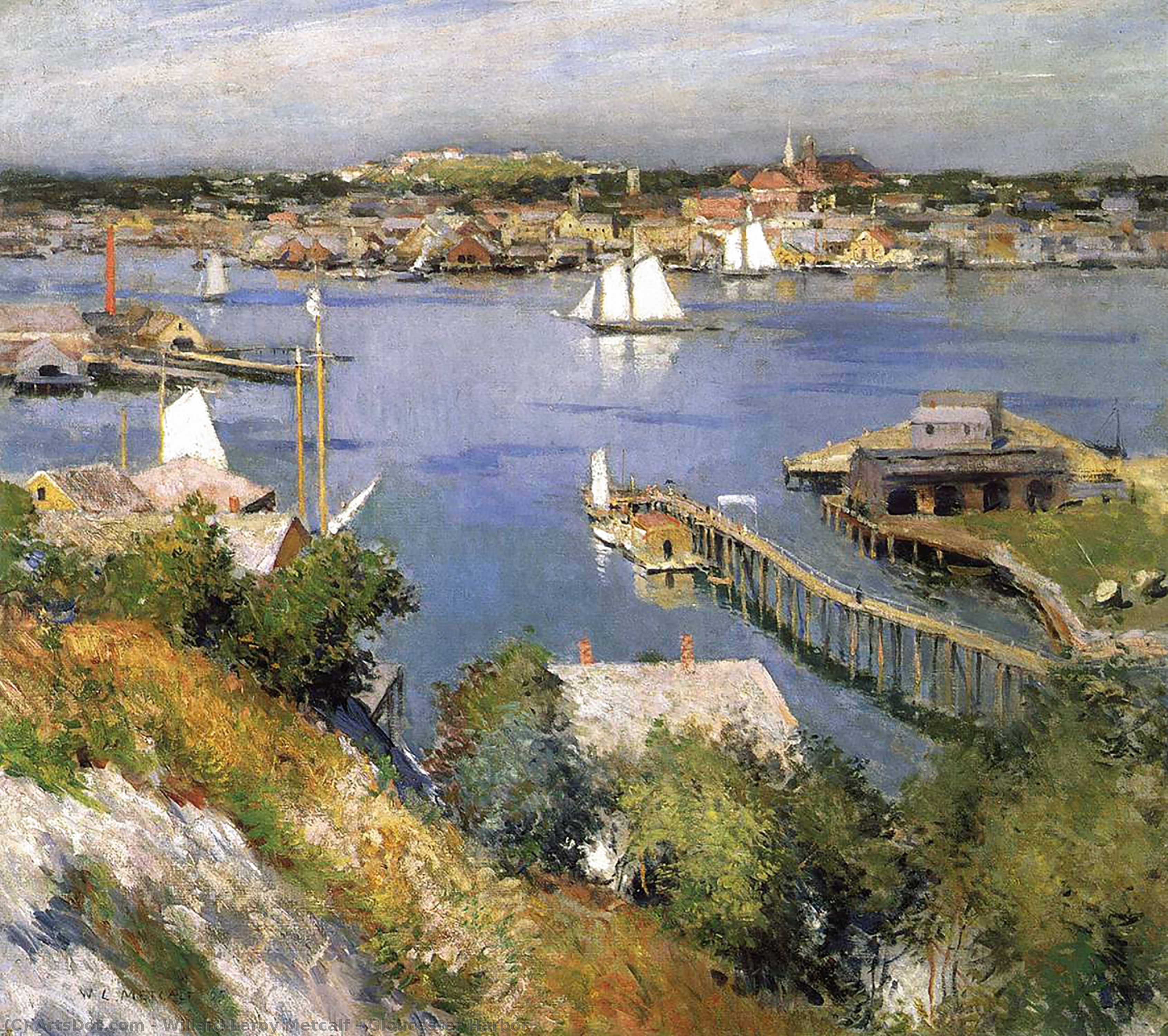
Gloucester Harbor (1895) by Willard Metcalf

Gloucester Harbor

1895 · Oil On Canvas

Step into a world of serene coastal beauty with Willard Leroy Metcalf’s “Gloucester Harbor” (1895). This captivating painting isn't merely a depiction of a New England harbor; it’s an experience – a masterclass in American Impressionism that invites contemplation and evokes the tranquility of seaside life.

2
Flying Shadows (1909) by Willard Metcalf

Flying Shadows

1909 · Oil On Canvas

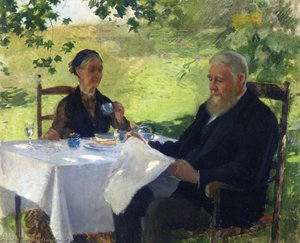
The artwork titled Flying Shadows is an oil on canvas painting by the artist Willard Metcalf. This specific work dates to 1909. The physical dimensions of the piece are 66 x 73.7 cms, which corresponds to 26 x 29 ins.

3
Spring at Leete's Island (1905) by Willard Metcalf

Spring at Leete's Island

1905 · Oil On Canvas

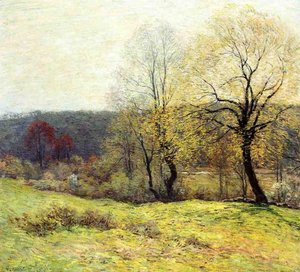
The air feels heavy with the scent of damp earth and new growth as the scene unfolds across a lush green field. Sunlight filters through a sky crowded with drifting clouds, casting a soft, shifting light over the landscape. In the foreground, trees reach upward, their branches framing a view that stretches toward a quiet body of water in the distance. Life moves through this meadow in small, unhurried increments.…

4
The Golden Carnival (1910) by Willard Metcalf

The Golden Carnival

1910 · Oil On Canvas

The Golden Carnival is an oil on canvas painted by Willard Metcalf in 1910. This work captures a valley where mountains rise in the distance and a river winds through the terrain. People move through the landscape, some resting by the water's edge and others positioned upon the hillsides. It is a quiet scene of human presence within the natural world.

5
The First Snow (1906) by Willard Metcalf

The First Snow

1906 · Oil On Canvas · Museum of Fine Arts, Boston

We are looking at The First Snow, a quiet work by Willard Metcalf. Painted in 1906, this oil on canvas captures a specific, fleeting moment of winter. It is a piece that invites a slower kind of observation, much like the stillness of the season it depicts.

6
Early Autumn (1908) by Willard Metcalf

Early Autumn

1908 · Oil On Canvas · Yale University Art Gallery, New Haven

Early Autumn is an oil painting by the American artist Willard Metcalf. The work is dated 1908. This piece belongs to the period of the artist's career following his studies in both the United States and Europe.

7
Jewish Girl, Tunis (1887) by Willard Metcalf

Jewish Girl, Tunis

1887 · Oil On Canvas · New Britain Museum of American Art, New Britain

In Jewish Girl, Tunis, Willard Metcalf presents a medium close-up portrait of a young girl, likely of Tunisian Jewish descent. The subject is positioned centrally against a neutral, textured background. This arrangement focuses the viewer's attention entirely on the girl's presence and her quiet, contemplative expression. The eye-level perspective establishes a direct connection between the subject and the observer.

8
The Red Oak (no.2) (1911) by Willard Metcalf

The Red Oak (no.2)

1911 · Oil On Canvas

To stand before Willard Leroy Metcalf's The Red Oak (no.2) is to step into a moment suspended in time—a breath of late afternoon light filtering through the heart of an American landscape. This painting, executed in 1911, is far more than a mere depiction of foliage; it is a meditation on permanence amidst the gentle flux of nature. Metcalf, a master chronicler of the ephemeral beauty surrounding him, has captured…

9
Poppy Garden (1905) by Willard Metcalf

Poppy Garden

1905 · Oil

In the heart of the American Impressionist movement, few works capture the fleeting essence of a summer afternoon as tenderly as Willard Leroy Metcalf’s Poppy Garden. Painted in 1905, this masterpiece serves as a vibrant window into a world where nature is not merely observed, but felt. The canvas is dominated by a breathtaking sea of red poppies, their petals acting as brilliant embers against the lush greenery of the…

10
September Morning, Plainfield, New Hampshire (1911) by Willard Metcalf

September Morning, Plainfield, New Hampshire

1911 · Oil On Canvas

The oil on canvas painting titled September Morning, Plainfield, New Hampshire was created by the American artist Willard Metcalf. This work dates to 1911. The artist, born in Lowell, United States, in 1858, focused much of his career on the landscapes of New England. He was a member of the Old Lyme Art Colony and later became a founding member of The Ten American Painters.

Willard Metcalf's famous paintings, numbers 11 to 100

11Ten Cent Breakfast by Willard MetcalfTen Cent BreakfastDenver Art Museum 12The Village- September Morning by Willard MetcalfThe Village- September Morning 13The White Veil (1909) by Willard MetcalfThe White Veil1909 · Detroit Institute of Arts 14Ebbing Tide, Version Two (1907) by Willard MetcalfEbbing Tide, Version Two1907 15The Passing Glory (1907) by Willard MetcalfThe Passing Glory1907 16Cap Ferrat, marina Saint Jean (1903) by Willard MetcalfCap Ferrat, marina Saint Jean1903 17Closing Autumn (1924) by Willard MetcalfClosing Autumn1924 18havana harbor by Willard Metcalfhavana harbor 19Poppy Field, Giverny by Willard MetcalfPoppy Field, Giverny 20Child in Sunlight by Willard MetcalfChild in Sunlight 21Ebb Tide (1895) by Willard MetcalfEbb Tide1895 22Early Spring Afternoon, Central park (1911) by Willard MetcalfEarly Spring Afternoon, Central park1911 · Brooklyn Museum 23The Sunny Brook, Chester, Vermont (1923) by Willard MetcalfThe Sunny Brook, Chester, Vermont1923 24Sunlight and Shadow (1888) by Willard MetcalfSunlight and Shadow1888 · Museum of Fine Arts 25Unfolding Buds (1909) by Willard MetcalfUnfolding Buds1909 · Detroit Institute of Arts 26Chase's House, New Hampshire (1875) by Willard MetcalfChase's House, New Hampshire1875 27Grazing sheep on the coast of Maine (1877) by Willard MetcalfGrazing sheep on the coast of Maine1877 28Sandy Hollow, Manchaset (1877) by Willard MetcalfSandy Hollow, Manchaset1877 29Reflections at Grez sur Loing (1884) by Willard MetcalfReflections at Grez sur Loing1884 30On the Suffolk Coast (1885) by Willard MetcalfOn the Suffolk Coast1885 31Great Diamond Island (1879) by Willard MetcalfGreat Diamond Island1879 32Close of Day on the Maine Shore (1881) by Willard MetcalfClose of Day on the Maine Shore1881 33Landscape (1884) by Willard MetcalfLandscape1884 34Old Woman with Child and Goose (1884) by Willard MetcalfOld Woman with Child and Goose1884 35Midsummer Twilight (1890) by Willard MetcalfMidsummer Twilight1890 · National Gallery of Art 36Giverny (1888) by Willard MetcalfGiverny1888 37Haystacks (1890) by Willard MetcalfHaystacks1890 38Haystacks at Sunset (1888) by Willard MetcalfHaystacks at Sunset1888 39Venice (1887) by Willard MetcalfVenice1887 40Coast of Maine (1889) by Willard MetcalfCoast of Maine1889 41Pottery Shop at Tunis (1887) by Willard MetcalfPottery Shop at Tunis1887 42Sunset at Grez (1887) by Willard MetcalfSunset at Grez1887 43Goose Girl (1886) by Willard MetcalfGoose Girl1886 44Tea on the Porch (1890) by Willard MetcalfTea on the Porch1890 45The Jetty (1895) by Willard MetcalfThe Jetty1895 46Sunset Hour on the West Lagoon, World Columbian Exposition 1893 (1893) by Willard MetcalfSunset Hour on the West Lagoon, World Columbian Exposition 18931893 47Inner Harbour, Gloucester (1895) by Willard MetcalfInner Harbour, Gloucester1895 48Mill Pond (1904) by Willard MetcalfMill Pond1904 · Rhode Island School of Design Museum of Art 49Inlet at East Boothbay Harbor (1904) by Willard MetcalfInlet at East Boothbay Harbor1904 50Purple, White and Gold (1903) by Willard MetcalfPurple, White and Gold1903 51A Summer's Night (1902) by Willard MetcalfA Summer's Night1902 52Moonlight, Kittery Maine (1902) by Willard MetcalfMoonlight, Kittery Maine1902 53Midsummer Twilight (1902) by Willard MetcalfMidsummer Twilight1902 54Havana Cathedral (1902) by Willard MetcalfHavana Cathedral1902 55The Landing Place (1904) by Willard MetcalfThe Landing Place1904 56Prelude (1909) by Willard MetcalfPrelude1909 · Worcester Art Museum 57The White Veil (1909) by Willard MetcalfThe White Veil1909 · Rhode Island School of Design Museum of Art 58The Birches (1906) by Willard MetcalfThe Birches1906 · Museum of Fine Arts 59The White Mantle (1906) by Willard MetcalfThe White Mantle1906 60Au Cafe by Willard MetcalfAu Cafe 61The Red Bridge (1911) by Willard MetcalfThe Red Bridge1911 62Fall (1911) by Willard MetcalfFall1911 63Early Spring, Old Lyme (1906) by Willard MetcalfEarly Spring, Old Lyme1906 64Cornish Hills (1911) by Willard MetcalfCornish Hills1911 65September (1910) by Willard MetcalfSeptember1910 66The Golden Hour (1907) by Willard MetcalfThe Golden Hour1907 67May Pastoral (1907) by Willard MetcalfMay Pastoral1907 68Laurel Woods (1906) by Willard MetcalfLaurel Woods1906 69The Trout Pool, November (1910) by Willard MetcalfThe Trout Pool, November1910 70The Trout Brook (1907) by Willard MetcalfThe Trout Brook1907 71Valley of the Mugnone (1911) by Willard MetcalfValley of the Mugnone1911 72Green Canopy (1908) by Willard MetcalfGreen Canopy1908 73Midsummer Shadows (1906) by Willard MetcalfMidsummer Shadows1906 · Yale University Art Gallery 74The Falls (1909) by Willard MetcalfThe Falls1909 75October (1908) by Willard MetcalfOctober1908 76Maytime (1910) by Willard MetcalfMaytime1910 77Dogwood Blossoms (1906) by Willard MetcalfDogwood Blossoms1906 78Johnny Cake Hill (1906) by Willard MetcalfJohnny Cake Hill1906 79The Red Maple (1906) by Willard MetcalfThe Red Maple1906 80October Morning No. 1 (1910) by Willard MetcalfOctober Morning No. 11910 81The Golden Screen (1906) by Willard MetcalfThe Golden Screen1906 82The Frozen Pool, March (1909) by Willard MetcalfThe Frozen Pool, March1909 83Pasture, Old Lyme (1906) by Willard MetcalfPasture, Old Lyme1906 84A Family of Birches (1907) by Willard MetcalfA Family of Birches1907 · Smithsonian American Art Museum 85The Picnic (1907) by Willard MetcalfThe Picnic1907 86Thawing Brook (1911) by Willard MetcalfThawing Brook1911 87June Pastoral (1910) by Willard MetcalfJune Pastoral1910 88Early October (1906) by Willard MetcalfEarly October1906 89Willows in March (1911) by Willard MetcalfWillows in March1911 90May Night (1906) by Willard MetcalfMay Night1906 91Old Homestead Connecticut (1914) by Willard MetcalfOld Homestead Connecticut1914 · Saint Louis Art Museum 92Hillside Dwellings, Pelago, Italy (1914) by Willard MetcalfHillside Dwellings, Pelago, Italy1914 · El Paso Museum of Art 93Pelago, Tuscany (1913) by Willard MetcalfPelago, Tuscany1913 · Buffalo AKG Art Museum 94Joyous Maytime (1917) by Willard MetcalfJoyous Maytime1917 95Spring Planting (1912) by Willard MetcalfSpring Planting1912 96Summer Night No. 3 (1917) by Willard MetcalfSummer Night No. 31917 97Winter Afternoon (1917) by Willard MetcalfWinter Afternoon1917 98Mountain Lakes, Olden, Norwas (1913) by Willard MetcalfMountain Lakes, Olden, Norwas1913 99Salmon River, Norway (1913) by Willard MetcalfSalmon River, Norway1913 100Road To Cape Porpoise (1912) by Willard MetcalfRoad To Cape Porpoise1912

Willard Metcalf's famous paintings, period by period

The subjects that held Willard Metcalf's eye

The four subjects that come back most often in these originals, each with its finest example.

The museums that keep Willard Metcalf's originals

The 8 museums that hold the most of the paintings on this page.

Museum City Works by Willard Metcalf Paintings from this list
Museum of Fine Arts, BostonMuseum of Fine Arts Boston 2 The First Snow, The Birches
Yale University Art Gallery, New HavenYale University Art Gallery New Haven 2 Early Autumn, Midsummer Shadows
Detroit Institute of Arts, DetroitDetroit Institute of Arts Detroit 2 The White Veil, Unfolding Buds
Rhode Island School of Design Museum of Art, ProvidenceRhode Island School of Design Museum of Art Providence 2 Mill Pond, The White Veil
New Britain Museum of American Art, New BritainNew Britain Museum of American Art New Britain 3 Jewish Girl, Tunis
National Gallery of Art, WashingtonNational Gallery of Art Washington 2 Midsummer Twilight
Smithsonian American Art Museum, Washington, D.C.Smithsonian American Art Museum Washington, D.C. 2 A Family of Birches
Denver Art Museum, DenverDenver Art Museum Denver 1 Ten Cent Breakfast

Willard Metcalf across the decades: one unique original for each

Works per decade

Pick a decade to see the original that defines it.

Willard Metcalf's paintings: questions for the gallery

What is the single most famous work of Willard Metcalf?Reveal the answer

Gloucester Harbor (1895). Flying Shadows (1909) and Spring at Leete's Island (1905) come next.

At what age did Willard Metcalf create Gloucester Harbor?Reveal the answer

37 years old: Gloucester Harbor dates from 1895, and Willard Metcalf was born in 1858.

Which ten paintings by Willard Metcalf are the most famous?Reveal the answer

Gloucester Harbor, Flying Shadows, Spring at Leete's Island, The Golden Carnival, The First Snow, Early Autumn, Jewish Girl, Tunis, The Red Oak (no.2), Poppy Garden and September Morning, Plainfield, New Hampshire. The ranking above gives each one's year and museum.

How many works by Willard Metcalf are known?Reveal the answer

Our catalog holds 212 works by Willard Metcalf, dated from 1875 to 1924.

Where can the most famous Willard Metcalf originals be seen?Reveal the answer

Mostly in Museum of Fine Arts (Boston), Yale University Art Gallery (New Haven) and Detroit Institute of Arts (Detroit). The museum table above lists them all.

During which period did Willard Metcalf create the best-known paintings?Reveal the answer

In 1900s: 41 of the 100 works on this page were made then, Flying Shadows among them.

Which famous Willard Metcalf painting is the earliest, and which the latest?Reveal the answer

On this page, the earliest is Chase's House, New Hampshire (1875) and the latest Closing Autumn (1924).

What subjects did Willard Metcalf favour?Reveal the answer

Trees (11), Landscape (9) and American art (6), across the 100 works on this page.

What materials did Willard Metcalf paint with most?Reveal the answer

Oil On Canvas, for 17 of the 100 works on this page.

Which movement does the work of Willard Metcalf belong to?Reveal the answer

Impressionism, judging by the originals on this page.

What Willard Metcalf originals can I see at the Museum of Fine Arts?Reveal the answer

The First Snow and The Birches: the Museum of Fine Arts, Boston holds 2 of the works on this page.

Willard Metcalf: a portrait of the artist

A Life Immersed in Light and Landscape

Willard Leroy Metcalf, a pivotal figure in the blossoming of American Impressionism, dedicated his life to capturing the ephemeral beauty of the natural world. Born in Lowell, Massachusetts, in 1858, he wasn’t merely a painter of landscapes; he was a poet of light and atmosphere, translating the quietude of New England scenes and beyond onto canvas with a delicate touch and vibrant palette. His journey as an artist was one of rigorous training, extensive travel, and a profound commitment to portraying intimate moments in nature – fleeting glimpses of beauty often overlooked. Metcalf’s story is not simply about artistic development, but also about finding his voice amidst the evolving currents of late 19th and early 20th-century art, and ultimately, leaving an indelible mark on American Impressionism.

From Academic Foundations to European Influences

Metcalf’s formal artistic education began at the School of the Museum of Fine Arts in Boston, where he honed his foundational skills until 1878. This was followed by a crucial period of study at the Académie Julian in Paris, a renowned center for American artists seeking classical training. Initially, Metcalf focused on figure painting and illustration – skills that would later inform his compositions – but it was during his extended sojourn in Europe, beginning in 1883, that his artistic trajectory began to shift decisively towards landscape art. He studied with Gustave Boulanger and Jules-Joseph Lefebvre, absorbing the technical expertise of French academic tradition. However, it wasn’t just formal instruction that shaped his vision; it was immersion in the European landscape itself. Travels through England and Brittany exposed him to diverse light conditions and artistic communities. A particularly significant moment arrived in 1886 when Metcalf became the first American artist to visit Claude Monet's garden at Giverny, a watershed experience that profoundly impacted his approach to capturing light, color, and atmosphere. This encounter wasn’t about imitation, but rather an awakening to the possibilities of portraying the subjective experience of seeing – a cornerstone of Impressionist philosophy.

The Rise of an American Impressionist

Upon returning to the United States in 1889, Metcalf began to forge his own distinct style, blending academic training with the lessons learned from European masters and his growing sensitivity to the American landscape. He worked as an illustrator and teacher while continuing to paint, gradually moving away from traditional techniques towards a more expressive and atmospheric approach. His paintings of this period often depict serene scenes of New England life – coastal harbors, quiet villages, and sun-dappled meadows. Critics frequently drew parallels between his work and the poetry of Robert Frost and Walt Whitman, recognizing a shared sensibility for capturing the essence of American experience. In 1897, Metcalf played a pivotal role in the formation of “The Ten American Painters,” a group that seceded from the Society of American Artists to pursue greater artistic independence and experimentation. This act signified a turning point in American art, marking a shift towards a more modern and individualistic aesthetic. Notable works like *Gloucester Harbor* (1895) exemplify his mastery of light and color, while pieces such as *The River Epte, Giverny*, clearly demonstrate the enduring influence of Monet’s garden on his artistic vision.

Legacy and Enduring Influence

Willard Leroy Metcalf's contribution to American art extends beyond his captivating paintings. He was a dedicated educator, sharing his knowledge and passion for art by teaching at institutions like Cooper Union School of Art for Women in New York City and the Art Students League of New York. His influence on subsequent generations of artists is undeniable. Metcalf’s ability to capture fleeting moments of beauty and tranquility, combined with his technical skill and poetic sensibility, cemented his place as a significant figure in American art history. He wasn't interested in grand narratives or dramatic compositions; instead, he found inspiration in the everyday – the gentle play of light on water, the subtle hues of a twilight sky, the quiet dignity of rural life. His paintings are not merely representations of landscapes; they are evocations of mood and atmosphere, inviting viewers to share in his intimate connection with nature.

A Lasting Impression

Today, Metcalf’s work continues to resonate with audiences worldwide. His paintings can be found in major museum collections across the United States, including the Art Institute of Chicago, the Metropolitan Museum of Art, and the Smithsonian American Art Museum. He remains a celebrated figure in the history of American Impressionism, admired for his technical brilliance, poetic vision, and enduring commitment to capturing the beauty of the natural world.
  • His paintings often evoke a sense of quiet contemplation.
  • He was a founding member of The Ten American Painters.
  • Metcalf’s work is characterized by intimate and modest landscapes.
Willard Leroy Metcalf's legacy isn’t just about the art he created, but also about the way he encouraged others to see – to appreciate the subtle beauty that surrounds us and to find inspiration in the everyday moments of life.