Portrait of Vasily Perov

The 100 Most Famous Vasily Perov Paintings, a Gallery Selection

Updated November 2026 · ranked by our popularity score (searches, visits and orders for each work) · 170 works by Vasily Perov in our catalogue

In short

Of all the originals Vasily Perov left, the most famous is Last Journey (1865), in the collection of the Tretyakov Gallery, Moscow. Close behind it come The farmer in the field (1876) and Boy-craftsman (1865). Our catalog holds 170 works by Vasily Perov; the gallery has kept the 100 the world admires most, each shown with its date, its museum and its story.

1833 – 1882, Tobolsk Realism Most works: Tretyakov Gallery

Vasily Perov's top 10 paintings: the gallery's choice

1
Last Journey (1865) by Vasily Perov

Last Journey

1865 · Oil On Canvas · Tretyakov Gallery, Moscow

Vasily Grigoryevich Perov's "Last Journey," painted in 1865, is a poignant masterpiece of Realism that offers a stark and unflinching portrayal of life for the peasantry in 19th-century Russia. Measuring 43 x 57 cm, this oil on canvas work transcends mere depiction; it serves as a social commentary and an emotional exploration of loss, resilience, and the burdens of rural existence.

2
The farmer in the field (1876) by Vasily Perov

The farmer in the field

1876 · Oil

In the heart of a sprawling, sun-drenched landscape, Vasily Grigoryevich Perov captures a profound moment of stillness in his 1876 masterpiece, The Farmer in the Field. The painting presents us with an elderly man, a figure etched by time and toil, seated upon a weathered rock amidst the vastness of a rural expanse. His long, white beard flows like a river of silver, contrasting softly against the earthy tones of…

3
Boy-craftsman (1865) by Vasily Perov

Boy-craftsman

1865 · Oil On Canvas

In Boy-craftsman, Vasily Perov presents a quiet, intimate moment centered on a young boy. The subject stands before a window framed by a striped awning, his gaze directed upward toward the glass. He is dressed in a dark jacket layered over a lighter-colored shirt, and his bare feet suggest a sense of unadorned reality. In one hand, he holds a plate, while the other cradles a small bird or animal,…

4
The conversation at the round table (1866) by Vasily Perov

The conversation at the round table

1866 · Oil

The conversation at the round table is an oil painting by the Russian artist Vasily Perov. Created about 1866, the work belongs to the realist tradition, focusing on the meticulous rendering of figures and their immediate environment.

5
The funeral of a poor quarter of Paris (1863) by Vasily Perov

The funeral of a poor quarter of Paris

1863 · Etching

Vasily Perov created The funeral of a poor quarter of Paris about 1863. The work captures a somber funeral procession moving through an impoverished neighborhood in Paris. It focuses on the harsh realities of life within a dilapidated urban setting, documenting the experiences of the marginalized and the forgotten.

6
Teatime in Mytischi near Moscow (1862) by Vasily Perov

Teatime in Mytischi near Moscow

1862 · Charcoal

Teatime in Mytischi near Moscow is a work by Vasily Perov. The artist, born in 1833 in Tobolsk, Russia, captured this scene about 1862. His hand moved across the surface to document a specific moment of existence, a fragment of life caught in the quietude of the Russian landscape. Perov lived until 1882, leaving behind a record of the world as it was seen through his eyes.

7
Paris sharmanschitsa. Sketch (1863) by Vasily Perov

Paris sharmanschitsa. Sketch

1863 · Charcoal

The artwork titled Paris sharmanschitsa. Sketch is a black and white sketch created by the artist Vasily Perov. This specific piece dates to 1863. The work is executed in a monochromatic palette, utilizing various shades of gray to define the forms within the composition.

8
Burglary at Easter Eve (1861) by Vasily Perov

Burglary at Easter Eve

1861 · Oil On Canvas

In "Burglary at Easter Eve," Vasily Perov captures a moment of sudden, sharp intrusion. The scene unfolds within a modest room, where the sanctity of the holiday is fractured by a crime. Three figures occupy the space, caught in a frozen instant of domestic upheaval. Two figures remain standing, their presence looming over the quietude of the home, while a third figure is positioned kneeling on the floor. The air…

9
Procession on Easter. Sketch for the painting (1860) by Vasily Perov

Procession on Easter. Sketch for the painting

1860 · Charcoal

The scene unfolds within the lines of Procession on Easter. Sketch for the painting, a work that captures a fleeting moment of communal gathering. This sketch, created by the artist Vasily Perov, offers a glimpse into a world of movement and shared purpose. The year 1860 marks this specific creation, a time when the artist's hand began to trace the intricate social textures of his surroundings.

10
Organ Grinder (1863) by Vasily Perov

Organ Grinder

1863 · Oil

The oil painting titled Organ Grinder is a work by the Russian artist Vasily Perov. Created around 1863, this piece captures a quiet, introspective moment through the medium of oil on canvas. It reflects a period in Perov's career when he was developing the realist sensibilities that would eventually define his legacy.

The Vasily Perov selection continues, 11 to 100

11Portrait of an Elderly Woman in a Cap (1870) by Vasily PerovPortrait of an Elderly Woman in a Cap1870 · Yekaterinburg Museum of Fine Arts 12The Market in Moscow (1868) by Vasily PerovThe Market in Moscow1868 13Celebration in the outskirts of Paris (1864) by Vasily PerovCelebration in the outskirts of Paris1864 14Pilgrims. On a pilgrimage (1867) by Vasily PerovPilgrims. On a pilgrimage1867 15Repast (1865) by Vasily PerovRepast1865 16In the pawnshop (1867) by Vasily PerovIn the pawnshop1867 17The arrival of a governess in a merchant's house (1866) by Vasily PerovThe arrival of a governess in a merchant's house1866 18Repast (1865) by Vasily PerovRepast1865 19Lent Monday (1866) by Vasily PerovLent Monday1866 20Head of a Man (1870) by Vasily PerovHead of a Man1870 · Metropolitan Museum of Art 21Celebration in the outskirts of Paris (in Montmartre) (1864) by Vasily PerovCelebration in the outskirts of Paris (in Montmartre)1864 22Portrait of A. A. Borisov (1869) by Vasily PerovPortrait of A. A. Borisov1869 23Savoyard (1864) by Vasily PerovSavoyard1864 24To the Holy Trinity (1870) by Vasily PerovTo the Holy Trinity1870 25Arrival schoolgirl to a blind father (1870) by Vasily PerovArrival schoolgirl to a blind father1870 26Grandfather and grandson (1871) by Vasily PerovGrandfather and grandson1871 27Sad Father (1874) by Vasily PerovSad Father1874 28Fedot and Arina (1873) by Vasily PerovFedot and Arina1873 29Mother with sick child (1878) by Vasily PerovMother with sick child1878 30Naushnitsa. Before the storm (1874) by Vasily PerovNaushnitsa. Before the storm1874 31Joyful Father (1874) by Vasily PerovJoyful Father1874 32Out under (1879) by Vasily PerovOut under1879 33By train (1879) by Vasily PerovBy train1879 34Nikita Pustosvyat. The dispute about the faith (1880) by Vasily PerovNikita Pustosvyat. The dispute about the faith1880 35Modern Idyll (1880) by Vasily PerovModern Idyll1880 36Walkers-seeking (1880) by Vasily PerovWalkers-seeking1880 37Blessed One (1879) by Vasily PerovBlessed One1879 38The girl, thrown into the water (1879) by Vasily PerovThe girl, thrown into the water1879 39Portrait of a Man (1861) by Vasily PerovPortrait of a Man1861 · Hermitage Museum 40Self-portrait (1870) by Vasily PerovSelf-portrait1870 41Incorrigible One (1873) by Vasily PerovIncorrigible One1873 42Self-Educating Caretaker (1868) by Vasily PerovSelf-Educating Caretaker1868 43Self-portrait (1851) by Vasily PerovSelf-portrait1851 · Kiev National Picture Gallery 44Courting an official to his daughter tailor (1862) by Vasily PerovCourting an official to his daughter tailor1862 45Wanderer (1859) by Vasily PerovWanderer1859 46Sermon in a Village (1861) by Vasily PerovSermon in a Village1861 · Tretyakov Gallery 47Portrait of an unknown (1860) by Vasily PerovPortrait of an unknown1860 48Art teacher (1863) by Vasily PerovArt teacher1863 49Portrait of the Artist Illarion Prianishnikov (1862) by Vasily PerovPortrait of the Artist Illarion Prianishnikov1862 50Parisian promenade (1863) by Vasily PerovParisian promenade1863 51Portrait of Nikolai Kridener, the Artist s Brother (1856) by Vasily PerovPortrait of Nikolai Kridener, the Artist s Brother1856 52Procession on Easter (1862) by Vasily PerovProcession on Easter1862 53Street musicians in Paris (1863) by Vasily PerovStreet musicians in Paris1863 54Seller singers. Sketch (1863) by Vasily PerovSeller singers. Sketch1863 55Tea Party at Mytishchi near Moscow (1862) by Vasily PerovTea Party at Mytishchi near Moscow1862 56Portrait of E.E. Perov (1860) by Vasily PerovPortrait of E.E. Perov1860 57Amateur (1862) by Vasily PerovAmateur1862 58Arriving at an the inquiry (1857) by Vasily PerovArriving at an the inquiry1857 59Scene on a Grave (1859) by Vasily PerovScene on a Grave1859 60Art teacher (1867) by Vasily PerovArt teacher1867 61Boy with raised hands, reaching out to the public (1864) by Vasily PerovBoy with raised hands, reaching out to the public1864 62Merrymaking-in-Paris (1864) by Vasily PerovMerrymaking-in-Paris1864 63Portrait of A.F. Pysems'kogo (1869) by Vasily PerovPortrait of A.F. Pysems'kogo1869 64The boy, preparing for a fight (1866) by Vasily PerovThe boy, preparing for a fight1866 65Drowned (1867) by Vasily PerovDrowned1867 66Parisian rag-picker (1864) by Vasily PerovParisian rag-picker1864 67Drowned (1867) by Vasily PerovDrowned1867 68Small seventeen (baker) (1869) by Vasily PerovSmall seventeen (baker)1869 69Christ and the Virgin at the sea (1867) by Vasily PerovChrist and the Virgin at the sea1867 70Solitary Guitarist (1865) by Vasily PerovSolitary Guitarist1865 71Wanderer (1870) by Vasily PerovWanderer1870 72Portrait of N.F. Rezanov (1868) by Vasily PerovPortrait of N.F. Rezanov1868 73Triple (1865) by Vasily PerovTriple1865 74Fowler (1870) by Vasily PerovFowler1870 75A Drowned Woman (Found Drowned) (1867) by Vasily PerovA Drowned Woman (Found Drowned)1867 76Journey of the quarterly family on a pilgrimage. Sketch (1868) by Vasily PerovJourney of the quarterly family on a pilgrimage. Sketch1868 77Portrait of F.F. Rezanov (1868) by Vasily PerovPortrait of F.F. Rezanov1868 78Portrait of Feodosya Resanova (1868) by Vasily PerovPortrait of Feodosya Resanova1868 79Fomushka-owl (1868) by Vasily PerovFomushka-owl1868 80Portrait of Nikolai Rubinstein (1870) by Vasily PerovPortrait of Nikolai Rubinstein1870 81Portrait Avdotya Kuznetsova (1870) by Vasily PerovPortrait Avdotya Kuznetsova1870 82Blind Musician (1864) by Vasily PerovBlind Musician1864 83Wanderer (1869) by Vasily PerovWanderer1869 84On the railroad (1868) by Vasily PerovOn the railroad1868 85Portrait of the Composer Anton Rubinstein (1870) by Vasily PerovPortrait of the Composer Anton Rubinstein1870 86Portrait of Nikolai Lanin (1869) by Vasily PerovPortrait of Nikolai Lanin1869 87Portrait of Unknown Man (1870) by Vasily PerovPortrait of Unknown Man1870 88Going to the Bath House (1866) by Vasily PerovGoing to the Bath House1866 89Orphans in the cemetery (1864) by Vasily PerovOrphans in the cemetery1864 90Portrait of the Playwright Alexander Ostrovsky (1871) by Vasily PerovPortrait of the Playwright Alexander Ostrovsky1871 91Children Sleeping (1870) by Vasily PerovChildren Sleeping1870 92Organ Grinder in Paris (1864) by Vasily PerovOrgan Grinder in Paris1864 93Portrait of Vasily Bezsonov (1869) by Vasily PerovPortrait of Vasily Bezsonov1869 94A Drowned Woman (also known as Found Drowned) (1867) by Vasily PerovA Drowned Woman (also known as Found Drowned)1867 95Vendor of Song Books (1864) by Vasily PerovVendor of Song Books1864 96Arrival of a New Governess in a Merchant House (1866) by Vasily PerovArrival of a New Governess in a Merchant House1866 97Students talk with the monk (1871) by Vasily PerovStudents talk with the monk1871 98Fisherman (1871) by Vasily PerovFisherman1871 99Pugachev escort convoys of prisoners (1875) by Vasily PerovPugachev escort convoys of prisoners1875 100Portrait of a merchant S.T. Kuznetsov (1873) by Vasily PerovPortrait of a merchant S.T. Kuznetsov1873

Vasily Perov's famous paintings, period by period

The subjects that held Vasily Perov's eye

The four subjects that come back most often in these originals, each with its finest example.

The museums that keep Vasily Perov's originals

The 5 museums that hold the most of the paintings on this page.

Museum City Works by Vasily Perov Paintings from this list
Tretyakov Gallery, MoscowTretyakov Gallery Moscow 9 Last Journey, Sermon in a Village
Yekaterinburg Museum of Fine Arts, YekaterinburgYekaterinburg Museum of Fine Arts Yekaterinburg 1 Portrait of an Elderly Woman in a Cap
Metropolitan Museum of Art, New YorkMetropolitan Museum of Art New York 1 Head of a Man
Hermitage Museum, Saint PetersburgHermitage Museum Saint Petersburg 1 Portrait of a Man
Kiev National Picture Gallery, KyivKiev National Picture Gallery Kyiv 1 Self-portrait

Vasily Perov decade by decade: the original that defines each

Works per decade

Pick a decade to see the original that defines it.

Collectors' questions about Vasily Perov's paintings

Which work is Vasily Perov most famous for?Reveal the answer

Last Journey (1865), Tretyakov Gallery, Moscow. The farmer in the field (1876) and Boy-craftsman (1865) come next.

What age was Vasily Perov when Last Journey was made?Reveal the answer

32 years old: Last Journey dates from 1865, and Vasily Perov was born in 1833.

What are the ten most famous Vasily Perov paintings?Reveal the answer

Last Journey, The farmer in the field, Boy-craftsman, The conversation at the round table, The funeral of a poor quarter of Paris, Teatime in Mytischi near Moscow, Paris sharmanschitsa. Sketch, Burglary at Easter Eve, Procession on Easter. Sketch for the painting and Organ Grinder. The ranking above gives each one's year and museum.

How many paintings did Vasily Perov leave?Reveal the answer

Our catalog holds 170 works by Vasily Perov, dated from 1851 to 1880.

In which museums do Vasily Perov's masterpieces hang?Reveal the answer

Mostly in Tretyakov Gallery (Moscow), Yekaterinburg Museum of Fine Arts (Yekaterinburg) and Metropolitan Museum of Art (New York). The museum table above lists them all.

In which years did Vasily Perov paint the most famous works?Reveal the answer

In 1860s: 63 of the 100 works on this page were made then, Last Journey among them.

What are the first and the last famous originals of Vasily Perov?Reveal the answer

On this page, the earliest is Self-portrait (1851) and the latest Nikita Pustosvyat. The dispute about the faith (1880).

Which subjects did Vasily Perov choose most often?Reveal the answer

Men (27), Portraits (19) and People (10), across the 100 works on this page.

Which technique did Vasily Perov use most?Reveal the answer

Oil On Canvas, for 15 of the 100 works on this page.

To which art movement does Vasily Perov belong?Reveal the answer

Realism, judging by the originals on this page.

Which Vasily Perov works hang at the Tretyakov Gallery?Reveal the answer

Last Journey and Sermon in a Village: the Tretyakov Gallery, Moscow holds 2 of the works on this page.

Vasily Perov: life and work

A Life Etched in Realism: Vasily Perov and the Soul of Russia

Vasily Grigoryevich Perov, born Vasily Vasiliev in 1834 in the remote Siberian town of Tobolsk, emerged as a pivotal figure in Russian art, a painter whose work became synonymous with critical realism. His life story is itself imbued with the social complexities he would later portray on canvas. Born out of wedlock to Baron Grigory Kridener and Akulina Ivanova, Perov’s early years were marked by an unconventional upbringing that instilled within him a keen sensitivity to societal inequalities. The adoption of the surname “Perov,” derived from the Russian word for ‘feather,’ a nod to his early skill in calligraphy, foreshadowed his dedication to meticulously detailing the world around him—a world often overlooked or deliberately obscured. His formal artistic journey began at the Alexander Stupin Art School in Arzamas, where he honed fundamental skills before progressing to the Moscow School of Painting, Sculpture and Architecture in 1853. This period was crucial in shaping his technical abilities and exposing him to a broader range of artistic influences. Early recognition came with silver and gold medals awarded by the Imperial Academy of Arts for works like “Commissary of Rural Police Investigating” and, most notably, "Sermon in a Village" in 1861—a painting that would propel him into the national spotlight and earn him the opportunity to study abroad.

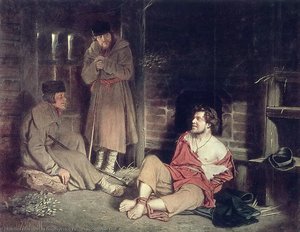
The Voice of the Voiceless: Themes and Techniques

Perov’s artistic vision was deeply rooted in a commitment to portraying Russian society with unflinching honesty. He rejected the idealized depictions favored by many of his contemporaries, instead choosing to focus on the lives of ordinary people—peasants, laborers, the marginalized, and the forgotten. His paintings are not merely representations of reality; they are powerful social commentaries that expose the hardships, injustices, and spiritual emptiness prevalent in 19th-century Russia. “Sermon in a Village,” for example, subtly critiques religious hypocrisy by depicting a disengaged congregation during a church service, while "The Queue at the Fountain" starkly illustrates the daily struggles of rural life. His technique was characterized by meticulous detail, somber color palettes, and a masterful use of light and shadow to create dramatic effect. He wasn’t interested in romanticizing poverty or suffering; rather, he sought to present it with dignity and empathy, forcing viewers to confront uncomfortable truths about their own society. Works like “The Last Journey,” depicting a peasant funeral procession, and "Troika: Apprentice Workmen Carrying Water" are poignant examples of his ability to evoke profound emotional responses through realistic portrayals of everyday life. Perov’s skill extended beyond oil painting; he also excelled in etching, as demonstrated by the powerful monochromatic work “Naushnitsa. Before the storm,” which showcases his mastery of chiaroscuro and intricate detail.

Founding a Movement: The Peredvizhniki

Perov’s dedication to realism aligned perfectly with the burgeoning spirit of artistic rebellion that led to the formation of the Peredvizhniki (Wanderers) in 1870. This collective of Russian realist painters broke away from the constraints of the Academy, establishing an independent society dedicated to exhibiting art throughout Russia—reaching audiences beyond the confines of St. Petersburg and Moscow.
  • The Peredvizhniki aimed to bring art directly to the people,
  • to address social issues through their work,
  • and to promote a uniquely Russian artistic identity.
Perov was not merely a member; he was a founding force, instrumental in shaping the movement’s ideals and advocating for its principles. His commitment to portraying the lives of ordinary Russians resonated deeply with the Peredvizhniki's mission, solidifying his position as a leading figure within the group. The Wanderers’ exhibitions became immensely popular, attracting large crowds and sparking important conversations about art, society, and national identity.

Legacy and Enduring Influence

Vasily Perov’s untimely death from tuberculosis in 1882 at the age of 48 marked a significant loss for Russian art. However, his legacy continued to inspire generations of artists who followed in his footsteps. His influence can be seen in the works of Ilya Repin and Vasily Surikov, both masters of realist painting who further developed the tradition he helped establish. Perov’s paintings remain relevant today not only for their artistic merit but also for their enduring social commentary. They serve as a powerful reminder of the hardships faced by ordinary people throughout history and continue to provoke empathy and understanding. His works are now housed in prominent collections, including the Tropinin and Contemporary Moscow Artists Museum, ensuring that his vision continues to resonate with audiences worldwide. Perov’s contribution extends beyond mere artistic skill; he was a social conscience etched onto canvas, a voice for the voiceless, and a pioneer of Russian realism. He left behind a body of work that not only documented his time but also challenged it, forever changing the landscape of Russian art.