Portrait of Tarsila do Amaral

The 39 Most Famous Tarsila do Amaral Paintings, Each One of a Kind

Updated November 2026 · ranked by our popularity score (searches, visits and orders for each work) · 46 works by Tarsila do Amaral in our catalogue

In short

Abaporu (1928) is the Tarsila do Amaral painting that draws the most eyes. After it, the eye goes to Amor (Ilustração para (1925) and Rio de Janeiro (Sugar Loaf) (1923). Among the 46 works of Tarsila do Amaral in our catalog, these 39 are the most famous, each a unique original presented with its year, its museum and the reason it endures.

1886 – 1973, Cachoeira do Sul Modernism Most works: Centro Cultural São Paulo

Top 10 paintings by Tarsila do Amaral, through the gallery's eye

1
Abaporu (1928) by Tarsila do Amaral

Abaporu

1928 · Oil On Canvas

Tarsila do Amaral produced the oil on canvas work Abaporu in 1928. The painting was created as a birthday gift for her husband, the writer Oswald de Andrade. This specific piece emerged during a period of significant artistic development for the artist.

2
Amor (Ilustração para (1925) by Tarsila do Amaral

Amor (Ilustração para

1925 · Illustration · Centro Cultural São Paulo, Sao Paulo

In the delicate interplay of light and shadow, Tarsila do Amaral presents us with a profound moment of tenderness in her 1925 work, Amor. This evocative illustration transcends simple imagery, offering instead a soulful meditation on affection and purity. At its heart, the composition features a graceful bird—reminiscent of a dove—captured in a moment of flight with wings elegantly spread. Clutched tenderly within its beak is a heart, inscribed with…

3
Rio de Janeiro (Sugar Loaf) (1923) by Tarsila do Amaral

Rio de Janeiro (Sugar Loaf)

1923 · Oil On Canvas · The Ema Klabin House Museum, Sao Paulo

In this 1923 oil on canvas, we find ourselves looking upon a quiet corner of Rio de Janeiro. The composition is anchored by the presence of the Sugar Loaf mountain, which rises with a steady, singular strength in the background. There is a certain stillness here. In the foreground, two palm trees lean into the frame, their forms simplified and clean, grounding the viewer in a tropical atmosphere. A small…

4
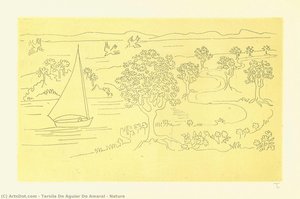
Nature (1971) by Tarsila do Amaral

Nature

In this 1971 work, we find ourselves drifting into a tranquil coastal sanctuary. The composition centers on a single sailboat, suspended upon a shimmering expanse of water that reflects the soft, ambient light of a peaceful afternoon. There is a profound sense of stillness here, interrupted only by the rhythmic vitality of birds in flight, their silhouettes dancing against the sky. A lush shoreline, lined with verdant trees, frames the…

6
Paisagem antropofágica (1930) by Tarsila do Amaral

Paisagem antropofágica

1930 · Acrylic On Canvas · Centro Cultural São Paulo, Sao Paulo

Tarsila do Amaral’s “Paisagem Antropofágica” (Anthropophagous Landscape), painted in 1930, isn't merely a depiction of a landscape; it’s a vibrant distillation of Brazil itself – its anxieties, its aspirations, and its complex relationship with the influences that shaped its identity. This iconic work, housed within the collections of major museums worldwide, offers a profound glimpse into the heart of Brazilian modernism and the artist’s unique vision. The painting immediately captivates…

7
Antropofagic landscape with ox (1971) by Tarsila do Amaral

Antropofagic landscape with ox

1971 · Painting · Museu de Valores do Banco Central do Brasil, Brasília

The sun hangs over a wide, open landscape where time seems to slow to the pace of grazing animals. In this 1971 work, the earth feels heavy and present, stretching out in a way that invites the eye to wander toward the distant trees. Three cows occupy the space, scattered across the field in a rhythmic arrangement that guides the viewer through the greenery. One rests on the left, another…

8
São Paulo (1924) by Tarsila do Amaral

São Paulo

1924 · Acrylic On Canvas · Pinacoteca do Estado de São Paulo, Sao Paulo

Tarsila do Amaral's "São Paulo," painted in 1924, isn't merely a depiction of a city; it’s a vibrant distillation of a nation’s burgeoning identity and a bold declaration of modernism. Emerging from the fertile ground of early 20th-century Brazil, this oil on canvas transports us to a São Paulo undergoing rapid transformation – a metropolis embracing progress while simultaneously retaining echoes of its rural past. The painting captures a pivotal…

10
Self-portrait with orange dress (1921) by Tarsila do Amaral

Self-portrait with orange dress

The subject sits in a relaxed pose, her dark hair framing a face that meets the viewer with a subtle, knowing smile. She wears a dress of bright orange, a color that commands the eye and anchors the composition. In the background, secondary figures appear like whispers, adding a sense of depth and social context to this personal encounter. The gaze is direct, bridging the gap between the painted world…

Tarsila do Amaral's famous paintings, numbers 11 to 39

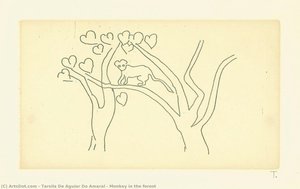
11In praise of nature (1971) by Tarsila do AmaralIn praise of nature1971 · Museu de Valores do Banco Central do Brasil 12Pão de Açúcar (Ilustração para (1925) by Tarsila do AmaralPão de Açúcar (Ilustração para1925 · Centro Cultural São Paulo 13Flor Gente (Ilustração para (1925) by Tarsila do AmaralFlor Gente (Ilustração para1925 · Centro Cultural São Paulo 14Carnaval (Ilustração para (1925) by Tarsila do AmaralCarnaval (Ilustração para1925 · Centro Cultural São Paulo 15Fazenda (Ilustração para (1925) by Tarsila do AmaralFazenda (Ilustração para1925 · Centro Cultural São Paulo 16Workers (1938) by Tarsila do AmaralWorkers1938 · Museu de Valores do Banco Central do Brasil 17Retrato de Antonio de Toledo Piza by Tarsila do AmaralRetrato de Antonio de Toledo PizaIpiranga Museum 18Retrato de José Maria Nunes Garcia by Tarsila do AmaralRetrato de José Maria Nunes GarciaIpiranga Museum 19Retrato de Joaquim do Amaral Camargo by Tarsila do AmaralRetrato de Joaquim do Amaral CamargoIpiranga Museum 20Retrato de Frei Miguel Arcanjo da Anunciação by Tarsila do AmaralRetrato de Frei Miguel Arcanjo da AnunciaçãoIpiranga Museum 21Retrato de Francisco Aranha Barreto by Tarsila do AmaralRetrato de Francisco Aranha BarretoIpiranga Museum 22Monkey in the forest (1971) by Tarsila do AmaralMonkey in the forest1971 · Museu de Valores do Banco Central do Brasil 23In praise of nature (1971) by Tarsila do AmaralIn praise of nature1971 · Museu de Valores do Banco Central do Brasil 24Study (Nude - Figure from the hips up) (1922) by Tarsila do AmaralStudy (Nude - Figure from the hips up)1922 · Museu de Valores do Banco Central do Brasil 25Cidade (Ilustração para (1925) by Tarsila do AmaralCidade (Ilustração para1925 · Centro Cultural São Paulo 26Estudo para a Negra (1923) by Tarsila do AmaralEstudo para a Negra1923 · Centro Cultural São Paulo 27Locomotiva (Ilustração para (1925) by Tarsila do AmaralLocomotiva (Ilustração para1925 · Centro Cultural São Paulo 28Oswald de Andrade (1923) by Tarsila do AmaralOswald de Andrade1923 · Centro Cultural São Paulo 29Paisagem (1925) by Tarsila do AmaralPaisagem1925 · Centro Cultural São Paulo 30Barco (Ilustração para (1925) by Tarsila do AmaralBarco (Ilustração para1925 · Centro Cultural São Paulo 31Farmhouse (1971) by Tarsila do AmaralFarmhouse1971 · Museu de Valores do Banco Central do Brasil 32Trees (1971) by Tarsila do AmaralTrees1971 · Museu de Valores do Banco Central do Brasil 33Pinheiros (Ilustração para (1925) by Tarsila do AmaralPinheiros (Ilustração para1925 · Centro Cultural São Paulo 34Port I (1953) by Tarsila do AmaralPort I1953 · Museu de Valores do Banco Central do Brasil 35Estudo para La tasse (1923) by Tarsila do AmaralEstudo para La tasse1923 · Centro Cultural São Paulo 36Urutu Snake (1928) by Tarsila do AmaralUrutu Snake1928 · MAM Rio 37Landscape VII (1971) by Tarsila do AmaralLandscape VII1971 · Museu de Valores do Banco Central do Brasil 38Paisagem Antropofágica by Tarsila do AmaralPaisagem AntropofágicaMuseu Nacional de Belas Artes 39Portal com gente by Tarsila do AmaralPortal com genteCentro Cultural São Paulo

Tarsila do Amaral's famous paintings, period by period

The subjects that held Tarsila do Amaral's eye

The four subjects that come back most often in these originals, each with its finest example.

The museums that keep Tarsila do Amaral's originals

The 7 museums that hold the most of the paintings on this page.

Museum City Works by Tarsila do Amaral Paintings from this list
Centro Cultural São Paulo, Sao PauloCentro Cultural São Paulo Sao Paulo 15 Amor (Ilustração para, Paisagem antropofágica, Pão de Açúcar (Ilustração para
Museu de Valores do Banco Central do Brasil, BrasíliaMuseu de Valores do Banco Central do Brasil Brasília 13 Nature, Antropofagic animals in the landscape, Antropofagic landscape with ox
Ipiranga Museum, São PauloIpiranga Museum São Paulo 6 Retrato de Marechal Arouche, Retrato de Antonio de Toledo Piza, Retrato de José Maria Nunes Garcia
The Ema Klabin House Museum, Sao PauloThe Ema Klabin House Museum Sao Paulo 1 Rio de Janeiro (Sugar Loaf)
Pinacoteca do Estado de São Paulo, Sao PauloPinacoteca do Estado de São Paulo Sao Paulo 1 São Paulo
MAM Rio, Rio de JaneiroMAM Rio Rio de Janeiro 1 Urutu Snake
Museu Nacional de Belas Artes, Rio de JaneiroMuseu Nacional de Belas Artes Rio de Janeiro 1 Paisagem Antropofágica

Tarsila do Amaral across the decades: one unique original for each

Works per decade

Pick a decade to see the original that defines it.

Tarsila do Amaral's paintings: questions for the gallery

What is the single most famous work of Tarsila do Amaral?Reveal the answer

Abaporu (1928). Amor (Ilustração para (1925) and Rio de Janeiro (Sugar Loaf) (1923) come next.

At what age did Tarsila do Amaral create Abaporu?Reveal the answer

42 years old: Abaporu dates from 1928, and Tarsila do Amaral was born in 1886.

Which ten paintings by Tarsila do Amaral are the most famous?Reveal the answer

Abaporu, Amor (Ilustração para, Rio de Janeiro (Sugar Loaf), Nature, Antropofagic animals in the landscape, Paisagem antropofágica, Antropofagic landscape with ox, São Paulo, Retrato de Marechal Arouche and Self-portrait with orange dress. The ranking above gives each one's year and museum.

How many works by Tarsila do Amaral are known?Reveal the answer

Our catalog holds 46 works by Tarsila do Amaral, dated from 1921 to 1971.

Where can the most famous Tarsila do Amaral originals be seen?Reveal the answer

Mostly in Centro Cultural São Paulo (Sao Paulo), Museu de Valores do Banco Central do Brasil (Brasília) and Ipiranga Museum (São Paulo). The museum table above lists them all.

During which period did Tarsila do Amaral create the best-known paintings?Reveal the answer

In 1920s: 19 of the 39 works on this page were made then, Abaporu among them.

Which famous Tarsila do Amaral painting is the earliest, and which the latest?Reveal the answer

On this page, the earliest is Self-portrait with orange dress (1921) and the latest Nature (1971).

What subjects did Tarsila do Amaral favour?Reveal the answer

Landscape (13), Brazil (7) and Portrait (5), across the 39 works on this page.

What materials did Tarsila do Amaral paint with most?Reveal the answer

Painting, for 6 of the 39 works on this page.

Which movement does the work of Tarsila do Amaral belong to?Reveal the answer

Modernism, judging by the originals on this page.

What Tarsila do Amaral originals can I see at the Centro Cultural São Paulo?Reveal the answer

Amor (Ilustração para, Paisagem antropofágica and Pão de Açúcar (Ilustração para: the Centro Cultural São Paulo, Sao Paulo holds 15 of the works on this page.

Tarsila do Amaral: a portrait of the artist

A Brazilian Visionary: The Life and Art of Tarsila do Amaral

Tarsila do Amaral emerged as a pivotal figure in the vibrant tapestry of early 20th-century Brazilian art, a painter who dared to distill the essence of her nation’s identity onto canvas with bold colors and an innovative spirit. Born on September 1, 1886, in Capivari, São Paulo, into a prosperous coffee-producing family, Tarsila's upbringing afforded her opportunities uncommon for women of her time. This privilege allowed her to pursue artistic training, initially under the guidance of Pedro Alexandrino Borges before embarking on a transformative journey to Paris in 1920. It was within the walls of the Académie Julian and later the Académie Moderne that she encountered the avant-garde currents reshaping the art world – Cubism, Futurism, and Expressionism – influences that would profoundly shape her artistic trajectory. The mentorship of Fernand Léger, Albert Gleizes, and André Lhote proved particularly impactful, encouraging her to synthesize European modernism with a distinctly Brazilian sensibility.

Forging a National Identity Through Art

Upon returning to Brazil in the early 1920s, Tarsila became a central force in defining a uniquely Brazilian modernist tradition. She wasn’t simply importing European styles; she was actively seeking to create an art that spoke to the soul of her nation, reflecting its landscapes, people, and cultural complexities. This quest led her to collaborate with a group of like-minded artists and intellectuals – Anita Malfatti, Menotti Del Picchia, Mário de Andrade, and Oswald de Andrade – collectively known as *Grupo dos Cinco*. Together, they challenged conventional artistic norms and spearheaded a movement that sought to break free from academic constraints and embrace a new visual language. Tarsila’s contribution was particularly significant in articulating this vision through her paintings, which often depicted scenes of Brazilian life with a dreamlike quality and vibrant palette.

The Power of *Abaporu* and the Antropofagia Movement

Perhaps no single work embodies Tarsila's artistic philosophy more powerfully than *Abaporu* (1928). This iconic painting, depicting a solitary figure with oversized feet seated amidst a surreal landscape, became the catalyst for one of Brazil’s most influential cultural movements: Antropofagia – or “cannibalism.” Inspired by Oswald de Andrade's manifesto of the same name, Antropofagia proposed that Brazilian artists should "devour" foreign influences and transform them into something uniquely their own. *Abaporu* visually captured this concept, representing a rejection of colonial imitation and an embrace of cultural hybridity. The painting’s imagery – the large feet rooted in the land, the enigmatic expression – resonated deeply with a nation grappling with its identity in the wake of independence. It wasn't merely a work of art; it was a declaration of artistic sovereignty. Beyond *Abaporu*, works like *A Negra* (1923) and *Morro da Favela* demonstrated her engagement with social themes, portraying marginalized communities and challenging prevailing societal norms.

Legacy and Enduring Influence

Throughout her long and prolific career, Tarsila do Amaral continued to explore the complexities of Brazilian identity through a diverse body of work. Her paintings are characterized by their bold colors, simplified forms, and dreamlike atmosphere, often blending elements of realism with surrealism and abstraction. She didn’t shy away from experimentation, constantly evolving her style while remaining true to her core vision. Her influence extended beyond the realm of painting, inspiring generations of Brazilian artists and shaping the nation's cultural landscape. Today, Tarsila do Amaral’s works are held in prestigious collections worldwide, including the Museu de Valores do Banco Central do Brasil and the Museu de Arte do Rio Grande do Sul. Her art continues to captivate audiences with its vibrant energy, poetic imagery, and profound exploration of what it means to be Brazilian. She passed away on January 17, 1973, leaving behind a legacy as one of Latin America’s most important modernist artists – a visionary who dared to paint her nation's soul.