Portrait of Pierre Bonnard

The 100 Most Famous Pierre Bonnard Paintings, Each One of a Kind

Updated October 2026 · ranked by our popularity score (searches, visits and orders for each work) · 612 works by Pierre Bonnard in our catalogue

In short

Nude (1920) is the Pierre Bonnard painting that draws the most eyes. After it, the eye goes to La toilette, ca Private (1932) and The almond tree in blossom. Among the 612 works of Pierre Bonnard in our catalog, these 100 are the most famous, each a unique original presented with its year, its museum and the reason it endures.

1867 – 1947, Fontenay-aux-Roses Post-impressionism Most works: Metropolitan Museum of Art

Top 10 paintings by Pierre Bonnard, through the gallery's eye

1
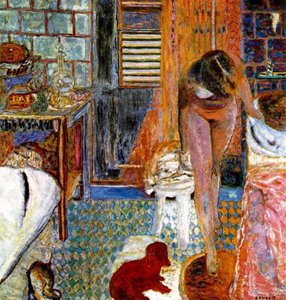
Nude (1920) by Pierre Bonnard

Nude

1920 · Oil On Canvas

Subject and Composition This captivating artwork presents an intimate portrait of a nude female figure, rendered with a delicate balance of realism and stylization. The figure’s relaxed yet poised posture invites viewers into a moment of quiet introspection, emphasizing themes of vulnerability, inner strength, and personal reflection. The composition centers the figure, subtly framed by a richly textured background that enhances her presence and invites a deeper exploration of her…

2
La toilette, ca Private (1932) by Pierre Bonnard

La toilette, ca Private

1932 · Oil On Canvas

Pierre Bonnard’s La toilette, ca Private transports us into a moment suspended in time—a private ritual unfolding within the soft embrace of a sunlit bedroom. The scene is less a mere depiction and more an immersion into memory itself. We find ourselves observing a woman near a window, her lower form anchoring the composition while the surrounding elements whisper tales of domestic life. Bonnard masterfully captures the interplay between the…

3
The almond tree in blossom by Pierre Bonnard

The almond tree in blossom

Oil On Canvas

The painting features a tree with branches and leaves in the foreground. This tree is in blossom, with many flowers appearing on its branches. Several birds are perched on the branches. In the background, there are two smaller trees: one is located towards the left side of the painting, and another is positioned further back on the right side. The composition is balanced, with the foreground tree occupying a significant…

4
Le placard rouge (The Red Cupboard), (1939) by Pierre Bonnard

Le placard rouge (The Red Cupboard),

1939 · Oil On Canvas

To gaze upon Pierre Bonnard's Le placard rouge (The Red Cupboard) is to step directly into a moment suspended in time—a warm, intimate glimpse into the heart of a French kitchen from the early decades of the twentieth century. This painting transcends a mere depiction of household objects; it is an immersion into color, light, and the quiet poetry of domestic life. The overwhelming presence of the red walls and…

5
Summer in Normandy (1912) by Pierre Bonnard

Summer in Normandy

1912 · Oil On Canvas · Pushkin State Museum, Moscow

Pierre Bonnard’s “Summer in Normandy,” painted in 1912, isn't merely a depiction of a landscape; it’s an embodiment of Impressionism’s lingering influence and Bonnard’s distinctive approach to capturing the essence of domestic serenity. Currently residing at the Pushkin State Museum in Moscow, Russia, this oil on panel masterpiece transcends its physical dimensions, inviting viewers into a realm of muted hues and subtle textures that speak volumes about the artist's vision.

6
Woman with a Parrot by Pierre Bonnard

Woman with a Parrot

Oil On Canvas

The canvas invites the viewer into a quiet domestic tableau, where a woman stands before a tree, her gaze drifting beyond the frame as she cradles a bright parrot on her shoulder. Two other figures linger in the background—one near the left edge, another further back to the right—adding depth and narrative intrigue. Scattered objects—a bowl in the lower‑right corner, a chair toward the top‑left, a banana near the center,…

7
Young Girl Sitting with a Rabbit (1891) by Pierre Bonnard

Young Girl Sitting with a Rabbit

1891 · Oil On Canvas · National Museum of Western Art, Tokyo

In this 1891 composition, we find a young girl nestled within a dense, organic environment. She sits with a quiet stillness, her form integrated into a lush landscape of deep greens and earthy ochres. A rabbit rests near her, adding to the sense of a private, undisturbed moment. The scene is not one of grand drama, but of a soft, intimate connection between a child and the natural world. There…

8
The Palm (1926) by Pierre Bonnard

The Palm

1926 · Acrylic On Canvas · The Phillips Collection, Washington, D.C.

The painting depicts a cityscape viewed from an elevated perspective, featuring a woman standing in the foreground. She is positioned toward the center of the composition, looking out over the urban landscape. The scene is characterized by a large building in the background and several smaller buildings scattered throughout the area. Spindly palm fronds encircle the view, and the landscape includes coral-tiled roofs. The color palette includes a sea of…

9
Bunch of Mimosa (1945) by Pierre Bonnard

Bunch of Mimosa

1945 · Oil On Canvas

Subject and Composition The painting presents a radiant bouquet of mimosa flowers, their golden petals spilling from a humble bowl onto a wooden table. The arrangement is centered, drawing the eye into a warm, almost tactile space that feels both intimate and inviting. Two chairs flank the scene, one on the right, one on the left, suggesting a quiet domestic moment paused in time. A potted plant in the background…

10
Woman with Dog (1922) by Pierre Bonnard

Woman with Dog

1922 · Oil On Canvas · The Phillips Collection, Washington, D.C.

The room feels still, held in a soft, suspended moment of domestic life. A woman sits at a table, her presence anchoring the composition with a gentle, steady weight. She wears a striped shirt of deep reds and oranges, a sudden pulse of warmth against the cooler, muted tones of the surrounding space. On her lap, a small dark dog rests, its form blending into the intimate shadows of the…

Pierre Bonnard's famous paintings, numbers 11 to 100

11Carafe, Marthe Bonnard with Her Dog (1915) by Pierre BonnardCarafe, Marthe Bonnard with Her Dog1915 · Villa Flora 12Almond Tree in Blossom by Pierre BonnardAlmond Tree in BlossomMusée d'Orsay 13The Windows (1925) by Pierre BonnardThe Windows1925 14L'escalier du jardin (the garden steps) private (1940) by Pierre BonnardL'escalier du jardin (the garden steps) private1940 · Pola Museum of Art 15The Cherry Pie by Pierre BonnardThe Cherry Pie 16Interior: The Terrasse Children (1899) by Pierre BonnardInterior: The Terrasse Children1899 · Dallas Museum of Art 17The Family of Claude Terrasse (1899) by Pierre BonnardThe Family of Claude Terrasse1899 · Metropolitan Museum of Art 18The Dressing Room (1914) by Pierre BonnardThe Dressing Room1914 · Metropolitan Museum of Art 19After the Shower (1914) by Pierre BonnardAfter the Shower1914 · Philadelphia Museum of Art 20La revue blanche by Pierre BonnardLa revue blancheDetroit Institute of Arts 21Afternoon bourgeois by Pierre BonnardAfternoon bourgeois 22Afternoon in París by Pierre BonnardAfternoon in ParísHermitage Museum 23Woman with Mimosa (1924) by Pierre BonnardWoman with Mimosa1924 · Metropolitan Museum of Art 24The Children's Meal (1895) by Pierre BonnardThe Children's Meal1895 · Metropolitan Museum of Art 25Nude by the Bath Tub (1931) by Pierre BonnardNude by the Bath Tub1931 26Portrait of Doctor Maurice Girardin (1917) by Pierre BonnardPortrait of Doctor Maurice Girardin1917 · Petit Palais 27Morning in the Garden at Vernonnet (1917) by Pierre BonnardMorning in the Garden at Vernonnet1917 · Metropolitan Museum of Art 28Grandmother with a Child (1894) by Pierre BonnardGrandmother with a Child1894 · Szépművészeti Múzeum 29The Lodge (1908) by Pierre BonnardThe Lodge1908 30The Letter (1906) by Pierre BonnardThe Letter1906 · National Gallery of Art 31The Little Laundress by Pierre BonnardThe Little Laundress 32Nude at the Fireplace (1913) by Pierre BonnardNude at the Fireplace1913 · Centre Pompidou 33The Artist's Studio (1900) by Pierre BonnardThe Artist's Studio1900 · National Gallery of Art 34Village Scene, Grasse (1912) by Pierre BonnardVillage Scene, Grasse1912 · Metropolitan Museum of Art 35View of Le Cannet, Roofs (1942) by Pierre BonnardView of Le Cannet, Roofs1942 36Madame Reine Thadée Natanson with the pearl necklace (1921) by Pierre BonnardMadame Reine Thadée Natanson with the pearl necklace1921 · Musée d'Orsay 37Lady Before the Mirror (1905) by Pierre BonnardLady Before the Mirror1905 · Bavarian State Painting Collections 38Children and Cat (1909) by Pierre BonnardChildren and Cat1909 · The Phillips Collection 39Woman with ducks (1892) by Pierre BonnardWoman with ducks1892 · Clemens Sels Museum Neuss 40The Dining Room in the countryside by Pierre BonnardThe Dining Room in the countryside 41Cannet landscape, view of the roofs by Pierre BonnardCannet landscape, view of the roofs 42Flowers on a Red Carpet (1928) by Pierre BonnardFlowers on a Red Carpet1928 43Woman Putting on Her Stockings (1893) by Pierre BonnardWoman Putting on Her Stockings1893 · Cleveland Museum of Art 44Café Terrace (1898) by Pierre BonnardCafé Terrace1898 · Cleveland Museum of Art 45Reclining Nude (1897) by Pierre BonnardReclining Nude1897 · MOMA - Museum of Modern Art 46The Claude Terrace Family in the garden (1896) by Pierre BonnardThe Claude Terrace Family in the garden1896 · Alte Nationalgalerie 47La Chanson du Grand-pere (1893) by Pierre BonnardLa Chanson du Grand-pere1893 48The Cab Horse (1895) by Pierre BonnardThe Cab Horse1895 · National Gallery of Art 49Nannies' promenade, frieze of carriages (1896) by Pierre BonnardNannies' promenade, frieze of carriages1896 50By the Sea, Under the Pines (1921) by Pierre BonnardBy the Sea, Under the Pines1921 51Nude Facing Forward (1905) by Pierre BonnardNude Facing Forward1905 · Petit Palais 52Misia Sert on Edward's boat (1905) by Pierre BonnardMisia Sert on Edward's boat1905 · Collection Bemberg 53Nu debout, de profil (1905) by Pierre BonnardNu debout, de profil1905 54Woman at Her Toilet (1905) by Pierre BonnardWoman at Her Toilet1905 · Foundation E.G. Bührle Collection 55Interior Scene (1905) by Pierre BonnardInterior Scene1905 · Foundation E.G. Bührle Collection 56The Painter's Studio (1905) by Pierre BonnardThe Painter's Studio1905 · Museum of Fine Arts 57Nude (1903) by Pierre BonnardNude1903 · Gothenburg Museum of Art 58Model in Armchair (1903) by Pierre BonnardModel in Armchair1903 · Gothenburg Museum of Art 59Nude, Red Chair (1905) by Pierre BonnardNude, Red Chair1905 60Untitled (Woman on balcony) (1900) by Pierre BonnardUntitled (Woman on balcony)1900 61The Luncheon (1899) by Pierre BonnardThe Luncheon1899 · Foundation E.G. Bührle Collection 62Man and Woman (1900) by Pierre BonnardMan and Woman1900 · Musée d'Orsay 63IN A BOAT (1907) by Pierre BonnardIN A BOAT1907 64The Woman with the Dog (1906) by Pierre BonnardThe Woman with the Dog1906 · Musee des Beaux-Arts 65Nude (1906) by Pierre BonnardNude1906 66Fishermen in a Boat, Brittany (1907) by Pierre BonnardFishermen in a Boat, Brittany1907 · Galerie Rosengart 67Reclining Nude against a White and Blue Plaid (1909) by Pierre BonnardReclining Nude against a White and Blue Plaid1909 · Städel Museum 68Nu assis, jambe pliée (1909) by Pierre BonnardNu assis, jambe pliée1909 69Movement of the Street (1907) by Pierre BonnardMovement of the Street1907 · The Phillips Collection 70In a boat (1907) by Pierre BonnardIn a boat1907 · Musée d'Orsay 71Le Café (1907) by Pierre BonnardLe Café1907 72Nude sitting, Flowers in hair (1907) by Pierre BonnardNude sitting, Flowers in hair1907 73After the Bath (1910) by Pierre BonnardAfter the Bath1910 · Metropolitan Museum of Art 74Young Girls with the Seagull (1917) by Pierre BonnardYoung Girls with the Seagull1917 · Petit Palais 75Indoor (By lamp light) (1912) by Pierre BonnardIndoor (By lamp light)1912 76Woman Picking Flowers (1916) by Pierre BonnardWoman Picking Flowers1916 · Dixon Gallery and Gardens 77Woman in a Landscape (1914) by Pierre BonnardWoman in a Landscape1914 · National Museum of Art, Architecture and Design 78Painting (1917) by Pierre BonnardPainting1917 · National Museum of Art, Architecture and Design 79Woman leaning on her Elbow with a Dog and a Still Life (1917) by Pierre BonnardWoman leaning on her Elbow with a Dog and a Still Life1917 80Portrait of woman in large hat (1917) by Pierre BonnardPortrait of woman in large hat1917 81Pont de la Concorde (1913) by Pierre BonnardPont de la Concorde1913 82Girl in blue, with rose (1916) by Pierre BonnardGirl in blue, with rose1916 83Cats on the Railing (1909) by Pierre BonnardCats on the Railing1909 · Ohara Museum of Art 84Lignite Mine (1919) by Pierre BonnardLignite Mine1919 · Bavarian State Painting Collections 85The Abduction of Europa (1919) by Pierre BonnardThe Abduction of Europa1919 · Toledo Museum of Art 86Torso of woman, profile (1918) by Pierre BonnardTorso of woman, profile1918 · Chapelle des pénitents blancs 87Interior with a Woman in a Wicker Chair (1920) by Pierre BonnardInterior with a Woman in a Wicker Chair1920 · Nationalmuseum 88A Woman with a White Corsage (1922) by Pierre BonnardA Woman with a White Corsage1922 89The Striped Blouse (1922) by Pierre BonnardThe Striped Blouse1922 90Interior at antibes (1920) by Pierre BonnardInterior at antibes1920 91IN A BOAT. THE PROMENADE AT SEA (1924) by Pierre BonnardIN A BOAT. THE PROMENADE AT SEA1924 92Le Déjeuner (1923) by Pierre BonnardLe Déjeuner1923 · National Gallery of Ireland 93Sleeping woman (1928) by Pierre BonnardSleeping woman1928 94The terrace of Vernon (1928) by Pierre BonnardThe terrace of Vernon1928 · Kunstsammlung Nordrhein-Westfalen 95Young Girl with Umbrella (1894) by Pierre BonnardYoung Girl with Umbrella1894 96Boat Ride (En bateau) (1930) by Pierre BonnardBoat Ride (En bateau)1930 · Collection Bemberg 97Blond Nude Seated (1931) by Pierre BonnardBlond Nude Seated1931 98Portrait of Madame Henri Jean Arthur Fontaine (1930) by Pierre BonnardPortrait of Madame Henri Jean Arthur Fontaine1930 · Musée d'Orsay 99Landing Stage (1939) by Pierre BonnardLanding Stage1939 100The Dessert (1921) by Pierre BonnardThe Dessert1921 · Cleveland Museum of Art

Pierre Bonnard's famous paintings, period by period

The subjects that held Pierre Bonnard's eye

The four subjects that come back most often in these originals, each with its finest example.

The museums that keep Pierre Bonnard's originals

The 8 museums that hold the most of the paintings on this page.

Museum City Works by Pierre Bonnard Paintings from this list
Metropolitan Museum of Art, New YorkMetropolitan Museum of Art New York 23 The Family of Claude Terrasse, The Dressing Room, Woman with Mimosa
Musée d'Orsay, ParisMusée d'Orsay Paris 17 Almond Tree in Blossom, Madame Reine Thadée Natanson with the pearl necklace, Man and Woman
The Phillips Collection, Washington, D.C.The Phillips Collection Washington, D.C. 15 The Palm, Woman with Dog, Children and Cat
National Gallery of Art, WashingtonNational Gallery of Art Washington 12 The Letter, The Artist's Studio, The Cab Horse
Petit Palais, ParisPetit Palais Paris 6 Portrait of Doctor Maurice Girardin, Nude Facing Forward, Young Girls with the Seagull
Cleveland Museum of Art, ClevelandCleveland Museum of Art Cleveland 5 Woman Putting on Her Stockings, Café Terrace, The Dessert
Foundation E.G. Bührle Collection, ZurichFoundation E.G. Bührle Collection Zurich 4 Woman at Her Toilet, Interior Scene, The Luncheon
Collection Bemberg, ToulouseCollection Bemberg Toulouse 11 Misia Sert on Edward's boat, Boat Ride (En bateau)

Pierre Bonnard across the decades: one unique original for each

Works per decade

Pick a decade to see the original that defines it.

Pierre Bonnard's paintings: questions for the gallery

What is the single most famous work of Pierre Bonnard?Reveal the answer

Nude (1920). La toilette, ca Private (1932) and The almond tree in blossom come next.

At what age did Pierre Bonnard create Nude?Reveal the answer

53 years old: Nude dates from 1920, and Pierre Bonnard was born in 1867.

Which ten paintings by Pierre Bonnard are the most famous?Reveal the answer

Nude, La toilette, ca Private, The almond tree in blossom, Le placard rouge (The Red Cupboard),, Summer in Normandy, Woman with a Parrot, Young Girl Sitting with a Rabbit, The Palm, Bunch of Mimosa and Woman with Dog. The ranking above gives each one's year and museum.

How many works by Pierre Bonnard are known?Reveal the answer

Our catalog holds 612 works by Pierre Bonnard, dated from 1891 to 1945.

Where can the most famous Pierre Bonnard originals be seen?Reveal the answer

Mostly in Metropolitan Museum of Art (New York), Musée d'Orsay (Paris) and The Phillips Collection (Washington, D.C.). The museum table above lists them all.

During which period did Pierre Bonnard create the best-known paintings?Reveal the answer

In 1900s: 27 of the 100 works on this page were made then, The Lodge among them.

Which famous Pierre Bonnard painting is the earliest, and which the latest?Reveal the answer

On this page, the earliest is Young Girl Sitting with a Rabbit (1891) and the latest Bunch of Mimosa (1945).

What subjects did Pierre Bonnard favour?Reveal the answer

Woman (11), Domestic scene (10) and Flowers (7), across the 100 works on this page.

What materials did Pierre Bonnard paint with most?Reveal the answer

Oil On Canvas, for 28 of the 100 works on this page.

Which movement does the work of Pierre Bonnard belong to?Reveal the answer

Post-impressionism, judging by the originals on this page.

What Pierre Bonnard originals can I see at the Metropolitan Museum of Art?Reveal the answer

The Family of Claude Terrasse, The Dressing Room and Woman with Mimosa: the Metropolitan Museum of Art, New York holds 7 of the works on this page.

Where can I order a hand-painted Pierre Bonnard reproduction?Reveal the answer

Yes, as a reproduction: the original stays in its museum, but any painting on this page can be painted by hand for you, made to order one at a time, from the painting's own page.

Pierre Bonnard: a portrait of the artist

Early Life, Family and Training

Pierre Bonnard entered the world on 3 October 1867 in Fontenay-aux-Roses, Hauts-de-Seine, France. He was born into a family of structured expectations; his father, Eugène Bonnard, held a senior position within the French Ministry of War. While his lineage was rooted in the administrative stability of the state, Pierre’s domestic sphere was shaped by his mother, Élisabeth Mertzdorff, who hailed from Alsace. He grew up alongside his brother, Charles, and his sister, Andrée, within a household that would eventually see his sister marry the composer Claude Terrasse.

His formal education followed the traditional paths of the era, yet his inclinations leaned toward the visual rather than the bureaucratic. He sought instruction at the Ecole des Beaux-Arts and later at the Academie Julian. These institutions provided the technical foundation for a man who would eventually move away from academic rigidity. His early years were marked by a developing sensitivity to the way light and form could be captured, a skill that would later define his approach to the most mundane aspects of existence.

The Nabis and Artistic Development

Bonnard’s early years were marked by a quiet departure from the legal path his father had envisioned. After honing his observational skills through caricature, he found his true calling within the avant-garde circles of Paris. He became a founding member of Les Nabis, a group of artists who sought to move beyond mere representation. This period was defined by a shift toward the decorative and the symbolic, as he began to distance himself from the strictures of academic tradition. He was a leading figure in the transition from Impressionism to Modernism, navigating the space between the fleeting light of the previous generation and the more structured, subjective explorations of the new century.

His developing vision was shaped by a profound interest in the works of Paul Gauguin, whose influence helped steer him toward a more stylized approach to form and color. This was further enriched by the influence of Japanese art. The prints of Hokusai and other Japanese masters offered him a new way to organize space and line. Rather than focusing on grand historical narratives, Bonnard turned his attention to the quietude of domestic life. He sought to capture the atmosphere of a moment, often working from memory to translate personal impressions onto the canvas. This method allowed him to prioritize the emotional resonance of a scene over a literal, photographic depiction of reality.

Technique and Unique Artistic Style

Bonnard’s approach to the canvas was defined by a preference for the internal logic of color over the strictures of literal representation. He often moved away from direct observation, choosing instead to paint from memory. This reliance on recollection allowed him to distill a scene into its essential emotional components, frequently resulting in works where the decorative qualities and chromatic intensity took precedence over the actual subject matter. In his hands, a domestic interior became less a record of a room and more an exploration of how light and hue interact within a private space.

His physical relationship with the medium was equally unconventional. He frequently unstretched his canvases, tacking them directly to the wall. This method allowed him to work on the edges of the frame, occasionally using the cropping effect to further flatten the pictorial space. Such techniques contributed to the stylized, almost graphic quality of his compositions. The resulting surfaces often appeared to breathe with a sense of movement, achieved through a varied application of oil color that could range from thin, translucent washes to thick, textured marks.

This focus on the atmosphere of the everyday meant that even the most mundane arrangements—a bowl of fruit or a woman in a quiet room—were transformed through his specific use of light. He possessed a particular ability to capture both the harsh glare of midday sun and the soft, artificial glow of an indoor lamp. By prioritizing the subjective experience of color, he moved his work toward a modern sensibility that favored the sensation of a moment over its mere documentation.

Life with Marthe de Méligny

In 1893, a woman named Maria Boursin entered Bonnard’s life, a presence that would define the domestic landscape of his later years. Known to him as Marthe, she was more than a companion; she became the primary lens through which he viewed the private world. Their relationship was one of long-term intimacy and shared space, evolving from a deep connection into a formal union when they married in 1925. This partnership provided the steady, quiet rhythm that underpinned his creative output for decades.

Marthe was a constant presence in his studio, often serving as his most frequent model. She appeared in his works in a variety of roles, from the casual participant in a family scene to the subject of many nudes. Because she bathed every day to manage a tubercular condition, Bonnard frequently captured her in the private, vulnerable moments of her bathing rituals. These depictions were not mere studies of anatomy but were reflections of their daily life together, often characterized by the soft light of their shared surroundings.

Their life together was marked by a certain stillness, a sense of being caught in a fleeting moment of domesticity. Even as the years passed, her image remained central to his vision, appearing in various forms as they moved through their lives. She remained by his side until her death in 1942, leaving behind a visual record of a life lived in close, observant proximity.

Key Works and Notable Paintings

Bonnard’s early output reveals the foundations of his evolving vision. In 1891, Panneaux décoratifs - Femmes au jardin demonstrated the stylized decorative qualities that would define his career. By 1892, The Dressing Gown showed a growing interest in the quietude of domestic life. These early years were marked by a transition from the structured influences of his training toward a more personal, subjective way of seeing the world.

As his style matured, the subject matter often became secondary to the way light and color occupied a space. Girl in Straw Hat (Femme au chapeau rouge, painted in 1903, exemplifies this shift, where the figure is often absorbed into a complex arrangement of color. Later, in 1925, The Window captured a sense of looking through a frame into a world of shifting light. His late work continued this exploration until the very end; The Almond Tree in Blossom, painted about 1946, remains a significant example of his preoccupation with the interplay of light and nature.

Legacy and Lasting Influence

Bonnard’s contribution to modernism lies in his refusal to be easily categorized. While his early years were defined by his membership in Les Nabis alongside Edouard Vuillard and Paul Serusier, his work eventually moved beyond the group's specific boundaries. He transitioned from the structured concerns of Impressionism toward a more complex, subjective modernism. His paintings are visually complex in the extreme, often blurring the lines between the subject and its surroundings. This complexity was achieved through a restless, tactile approach to the medium, utilizing a remarkable range of thick or thin, fat or lean, brushed or wiped marks.

The artist’s influence is felt in the way he treated the surface of the canvas. By often tacking unstretched canvases directly to the wall, he allowed for a unique, haptic quality that influenced how subsequent generations approached the physical presence of a painting. His ability to manipulate color and light allowed him to capture the flux of a moment, often treating the scene as a fragment of a larger, shifting experience. He did not merely record a view; he reconstructed it through a personal, internal logic that prioritized the sensation of seeing over the mere accuracy of the object.

  • La Vielle Femme, l’Enfant, et la Bassett (1927)
  • Méditerranée (1909 and 1911)
  • The White Interior (1932)
  • The French Window (1932)

Where to See His Works Today

The physical presence of Bonnard’s vision remains scattered across several major institutions, allowing his specific approach to light and domesticity to be studied in various contexts. In the United States, his influence is felt through collections in New York City, where the Museum of Modern Art holds his paintings. The Metropolitan Museum of Art also maintains works that reflect his shift toward a more modern sensibility. For those seeking his presence in the American Midwest, the Art Institute of Chicago preserves pieces that highlight his unique handling of color.

Across the Atlantic, his reach extends into the prominent galleries of Europe. The Tate Modern in London houses his works, offering a perspective on his development within the broader movements of the era. These collections provide a way to encounter the quiet, often fragmented scenes he composed from memory, moving away from the grand narratives of his predecessors toward the intimacy of the everyday.

All 612 works by Pierre Bonnard →