Portrait of Luigi Loir

The 63 Most Famous Luigi Loir Paintings, a Gallery Selection

Updated November 2026 · ranked by our popularity score (searches, visits and orders for each work) · 63 works by Luigi Loir in our catalogue

In short

Of all the originals Luigi Loir left, the most famous is L'Avenue du Boid de Bologne. Close behind it come Paris, Morning (1890) and The Grand Boulevards (1888). Our catalog holds 63 works by Luigi Loir; the gallery has kept the 63 the world admires most, each shown with its date, its museum and its story.

1845 – 1916, Gorizia Impressionism Most works: Carnavalet Museum

Luigi Loir's top 10 paintings: the gallery's choice

1
L'Avenue du Boid de Bologne by Luigi Loir

L'Avenue du Boid de Bologne

Oil On Panel

The scene unfolds within L'Avenue du Boid de Bologne, a lively urban landscape captured by the hand of Luigi Loir. This oil on panel work invites us into a bustling moment of city life, where the energy of the street feels immediate and alive. We find ourselves walking alongside a crowd of pedestrians, some carrying handbags or backpacks, as they navigate the sidewalks of this busy environment. A bicycle rests…

2
Paris, Morning (1890) by Luigi Loir

Paris, Morning

1890 · Oil On Canvas

In Paris, Morning, Luigi Loir captures a bustling Parisian street scene during the transition of dusk or twilight. The artist employs a wide-angle perspective to convey the vastness of the urban space, drawing the eye through a crowded thoroughfare. This sense of scale is populated by the rhythmic movement of pedestrians, vendors, and horse-drawn carriages navigating the city. The composition focuses on the energy of everyday life, freezing a fleeting…

3
The Grand Boulevards (1888) by Luigi Loir

The Grand Boulevards

1888 · Oil On Canvas

The scene depicts a wide Parisian street during the twilight hours of 1888. A large building with a prominent mansard roof dominates the upper portion of the composition, acting as a structural anchor for the surrounding activity. Below this architecture, the street unfolds with a variety of pedestrians, horse-drawn carriages, and vendors. The light is soft and diffused, characteristic of dusk, with illumination emanating from street lamps, shop windows, and…

4
The Porte Maillot, Snow Effect, Sunset (1899) by Luigi Loir

The Porte Maillot, Snow Effect, Sunset

1899 · Oil On Canvas

The Porte Maillot, Snow Effect, Sunset is a painting by Luigi Loir. Created about 1899, this work captures a specific moment of urban life during winter. The scene focuses on the quietude of a city transformed by falling snow and the fading light of a sunset.

The Luigi Loir selection continues, 11 to 63

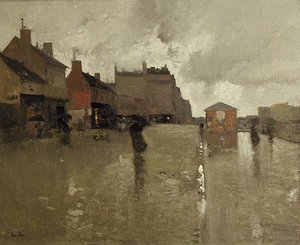
11Festival of Place du Trône, Paris (1890) by Luigi LoirFestival of Place du Trône, Paris1890 · Petit Palais 12Paris with Snow (1889) by Luigi LoirParis with Snow1889 13Visit of the Russian Sovereigns to Paris; the official procession passing Place de la Concorde, October 6, 1896 (1896) by Luigi LoirVisit of the Russian Sovereigns to Paris; the official procession passing Place de la Concorde, October 6, 18961896 · Carnavalet Museum 14The Outing of the Russian Emperor to the Opera Gala in Paris (1896) by Luigi LoirThe Outing of the Russian Emperor to the Opera Gala in Paris1896 15Rue des Nations, at the 1900 Exposition Universelle (1900) by Luigi LoirRue des Nations, at the 1900 Exposition Universelle1900 · Carnavalet Museum 16The Carousel (1900) by Luigi LoirThe Carousel1900 · Carnavalet Museum 17Underground Railway (1899) by Luigi LoirUnderground Railway1899 · National Gallery Prague 18The Place Animee at Sunset (1899) by Luigi LoirThe Place Animee at Sunset1899 19Le Boulevard sous la Pluie (1899) by Luigi LoirLe Boulevard sous la Pluie1899 20At the Seashore by Luigi LoirAt the Seashore 21At the Seashore by Luigi LoirAt the Seashore 22Street Scene, Paris by Luigi LoirStreet Scene, Paris 23Docks by Luigi LoirDocks 24Promenade on the Champs-Elysees, Paris by Luigi LoirPromenade on the Champs-Elysees, Paris 25A carnival by Luigi LoirA carnival 26Brettons coming out of a church in the dark by Luigi LoirBrettons coming out of a church in the dark 27Porte des Ternes, Paris by Luigi LoirPorte des Ternes, Paris 28The Opera Square view from the Boulevard des Capucines, Paris by Luigi LoirThe Opera Square view from the Boulevard des Capucines, Paris 29A Parisian boulevard by Luigi LoirA Parisian boulevard 30Une porte de Paris. After the rain by Luigi LoirUne porte de Paris. After the rain 31The docks near the Pont Neuf by Luigi LoirThe docks near the Pont Neuf 32At the Quayside by Luigi LoirAt the Quayside 33Banks of the Seine by Luigi LoirBanks of the Seine 34le Marche aux puces, Porte de Clignancourt by Luigi Loirle Marche aux puces, Porte de Clignancourt 35An Afternoon stroll by Luigi LoirAn Afternoon stroll 36A Parisian street scene in winter by Luigi LoirA Parisian street scene in winterOslo Museum 37A boulevard in Paris on a rainy day, the Pantheon beyond by Luigi LoirA boulevard in Paris on a rainy day, the Pantheon beyond 38Paris in Winter by Luigi LoirParis in Winter 39Boulevard Henri IV, Sunset by Luigi LoirBoulevard Henri IV, Sunset 40The entertainers and their trailers behind a carnival by Luigi LoirThe entertainers and their trailers behind a carnival 41Strollers at dusk by Luigi LoirStrollers at dusk 42On the Quai in Le Havre by Luigi LoirOn the Quai in Le Havre 43View of the city by Luigi LoirView of the city 44Fun fair by Luigi LoirFun fair 45Paris under the snow by Luigi LoirParis under the snow 46Boulevard Saint Michel by Luigi LoirBoulevard Saint Michel 47Paris, Le Louvre, Le Quai De La Megisserie Et Les Marchands D'Oiseaux by Luigi LoirParis, Le Louvre, Le Quai De La Megisserie Et Les Marchands D'Oiseaux 48The barracks of the New Year, Paris, Porte Saint Martin by Luigi LoirThe barracks of the New Year, Paris, Porte Saint Martin 49The Night Cafe by Luigi LoirThe Night Cafe 50Paris at Night by Luigi LoirParis at Night 51Place de la Republique, Paris by Luigi LoirPlace de la Republique, Paris 52On the docks near the Pont Neuf 1 by Luigi LoirOn the docks near the Pont Neuf 1 53A Parisian Street Scene by Luigi LoirA Parisian Street Scene 54Mid-Lent in Paris (1912) by Luigi LoirMid-Lent in Paris1912 · Carnavalet Museum 55Carnival by Luigi LoirCarnival 56Winters Day at the Skating Pond by Luigi LoirWinters Day at the Skating Pond 57Still life with flowers by Luigi LoirStill life with flowers 58Evening Promenade, Le Havre by Luigi LoirEvening Promenade, Le Havre 59Sunset by Luigi LoirSunset 60La Seine à Asnières by Luigi LoirLa Seine à Asnières 61A Night On The Seine by Luigi LoirA Night On The Seine 62Boulevard Berthier, Paris by Luigi LoirBoulevard Berthier, Paris 63Fillettes sur les quais, place du Châtelet by Luigi LoirFillettes sur les quais, place du Châtelet

Luigi Loir's famous paintings, period by period

The subjects that held Luigi Loir's eye

The four subjects that come back most often in these originals, each with its finest example.

The museums that keep Luigi Loir's originals

The 6 museums that hold the most of the paintings on this page.

Museum City Works by Luigi Loir Paintings from this list
Carnavalet Museum, ParisCarnavalet Museum Paris 5 A Corner of Bercy During the Flood, Visit of the Russian Sovereigns to Paris; the official procession passing Place de la Concorde, October 6, 1896, Rue des Nations, at the 1900 Exposition Universelle
Minneapolis Institute of Art, MinneapolisMinneapolis Institute of Art Minneapolis 1 L'Avenue de Neuilly on a Winter Day
Art Institute of Chicago, ChicagoArt Institute of Chicago Chicago 1 The Boathouse
Petit Palais, ParisPetit Palais Paris 1 Festival of Place du Trône, Paris
National Gallery Prague, PragueNational Gallery Prague Prague 1 Underground Railway
Oslo Museum, OsloOslo Museum Oslo 1 A Parisian street scene in winter

Luigi Loir decade by decade: the original that defines each

Works per decade

Pick a decade to see the original that defines it.

Collectors' questions about Luigi Loir's paintings

Which work is Luigi Loir most famous for?Reveal the answer

L'Avenue du Boid de Bologne. Paris, Morning (1890) and The Grand Boulevards (1888) come next.

What are the ten most famous Luigi Loir paintings?Reveal the answer

L'Avenue du Boid de Bologne, Paris, Morning, The Grand Boulevards, The Porte Maillot, Snow Effect, Sunset, A Parisian Street Scene with Sacre Coeur in the back, L'Avenue de Neuilly on a Winter Day, A Corner of Bercy During the Flood, The Boathouse, Return of the Fishermen to Boulogne and The Louvre from the Jardin des Tuileries. The ranking above gives each one's year and museum.

How many paintings did Luigi Loir leave?Reveal the answer

Our catalog holds 63 works by Luigi Loir, dated from 1874 to 1912.

In which museums do Luigi Loir's masterpieces hang?Reveal the answer

Mostly in Carnavalet Museum (Paris), Minneapolis Institute of Art (Minneapolis) and Art Institute of Chicago (Chicago). The museum table above lists them all.

In which years did Luigi Loir paint the most famous works?Reveal the answer

In 1890s: 8 of the 63 works on this page were made then, Paris, Morning among them.

What are the first and the last famous originals of Luigi Loir?Reveal the answer

On this page, the earliest is L'Avenue de Neuilly on a Winter Day (1874) and the latest Mid-Lent in Paris (1912).

Which subjects did Luigi Loir choose most often?Reveal the answer

France (15), Urban landscape (8) and Parisian street scene (7), across the 63 works on this page.

Which technique did Luigi Loir use most?Reveal the answer

Oil On Canvas, for 3 of the 63 works on this page.

To which art movement does Luigi Loir belong?Reveal the answer

Impressionism, judging by the originals on this page.

Which Luigi Loir works hang at the Carnavalet Museum?Reveal the answer

A Corner of Bercy During the Flood, Visit of the Russian Sovereigns to Paris; the official procession passing Place de la Concorde, October 6, 1896 and Rue des Nations, at the 1900 Exposition Universelle: the Carnavalet Museum, Paris holds 5 of the works on this page.

Luigi Loir: life and work

The Luminous Spirit of Paris: The Life and Art of Luigi Loir

Luigi Loir, born Aloys François Joseph Loi in the heart of Paris in 1845, remains one of the most evocative chroniclers of the French capital's golden age. A painter whose brush captured not just scenery but the very pulse of urban existence, Loir occupied a unique space within the Impressionist movement. While his contemporaries often sought solace in the quietude of rural landscapes and sun-drenched haystacks, Loir turned his gaze toward the rhythmic energy of the city. His work serves as a visual diary of 19th-century Paris, documenting the architectural majesty and the fleeting, atmospheric shifts of light that define the Seine and the bustling streets of Montmartre. Born into an artistic lineage—his father being a painter himself—Loir’s development was steeped in the traditions of visual storytelling from his earliest years. He refined his technical prowess at the prestigious École Supérieure des Beaux-Arts, where he encountered the transformative teachings of masters such as Jean-Baptiste Camille Corot and Frédéric Bazille. From Corot, he likely inherited a sensitivity to natural light and tonal subtlety, while the influence of Bazille helped anchor his work within the burgeoning Impressionist ethos of direct observation. This rigorous training provided him with the structural foundation necessary to balance meticulous detail with the spontaneous, airy qualities that would become his hallmark.

A Master of Urban Atmosphere and Light

The true magic of Loir’s oeuvre lies in his ability to render the bustling energy of Paris with a sense of profound immediacy. He possessed a rare talent for capturing the "fleeting moment"—the way moonlight dances upon the ripples of the Seine or how the evening haze softens the edges of a bridge at dusk. His canvases, such as the breathtaking Paris at Night and The Louvre from the Jardin des Tuileries, demonstrate a sophisticated use of color and layering to create depth and movement. Unlike the more fragmented brushwork seen in some radical Impressionist works, Loir maintained a certain architectural clarity, ensuring that the grandeur of Paris's monuments remained as steadfast as the light that bathed them. His versatility allowed him to traverse various moods and mediums, from the sweeping panoramic views of the city to intimate, charming vignettes. In works like Fillettes sur les quais, place du Châtelet, he utilizes a delicate watercolor technique to evoke the warmth and innocence of Parisian street life. Conversely, his larger oil paintings can convey a sense of epic scale and seasonal drama, as seen in the evocative Winter's Day at the Skating Pond. Through these varied approaches, Loir achieved a remarkable feat: he made the monumental feel intimate and the everyday feel extraordinary.

Legacy and Historical Significance

Though history often centers its narrative on the titans of Impressionism like Monet or Renoir, the significance of Luigi Loir cannot be understated. He provided a vital urban counterpoint to the movement's pastoral tendencies, ensuring that the evolution of the modern city was recorded with as much artistic fervor as the natural world. His work stands as a testament to the transformation of Paris during the late 19th century, capturing a period of immense architectural and social change. Today, Loir’s paintings continue to enchant collectors and art enthusiasts alike, offering a nostalgic window into a vanished era. His ability to blend technical precision with an emotive, luminous palette ensures that his vision of Paris remains eternally vibrant. To look upon a Loir landscape is to experience the heartbeat of a city that never truly sleeps, preserved forever in layers of light, color, and motion.