Portrait of L. S. Lowry

The 100 Most Famous L. S. Lowry Paintings, a Gallery Selection

Updated November 2026 · ranked by our popularity score (searches, visits and orders for each work) · 117 works by L. S. Lowry in our catalogue

In short

Of all the originals L. S. Lowry left, the most famous is Swinton Moss (1922), in the collection of the The Lowry, Greater Manchester. Close behind it come Canal Scene near Accrington (1939) and A Fight (1935). Our catalog holds 117 works by L. S. Lowry; the gallery has kept the 100 the world admires most, each shown with its date, its museum and its story.

1887 – 1976, Stretford Contemporary realism Most works: The Lowry

L. S. Lowry's top 10 paintings: the gallery's choice

1
Swinton Moss (1922) by L. S. Lowry

Swinton Moss

1922 · Oil On Board · The Lowry, Greater Manchester

To stand before Laurence Stephen Lowry's depiction of Swinton Moss is to step directly into the atmospheric heart of early twentieth-century North West England. This painting, executed in 1922, is more than a mere record of a field; it is a profound meditation on community, transience, and the enduring rhythm of everyday life set against the backdrop of industrial change. Lowry possessed an unparalleled gift for capturing not just what…

2
Canal Scene near Accrington (1939) by L. S. Lowry

Canal Scene near Accrington

1939 · Oil On Canvas · The Lowry, Greater Manchester

The canal curves through the landscape, a dark ribbon cutting past a red and white building. Boats rest at the water's edge, their heavy shapes scattered across the harbor. In the background, a clock tower rises above the industrial structures, marking time over the movement of the docks. Piles of wood and metal lie in the corners of the composition, raw materials waiting for use. Four men move through the…

3
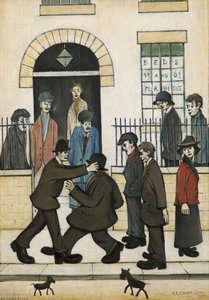
A Fight (1935) by L. S. Lowry

A Fight

1935 · Watercolor · The Lowry, Greater Manchester

In the heart of Northern England’s industrial landscape, where the smoke of chimneys once veiled the sky, Laurence Stephen Lowry captured more than just scenery; he captured the very pulse of human anxiety. “A Fight,” painted around 1935, serves as a profound window into a moment of suspended animation. At first glance, the scene appears to be a common street tableau outside a Manchester lodging house, yet beneath the surface…

4
Seascape by L. S. Lowry

Seascape

Oil On Canvas · The Lowry, Greater Manchester

To stand before Laurence Stephen Lowry's Seascape is to encounter not a dramatic vista, but a profound moment of stillness—a quiet meditation rendered in pigment. This work strips away the clamor of narrative, presenting instead the elemental dialogue between sky, sea, and sand. It is a composition so deceptively simple that its power lies entirely within its restraint. Lowry divides the canvas into three immaculate horizontal bands: the expansive, cloud-veiled…

5
The Canal Bridge (1949) by L. S. Lowry

The Canal Bridge

1949 · Oil On Canvas

We are looking at The Canal Bridge, an oil painting by L. S. Lowry. Completed in 1949, this work measures 71 x 91 cm. It is currently held within the collection of the Southampton City Art Gallery in the United Kingdom.

6
North James Henry Street, Salford by L. S. Lowry

North James Henry Street, Salford

Drawing · The Lowry, Greater Manchester

In the evocative monochrome of North James Henry Street, Salford, we are transported to the heart of an era defined by soot, steel, and the rhythmic pulse of industrial life. This exquisite drawing by Laurence Stephen Lowry serves as more than a mere topographical record; it is a poignant window into the soul of Northern England. Through his masterful use of line and shadow, Lowry captures a fleeting moment on…

7
The Cripples by L. S. Lowry

The Cripples

Acrylic On Canvas · The Lowry, Greater Manchester

Laurence Stephen Lowry's "The Cripples," painted in 1949, isn’t merely a depiction of Manchester street life; it’s a poignant and unsettling meditation on anonymity, social exclusion, and the quiet dignity of those often overlooked. This iconic work, now housed within the collection of The Lowry in Salford, offers a rare glimpse into the artist's unique perspective – one that eschewed sentimentality for a starkly observed reality, revealing a profound sensitivity…

8
Man Lying on a Wall by L. S. Lowry

Man Lying on a Wall

Oil On Canvas · The Lowry, Greater Manchester

Man Lying on a Wall is an oil on canvas created by L. S. Lowry in 1957. The work captures a solitary man resting against a brick wall. He is dressed in a pinstripe suit and black shoes, topped with a bowler hat. A cigarette rests between his fingers, a small ember of movement in a still scene.

9
Belle Vue House, Leaf Square, Salford by L. S. Lowry

Belle Vue House, Leaf Square, Salford

Drawing · The Lowry, Greater Manchester

Belle Vue House, Leaf Square, Salford is a work by the English artist L. S. Lowry. This piece, measuring 34 x 24 cm, remains undated. It captures a specific architectural and social moment within the urban landscape of Salford, United Kingdom.

10
A View from the Window of the Royal Technical College, Salford by L. S. Lowry

A View from the Window of the Royal Technical College, Salford

Watercolor · The Lowry, Greater Manchester

Laurence Stephen Lowry’s “A View from the Window of the Royal Technical College, Salford,” completed in 1924, is far more than a mere topographical record of a Northern English cityscape; it is a profound distillation of an era. To gaze upon this work is to step into the rhythmic, often heavy pulse of Salford during its industrial zenith. The painting captures a moment of quiet, almost voyeuristic observation amidst the…

The L. S. Lowry selection continues, 11 to 100

11By the County Court, Salford by L. S. LowryBy the County Court, SalfordThe Lowry 12Wet Earth Colliery, Dixon Fold by L. S. LowryWet Earth Colliery, Dixon FoldThe Lowry 13Arden's Farm, Swinton (1909) by L. S. LowryArden's Farm, Swinton1909 · The Lowry 14Still Life (1906) by L. S. LowryStill Life1906 · The Lowry 15Seascape (1950) by L. S. LowrySeascape1950 16Blitzed Site by L. S. LowryBlitzed SiteThe Lowry 17Portrait of the Artist's Mother (1912) by L. S. LowryPortrait of the Artist's Mother1912 · The Lowry 18Monday Morning (1946) by L. S. LowryMonday Morning1946 19St Augustine's Church, Manchester (1945) by L. S. LowrySt Augustine's Church, Manchester1945 20Woman in a Chair (1956) by L. S. LowryWoman in a Chair1956 · The Lowry 21An Old Street (1937) by L. S. LowryAn Old Street1937 22Figures in a Park by L. S. LowryFigures in a Park 23Family Group by L. S. LowryFamily Group 24The Lookers On by L. S. LowryThe Lookers On 25Untitled (946) by L. S. LowryUntitled (946) 26Untitled (692) by L. S. LowryUntitled (692) 27Untitled (453) by L. S. LowryUntitled (453) 28Untitled (412) by L. S. LowryUntitled (412) 29The Steps, Peel Park, Salford by L. S. LowryThe Steps, Peel Park, SalfordThe Lowry 30Untitled (531) by L. S. LowryUntitled (531) 31Untitled (581) by L. S. LowryUntitled (581) 32Three Women and a Dog by L. S. LowryThree Women and a Dog 33Oldfield Road Dwellings by L. S. LowryOldfield Road DwellingsThe Lowry 34Piccadilly Circus, London by L. S. LowryPiccadilly Circus, London 35Ann by L. S. LowryAnnThe Lowry 36Unfinished (verso) by L. S. LowryUnfinished (verso)Swindon Art Gallery 37The Funeral Party by L. S. LowryThe Funeral PartyThe Lowry 38Clifton Junction, Evening (1910) by L. S. LowryClifton Junction, Evening1910 · The Lowry 39Portrait of Male Model (1908) by L. S. LowryPortrait of Male Model1908 · The Lowry 40Hetty (1910) by L. S. LowryHetty1910 · The Lowry 41Chinese Lantern and Oranges (1908) by L. S. LowryChinese Lantern and Oranges1908 · The Lowry 42Portrait of a Boy (1914) by L. S. LowryPortrait of a Boy1914 · The Lowry 43Old Salford Street Scene (1922) by L. S. LowryOld Salford Street Scene1922 44Frank Jopling Fletcher (1888–1955) (1919) by L. S. LowryFrank Jopling Fletcher (1888–1955)1919 · The Lowry 45Landscape with Road (1925) by L. S. LowryLandscape with Road1925 46An Accident (1926) by L. S. LowryAn Accident1926 47Coming Out of School (1927) by L. S. LowryComing Out of School1927 48The Mill Gates (1928) by L. S. LowryThe Mill Gates1928 49Girl in a Cloche Hat (1927) by L. S. LowryGirl in a Cloche Hat1927 · The Lowry 50A Street Scene (St Simon's Church) (1928) by L. S. LowryA Street Scene (St Simon's Church)1928 · The Lowry 51Self Portrait (1925) by L. S. LowrySelf Portrait1925 · The Lowry 52Laying a Foundation Stone (1936) by L. S. LowryLaying a Foundation Stone1936 53The Courtyard (1936) by L. S. LowryThe Courtyard1936 54A Landmark (1936) by L. S. LowryA Landmark1936 · The Lowry 55Head of a Man (1938) by L. S. LowryHead of a Man1938 · The Lowry 56The Coal Barge (1938) by L. S. LowryThe Coal Barge1938 · The Lowry 57Portrait of the Artist's Father (1910) by L. S. LowryPortrait of the Artist's Father1910 · The Lowry 58Landscape with Road (1941) by L. S. LowryLandscape with Road1941 59Fire Watcher (recto) (1943) by L. S. LowryFire Watcher (recto)1943 60Mountain Lake (1943) by L. S. LowryMountain Lake1943 · Kettle's Yard 61Albion Mill (1941) by L. S. LowryAlbion Mill1941 · The Lowry 62Winter in Pendlebury, Manchester (recto) (1943) by L. S. LowryWinter in Pendlebury, Manchester (recto)1943 · Swindon Art Gallery 63After the Wedding (1939) by L. S. LowryAfter the Wedding1939 · Fitzwilliam College 64An Old Farm (1943) by L. S. LowryAn Old Farm1943 · The Lowry 65A River Bank (1947) by L. S. LowryA River Bank1947 66The Park (1946) by L. S. LowryThe Park1946 · Arts Council Collection 67Street in Pendelbury (1948) by L. S. LowryStreet in Pendelbury1948 68The Old House, Grove Street, Salford (1948) by L. S. LowryThe Old House, Grove Street, Salford1948 69Level Crossing (1946) by L. S. LowryLevel Crossing1946 · The Lowry 70The Pond (1950) by L. S. LowryThe Pond1950 71Industrial Landscape, River Scene (1950) by L. S. LowryIndustrial Landscape, River Scene1950 · New Walk Museum - Art Gallery 72Industrial Landscape (1955) by L. S. LowryIndustrial Landscape1955 73View of Deptford Power Station from Greenwich (1959) by L. S. LowryView of Deptford Power Station from Greenwich1959 · National Maritime Museum 74Clifton Junction, Morning (1910) by L. S. LowryClifton Junction, Morning1910 · The Lowry 75The Cripples (1949) by L. S. LowryThe Cripples1949 · The Lowry 76Untitled (822) by L. S. LowryUntitled (822) 77Untitled (434) by L. S. LowryUntitled (434) 78Untitled (798) by L. S. LowryUntitled (798) 79Untitled (825) by L. S. LowryUntitled (825) 80Untitled (218) by L. S. LowryUntitled (218) 81Untitled (752) by L. S. LowryUntitled (752) 82Untitled (379) by L. S. LowryUntitled (379) 83Untitled (138) by L. S. LowryUntitled (138) 84Untitled (330) by L. S. LowryUntitled (330) 85Untitled (769) by L. S. LowryUntitled (769) 86Untitled (642) by L. S. LowryUntitled (642) 87Untitled (778) by L. S. LowryUntitled (778) 88Untitled (719) by L. S. LowryUntitled (719) 89Untitled (800) by L. S. LowryUntitled (800) 90Untitled (447) by L. S. LowryUntitled (447) 91Untitled (985) by L. S. LowryUntitled (985) 92Untitled (427) by L. S. LowryUntitled (427) 93Untitled (284) by L. S. LowryUntitled (284) 94Untitled (790) by L. S. LowryUntitled (790) 95St Augustine by L. S. LowrySt AugustineThe Lowry 96Yachts by L. S. LowryYachtsThe Lowry 97View from the Window of the Royal Technical College, Salford, Looking towards Manchester by L. S. LowryView from the Window of the Royal Technical College, Salford, Looking towards ManchesterThe Lowry 98Untitled (328) by L. S. LowryUntitled (328) 99Untitled (251) by L. S. LowryUntitled (251) 100Untitled (963) by L. S. LowryUntitled (963)

L. S. Lowry's famous paintings, period by period

The subjects that held L. S. Lowry's eye

The four subjects that come back most often in these originals, each with its finest example.

The museums that keep L. S. Lowry's originals

The 7 museums that hold the most of the paintings on this page.

Museum City Works by L. S. Lowry Paintings from this list
The Lowry, Greater ManchesterThe Lowry Greater Manchester 54 Swinton Moss, Canal Scene near Accrington, A Fight
Swindon Art Gallery, SwindonSwindon Art Gallery Swindon 2 Unfinished (verso), Winter in Pendlebury, Manchester (recto)
Kettle's Yard, CambridgeKettle's Yard Cambridge 1 Mountain Lake
Fitzwilliam College, CambridgeFitzwilliam College Cambridge 1 After the Wedding
Arts Council Collection, LondonArts Council Collection London 1 The Park
New Walk Museum - Art Gallery, LeicesterNew Walk Museum - Art Gallery Leicester 1 Industrial Landscape, River Scene
National Maritime Museum, LondonNational Maritime Museum London 1 View of Deptford Power Station from Greenwich

L. S. Lowry decade by decade: the original that defines each

Works per decade

Pick a decade to see the original that defines it.

Collectors' questions about L. S. Lowry's paintings

Which work is L. S. Lowry most famous for?Reveal the answer

Swinton Moss (1922), The Lowry, Greater Manchester. Canal Scene near Accrington (1939) and A Fight (1935) come next.

What age was L. S. Lowry when Swinton Moss was made?Reveal the answer

35 years old: Swinton Moss dates from 1922, and L. S. Lowry was born in 1887.

What are the ten most famous L. S. Lowry paintings?Reveal the answer

Swinton Moss, Canal Scene near Accrington, A Fight, Seascape, The Canal Bridge, North James Henry Street, Salford, The Cripples, Man Lying on a Wall, Belle Vue House, Leaf Square, Salford and A View from the Window of the Royal Technical College, Salford. The ranking above gives each one's year and museum.

How many paintings did L. S. Lowry leave?Reveal the answer

Our catalog holds 117 works by L. S. Lowry, dated from 1906 to 1959.

In which museums do L. S. Lowry's masterpieces hang?Reveal the answer

Mostly in The Lowry (Greater Manchester), Swindon Art Gallery (Swindon) and Kettle's Yard (Cambridge). The museum table above lists them all.

In which years did L. S. Lowry paint the most famous works?Reveal the answer

In 1940s: 15 of the 100 works on this page were made then, The Canal Bridge among them.

What are the first and the last famous originals of L. S. Lowry?Reveal the answer

On this page, the earliest is Still Life (1906) and the latest View of Deptford Power Station from Greenwich (1959).

Which subjects did L. S. Lowry choose most often?Reveal the answer

Northern england (8), Industrial landscape (6) and People (6), across the 100 works on this page.

Which technique did L. S. Lowry use most?Reveal the answer

Oil On Canvas, for 6 of the 100 works on this page.

To which art movement does L. S. Lowry belong?Reveal the answer

Contemporary realism, judging by the originals on this page.

Which L. S. Lowry works hang at the The Lowry?Reveal the answer

Swinton Moss, Canal Scene near Accrington and A Fight: the The Lowry, Greater Manchester holds 41 of the works on this page.

L. S. Lowry: life and work

The Quiet Observer of Industrial England

Laurence Stephen Lowry, born in the heart of Stretford, Cheshire, in 1887, remains one of Britain’s most beloved and distinctive voices in twentieth-century art. While his name is now synonymous with the gritty, evocative landscapes of Northern England, his journey to international acclaim was a slow, poignant ascent. For much of his life, Lowry lived as a quiet observer, working as a rent collector by day while honing his craft in the evenings. This dual existence allowed him to witness the rhythmic, often harsh, pulse of industrial life with a unique intimacy. His work does not merely represent the smoke-filled horizons of Salford and Pendlebury; it captures a profound sensitivity to the human condition, finding a quiet dignity within the stark realities of the industrial age.

Lowry’s artistic development was deeply rooted in his surroundings, yet his technical foundations were built upon a careful study of form and light. Initially influenced by the principles of Impressionism and Post-Impressionism, he sought to capture the essence of a scene rather than its mere surface. His early training at the Manchester Art School provided him with the tools to translate the sprawling factories and crowded streets into something much more symbolic. As his style matured, he moved away from grand narratives, choosing instead to focus on subtle nuances of observation. He often worked within a highly restricted palette—utilizing colors such as flake white, ivory black, vermilion, Prussian blue, and yellow ochre—to create compositions that felt both grounded in reality and elevated by a dreamlike, almost surrealist quality.

The Magic of the Matchstick Men

Perhaps the most enduring legacy of Lowry is his creation of the so-called "matchstick men." These stylized, simplified human figures, often depicted without shadows or distinct facial features, populate his urban landscapes with a sense of collective movement and shared destiny. Through these figures, Lowry transformed bustling street scenes into poetic meditations on community and solitude. Whether they are walking toward a football match, congregating near a mill, or wandering through a park, these characters embody the resilience of the working class. There is a haunting beauty in how he places these small, fragile forms against the backdrop of massive, brooding industrial structures, creating a tension between the monumental scale of industry and the delicate nature of human life.

Beyond his famous urban scenes, Lowry’s repertoire was surprisingly diverse, revealing an artist of great depth and curiosity. While the industrial landscape is his most celebrated subject, he also explored:

  • Mysterious Unpopulated Landscapes: Brooding, atmospheric scenes that evoke a sense of solitude and the passage of time.
  • Seascapes: Pure, elemental depictions of sea and sky that emerged from his fascination with the coast in the 1940s.
  • Portraits: Intimate, often somber studies of individuals that showcase his ability to capture character through minimal detail.
  • The "Marionette" Works: A collection of unpublished, surrealist-leaning pieces discovered only after his death, revealing a more experimental side of his imagination.

A Lasting Legacy in British Art

Though he achieved significant national fame following his first solo exhibition in London in 1939, Lowry’s true impact is felt in the way he redefined the English landscape. He did not seek to glorify progress or paint heroic vistas; instead, he found beauty in the mundane and the melancholic. His ability to find poignant beauty in the soot-stained streets of the North West has made his work a cornerstone of British cultural identity. Today, institutions such as The Lowry in Salford Quays serve as vital guardians of his immense legacy, housing one of the largest public collections of his work.

Lowry’s significance lies in his refusal to look away from the difficult realities of his era. By documenting the lives of ordinary people with such empathy and stylistic innovation, he ensured that the spirit of industrial England would be preserved not just as history, but as art. He remains a master of atmosphere, an artist who proved that even in the most crowded, industrial settings, there is a profound, quiet magic to be found.