Portrait of John Singer Sargent

The 100 Most Famous John Singer Sargent Paintings, Each One of a Kind

Updated October 2026 · ranked by our popularity score (searches, visits and orders for each work) · 1,549 works by John Singer Sargent in our catalogue

In short

Madame X (1884) is the John Singer Sargent painting that draws the most eyes; the original belongs to the Metropolitan Museum of Art, New York. After it, the eye goes to Carnation, Lily, Lily, Rose (1885) and Gassed (1918). Among the 1,549 works of John Singer Sargent in our catalog, these 100 are the most famous, each a unique original presented with its year, its museum and the reason it endures.

1856 – 1925, Florence Impressionism Most works: Metropolitan Museum of Art

Top 10 paintings by John Singer Sargent, through the gallery's eye

1
Madame X (1884) by John Singer Sargent

Madame X

1884 · Oil On Canvas · Metropolitan Museum of Art, New York

This captivating full-length portrait embodies the refined aesthetic of the late 19th century, showcasing a woman of striking presence and subtle melancholy. Executed in the manner of John Singer Sargent, though authorship is currently unknown, the work exemplifies the era’s fascination with portraying wealth, status, and inner life through sophisticated portraiture. It's a piece that invites contemplation and adds a touch of timeless grace to any space.

2
Carnation, Lily, Lily, Rose (1885) by John Singer Sargent

Carnation, Lily, Lily, Rose

1885 · Oil On Canvas · Tate Gallery, London

John Singer Sargent’s Carnation, Lily, Lily, Rose (1885-86) is a landmark achievement in late Impressionism, subtly infused with Symbolist undertones. More than just a depiction of two young girls in a garden, it's an atmospheric poem rendered in paint – a fleeting moment of childhood innocence and the tranquil beauty of dusk captured with remarkable sensitivity.

3
Gassed (1918) by John Singer Sargent

Gassed

1918 · Acrylic On Canvas · Imperial War Museum, London

John Singer Sargent’s “Gassed,” painted in 1918, is not a triumphant depiction of wartime heroism, but rather a profoundly poignant observation of the human condition amidst the devastation of World War I. This evocative black and white composition captures a group of soldiers – fourteen in number – gathered around a simple wooden bench, their postures suggesting both weariness and an unspoken camaraderie. The scene, rendered with Sargent’s signature meticulous…

4
The Daughters of Edward Darley Boit by John Singer Sargent

The Daughters of Edward Darley Boit

Oil On Canvas · Museum of Fine Arts, Boston

In the quiet, shadowed corridors of an opulent Parisian apartment, a moment of profound stillness is captured forever within John Singer Sargent’s 1882 masterpiece, The Daughters of Edward Darley Boit. This is not merely a portrait of four young girls; it is an evocative exploration of childhood, space, and the enigmatic threshold between innocence and the unknown. As the viewer enters the scene, they are met with a composition that…

5
Lady Agnew of Lochnaw (1893) by John Singer Sargent

Lady Agnew of Lochnaw

1893 · Acrylic · Scottish National Gallery, Edinburgh

A Portrait Steeped in Refinement: Lady Agnew of Lochnaw by John Singer Sargent Subject Matter: This captivating portrait depicts Lady Agnew of Lochnaw, a prominent Scottish socialite and philanthropist. Her serene gaze directs the viewer’s attention, conveying an aura of composure and dignity – qualities characteristic of Sargent's favored subjects. Style & Technique: Sargent’s masterful brushwork exemplifies Impressionistic tendencies while retaining a meticulous realism. He skillfully captures the subtle nuances…

6
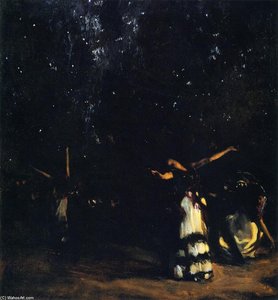
El Jaleo (1882) by John Singer Sargent

El Jaleo

1882 · Oil On Canvas · Isabella Stewart Gardner Museum, Boston

A Captivating Glimpse into Spanish Culture John Singer Sargent's masterpiece transports viewers into the heart of a flamenco performance, capturing the raw energy and passion of the dance. The central figure, a Spanish Romani dancer, is depicted in mid-motion, her white dress flowing dramatically against a backdrop of musicians and spectators. This dynamic scene encapsulates the vibrant spirit of Spanish culture, making it a captivating addition to any art collection…

7
A Dinner Table at Night (also known as Mr. and Mrs. Albert Vickers) (1884) by John Singer Sargent

A Dinner Table at Night (also known as Mr. and Mrs. Albert Vickers)

1884 · Oil On Canvas · Fine Arts Museums of San Francisco, San Francisco

An Intimate Glimpse into Victorian Society John Singer Sargent’s “A Dinner Table at Night,” also known as “Mr. and Mrs. Albert Vickers,” is more than just a depiction of a couple dining; it's an invitation into the heart of Victorian social life, rendered with a masterful blend of realism and impressionistic flair. Painted in 1884, the artwork captures a moment of quiet intimacy, a carefully constructed tableau that speaks volumes…

8
Boat in the Waters off Capri (1878) by John Singer Sargent

Boat in the Waters off Capri

1878 · Watercolor

John Singer Sargent's "Boat in the Waters off Capri," painted in 1878, is more than a mere depiction of a coastal scene; it’s an invitation to pause and breathe within a world steeped in light and tranquility. The watercolor captures a fleeting moment on the idyllic shores of Capri, where two small boats rest gently upon turquoise waters under a soft, diffused sky. This work isn't about grand narratives or…

9
A Backwater at Calcot Near Reading (1888) by John Singer Sargent

A Backwater at Calcot Near Reading

1888 · Oil On Canvas · Baltimore Museum of Art, Baltimore

A Serene Escape in Nature John Singer Sargent's "A Backwater at Calcot Near Reading" invites viewers into a tranquil riverside scene, capturing the quiet beauty of nature during the golden hour. This captivating landscape showcases Sargent's mastery of light and atmosphere, offering a moment of peaceful reflection amidst the lush greenery and calm waters. Impressionistic Style and Technique Painted in 1888, this artwork exemplifies Sargent's impressionistic style, characterized by loose,…

10
Capri (also known as A Girl of Capri) (1878) by John Singer Sargent

Capri (also known as A Girl of Capri)

1878 · Oil On Canvas · Museum of Fine Arts, Boston

A Captivating Glimpse of Capri Immerse yourself in the serene beauty of this captivating artwork, which transports you to the picturesque island of Capri. The painting depicts a young woman standing near a stone wall, surrounded by lush foliage and bathed in soft, natural light. Her vibrant floral dress adds a touch of color to the earthy tones of the landscape, creating a harmonious blend that is both visually striking…

John Singer Sargent's famous paintings, numbers 11 to 100

11Street in Venice (1882) by John Singer SargentStreet in Venice1882 · National Gallery of Art 12Cashmere (1908) by John Singer SargentCashmere1908 13Las Meninas (after Velazquez) (1879) by John Singer SargentLas Meninas (after Velazquez)1879 · Museo del Prado 14Madame X (also known as Madame Pierre Gautreau) (1884) by John Singer SargentMadame X (also known as Madame Pierre Gautreau)1884 · Metropolitan Museum of Art 15The Daughters of Edward Darley Boit (1882) by John Singer SargentThe Daughters of Edward Darley Boit1882 · Museum of Fine Arts 16The Wyndham Sisters (1899) by John Singer SargentThe Wyndham Sisters1899 · Metropolitan Museum of Art 17Capri Girl (Dans les Oliviers, à Capri) (1878) by John Singer SargentCapri Girl (Dans les Oliviers, à Capri)1878 18Carnation, Lily, Lily, Rose (1885) by John Singer SargentCarnation, Lily, Lily, Rose1885 · Tate Britain 19Group with Parasols (A Siesta) (1905) by John Singer SargentGroup with Parasols (A Siesta)1905 20Lady Agnew of Lochnaw by John Singer SargentLady Agnew of Lochnaw 21Graveyard in the Tyrol (1915) by John Singer SargentGraveyard in the Tyrol1915 22Carnation, Lily, Lily, Rose (1885) by John Singer SargentCarnation, Lily, Lily, Rose1885 · Tate Gallery 23John D. Rockefeller (1917) by John Singer SargentJohn D. Rockefeller1917 24Neopolitan Children Bathing (1878) by John Singer SargentNeopolitan Children Bathing1878 · Sterling and Francine Clark Art Institute 25Two Girls with Parasols at Fladbury (1889) by John Singer SargentTwo Girls with Parasols at Fladbury1889 · Metropolitan Museum of Art 26The Spanish Dancer (1879) by John Singer SargentThe Spanish Dancer1879 · National Gallery of Art 27Sir Edmund Gosse (1886) by John Singer SargentSir Edmund Gosse1886 · National Portrait Gallery 28Essie, Ruby and Ferdinand, Children of Asher Wertheimer (1902) by John Singer SargentEssie, Ruby and Ferdinand, Children of Asher Wertheimer1902 · Tate Gallery 29Miss Beatrice Townsend (1882) by John Singer SargentMiss Beatrice Townsend1882 · National Gallery of Art 30Ada Rehan (1894) by John Singer SargentAda Rehan1894 · Metropolitan Museum of Art 31La Carmencita (1890) by John Singer SargentLa Carmencita1890 · Musée d'Orsay 32William Butler Yeats (1908) by John Singer SargentWilliam Butler Yeats1908 33The Duchess of Sutherland (1904) by John Singer SargentThe Duchess of Sutherland1904 · Thyssen-Bornemisza Museum 34Hugh Lane (1906) by John Singer SargentHugh Lane1906 35madame x by John Singer Sargentmadame x 36Peter A. B. Widener (1902) by John Singer SargentPeter A. B. Widener1902 37Lady Eden (1906) by John Singer SargentLady Eden1906 · Philadelphia Museum of Art 38Mrs Carl Meyer and her Children (1896) by John Singer SargentMrs Carl Meyer and her Children1896 · Tate Britain 39Eleanora Duse (1893) by John Singer SargentEleanora Duse1893 40Group in Simplon (1911) by John Singer SargentGroup in Simplon1911 41A Jersey Calf (1893) by John Singer SargentA Jersey Calf1893 · Yale University Art Gallery 42Venetian Women in the Palazzo Rezzonico (1880) by John Singer SargentVenetian Women in the Palazzo Rezzonico1880 43Mrs. Robert Harrison (1886) by John Singer SargentMrs. Robert Harrison1886 44Fishing for Oysters at Cancale (1878) by John Singer SargentFishing for Oysters at Cancale1878 · Museum of Fine Arts 45Studies of a Dead Bird (1874) by John Singer SargentStudies of a Dead Bird1874 · Metropolitan Museum of Art 46Olivia Richardson (1883) by John Singer SargentOlivia Richardson1883 47Entrance to a Mosque (also known as Courtyard, Tetuan) (1880) by John Singer SargentEntrance to a Mosque (also known as Courtyard, Tetuan)1880 · Metropolitan Museum of Art 48Two Girls Lying on the Grass (also known as Two Girls on a Lawn) (1889) by John Singer SargentTwo Girls Lying on the Grass (also known as Two Girls on a Lawn)1889 · Metropolitan Museum of Art 49Lady Fauden Phillips (Helen Levy) (1898) by John Singer SargentLady Fauden Phillips (Helen Levy)1898 50Self-Portrait (1892) by John Singer SargentSelf-Portrait1892 · Nationalmuseum 51MId-Ocean, Mid-Winter (also known as Mid Ocean in Winter) (1876) by John Singer SargentMId-Ocean, Mid-Winter (also known as Mid Ocean in Winter)1876 52Mrs. Asher Wertheimer (1904) by John Singer SargentMrs. Asher Wertheimer1904 · Tate Gallery 53Two Women Asleep in a Punt under the Willows (1887) by John Singer SargentTwo Women Asleep in a Punt under the Willows1887 54Field Marshal Earl Roberts, K.G., V. C. (1906) by John Singer SargentField Marshal Earl Roberts, K.G., V. C.1906 · National Portrait Gallery 55President Woodrow Wilson (1917) by John Singer SargentPresident Woodrow Wilson1917 · National Gallery of Ireland 56The Misses Hunter (1902) by John Singer SargentThe Misses Hunter1902 · Tate Gallery 57Carnation, Lily, Lily, Rose (study) (1885) by John Singer SargentCarnation, Lily, Lily, Rose (study)1885 · Nationalmuseum 58Portrait of Two Children (1887) by John Singer SargentPortrait of Two Children1887 59Falconieri Gardens, Frascati (1907) by John Singer SargentFalconieri Gardens, Frascati1907 60Madame Gautreau (1883) by John Singer SargentMadame Gautreau1883 · Harvard Art Museums 61Nude Egyptian Girl (1891) by John Singer SargentNude Egyptian Girl1891 62Thistles (1884) by John Singer SargentThistles1884 63John D. Rockefeller (1917) by John Singer SargentJohn D. Rockefeller1917 64Mrs Edward Goetz (1901) by John Singer SargentMrs Edward Goetz1901 · Brigham Young University Museum of Art 65Mrs. Waldo Story (1883) by John Singer SargentMrs. Waldo Story1883 66Group with Parasols (1905) by John Singer SargentGroup with Parasols1905 67Mrs. Albert Vickers (1884) by John Singer SargentMrs. Albert Vickers1884 · Virginia Museum of Fine Arts 68A Venetian Woman (1882) by John Singer SargentA Venetian Woman1882 · Cincinnati Art Museum 69Mr. and Mrs. John W. Field (1882) by John Singer SargentMr. and Mrs. John W. Field1882 · Pennsylvania Academy of Fine Arts 70Olive Trees (1883) by John Singer SargentOlive Trees1883 71Head of a Young Man (also known as Portrait of a Sailor) (1878) by John Singer SargentHead of a Young Man (also known as Portrait of a Sailor)1878 72Mrs. William Henry Vanderbilt (1888) by John Singer SargentMrs. William Henry Vanderbilt1888 73Mrs. John William Crombie (Minna Watson) (1898) by John Singer SargentMrs. John William Crombie (Minna Watson)1898 74In a Punt (Violet Sargent and Madame Paul Helleu) (also known as Two Woman in a Punt) (1889) by John Singer SargentIn a Punt (Violet Sargent and Madame Paul Helleu) (also known as Two Woman in a Punt)1889 75A Venetian woman (1882) by John Singer SargentA Venetian woman1882 76Mr. and Mrs. I. N. Phelps Stokes (1897) by John Singer SargentMr. and Mrs. I. N. Phelps Stokes1897 · Metropolitan Museum of Art 77Charles Deering (1877) by John Singer SargentCharles Deering1877 78Seascape (1875) by John Singer SargentSeascape1875 79Robert Louis Stevenson and his wife (1885) by John Singer SargentRobert Louis Stevenson and his wife1885 · Crystal Bridges Museum of American Art 80Mrs. Asher Wertheimer (Flora Joseph) (1898) by John Singer SargentMrs. Asher Wertheimer (Flora Joseph)1898 · New Orleans Museum of Art 81Campo San Canciano, Venice (also known as A Piazza at Venice) (1882) by John Singer SargentCampo San Canciano, Venice (also known as A Piazza at Venice)1882 82Statue of Perseus by Night (1902) by John Singer SargentStatue of Perseus by Night1902 83Madame Roger Jourdain (1885) by John Singer SargentMadame Roger Jourdain1885 84Study for Madame X (1883) by John Singer SargentStudy for Madame X1883 85Study for Madame X (1882) by John Singer SargentStudy for Madame X1882 86Grand Canal at San Samuele (1902) by John Singer SargentGrand Canal at San Samuele1902 87isabella stewart gardner by John Singer Sargentisabella stewart gardner 88Elizabeth Garrett Anderson (1900) by John Singer SargentElizabeth Garrett Anderson1900 · National Portrait Gallery 89Rose Marie Ormond (1912) by John Singer SargentRose Marie Ormond1912 90Study for 'Oyster Gatherers at Cancale' (1877) by John Singer SargentStudy for 'Oyster Gatherers at Cancale'1877 91Head of a Male Model (1878) by John Singer SargentHead of a Male Model1878 92Alhambra, Patio de la Reja (1879) by John Singer SargentAlhambra, Patio de la Reja1879 93Judith Gautier (1885) by John Singer SargentJudith Gautier1885 · Detroit Institute of Arts 94Self Portrait (1906) by John Singer SargentSelf Portrait1906 95Francisco Bernareggi (1908) by John Singer SargentFrancisco Bernareggi1908 · Nelson-Atkins Museum of Art 96The Honourable Victoria Stanley (1899) by John Singer SargentThe Honourable Victoria Stanley1899 97Teresa Gosse (1885) by John Singer SargentTeresa Gosse1885 98Carnation, Lily, Lily, Rose (study) (1885) by John Singer SargentCarnation, Lily, Lily, Rose (study)1885 99Morning Walk (1888) by John Singer SargentMorning Walk1888 100Helen Sears (1895) by John Singer SargentHelen Sears1895 · Museum of Fine Arts

John Singer Sargent's famous paintings, period by period

The subjects that held John Singer Sargent's eye

The four subjects that come back most often in these originals, each with its finest example.

The museums that keep John Singer Sargent's originals

The 8 museums that hold the most of the paintings on this page.

Museum City Works by John Singer Sargent Paintings from this list
Metropolitan Museum of Art, New YorkMetropolitan Museum of Art New York 65 Madame X, Madame X (also known as Madame Pierre Gautreau), The Wyndham Sisters
Museum of Fine Arts, BostonMuseum of Fine Arts Boston 54 The Daughters of Edward Darley Boit, Capri (also known as A Girl of Capri), The Daughters of Edward Darley Boit
Tate Gallery, LondonTate Gallery London 24 Carnation, Lily, Lily, Rose, Carnation, Lily, Lily, Rose, Essie, Ruby and Ferdinand, Children of Asher Wertheimer
National Portrait Gallery, LondonNational Portrait Gallery London 20 Sir Edmund Gosse, Field Marshal Earl Roberts, K.G., V. C., Elizabeth Garrett Anderson
National Gallery of Art, WashingtonNational Gallery of Art Washington 19 Street in Venice, The Spanish Dancer, Miss Beatrice Townsend
Nationalmuseum, StockholmNationalmuseum Stockholm 34 Self-Portrait, Carnation, Lily, Lily, Rose (study)
Tate Britain, LondonTate Britain London 4 Carnation, Lily, Lily, Rose, Mrs Carl Meyer and her Children
Harvard Art Museums, CambridgeHarvard Art Museums Cambridge 28 Madame Gautreau

John Singer Sargent across the decades: one unique original for each

Works per decade

Pick a decade to see the original that defines it.

John Singer Sargent's paintings: questions for the gallery

What is the single most famous work of John Singer Sargent?Reveal the answer

Madame X (1884), Metropolitan Museum of Art, New York. Carnation, Lily, Lily, Rose (1885) and Gassed (1918) come next.

At what age did John Singer Sargent create Madame X?Reveal the answer

28 years old: Madame X dates from 1884, and John Singer Sargent was born in 1856.

Which ten paintings by John Singer Sargent are the most famous?Reveal the answer

Madame X, Carnation, Lily, Lily, Rose, Gassed, The Daughters of Edward Darley Boit, Lady Agnew of Lochnaw, El Jaleo, A Dinner Table at Night (also known as Mr. and Mrs. Albert Vickers), Boat in the Waters off Capri, A Backwater at Calcot Near Reading and Capri (also known as A Girl of Capri). The ranking above gives each one's year and museum.

How many works by John Singer Sargent are known?Reveal the answer

Our catalog holds 1,549 works by John Singer Sargent, dated from 1874 to 1918.

Where can the most famous John Singer Sargent originals be seen?Reveal the answer

Mostly in Metropolitan Museum of Art (New York), Museum of Fine Arts (Boston) and Tate Gallery (London). The museum table above lists them all.

During which period did John Singer Sargent create the best-known paintings?Reveal the answer

In 1880s: 40 of the 100 works on this page were made then, Madame X among them.

Which famous John Singer Sargent painting is the earliest, and which the latest?Reveal the answer

On this page, the earliest is Studies of a Dead Bird (1874) and the latest Gassed (1918).

What subjects did John Singer Sargent favour?Reveal the answer

Portraiture (34), Elegance (25) and Victorian era (18), across the 100 works on this page.

What materials did John Singer Sargent paint with most?Reveal the answer

Oil On Canvas, for 70 of the 100 works on this page.

Which movement does the work of John Singer Sargent belong to?Reveal the answer

Impressionism, judging by the originals on this page.

What John Singer Sargent originals can I see at the Metropolitan Museum of Art?Reveal the answer

Madame X, Madame X (also known as Madame Pierre Gautreau) and The Wyndham Sisters: the Metropolitan Museum of Art, New York holds 9 of the works on this page.

Where can I order a hand-painted John Singer Sargent reproduction?Reveal the answer

Yes, as a reproduction: the original stays in its museum, but any painting on this page can be painted by hand for you, made to order one at a time, from the painting's own page.

John Singer Sargent: a portrait of the artist

Early Life, Family and Training

Born in Florence, Italy, on January 12, 1856, John Singer Sargent entered a world shaped by the movement of his American expatriate parents, FitzWilliam and Mary Newbold Sargent. His father had previously served as an eye surgeon at the Wills Eye Hospital in Philadelphia between 1844 and 1854. This medical background provided a stable, if transient, foundation before the family’s life became defined by the cosmopolitan rhythms of Europe. The household was one of artistic inclination; his sister, Mary, was born in 1857, and his sister Emily would later establish herself as an accomplished painter. These early years were less about a fixed home and more about an immersion in the visual traditions of the continent.

His formal education followed a path through the major centers of European art, with training spanning Florence, Paris, and London. In Paris, he entered the studio of Carolus-Duran, a mentorship that would fundamentally shape his technical approach. This period of study was crucial in refining the observational skills that characterized his early development. Rather than following a rigid, academic path, his training was a sequence of direct engagement with the masters and the specific methods of the Parisian ateliers. He emerged from these studies with a technical facility that allowed him to move between the structured demands of portraiture and the more spontaneous requirements of his later studies.

The Paris Years and Artistic Scandal

In 1874, at the age of eighteen, Sargent entered the Paris studio of Carolus-Duran. This mentorship proved transformative, as the emphasis on direct painting helped hone his technical facility and ability to capture likenesses with speed. To further refine his skills, he enrolled at the École des Beaux-Arts, drawing from life models and casts to solidify his foundation. During these formative years, he began to establish himself among the city's elite, navigating the social and artistic hierarchies of the French capital.

His ascent toward becoming a premier society painter was interrupted by a sudden, sharp controversy. The unveiling of Madame X (Portrait of Madame Pierre Gautreau) at the 1884 Salon ignited a scandal that threatened his burgeoning career. The painting's daring depiction of the socialite—noted for her pale complexion and suggestive pose—was deemed provocative by Parisian society. Though he later repainted the strap of her gown, the social fallout was significant. This scandal eventually forced him to leave Paris and return to England, seeking a more receptive audience for his talents.

Success in London and Portraiture

The scandal in Paris prompted a significant shift in his trajectory, leading him to relocate to London in 1886. This move proved to be a turning point, as he transitioned from a controversial figure to the leading portrait painter of his generation. He possessed a rare level of professional agency; he could choose which commissions to accept and set very high prices for his work. This autonomy allowed him to navigate the highest echelons of society with a sense of command that few of his contemporaries could match.

His subjects were the architects of their era, ranging from the social elite to prominent political figures. Among the numerous celebrities who sat for him was former president Theodore Roosevelt. He did not merely record a likeness; he captured the social dynamics and the opulence of the Edwardian era. His ability to document the character of his sitters made him a sought-after figure for those wishing to secure their place in the visual history of the age.

Technique and Artistic Style

Sargent’s approach to the canvas was defined by a remarkable technical facility, particularly his ability to draw with a brush. Under the mentorship of Carolus-Duran, he embraced the principle of direct painting, a method that prioritized the immediate application of pigment over the safety of preliminary sketches. This training encouraged him to capture the essence of a subject through spontaneous, decisive movements. His method often involved blocking in tones in discreet, mosaic-like patches, which he would later blend together to achieve a sense of depth and form. Such a process allowed for a certain fluidity that became a hallmark of his hand.

His output reflected a dual nature in his artistic temperament. In his commissioned portraits, he adhered to the grand manner, meeting the expectations of his high-society sitters with elegance and poise. However, his informal studies and landscape paintings revealed a different inclination. In these works, he displayed a familiarity with Impressionism, utilizing loose brushwork to catch the shifting qualities of light. This versatility allowed him to move between the structured demands of formal portraiture and the more expressive, atmospheric requirements of plein-air painting.

Key Works and Artistic Range

Sargent’s output was vast, comprising roughly 900 oil paintings and more than 2,000 watercolors. His subject matter followed his movements across the globe, documenting landscapes and figures from Venice, the Tyrol, Corfu, and Capri to the Middle East, Spain, Montana, Maine, and Florida. This geographic breadth allowed him to move between the structured demands of high-society portraiture and the spontaneous requirements of plein-air studies. While his reputation was often tied to the elegance of his sitters, his sketches and charcoal drawings reveal a restless, observant eye that sought the essence of a moment rather than a mere likeness.

His ability to navigate different genres is evident in the contrast between his most famous subjects. Madame X remains a central piece of his early career, a work that defined his presence in the Parisian art scene. In contrast, his later interest in the natural world and more informal settings produced works like Carnation, Lily, Lily, Rose, a depiction of two young girls in an English garden. He also captured the energy of movement in El Jaleo, a portrayal of Spanish flamenco dancers. These works demonstrate a technical flexibility that allowed him to transition from the heavy, formal requirements of a commission to the light-filled atmosphere of a garden or a dance.

Legacy and Lasting Influence

By the time of his death on April 15, 1925, the scope of Sargent's output had reached a vast scale, encompassing roughly 900 oil paintings and over 2,000 watercolors. His technical facility, particularly the ability to draw with a brush, left a mark on subsequent generations of artists. While much of his fame rested on the high-society commissions of the Edwardian era, his influence extended into the very mechanics of how light and atmosphere are rendered on canvas.

The understanding of his artistic range underwent a significant shift in the 1980s. The rediscovery of his previously overlooked male nudes provided a more complex view of his creative intentions, moving the conversation beyond the social circles of his portraiture. This expansion of his known oeuvre revealed a more nuanced artist, one whose interests were not confined to the glittering surfaces of the Gilded Age. His works continue to draw audiences across the globe, maintaining a presence in major institutions such as the Metropolitan Museum of Art and the Tate Gallery.

All 1549 works by John Singer Sargent →