Portrait of Georges Seurat

Georges Seurat Paintings: The 100 Most Famous, Through a Gallery's Eye

Updated November 2026 · ranked by our popularity score (searches, visits and orders for each work) · 438 works by Georges Seurat in our catalogue

In short

To the gallery's eye, Georges Seurat's most famous painting is A Sunday Afternoon on the Island of La Grande Jatte (1886), whose original hangs in the Art Institute of Chicago, Chicago. Bañistas en Asnieres, 1889 and Circus Sideshow (1888) complete the trio every eye recognises. Of the 438 works by Georges Seurat in our catalog, the gallery presents the 100 most famous below, each original with its year, its museum and what makes it unique.

1859 – 1891, former 5th arrondissement of Paris Neo-impressionism Most works: Musée d'Orsay

The gallery's top 10 Georges Seurat paintings

1
A Sunday Afternoon on the Island of La Grande Jatte (1886) by Georges Seurat

A Sunday Afternoon on the Island of La Grande Jatte

1886 · Oil On Canvas · Art Institute of Chicago, Chicago

Georges Seurat’s monumental masterpiece, created between 1884 and 1886, is more than just a depiction of leisure; it's a groundbreaking exploration of color, light, and the burgeoning modern world. This iconic painting transports viewers to the tranquil banks of the Seine on the Île de la Grande Jatte, offering a glimpse into Parisian society at a pivotal moment in history.

2
Bañistas en Asnieres, 1889 by Georges Seurat

Bañistas en Asnieres, 1889

Oil On Canvas · National Gallery, London

Immerse yourself in the vibrant and lively depiction of "Bañistas en Asnieres," a masterpiece by Georges Seurat. This enchanting artwork captures a group of people enjoying a day by the water, exuding a sense of leisure, relaxation, and social interaction. The scene is bathed in soft pastel tones, creating a serene and pleasant atmosphere that invites viewers to experience the tranquility and joy of a sunny afternoon by the river.

3
Circus Sideshow (1888) by Georges Seurat

Circus Sideshow

1888 · Oil On Canvas · Metropolitan Museum of Art, New York

The Vivid Energy of Performance Immerse yourself in the dynamic world of "Circus Sideshow," a captivating artwork by Georges Pierre Seurat that brings the excitement and vibrancy of a circus performance to life. This masterpiece, created in 1888, is a testament to Seurat's innovative approach to art and his ability to capture the essence of modern life with unparalleled precision and color. A Masterpiece of Pointillism Seurat's "Circus Sideshow" is…

4
Models (1887) by Georges Seurat

Models

1887 · Oil On Canvas · Barnes Foundation, Philadelphia

The painting depicts a nude female body in three different poses, serving as a response to critics who claimed Seurat's technique was too cold to represent life. The composition is highly intricate, featuring the models in a way that subverts traditional hierarchies by using large canvas dimensions typically reserved for history paintings. In the left background, the work incorporates part of Seurat's earlier masterpiece, A Sunday Afternoon on the Island…

5
Sunday Afternoon on the Isle of Lan Grande Jatte by Georges Seurat

Sunday Afternoon on the Isle of Lan Grande Jatte

Oil On Canvas

Georges Seurat's A Sunday Afternoon on the Isle of La Grande Jatte (1884-1886) isn’t simply a depiction of leisure; it is a groundbreaking statement about perception, society, and the dawn of modern art. This monumental canvas – measuring an impressive 208 x 308 cm – invites viewers into a meticulously constructed world, offering a glimpse into Parisian life at a pivotal moment in history.

6
The circus by Georges Seurat

The circus

Mosaic · Musée d'Orsay, Paris

Step into the luminous heart of the nineteenth century with Georges Seurat’s breathtaking exploration of spectacle, The Circus. This masterpiece does not merely depict a scene; it captures the very pulse of an era. At its center, a magnificent white horse and its rider command the arena, frozen in a moment of poised athleticism that radiates grace and strength. Surrounding this central performance, the viewer is enveloped by tiered boxes…

7
Study for "Un dimanche après midi à l'île de la Grande Jatte" (1884) by Georges Seurat

Study for "Un dimanche après midi à l'île de la Grande Jatte"

1884 · Acrylic On Canvas · Musée d'Orsay, Paris

A Glimpse into Modern Life: Seurat’s Study for “Un dimanche après midi à l'île de la Grande Jatte” Georges Pierre Seurat’s *Study for "Un dimanche après midi à l'île de la Grande Jatte"* (1884) offers a captivating window into the artist’s meticulous process and groundbreaking vision. This conté crayon drawing, measuring just 16 x 25 cm, is far more than a preparatory sketch; it’s a compelling artwork in its own…

8
Final Study for Bathing at Asnieres (1884) by Georges Seurat

Final Study for Bathing at Asnieres

1884 · Acrylic On Canvas · Art Institute of Chicago, Chicago

A Glimpse into Modernity: Decoding Seurat’s *Final Study for Bathing at Asnières* Georges Pierre Seurat's *Final Study for Bathing at Asnières*, painted in 1884, is far more than a preparatory sketch; it’s a concentrated distillation of the ideas that would blossom into his monumental masterpiece, *Bathers at Asnières*. This intimate oil on canvas (15 x 25 cm) offers a compelling window into the birth of Neo-Impressionism and Seurat's revolutionary approach…

9
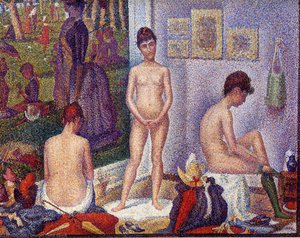
Les poseuses (1886) by Georges Seurat

Les poseuses

1886 · Oil On Canvas

A Summer’s Day Frozen in Time: Exploring Seurat's *Les Poseuses* Les Poseuses (The Posed Women), painted in 1886 by Georges Pierre Seurat, is a quintessential example of Neo-Impressionism and a landmark work within the Post-Impressionist movement. This large-scale canvas isn’t merely a depiction of nude figures; it's a meticulously constructed exploration of color, light, and modern life. Subject & Composition: A Scene of Leisurely Modernity The painting presents a group…

10
Sailboat (1884) by Georges Seurat

Sailboat

1884 · Oil On Canvas · National Gallery of Art, Washington

In the quietude of 1884, Georges Seurat captured a moment that would forever alter the trajectory of modern art. His masterpiece, "Sailboat," is far more than a mere depiction of a tranquil afternoon; it is a profound exploration of how we perceive the world around us. At first glance, the viewer is greeted by a serene park scene, where figures linger near the water's edge and the gentle presence of…

Georges Seurat paintings, ranked 11 to 100

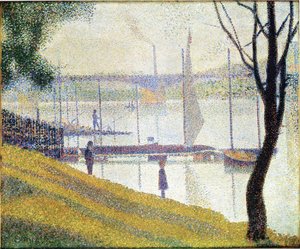
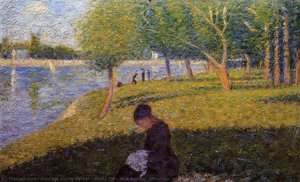
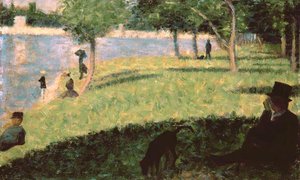
11The Eiffel Tower (1889) by Georges SeuratThe Eiffel Tower1889 · Fine Arts Museums of San Francisco 12Bridge at Courbevoie (1887) by Georges SeuratBridge at Courbevoie1887 · Courtauld Gallery 13Chahut (1890) by Georges SeuratChahut1890 · Kröller-Müller Museum 14The Eiffel tower (1889) by Georges SeuratThe Eiffel tower1889 15Study for 'A Sunday Afternoon on the Island of La Grande Jatte' (1886) by Georges SeuratStudy for 'A Sunday Afternoon on the Island of La Grande Jatte'1886 · Musée d'Orsay 16grande jatte (large scan) by Georges Seuratgrande jatte (large scan) 17Farm Women at Work (1883) by Georges SeuratFarm Women at Work1883 · Solomon R. Guggenheim Museum 18Study for 'La Grande Jatte' (1885) by Georges SeuratStudy for 'La Grande Jatte'1885 · Art Institute of Chicago 19Le Chahut (1890) by Georges SeuratLe Chahut1890 · Kröller-Müller Museum 20The river Seine at La Grande-Jatte (1888) by Georges SeuratThe river Seine at La Grande-Jatte1888 21At the ''Concert Européen'' by Georges SeuratAt the ''Concert Européen'' 22Village Road (1883) by Georges SeuratVillage Road1883 · Musée d'Orsay 23Women by the Water (1884) by Georges SeuratWomen by the Water1884 24Watering Can (1883) by Georges SeuratWatering Can1883 25Rainbow (1883) by Georges SeuratRainbow1883 · National Gallery 26Stone breakers, Le-Raincy (1881) by Georges SeuratStone breakers, Le-Raincy1881 27Woman with Umbrella (1884) by Georges SeuratWoman with Umbrella1884 28The Artist's Mother by Georges SeuratThe Artist's Mother 29The Seine at La Grande Jatte in the Spring (1888) by Georges SeuratThe Seine at La Grande Jatte in the Spring1888 · Metropolitan Museum of Art 30Portrait of Edmond-François Aman-Jean (1883) by Georges SeuratPortrait of Edmond-François Aman-Jean1883 · Metropolitan Museum of Art 31Port-en-Bessin, the Semaphore and Cliffs (1888) by Georges SeuratPort-en-Bessin, the Semaphore and Cliffs1888 · National Gallery of Art 32Une baignade, Asniéres, NG, Lond (1884) by Georges SeuratUne baignade, Asniéres, NG, Lond1884 33Group of Figures (Study for "Un dimanche à la Grande Jatte") (1884) by Georges SeuratGroup of Figures (Study for "Un dimanche à la Grande Jatte")1884 · Barnes Foundation 34La Grande Jatte (1884) by Georges SeuratLa Grande Jatte1884 35Port-en-Bessin, Entrance to the Outer Harbor (1888) by Georges SeuratPort-en-Bessin, Entrance to the Outer Harbor1888 · MOMA - Museum of Modern Art 36Artist at work (1884) by Georges SeuratArtist at work1884 37Port-en-Bessin (1888) by Georges SeuratPort-en-Bessin1888 38White dog (1885) by Georges SeuratWhite dog1885 · Galerie Rosengart 39Study for 'Invitation to the Sideshow' (1888) by Georges SeuratStudy for 'Invitation to the Sideshow'1888 · Foundation E.G. Bührle Collection 40Rock-Breakers, Le Raincy (1882) by Georges SeuratRock-Breakers, Le Raincy1882 · Norton Simon Museum 41Seated Nude: Study for (1883) by Georges SeuratSeated Nude: Study for1883 · Scottish National Gallery 42The Circus (1891) by Georges SeuratThe Circus1891 · Musée d'Orsay 43Boy with horse (1883) by Georges SeuratBoy with horse1883 44untitled (1662) by Georges Seuratuntitled (1662) 45Port-en-Bessin Entrance to the Harbor (1888) by Georges SeuratPort-en-Bessin Entrance to the Harbor1888 46Landscape by Georges SeuratLandscape 47untitled (4494) by Georges Seuratuntitled (4494) 48The Mower (1882) by Georges SeuratThe Mower1882 · Metropolitan Museum of Art 49Seascape (Gravelines) (1890) by Georges SeuratSeascape (Gravelines)1890 · National Gallery of Art 50La Grande Jatte (Study VI) (1884) by Georges SeuratLa Grande Jatte (Study VI)1884 · National Gallery 51Study for 'A Sunday on the Island of La Grand Jatte' Couple Walking by Georges SeuratStudy for 'A Sunday on the Island of La Grand Jatte' Couple WalkingFitzwilliam College 52Young Peasant in Blue (1881) by Georges SeuratYoung Peasant in Blue1881 · Musée d'Orsay 53La Grande Jatte - Woman Fishing and Seated Figures by Georges SeuratLa Grande Jatte - Woman Fishing and Seated Figures 54Seated Man. Study for ''Bathers at Asnieres'' (1883) by Georges SeuratSeated Man. Study for ''Bathers at Asnieres''1883 · Cleveland Museum of Art 55Ville d'Avray, France, maisons blanches (1882) by Georges SeuratVille d'Avray, France, maisons blanches1882 · Walker Art Gallery 56Young Woman Powdering Herself (1890) by Georges SeuratYoung Woman Powdering Herself1890 · Courtauld Gallery 57The Channel at Gravelines, Grand Fort-Philippe (1890) by Georges SeuratThe Channel at Gravelines, Grand Fort-Philippe1890 58Sidewalk Show (1884) by Georges SeuratSidewalk Show1884 59A River Bank (The Seine at Asnieres) (1883) by Georges SeuratA River Bank (The Seine at Asnieres)1883 60Gray Weather by Georges SeuratGray Weather 61POSEUSE DE DOS by Georges SeuratPOSEUSE DE DOS 62Study for ''The Circus'' by Georges SeuratStudy for ''The Circus'' 63Study for Bathers, Asnières by Georges SeuratStudy for Bathers, Asnières 64View of Fort Samson (1885) by Georges SeuratView of Fort Samson1885 · Hermitage Museum 65Une Perissoire (1884) by Georges SeuratUne Perissoire1884 66Le Bec du Hoc, Grandcamp (1885) by Georges SeuratLe Bec du Hoc, Grandcamp1885 67The Riverside (1883) by Georges SeuratThe Riverside1883 68The Hedge (also known as The Clearing) (1882) by Georges SeuratThe Hedge (also known as The Clearing)1882 69Madame Seurat Reading by Georges SeuratMadame Seurat Reading 70Sleeping Woman by Georges SeuratSleeping Woman 71Peasant with Hoe (1882) by Georges SeuratPeasant with Hoe1882 72Boy Sitting in a Meadow (1883) by Georges SeuratBoy Sitting in a Meadow1883 · Kelvingrove Art Gallery and Museum 73Young Girl Seated, Sewing by Georges SeuratYoung Girl Seated, Sewing 74The Bec du Hoc at Grandcamp Sun by Georges SeuratThe Bec du Hoc at Grandcamp Sun 75The Harbour and the Quays at Port-en-Bessin (1888) by Georges SeuratThe Harbour and the Quays at Port-en-Bessin1888 · Minneapolis Institute of Art 76Low Tide at Grandcamp (1885) by Georges SeuratLow Tide at Grandcamp1885 · Pola Museum of Art 77Beached Boats, Grandcamp by Georges SeuratBeached Boats, Grandcamp 78Beach at Gravelines (1890) by Georges SeuratBeach at Gravelines1890 79La Luzerne, Saint Denis (1885) by Georges SeuratLa Luzerne, Saint Denis1885 80Part of the studio (1887) by Georges SeuratPart of the studio1887 81Portrait of Paul Signac (1890) by Georges SeuratPortrait of Paul Signac1890 82View of Le Crotoy from Upstream by Georges SeuratView of Le Crotoy from Upstream 83On the road (1882) by Georges SeuratOn the road1882 84The Channel at Gravelins, Grand-Fort-Philippe (1890) by Georges SeuratThe Channel at Gravelins, Grand-Fort-Philippe1890 · National Gallery 85Parade de cirque, Metropolitan (1888) by Georges SeuratParade de cirque, Metropolitan1888 86Alfalfa, St. Denis (1886) by Georges SeuratAlfalfa, St. Denis1886 87Nurse sitting holding her baby by Georges SeuratNurse sitting holding her baby 88Man Reading on a Terrace by Georges SeuratMan Reading on a Terrace 89Forest Path, Barbizon (1883) by Georges SeuratForest Path, Barbizon1883 90ETUDE POUR UN DIMANCHE APRES MIDI A L'ILE DE LA GRANDE JATTE by Georges SeuratETUDE POUR UN DIMANCHE APRES MIDI A L'ILE DE LA GRANDE JATTE 91Horses in the Water by Georges SeuratHorses in the Water 92Grassy Riverbank (1881) by Georges SeuratGrassy Riverbank1881 93Port-en-Bessin by Georges SeuratPort-en-Bessin 94Forest at Pontaubert (1881) by Georges SeuratForest at Pontaubert1881 95Seated Woman (1882) by Georges SeuratSeated Woman1882 96Bathing at Asnieres - Clothing on the Grass by Georges SeuratBathing at Asnieres - Clothing on the Grass 97Study for ''Bathers at Asnieres'' (1883) by Georges SeuratStudy for ''Bathers at Asnieres''1883 98Boats Near The Beach At Asnieres by Georges SeuratBoats Near The Beach At Asnieres 99Sunset (1881) by Georges SeuratSunset1881 · Bristol Museum - Art Gallery 100The Poppy Field, 1884 by Georges SeuratThe Poppy Field, 1884

Georges Seurat's famous paintings, period by period

The subjects that held Georges Seurat's eye

The four subjects that come back most often in these originals, each with its finest example.

The museums that keep Georges Seurat's originals

The 8 museums that hold the most of the paintings on this page.

Museum City Works by Georges Seurat Paintings from this list
Musée d'Orsay, ParisMusée d'Orsay Paris 20 The circus, Study for "Un dimanche après midi à l'île de la Grande Jatte", Study for 'A Sunday Afternoon on the Island of La Grande Jatte'
National Gallery, LondonNational Gallery London 12 Bañistas en Asnieres, 1889, Rainbow, La Grande Jatte (Study VI)
Metropolitan Museum of Art, New YorkMetropolitan Museum of Art New York 12 Circus Sideshow, The Seine at La Grande Jatte in the Spring, Portrait of Edmond-François Aman-Jean
National Gallery of Art, WashingtonNational Gallery of Art Washington 16 Sailboat, Port-en-Bessin, the Semaphore and Cliffs, Seascape (Gravelines)
Art Institute of Chicago, ChicagoArt Institute of Chicago Chicago 4 A Sunday Afternoon on the Island of La Grande Jatte, Final Study for Bathing at Asnieres, Study for 'La Grande Jatte'
Courtauld Gallery, LondonCourtauld Gallery London 10 Bridge at Courbevoie, Young Woman Powdering Herself
Kröller-Müller Museum, OtterloKröller-Müller Museum Otterlo 7 Chahut, Le Chahut
Barnes Foundation, PhiladelphiaBarnes Foundation Philadelphia 6 Models, Group of Figures (Study for "Un dimanche à la Grande Jatte")

Georges Seurat, the signature paintings of each year

Some ten years, from 1881 to 1891, were enough for Georges Seurat: the gallery walks through them year by year, one famous original after another.

Works per year

Pick a year to see its originals.

Georges Seurat's paintings: the gallery answers

Which Georges Seurat painting is the most famous of all?Reveal the answer

A Sunday Afternoon on the Island of La Grande Jatte (1886), Art Institute of Chicago, Chicago. Bañistas en Asnieres, 1889 and Circus Sideshow (1888) come next.

How old was Georges Seurat on completing A Sunday Afternoon on the Island of La Grande Jatte?Reveal the answer

27 years old: A Sunday Afternoon on the Island of La Grande Jatte dates from 1886, and Georges Seurat was born in 1859.

Which are Georges Seurat's top 10 paintings?Reveal the answer

A Sunday Afternoon on the Island of La Grande Jatte, Bañistas en Asnieres, 1889, Circus Sideshow, Models, Sunday Afternoon on the Isle of Lan Grande Jatte, The circus, Study for "Un dimanche après midi à l'île de la Grande Jatte", Final Study for Bathing at Asnieres, Les poseuses and Sailboat. The ranking above gives each one's year and museum.

How many works did Georges Seurat create?Reveal the answer

Our catalog holds 438 works by Georges Seurat, dated from 1881 to 1891.

Where do Georges Seurat's most famous originals hang?Reveal the answer

Mostly in Musée d'Orsay (Paris), National Gallery (London) and Metropolitan Museum of Art (New York). The museum table above lists them all.

When did Georges Seurat create the most famous paintings?Reveal the answer

In 1883: 13 of the 100 works on this page were made then, Farm Women at Work among them.

Which are Georges Seurat's earliest and latest famous works?Reveal the answer

On this page, the earliest is Stone breakers, Le-Raincy (1881) and the latest The Circus (1891).

Which subjects did Georges Seurat return to most?Reveal the answer

Color theory (28), Landscape (28) and Parisian scene (10), across the 100 works on this page.

Which medium did Georges Seurat work in most?Reveal the answer

Oil On Canvas, for 60 of the 100 works on this page.

Which movement is Georges Seurat associated with?Reveal the answer

Neo-impressionism, judging by the originals on this page.

Which Georges Seurat originals does the Musée d'Orsay hold?Reveal the answer

The circus, Study for "Un dimanche après midi à l'île de la Grande Jatte" and Study for 'A Sunday Afternoon on the Island of La Grande Jatte': the Musée d'Orsay, Paris holds 6 of the works on this page.

Georges Seurat: the artist

The Life of Georges Seurat

To understand the trajectory of modern painting, one must look at the brief, intense existence of Georges Seurat. Born in Paris, France, on December 2, 1859, he was the son of Ernestine Faivre and Antoine Chrysostome Seurat, a man who had transitioned from a legal official to a property speculator in Champagne. This background provided the stability necessary for his rapid, disciplined ascent within the Parisian art scene. He did not merely paint; he engineered a new way of seeing that challenged the spontaneous impulses of his predecessors.

His career was a sprint, not a marathon. He died in Paris, France, on March 29, 1891, at the age of 31. This premature end left a body of work that feels concentrated and deliberate, lacking the sprawling, loose evolution seen in many of his contemporaries. Even his final, unfinished efforts, such as The Circus, reveal a mind preoccupied with the structural mechanics of light and social order. He replaced the fleeting glance with a calculated, permanent precision.

The impact of his short life is measured by the sheer density of his technical innovations. He moved art away from the emotional spontaneity of the moment and toward a systematic, almost mathematical application of color. His presence in the history of the nineteenth century remains defined by this refusal to rely on intuition alone. He sought a logic in the canvas that remains visible in every dot of pigment he left behind.

Early Life, Family and Training

The trajectory of Georges Seurat began in Paris, where his family moved to Boulevard de Magenta shortly after his birth. His upbringing was shaped by a stable environment provided by his father, Antoine Chrysostome Seurat, a former legal official turned property speculator. This background allowed the young artist access to the formal education necessary to challenge the established norms of the late 19th century. He did not rely on mere intuition; his development was built on a foundation of rigorous, systematic training.

His formal education started at the École Municipale de Sculpture et Dessin, where he studied under the sculptor Justin Lequien. This early exposure to sculpture likely contributed to the structural, almost frieze-like quality seen in his later compositions. By 1878, he had moved into the upper echelons of French art education, enrolling at the prestigious École des Beaux-Arts. During his tenure there, he studied under Henri Lehmann, a period that instilled in him the traditional techniques and compositional discipline he would eventually deconstruct through scientific analysis.

Technique and Style

Seurat replaced the spontaneous, intuitive brushwork of his predecessors with a calculated, systematic approach to light. He developed Pointillism, a method defined by the application of small, distinct dots of pure color onto a canvas. This was not a decorative choice but a functional one. By utilizing Divisionism, he separated local color into individual dots, relying on the viewer’s eye to achieve optical blending. This process, which he termed chromoluminarism, treated color as a science rather than a mere feeling. He sought to reconstruct the physics of sight through the precise placement of pigment.

His precision extended to his preparatory work. He frequently used conté crayon on paper with a rough surface to map out his compositions. This disciplined method ensured that every dot in his final large-scale works was part of a larger, mathematically orchestrated structure. The resulting surfaces possess a rhythmic, vibrating quality that stems from the tension between individual points of color and the unified image they form on the retina. His work remains a study in how technical rigor can dictate visual perception.

Key Works and Artistic Vision

Seurat’s vision relied on a rigid, mathematical approach to light. He rejected the spontaneous, emotional brushwork of his predecessors in favor of a systematic reconstruction of sight. This method turned the canvas into a site of optical calculation rather than mere observation. His work sought to capture the essential, unchanging structure of a scene through the precise application of color theory. He did not simply paint a landscape; he engineered a visual experience based on how the human eye processes light and pigment.

His large-scale compositions demonstrate this commitment to order. A Sunday Afternoon on the Island of La Grande Jatte (1884-1886) uses a monumental scale to present a scene of Parisian leisure through a dense mosaic of dots. This work functions as a manifesto for Neo-Impressionism, replacing fluid movement with a sense of permanent, sculptural stillness. Similarly, Bathers at Asnières (1884) shows his early ability to reconcile classical, frieze-like figure types with the modern, industrial reality of the Seine. These paintings prove that his interest lay in the intersection of scientific precision and contemporary life.

Even his final, unfinished efforts reveal a preoccupation with the tension between movement and structure. The Circus (1890–91) utilizes a Neo-Impressionist style to depict the energy of a public spectacle, yet it remains anchored by his characteristic control of form. In Young Woman Powdering Herself (1889-1890), he applied his technique to a single subject, exploring the artifice of human vanity through a highly constructed setting. His output was a constant effort to find a logic in light that the fleeting glance of Impressionism could not provide.
Legacy and Influence

Seurat’s impact on the trajectory of modern art is measurable through the radical shifts his methods forced upon subsequent movements. By replacing the intuitive brushwork of his predecessors with a systematic, scientific approach to color and light, he expanded the boundaries of what a painting could achieve. This intellectual rigor moved art away from mere representation and toward a structured analysis of perception. His insistence on the optical blending of pigment changed the fundamental mechanics of how a viewer interacts with a canvas.

The ripples of his technical innovations reached far beyond the Neo-Impressionist circle. The Fauvists adopted his emphasis on bold, non-naturalistic color, while the Cubists drew from his ability to deconstruct forms into geometric components. Even the Abstract Expressionists, focused on the raw energy of the gesture, owe a debt to the way he liberated color from the constraints of traditional mixing. He proved that art could be both a rigorous intellectual pursuit and a method for capturing the essence of modern life.