Portrait of Eugène Fromentin

The 69 Most Famous Eugène Fromentin Paintings, Each One of a Kind

Updated October 2026 · ranked by our popularity score (searches, visits and orders for each work) · 69 works by Eugène Fromentin in our catalogue

In short

Women of the Ouled Nayls (1867) is the Eugène Fromentin painting that draws the most eyes; the original belongs to the Art Institute of Chicago, Chicago. After it, the eye goes to Souvenir of Ezneh, Upper Egypt (1876) and Moorish Burial (1853). Among the 69 works of Eugène Fromentin in our catalog, these 69 are the most famous, each a unique original presented with its year, its museum and the reason it endures.

1820 – 1876, La Rochelle Orientalism Most works: Musée d'Orsay

Top 10 paintings by Eugène Fromentin, through the gallery's eye

1
Women of the Ouled Nayls (1867) by Eugène Fromentin

Women of the Ouled Nayls

1867 · Oil On Canvas · Art Institute of Chicago, Chicago

In this 1867 oil on canvas, we find ourselves within an enclosed Algerian courtyard, observing a group of Ouled Nayls women during a moment of repose. The composition uses the high, rugged walls of the setting to create a sense of deep enclosure, pulling the viewer into a private, shadowed space. Light enters the scene with a heavy, directional quality, characteristic of late afternoon or twilight. This light catches the…

2
Souvenir of Ezneh, Upper Egypt (1876) by Eugène Fromentin

Souvenir of Ezneh, Upper Egypt

1876 · Oil On Canvas · Musée d'Orsay, Paris

This work, titled Souvenir of Ezneh, Upper Egypt, was painted by Eugène Fromentin in 1876. It is a piece that captures a specific moment of observation, reflecting the artist's deep engagement with the landscapes and people of the region. The composition focuses on a quiet scene along the riverbank, rendered with a sense of stillness that defines much of Fromentin's output from this period.

Eugène Fromentin's famous paintings, numbers 11 to 69

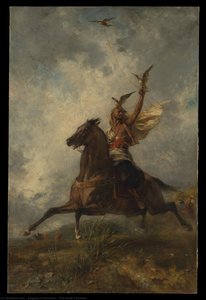
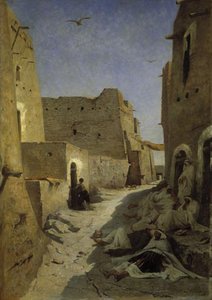
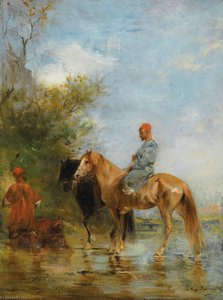
11The country's thirst (1869) by Eugène FromentinThe country's thirst1869 · Musée d'Orsay 12The Arab Falconer (1864) by Eugène FromentinThe Arab Falconer1864 · Metropolitan Museum of Art 13Orientals (1872) by Eugène FromentinOrientals1872 · Minneapolis Institute of Art 14At the Well (1875) by Eugène FromentinAt the Well1875 · Walters Art Museum 15Arabs Watering Their Horses (1872) by Eugène FromentinArabs Watering Their Horses1872 16Arabs Crossing a Ford (1873) by Eugène FromentinArabs Crossing a Ford1873 · Metropolitan Museum of Art 17Arabian Horses (1850) by Eugène FromentinArabian Horses1850 · Art Institute of Chicago 18A Fantasia, Algeria (1869) by Eugène FromentinA Fantasia, Algeria1869 · Musée d'Orsay 19Arabian Encampment (1847) by Eugène FromentinArabian Encampment1847 · Yale University Art Gallery 20North African Landscape (1847) by Eugène FromentinNorth African Landscape1847 · Museum of Fine Arts 21Horsemen at the Foot of the Chiffa Cliffs (1850) by Eugène FromentinHorsemen at the Foot of the Chiffa Cliffs1850 · Museum of Fine Arts Ghent (MSK) 22Farmyard with Cattle, Eugène Fromentin-Dupeux, 1849 (1849) by Eugène FromentinFarmyard with Cattle, Eugène Fromentin-Dupeux, 18491849 · Rijksmuseum 23Moroccan Combat Scene (1863) by Eugène FromentinMoroccan Combat Scene1863 · Cantor Arts Center at Stanford University 24Arabs Watering Their Horses (1870) by Eugène FromentinArabs Watering Their Horses1870 · Museum of Art 25Crossing the Ford, Algeria (1869) by Eugène FromentinCrossing the Ford, Algeria1869 · National Gallery of Ireland 26Lion hunting (1867) by Eugène FromentinLion hunting1867 · Museum of Fine Arts Ghent (MSK) 27On the Nile, Near Philae (1871) by Eugène FromentinOn the Nile, Near Philae1871 · Art Institute of Chicago 28African scene (1871) by Eugène FromentinAfrican scene1871 29Arabs on the Way to the Pastures of the Tell (1866) by Eugène FromentinArabs on the Way to the Pastures of the Tell1866 · High Museum of Art 30The Arab Falconer (1864) by Eugène FromentinThe Arab Falconer1864 31An Encampment in the Atlas Mountains (1865) by Eugène FromentinAn Encampment in the Atlas Mountains1865 · Walters Art Museum 32Scene in the Desert (1868) by Eugène FromentinScene in the Desert1868 33Falcon Hunt ('Algeria Remembered') (1874) by Eugène FromentinFalcon Hunt ('Algeria Remembered')1874 · National Gallery of Ireland 34An Arabian Camp (1873) by Eugène FromentinAn Arabian Camp1873 · Minneapolis Institute of Art 35Arabs Crossing a Ford (1873) by Eugène FromentinArabs Crossing a Ford1873 36La Caravane (Scene of Nomads) (1875) by Eugène FromentinLa Caravane (Scene of Nomads)1875 37Head of an Old Woman by Eugène FromentinHead of an Old WomanThe New Art Gallery Walsall 38scenery with trees by Eugène Fromentinscenery with trees 39Falkenjagd In Der Sahara by Eugène FromentinFalkenjagd In Der SaharaCondé Museum 40Arabs Fording A Mountain Stream by Eugène FromentinArabs Fording A Mountain Stream 41Night Robbers by Eugène FromentinNight Robbers 42Tents of the Smalah of Si-Hamed-Bel-Hadj - Sahara by Eugène FromentinTents of the Smalah of Si-Hamed-Bel-Hadj - Sahara 43Arabs Resting by Eugène FromentinArabs Resting 44Les bords du Nil by Eugène FromentinLes bords du NilNational Gallery 45Felucca au bord du nil by Eugène FromentinFelucca au bord du nil 46Arabs Hunting with a Falcon by Eugène FromentinArabs Hunting with a FalconMusee des Beaux-Arts 47Khan in Algiers by Eugène FromentinKhan in AlgiersMuseum of Fine Arts 48An Encampment in the Atlas Mountains by Eugène FromentinAn Encampment in the Atlas Mountains 49Une Rue A El-aghouat by Eugène FromentinUne Rue A El-aghouat 50The Bab-El-Gharbi Road by Eugène FromentinThe Bab-El-Gharbi Road 51Arab Horsemen by Eugène FromentinArab Horsemen 52Falcon Hunting In Algeria by Eugène FromentinFalcon Hunting In Algeria 53Departing For The Hunt by Eugène FromentinDeparting For The Hunt 54A Falcon Hunt in Algeria by Eugène FromentinA Falcon Hunt in Algeria 55Arab Horsemen Resting in the Forest by Eugène FromentinArab Horsemen Resting in the ForestMusée d'Orsay 56Rider Bunch In The Paying Sandstorm by Eugène FromentinRider Bunch In The Paying Sandstorm 57The Land of Thirst by Eugène FromentinThe Land of Thirst 58Muleteers stopped - algiers by Eugène FromentinMuleteers stopped - algiers 59Ville d-Algérie by Eugène FromentinVille d-Algérie 60Interior of the Workshop of an Arab Tailor by Eugène FromentinInterior of the Workshop of an Arab Tailor 61Departing For The Hunt - by Eugène FromentinDeparting For The Hunt - 62Abreuvoir à Laghouat, en Algerie by Eugène FromentinAbreuvoir à Laghouat, en Algerie 63Cavaliers au bord de l'eau by Eugène FromentinCavaliers au bord de l'eau 64Jeunes filles arabes by Eugène FromentinJeunes filles arabes 65Arab Camp by Eugène FromentinArab Camp 66The Land of Thirst (1869) by Eugène FromentinThe Land of Thirst1869 67Kabyle Shepherd (Shepherd: High Plateau of Kabylia) (1861) by Eugène FromentinKabyle Shepherd (Shepherd: High Plateau of Kabylia)1861 · Philadelphia Museum of Art 68Falconry in Algeria: the kill (1863) by Eugène FromentinFalconry in Algeria: the kill1863 · Musée d'Orsay 69Coup de vent dans les plaines d'Alfa (1864) by Eugène FromentinCoup de vent dans les plaines d'Alfa1864

The subjects that held Eugène Fromentin's eye

The four subjects that come back most often in these originals, each with its finest example.

The museums that keep Eugène Fromentin's originals

The 8 museums that hold the most of the paintings on this page.

Museum City Works by Eugène Fromentin Paintings from this list
Musée d'Orsay, ParisMusée d'Orsay Paris 5 Souvenir of Ezneh, Upper Egypt, The country's thirst, A Fantasia, Algeria
Art Institute of Chicago, ChicagoArt Institute of Chicago Chicago 3 Women of the Ouled Nayls, Arabian Horses, On the Nile, Near Philae
Museum of Fine Arts, BostonMuseum of Fine Arts Boston 3 Standard Bearer, North African Landscape, Khan in Algiers
National Gallery of Ireland, Dublin CityNational Gallery of Ireland Dublin City 3 L'Incendie, Crossing the Ford, Algeria, Falcon Hunt ('Algeria Remembered')
Metropolitan Museum of Art, New YorkMetropolitan Museum of Art New York 2 The Arab Falconer, Arabs Crossing a Ford
Minneapolis Institute of Art, MinneapolisMinneapolis Institute of Art Minneapolis 2 Orientals, An Arabian Camp
Walters Art Museum, BaltimoreWalters Art Museum Baltimore 2 At the Well, An Encampment in the Atlas Mountains
Museum of Fine Arts Ghent (MSK), GhentMuseum of Fine Arts Ghent (MSK) Ghent 2 Horsemen at the Foot of the Chiffa Cliffs, Lion hunting

Eugène Fromentin across the decades: one unique original for each

Works per decade

Pick a decade to see the original that defines it.

Eugène Fromentin's paintings: questions for the gallery

What is the single most famous work of Eugène Fromentin?Reveal the answer

Women of the Ouled Nayls (1867), Art Institute of Chicago, Chicago. Souvenir of Ezneh, Upper Egypt (1876) and Moorish Burial (1853) come next.

At what age did Eugène Fromentin create Women of the Ouled Nayls?Reveal the answer

47 years old: Women of the Ouled Nayls dates from 1867, and Eugène Fromentin was born in 1820.

Which ten paintings by Eugène Fromentin are the most famous?Reveal the answer

Women of the Ouled Nayls, Souvenir of Ezneh, Upper Egypt, Moorish Burial, Falconry in Algeria, Standard Bearer, The Arab Chief, Stop of Arab Riders in the Plain, Centaurs, L'Incendie and Before the Race: Fantasia or The Halt in the Desert. The ranking above gives each one's year and museum.

How many works by Eugène Fromentin are known?Reveal the answer

Our catalog holds 69 works by Eugène Fromentin, dated from 1847 to 1876.

Where can the most famous Eugène Fromentin originals be seen?Reveal the answer

Mostly in Musée d'Orsay (Paris), Art Institute of Chicago (Chicago) and Museum of Fine Arts (Boston). The museum table above lists them all.

During which period did Eugène Fromentin create the best-known paintings?Reveal the answer

In 1860s: 21 of the 69 works on this page were made then, Women of the Ouled Nayls among them.

Which famous Eugène Fromentin painting is the earliest, and which the latest?Reveal the answer

On this page, the earliest is Arabian Encampment (1847) and the latest Souvenir of Ezneh, Upper Egypt (1876).

What subjects did Eugène Fromentin favour?Reveal the answer

Landscape (8), Sky (5) and Horse (4), across the 69 works on this page.

What materials did Eugène Fromentin paint with most?Reveal the answer

Oil On Canvas, for 5 of the 69 works on this page.

Which movement does the work of Eugène Fromentin belong to?Reveal the answer

Orientalism and Romanticism, judging by the originals on this page.

What Eugène Fromentin originals can I see at the Musée d'Orsay?Reveal the answer

Souvenir of Ezneh, Upper Egypt, The country's thirst and A Fantasia, Algeria: the Musée d'Orsay, Paris holds 5 of the works on this page.

Where can I order a hand-painted Eugène Fromentin reproduction?Reveal the answer

Yes, as a reproduction: the original stays in its museum, but any painting on this page can be painted by hand for you, made to order one at a time, from the painting's own page.

Eugène Fromentin: a portrait of the artist

The Visionary of the Sahara: The Life and Legacy of Eugène Fromentin

Eugène Fromentin stands as a pivotal figure in French Orientalist painting, yet his legacy extends far beyond mere visual representation. Born in La Rochelle, France, in 1820, he embarked on an artistic journey marked by early exposure to landscape painting under the guidance of Louis Cabat. This foundational training propelled him toward a profound engagement with the vibrant culture of Algeria—a fascination that would define both his oeuvre and his intellectual pursuits. More than just capturing picturesque vistas, Fromentin sought to distill the essence of Algerian life, blending meticulous observation with expressive brushstrokes to create images imbued with a palpable, breathing atmosphere.

Fromentin’s artistic breakthrough arrived in 1847 with “Les gorges de la Chiffa,” a monumental canvas that immediately garnered acclaim at the Paris Salon and established him as one of the foremost interpreters of Algeria's dramatic topography. His connection to North Africa was not merely academic; through travels such as his 1852 mission accompanying an archaeological expedition, he achieved an intimate knowledge of the land. This firsthand experience allowed him to capture the rugged beauty of the Sahara Desert with remarkable accuracy, documenting its flora, fauna, and the nuanced habits of its people. His work often serves as a window into a world of light and shadow, where the heat of the desert and the resilience of human life are rendered with striking realism.

Mastery of Light and Orientalist Realism

The brilliance of Fromentin’s technique lies in his ability to blend elements of Orientalism and Romanticism. His paintings, such as “The Arab Falconer” and “Arabs Crossing a Ford,” exemplify a distinctive style characterized by luminous color palettes and dynamic compositions. Influenced deeply by the Romantic fervor of Eugène Delacroix, Fromentin utilized light to create depth and dimensionality, making the arid landscapes feel almost tactile. His use of vibrant colors was never merely decorative; it served to heighten the drama and tension inherent in scenes of survival and daily existence.

One of his most poignant works, “The Land of Thirst,” painted in 1869, showcases his mastery of narrative through landscape. In this piece, the artist depicts a dramatic scene of people struggling to survive within a harsh desert environment. Through intricate details and a powerful sense of atmosphere, he captures the essence of human resilience in the face of adversity. This ability to infuse realistic depictions with profound emotional weight is what separates Fromentin from many of his contemporaries who focused solely on the exoticism of the Orient.

The Scholar-Painter: Art Criticism and Literary Eminence

However, Fromentin's contribution to art history transcends purely visual aesthetics. He emerged as a pioneering art critic and writer, possessing a unique perspective that combined the eye of a practitioner with the soul of a philosopher. His seminal work, “Les maîtres d’autrefois” (The Masters of Past Time), published in 1876, remains an influential piece of art literature. In this ambitious undertaking, he provided a comprehensive analysis of early Netherlandish painting and the Northern Baroque masters, including legends such as Rubens and Rembrandt.

What made his criticism so revolutionary was his personal approach; he did not merely offer scholarly exposition but shared deeply personal reflections on artistic achievement. He viewed the Old Masters through the lens of an artist, considering their emotions and the social, political, and economic contexts in which they created their masterpieces. His insights were so profound that even the renowned critic Bernhard Berenson spoke of the necessity of reading Fromentin to truly understand the pictures he criticized. Through his dual identity as a painter and a man of letters, Eugène Fromentin left an indelible mark on the nineteenth-century intellectual landscape, bridging the gap between the seen world of the desert and the profound history of European art.

All 69 works by Eugène Fromentin →