Portrait of Canaletto

The 100 Most Famous Canaletto Paintings, a Gallery Selection

Updated November 2026 · ranked by our popularity score (searches, visits and orders for each work) · 549 works by Canaletto in our catalogue

In short

Of all the originals Canaletto left, the most famous is The Grand Canal and the Church of the Salute (1730), in the collection of the Museum of Fine Arts, Houston. Close behind it come The Bucintoro Returning to the Molo on Ascension Day (1730) and Capriccio with Ruins and Porta Portello, Padua (1750). Our catalog holds 549 works by Canaletto; the gallery has kept the 100 the world admires most, each shown with its date, its museum and its story.

1697 – 1768, Venice Rococo Most works: Royal Collection

Canaletto's top 10 paintings: the gallery's choice

1
The Grand Canal and the Church of the Salute (1730) by Canaletto

The Grand Canal and the Church of the Salute

1730 · Oil On Canvas · Museum of Fine Arts, Houston

The Grand Canal and the Church of the Salute by Canaletto captures a specific moment in the life of Venice. Painted in 1730, this Venetian Urban Landscape places the viewer directly beside the water. The scene unfolds with the grand dome of Santa Maria della Salute anchoring the composition, its massive structure rising above the activity of the canal. Sunlight dances upon the rippling surface, casting luminous reflections that breathe…

2
The Bucintoro Returning to the Molo on Ascension Day (1730) by Canaletto

The Bucintoro Returning to the Molo on Ascension Day

1730 · Oil On Canvas

In the heart of the eighteenth century, few sights could rival the grandeur of Venice during the festivities of Ascension Day. Giovanni Antonio Canal, known universally as Canaletto, captures this ephemeral magic in his masterpiece, The Bucintoro Returning to the Molo on Ascension Day. This sweeping oil-on-canvas work is far more than a mere topographical record; it is a window into a lost era of maritime splendor and civic pride.…

3
Capriccio with Ruins and Porta Portello, Padua (1750) by Canaletto

Capriccio with Ruins and Porta Portello, Padua

1750 · Oil On Canvas · Gallerie dell'Accademia di Venezia, Venice

Giovanni Antonio Canal, universally known as Canaletto, possessed an extraordinary gift for capturing the essence of Venice – its light, its atmosphere, and its vibrant daily life. His “Capriccio with Ruins and Porta Portello,” painted in 1750, is a quintessential example of this mastery, offering not merely a depiction of a scene but a carefully constructed evocation of memory, history, and the enduring beauty of a fading grandeur. This painting…

4
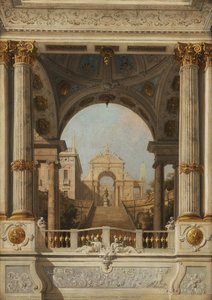
Capriccio of a Renaissance Triumphal Arch seen from the Portico of a Palace (1755) by Canaletto

Capriccio of a Renaissance Triumphal Arch seen from the Portico of a Palace

1755 · Oil On Canvas

To gaze upon Giovanni Antonio Canaletto’s Capriccio of a Renaissance Triumphal Arch seen from the Portico of a Palace is to step directly into a meticulously crafted dreamscape, a moment where the grandeur of classical antiquity meets the vibrant energy of 18th-century life. Painted in 1755, this oil on canvas is far more than a mere depiction of architecture; it is a masterful meditation on permanence, memory, and the enduring…

5
The Feast Day of St Roch (1735) by Canaletto

The Feast Day of St Roch

1735 · Oil On Canvas · National Gallery, London

To step before Canaletto’s “The Feast Day of St Roch” is to be instantly transported to the sun-drenched, bustling streets of 18th-century Venice. Created in 1735, this masterpiece serves as much more than a mere topographical record; it is a vibrant, breathing window into a vanished era of grandeur and communal devotion. The painting captures a pivotal moment during the feast day of Saint Roch, a figure deeply revered by…

6
The Grand Canal (1728) by Canaletto

The Grand Canal

1728 · Oil On Canvas · Galleria degli Uffizi, Florence

To gaze upon Canaletto’s 1728 masterpiece, The Grand Canal, is to be transported instantly to the golden age of the Venetian Republic. This breathtaking canvas does not merely depict a waterway; it captures the very soul of a city at its zenith, pulsating with commerce, elegance, and an almost ethereal light. As the eye wanders across the expansive horizontal panorama, one feels the gentle movement of gondolas slicing through the…

7
Piazza San Marco (1730) by Canaletto

Piazza San Marco

1730 · Oil On Canvas · Metropolitan Museum of Art, New York

Piazza San Marco by Canaletto presents a wide view of the principal public square in Venice, Italy. Completed in 1730, the oil painting captures a Venetian cityscape centered on the activity within the square. The scene is populated by various figures, including citizens, merchants, and clergy, who move across the open space. The composition includes architectural landmarks such as St. Mark's Basilica and the Campanile, which rise above the surrounding…

8
Grand Canal: Looking North-East from Santa Croce to San Geremia (1732) by Canaletto

Grand Canal: Looking North-East from Santa Croce to San Geremia

1732 · Etching · Royal Collection, London

To gaze upon this depiction of the Grand Canal looking northeast from Santa Croce toward San Geremia is to step directly into the heart of 18th-century Venice. It is more than just an architectural record; it is a meticulously preserved moment of life, rendered with the breathtaking precision characteristic of Giovanni Antonio Canaletto. The scene unfolds before us, dominated by the majestic sweep of the waterway, where history and daily…

9
Piazza San Marco with the Basilica (1730) by Canaletto

Piazza San Marco with the Basilica

1730 · Oil On Canvas · Harvard Art Museums, Cambridge

The sun hangs high over the bustling heart of Venice in Canaletto's 1730 oil on canvas, Piazza San Marco with the Basilica. This scene captures the very essence of the city's most famous square, where the air feels thick with the movement of a thousand daily lives. We find ourselves standing within the wide expanse of the piazza, looking toward the grand architecture that defines this urban center. The light…

10
Venice: The Canale di San Marco with the Bucintoro at Anchor (1730) by Canaletto

Venice: The Canale di San Marco with the Bucintoro at Anchor

1730 · Royal Collection, London

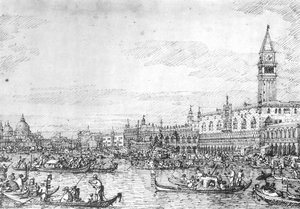
Giovanni Antonio Canal, universally known as Canaletto, possessed an extraordinary gift for capturing the vibrant pulse of 18th-century Venice. His “Venice: The Bucintoro at the Molo on Ascension Day,” painted around 1754, stands as a testament to this skill – a monumental canvas brimming with life, color, and meticulously rendered detail. More than just a depiction of a specific event, it’s an immersive experience, transporting the viewer directly into the…

The Canaletto selection continues, 11 to 100

11The Piazzetta Looking towards the Torre dell'Orologio (1725) by CanalettoThe Piazzetta Looking towards the Torre dell'Orologio1725 · Royal Collection 12The Piazzetta: Looking North, the Campanile under Repair (1745) by CanalettoThe Piazzetta: Looking North, the Campanile under Repair1745 · Royal Collection 13Santi Giovanni e Paolo and the Scuola di San Marco (1725) by CanalettoSanti Giovanni e Paolo and the Scuola di San Marco1725 · Gemäldegalerie 14Piazza San Marco: Looking East from the North-West Corner (1760) by CanalettoPiazza San Marco: Looking East from the North-West Corner1760 · National Gallery 15London: Ranelagh, Interior of the Rotunda (1754) by CanalettoLondon: Ranelagh, Interior of the Rotunda1754 · National Gallery 16Grand Canal: Looking North-East toward the Rialto Bridge (detail) (1725) by CanalettoGrand Canal: Looking North-East toward the Rialto Bridge (detail)1725 · Gemäldegalerie 17Grand Canal: Looking South-East from the Campo Santa Sophia to the Rialto Bridge (1756) by CanalettoGrand Canal: Looking South-East from the Campo Santa Sophia to the Rialto Bridge1756 · Staatliche Museen zu Berlin 18View through a Baroque Colonnade into a Garden, 1760-1768 (1768) by CanalettoView through a Baroque Colonnade into a Garden, 1760-17681768 · Albertina 19The Grand Canal near the Rialto Bridge, Venice (1730) by CanalettoThe Grand Canal near the Rialto Bridge, Venice1730 · Museum of Fine Arts 20Grand Canal: Looking North from Near the Rialto Bridge (1726) by CanalettoGrand Canal: Looking North from Near the Rialto Bridge1726 · Gemäldegalerie 21Capriccio: The Grand Canal, with an Imaginary Rialto Bridge and Other Buildings (1740) by CanalettoCapriccio: The Grand Canal, with an Imaginary Rialto Bridge and Other Buildings1740 · Galleria Nazionale 22View of San Giovanni dei Battuti at Murano (1725) by CanalettoView of San Giovanni dei Battuti at Murano1725 · Hermitage Museum 23Interior of San Marco, Venice (1745) by CanalettoInterior of San Marco, Venice1745 · Montreal Museum of Fine Arts 24Venice: Palazzo Grimani (1756) by CanalettoVenice: Palazzo Grimani1756 · National Gallery 25London: The Thames and the City of London from Richmond House (1747) by CanalettoLondon: The Thames and the City of London from Richmond House1747 26Alnwick Castle (1747) by CanalettoAlnwick Castle1747 27Venice, Bacino di San Marco on Ascension Day (1754) by CanalettoVenice, Bacino di San Marco on Ascension Day1754 28London seen through an arch of Westminster Bridge (1747) by CanalettoLondon seen through an arch of Westminster Bridge1747 29Entrance to the Grand Canal: Looking East (1725) by CanalettoEntrance to the Grand Canal: Looking East1725 · Gemäldegalerie 30Landscape with Ruins (also known as picket Duty in Virginia) by CanalettoLandscape with Ruins (also known as picket Duty in Virginia) 31The Piazzetta to the South (1720) by CanalettoThe Piazzetta to the South1720 · Royal Collection 32Piazza San Marco: Looking East along the Central Line (1723) by CanalettoPiazza San Marco: Looking East along the Central Line1723 · Thyssen-Bornemisza Museum 33Grand Canal: The Rialto Bridge from the South (1727) by CanalettoGrand Canal: The Rialto Bridge from the South1727 34Capriccio: The Horses of San Marco in the Piazzetta (1743) by CanalettoCapriccio: The Horses of San Marco in the Piazzetta1743 35Palazzo Ducale and the Piazza di San Marco (1755) by CanalettoPalazzo Ducale and the Piazza di San Marco1755 · Galleria degli Uffizi 36Piazza San Marco: Looking East from the South West Corner (1760) by CanalettoPiazza San Marco: Looking East from the South West Corner1760 · National Gallery 37Piazza San Marco, Looking toward San Geminiano (1735) by CanalettoPiazza San Marco, Looking toward San Geminiano1735 · Galleria Corsini 38View of the Arch of Constantine with the Colosseum (1742) by CanalettoView of the Arch of Constantine with the Colosseum1742 · J. Paul Getty Museum 39Arrival of the French Ambassador in Venice (detail) (1740) by CanalettoArrival of the French Ambassador in Venice (detail)1740 · Hermitage Museum 40Bacino di S. Marco: From the Piazzetta (1750) by CanalettoBacino di S. Marco: From the Piazzetta1750 · National Gallery of Victoria 41The Grand Canal, Venice, Looking South toward the Rialto Bridge (1734) by CanalettoThe Grand Canal, Venice, Looking South toward the Rialto Bridge1734 · Metropolitan Museum of Art 42The Colosseum (1743) by CanalettoThe Colosseum1743 · Galleria Borghese 43Perspective View (Stage design) by CanalettoPerspective View (Stage design)Accademia di San Luca 44Venice: Capriccio of the Courtyard of the Doges' Palace with the Scala dei Giganti (1744) by CanalettoVenice: Capriccio of the Courtyard of the Doges' Palace with the Scala dei Giganti1744 · Buckingham Palace 45Piazzetand the Doge s Palace from the Bacino di San Marco (1737) by CanalettoPiazzetand the Doge s Palace from the Bacino di San Marco1737 46The Stonemason's Yard (1726) by CanalettoThe Stonemason's Yard1726 · National Gallery 47Return of the Bucentoro to the Molo on Ascension Day (detail) (1732) by CanalettoReturn of the Bucentoro to the Molo on Ascension Day (detail)1732 · Royal Collection 48Venice: The Bacino from the Giudecca (1740) by CanalettoVenice: The Bacino from the Giudecca1740 · Wallace Collection 49The Doge's Palace with the Piazza di San Marco (1735) by CanalettoThe Doge's Palace with the Piazza di San Marco1735 · Galleria degli Uffizi 50The Grand Canal, Venice, Looking Southeast, with the Campo della Carità to the Right (1734) by CanalettoThe Grand Canal, Venice, Looking Southeast, with the Campo della Carità to the Right1734 · Metropolitan Museum of Art 51The Grand Canal with the Rialto Bridge and the Fondaco dei Tedeschi (1730) by CanalettoThe Grand Canal with the Rialto Bridge and the Fondaco dei Tedeschi1730 · Rijksmuseum 52The Grand Canal and the Church of the Salute (detail) (1730) by CanalettoThe Grand Canal and the Church of the Salute (detail)1730 · Museum of Fine Arts 53The Grand Canal from Campo San Vio towards the Bacino (1729) by CanalettoThe Grand Canal from Campo San Vio towards the Bacino1729 · Royal Collection 54Piazza San Marco: Looking South-East (1735) by CanalettoPiazza San Marco: Looking South-East1735 · National Gallery of Art 55Capriccio of the Rialto Bridge with the Lagoon Beyond (1746) by CanalettoCapriccio of the Rialto Bridge with the Lagoon Beyond1746 56Piazza San Marco, Looking Towards San Geminiano (1737) by CanalettoPiazza San Marco, Looking Towards San Geminiano1737 · Galleria Nazionale d'Arte Moderna 57A Regatta on the Grand Canal (1735) by CanalettoA Regatta on the Grand Canal1735 · National Gallery 58Rio dei Mendicanti: Looking South (1725) by CanalettoRio dei Mendicanti: Looking South1725 · Gemäldegalerie 59Grand Canal: Looking from Palazzo Balbi (1726) by CanalettoGrand Canal: Looking from Palazzo Balbi1726 · Gemäldegalerie 60The Porta Portello with the Brenta Canal in Padua, 1740-1743 (1743) by CanalettoThe Porta Portello with the Brenta Canal in Padua, 1740-17431743 · Albertina 61San Giacomo di Rialto (detail) (1725) by CanalettoSan Giacomo di Rialto (detail)1725 · Gemäldegalerie 62San Marco Square (Venice) (1743) by CanalettoSan Marco Square (Venice)1743 63Piazza San Marco, Looking East from the Southwest Corner (also known as Piazza San Marco and he Colonnade) (1756) by CanalettoPiazza San Marco, Looking East from the Southwest Corner (also known as Piazza San Marco and he Colonnade)1756 · National Gallery 64SS. Giovanni e Paulo and the Scuola de San Marco (1725) by CanalettoSS. Giovanni e Paulo and the Scuola de San Marco1725 · Staatliche Kunstsammlungen 65Rialto Bridge from the South (1737) by CanalettoRialto Bridge from the South1737 · Galleria Nazional d Art Antica 66A Regatta on the Grand Canal (1740) by CanalettoA Regatta on the Grand Canal1740 67Entrance to the Grand Canal and the Church of La Salute (1735) by CanalettoEntrance to the Grand Canal and the Church of La Salute1735 68The Grand Canal with the Rialto Bridge in the Background (detail) (1724) by CanalettoThe Grand Canal with the Rialto Bridge in the Background (detail)1724 · Gemäldegalerie 69Capriccio: Ruins and Classic Buildings (1730) by CanalettoCapriccio: Ruins and Classic Buildings1730 · Museo Poldi Pezzoli 70Capriccio (Venetian Courtyard) (1765) by CanalettoCapriccio (Venetian Courtyard)1765 · Tel Aviv Museum of Art 71Venice: Riva degli Schiavoni (1730) by CanalettoVenice: Riva degli Schiavoni1730 · Royal Collection 72Grand Canal, Looking East from the Campo San Vio (1723) by CanalettoGrand Canal, Looking East from the Campo San Vio1723 · Thyssen-Bornemisza Museum 73Reception of the Imperial Ambassador at the Doge's Palace (1729) by CanalettoReception of the Imperial Ambassador at the Doge's Palace1729 74Entrance of the Grand Canal - from the West End of the Molo by CanalettoEntrance of the Grand Canal - from the West End of the MoloNational Gallery of Art 75Venice Viewed from the San Giorgio Maggiore by CanalettoVenice Viewed from the San Giorgio MaggioreStädelsche Kunstinstitut Und Städtische Galerie 76The Grand Canal near the Ponte del Rialto (1725) by CanalettoThe Grand Canal near the Ponte del Rialto1725 · Ashmolean Museum of Art and Archaeology 77Rome: The Arch of Constantine (detail) (1742) by CanalettoRome: The Arch of Constantine (detail)1742 · Royal Collection 78View of the Church and the Doge's Palace from the Procuratie Vecchie (1742) by CanalettoView of the Church and the Doge's Palace from the Procuratie Vecchie1742 · National Gallery of Art 79Perspective View with Portico (detail) (1765) by CanalettoPerspective View with Portico (detail)1765 · Gallerie dell'Accademia di Venezia 80View of the Canale Grande from San Vio (Venice) by CanalettoView of the Canale Grande from San Vio (Venice)Bavarian State Painting Collections 81Reception of the Ambassador in the Doge's Palace (1730) by CanalettoReception of the Ambassador in the Doge's Palace1730 82The Vigilia di San Pietro by CanalettoThe Vigilia di San PietroStaatliche Museen zu Berlin 83Padua: The Prato della Valle with Santa Giustinia and the Church of Misericordia (sheet 1) (1740) by CanalettoPadua: The Prato della Valle with Santa Giustinia and the Church of Misericordia (sheet 1)1740 · Royal Collection 84The Grand Canal at the Salute Church (1738) by CanalettoThe Grand Canal at the Salute Church1738 · Private collection 85Grand Canal: San Geremia and the Entrance to the Cannaregio by CanalettoGrand Canal: San Geremia and the Entrance to the CannaregioBarnes Foundation 86San Giacomo de Rialto by CanalettoSan Giacomo de RialtoStaatliche Kunstsammlungen 87Imaginary View of Venice (1740) by CanalettoImaginary View of Venice1740 · British Museum 88London: Westminster Abbey, with a Procession of Knights of the Bath (1749) by CanalettoLondon: Westminster Abbey, with a Procession of Knights of the Bath1749 · Westminster Abbey 89La Vigilia di Santa Marta (1760) by CanalettoLa Vigilia di Santa Marta1760 · Staatliche Museen zu Berlin 90The Quay of the Dogana (1730) by CanalettoThe Quay of the Dogana1730 91View of the Ducal Palace (1730) by CanalettoView of the Ducal Palace1730 · El Paso Museum of Art 92Mestre (1741) by CanalettoMestre1741 93Roofs and Chimneys in Venice (1735) by CanalettoRoofs and Chimneys in Venice1735 94Padua: The Prato della Valle with Santa Giustinia and the Church of Misericordia (1740) by CanalettoPadua: The Prato della Valle with Santa Giustinia and the Church of Misericordia1740 95The Molo with the Library and the Entrance to the Grand Canal (1740) by CanalettoThe Molo with the Library and the Entrance to the Grand Canal1740 96Capriccio: a Palladian Design for the Rialto Bridge, with Buildings at Vicenza (1740) by CanalettoCapriccio: a Palladian Design for the Rialto Bridge, with Buildings at Vicenza1740 · Galleria Nazionale 97London: the Thames and the City of London from the Terrace of Richmond House (1747) by CanalettoLondon: the Thames and the City of London from the Terrace of Richmond House1747 98Piazza San Marco: Looking East from the South West Corner (1760) by CanalettoPiazza San Marco: Looking East from the South West Corner1760 99Interior Court of the Doge's Palace, Venice - Canaletto (2026) by CanalettoInterior Court of the Doge's Palace, Venice - Canaletto2026 · Fitzwilliam Museum 100The Feast Day of St Roch (detail) (1735) by CanalettoThe Feast Day of St Roch (detail)1735 · National Gallery

Canaletto's famous paintings, period by period

The subjects that held Canaletto's eye

The four subjects that come back most often in these originals, each with its finest example.

The museums that keep Canaletto's originals

The 8 museums that hold the most of the paintings on this page.

Museum City Works by Canaletto Paintings from this list
Royal Collection, LondonRoyal Collection London 54 Grand Canal: Looking North-East from Santa Croce to San Geremia, Venice: The Canale di San Marco with the Bucintoro at Anchor, The Piazzetta Looking towards the Torre dell'Orologio
National Gallery, LondonNational Gallery London 21 The Feast Day of St Roch, Piazza San Marco: Looking East from the North-West Corner, London: Ranelagh, Interior of the Rotunda
Gemäldegalerie, DresdenGemäldegalerie Dresden 10 Santi Giovanni e Paolo and the Scuola di San Marco, Grand Canal: Looking North-East toward the Rialto Bridge (detail), Grand Canal: Looking North from Near the Rialto Bridge
Metropolitan Museum of Art, New YorkMetropolitan Museum of Art New York 7 Piazza San Marco, The Grand Canal, Venice, Looking South toward the Rialto Bridge, The Grand Canal, Venice, Looking Southeast, with the Campo della Carità to the Right
National Gallery of Art, WashingtonNational Gallery of Art Washington 6 Piazza San Marco: Looking South-East, Entrance of the Grand Canal - from the West End of the Molo, View of the Church and the Doge's Palace from the Procuratie Vecchie
Museum of Fine Arts, HoustonMuseum of Fine Arts Houston 3 The Grand Canal and the Church of the Salute, The Grand Canal near the Rialto Bridge, Venice, The Grand Canal and the Church of the Salute (detail)
Galleria degli Uffizi, FlorenceGalleria degli Uffizi Florence 3 The Grand Canal, Palazzo Ducale and the Piazza di San Marco, The Doge's Palace with the Piazza di San Marco
Staatliche Museen zu Berlin, BerlinStaatliche Museen zu Berlin Berlin 3 Grand Canal: Looking South-East from the Campo Santa Sophia to the Rialto Bridge, The Vigilia di San Pietro, La Vigilia di Santa Marta

Canaletto decade by decade: the original that defines each

Works per decade

Pick a decade to see the original that defines it.

Collectors' questions about Canaletto's paintings

Which work is Canaletto most famous for?Reveal the answer

The Grand Canal and the Church of the Salute (1730), Museum of Fine Arts, Houston. The Bucintoro Returning to the Molo on Ascension Day (1730) and Capriccio with Ruins and Porta Portello, Padua (1750) come next.

What age was Canaletto when The Grand Canal and the Church of the Salute was made?Reveal the answer

33 years old: The Grand Canal and the Church of the Salute dates from 1730, and Canaletto was born in 1697.

What are the ten most famous Canaletto paintings?Reveal the answer

The Grand Canal and the Church of the Salute, The Bucintoro Returning to the Molo on Ascension Day, Capriccio with Ruins and Porta Portello, Padua, Capriccio of a Renaissance Triumphal Arch seen from the Portico of a Palace, The Feast Day of St Roch, The Grand Canal, Piazza San Marco, Grand Canal: Looking North-East from Santa Croce to San Geremia, Piazza San Marco with the Basilica and Venice: The Canale di San Marco with the Bucintoro at Anchor. The ranking above gives each one's year and museum.

How many paintings did Canaletto leave?Reveal the answer

Our catalog holds 549 works by Canaletto, dated from 1720 to 1768.

In which museums do Canaletto's masterpieces hang?Reveal the answer

Mostly in Royal Collection (London), National Gallery (London) and Gemäldegalerie (Dresden). The museum table above lists them all.

In which years did Canaletto paint the most famous works?Reveal the answer

In 1730s: 29 of the 100 works on this page were made then, The Grand Canal and the Church of the Salute among them.

What are the first and the last famous originals of Canaletto?Reveal the answer

On this page, the earliest is The Piazzetta to the South (1720) and the latest View through a Baroque Colonnade into a Garden, 1760-1768 (1768).

Which subjects did Canaletto choose most often?Reveal the answer

Architecture (58), Venice (40) and Cityscape (33), across the 100 works on this page.

Which technique did Canaletto use most?Reveal the answer

Oil On Canvas, for 73 of the 100 works on this page.

To which art movement does Canaletto belong?Reveal the answer

Rococo and Baroque, judging by the originals on this page.

Which Canaletto works hang at the Royal Collection?Reveal the answer

Grand Canal: Looking North-East from Santa Croce to San Geremia, Venice: The Canale di San Marco with the Bucintoro at Anchor and The Piazzetta Looking towards the Torre dell'Orologio: the Royal Collection, London holds 10 of the works on this page.

Canaletto: life and work

Early Life, Family and Training

Giovanni Antonio Canal, known to many as Canaletto, was born in Venice, Italy, on October 18, 1697. He grew up in a house where the lines of perspective and the illusion of space were part of daily life. His father, Bernardo Canal, was a painter who specialized in theatrical scene settings, and his mother was Artemisia Barbieri. From a young age, Canaletto watched how his father constructed the backdrops for the stage, learning how to make a flat surface appear as a deep, receding street or a grand hall.

His formal training began under his father's watchful eye. He did not work alone; he served an apprenticeship alongside his brother, both of them learning the craft of theatrical scene painting. This early work required a precise understanding of how light hits a surface and how architecture can be manipulated to trick the eye. These years spent working on stage sets provided the technical foundation for his later interest in the actual buildings and waterways of Venice.

The influence of his family's trade stayed with him as he moved toward more permanent subjects. His early years were defined by this apprenticeship, where the focus was on the mechanics of sight and the construction of space. He learned to handle the brush not just to depict a subject, but to build a world that felt physically present.

The Formative Years in Rome

In 1718, Canaletto left Venice for Rome. He spent much of this time working within the theatrical world, applying the skills he had learned from his father to the stage. During the carnival season of 1720, he helped produce the scenery for two operas at the Teatro Catranica. These productions were composed by Alessandro Scarlatti, Tito Sempronio Greco, and Turno Aricino. Working on these sets required a steady hand and a careful understanding of how light and shadow fall across a designed space.

While in Rome, he encountered the work of the vedutista Giovanni Paolo Pannini. This exposure to Pannini's approach to architectural views began to shift his focus. He moved away from the purely theatrical and toward a way of seeing the city itself. He started to look at the tangible, physical reality of buildings and streets, a habit that would define his later work. The transition from designing imaginary backdrops to documenting actual urban spaces was a quiet but significant change in his practice.

The Venetian Vedute and Topographical Style

After returning to Venice, Canaletto began to settle into a signature topographical style. He turned his attention to the city's canals, the facades of palaces, the activity of markets, and the quiet details of everyday life. His first known signed and dated work, an Architectural Capriccio from 1723, appeared in a private collection in Milan. This early work shows a growing interest in the way buildings occupy space.

He spent much of his time documenting the specific textures of the Venetian landscape. In 1725, he painted The Stonemason's Yard, a work that shows his early skill in capturing architectural detail. He also recorded the movement of the water and the crowds during public events, such as the Regatta on the Grand Canal. His paintings were not merely records; they were careful observations of how light and shadow fall upon stone and water.

The English Period and London Life

Between 1746 and 1756, Canaletto made several trips to England. During this time, he found a steady place among British collectors, aided significantly by the merchant and connoisseur Joseph "Consul" Smith. Smith’s influence helped secure a foothold for the artist within the circles of those who collected his views. While his eyes were often turned toward the architecture of Venice, his presence in England allowed him to document new landscapes and settings for a different kind of audience.

From 1749 to 1752, he lived in London, staying at 41 Beak Street in the Soho district. This period saw him moving through the city and its surroundings, capturing the specific light and structure of the English landscape. His work from these years reflects a shift in subject matter, moving away from the canals of his home toward the stone and greenery of the British countryside.

Technique and Artistic Style

Canaletto’s approach moved away from the religious and mythological subjects favored by earlier Venetian painters. Instead, he turned his attention to the tangible reality of the streets, the water, and the stone of the cities he documented. His work often relied on a precise sense of perspective. The meticulous nature of his preparatory drawings has led some to suggest he used a camera obscura to achieve such topographical accuracy. He did not simply record a scene as a camera might; he manipulated his images to ensure they felt harmonious to the human eye, balancing the actual view with a sense of compositional order.

Beyond his oil paintings, he was an important printmaker who utilized the etching technique to spread his visual records. His ability to capture light and shadow was not merely about imitation, but about how light actually hits a surface. He observed how sunlight glints off the water and how it casts long shadows across a piazza, recreating these effects in his studio to build depth and dimension. This careful observation allowed him to construct a vision of Venice that felt both real and carefully arranged.

Legacy and Where to See His Works

His presence remains felt in the collections of major institutions across Europe and beyond. In London, his hand is visible in the National Gallery and within the Royal Collection. These works offer a way to see the precise lines and light he captured during his time in Venice and his years in England. Many of his paintings have found permanent homes in the Gemäldegalerie in Dresden, adding to the weight of his influence on the way cities are documented.

Across the Atlantic, the National Gallery of Art in Washington holds his 1742 work, View of the Church and the Doge's Palace from the Procuratie Vecchie. This piece shows the way he handled the architecture and the atmosphere of the Venetian streets. His influence also extended to his family, as his nephew Bellotto followed his path, becoming an accomplished artist in his own right.