Portrait of Balthasar van der Ast

Balthasar van der Ast Paintings: The 70 Most Famous, Through a Gallery's Eye

Updated November 2026 · ranked by our popularity score (searches, visits and orders for each work) · 71 works by Balthasar van der Ast in our catalogue

In short

To the gallery's eye, Balthasar van der Ast's most famous painting is Still-Life with Fruits, Shells and Insects (1620), whose original hangs in the Hermitage Museum, Saint Petersburg. Flowers and Fruit (1620) and Chinese Vase with Flowers, Shells and Insects (1628) complete the trio every eye recognises. Of the 71 works by Balthasar van der Ast in our catalog, the gallery presents the 70 most famous below, each original with its year, its museum and what makes it unique.

1593 – 1657, Middelburg Dutch golden age Most works: Mauritshuis

The gallery's top 10 Balthasar van der Ast paintings

1
Still-Life with Fruits, Shells and Insects (1620) by Balthasar van der Ast

Still-Life with Fruits, Shells and Insects

1620 · Oil On Canvas · Hermitage Museum, Saint Petersburg

In the quiet, luminous atmosphere of the Dutch Golden Age, few artists could capture the profound drama found within the smallest corners of existence as masterfully as Balthasar van der Ast. His 1620 masterpiece, Still-Life with Fruits, Shells and Insects, serves as a breathtaking window into a miniature universe, where every element is orchestrated to evoke wonder. The composition centers upon a bountiful basket, overflowing with the vibrant offerings of…

2
Flowers and Fruit (1620) by Balthasar van der Ast

Flowers and Fruit

1620 · Oil On Panel · Rijksmuseum, Amsterdam

Within the hallowed halls of the Rijksmuseum in Amsterdam resides a painting that transcends mere representation, offering instead a profound meditation on beauty, mortality, and the bounty of nature – Balthasar van der Ast’s “Flowers and Fruit,” completed around 1620. More than just a collection of arranged flora and fauna, this oil-on-panel masterpiece is a testament to the artist's unparalleled skill in capturing not only the outward appearance but also…

3
Chinese Vase with Flowers, Shells and Insects (1628) by Balthasar van der Ast

Chinese Vase with Flowers, Shells and Insects

1628 · Oil On Panel · Thyssen-Bornemisza Museum, Madrid

A large, ornate blue and white Chinese porcelain vase holds the center of this composition. It overflows with an asymmetrical arrangement of flowers, their petals catching a light that seems to descend from the upper left. Deep blues and brilliant reds collide with soft pinks and crisp whites against a dark, near-black background. The light creates a strong sense of three-dimensionality, casting deep shadows that pull the viewer into the…

4
Vase with a single tulip (1625) by Balthasar van der Ast

Vase with a single tulip

1625 · Oil On Panel · Mauritshuis, The Hague

The gaze meets Vase with a single tulip, a work by Balthasar van der Ast that captures a quiet, singular moment of botanical grace. Created about 1625, this painting presents a rare sight for the seventeenth century: a composition that focuses its entire attention on one solitary flowering tulip. While many artists of this era crowded their canvases with lush, overflowing arrangements, this piece finds its strength in restraint. It…

5
Floral Still Life with Shells (1622) by Balthasar van der Ast

Floral Still Life with Shells

1622 · Oil On Panel · Saint Louis Art Museum, Saint Louis

Light spills from the upper left, catching the delicate edges of petals and the hard, smooth surfaces of shells resting on a ledge. In this vertical arrangement, a lush bouquet emerges from a somber, near-black background, creating a profound sense of depth. The composition breathes with a quiet energy, as if the viewer has just stepped into a private, sunlit corner of a seventeenth-century Dutch home. Tulips, roses, and carnations…

6
Fruit Still Life with Shells and Tulip (1620) by Balthasar van der Ast

Fruit Still Life with Shells and Tulip

1620 · Oil · Mauritshuis, The Hague

A Luminous Window into the Dutch Golden Age In the soft, flickering light of 1620, Balthasar van der Ast orchestrated a silent drama upon canvas that continues to captivate the modern eye. Fruit Still Life with Shells and Tulip is not merely a depiction of perishable beauty; it is a masterful orchestration of color, texture, and light that serves as a portal into the seventeenth-century Dutch soul. As one gazes…

7
Still Life with Flowers (1627) by Balthasar van der Ast

Still Life with Flowers

1627 · Oil On Panel · Rijksmuseum, Amsterdam

The oil on panel work titled Still Life with Flowers (Stilleven met bloemen) is a creation of the artist Balthasar van der Ast. This specific arrangement of flora and fauna is held within the Rijksmuseum collection. It is cataloged under the object number SK-A-2103.

8
Bouquet in a Wan-Li Vase with a Gilt Mount (1619) by Balthasar van der Ast

Bouquet in a Wan-Li Vase with a Gilt Mount

1619 · Oil On Panel · Norton Simon Museum, Pasadena

Bouquet in a Wan-Li Vase with a Gilt Mount is a work by the Dutch painter Balthasar van der Ast. Born in 1593, the artist established himself during a period of significant maritime and commercial expansion in the Netherlands. His technical precision in the still life genre reflects the meticulous observation characteristic of the era.

9
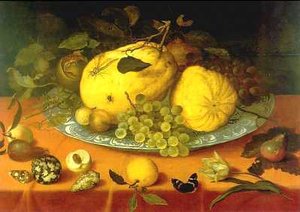
Plate with Fruits and Shells (1630) by Balthasar van der Ast

Plate with Fruits and Shells

1630 · Oil On Canvas · Hermitage Museum, Saint Petersburg

To gaze upon this exquisite depiction, Plate with Fruits and Shells, is to be transported into the sun-drenched abundance of a Dutch Golden Age table setting. It is more than a mere arrangement of edibles; it is a carefully orchestrated meditation on nature's generosity. The composition centers around a porcelain plate, a stage for an opulent gathering of ripe apples, vibrant oranges, and delicate seashells. Balthasar van der Ast, the…

10
Flowers in a Wan-Li Vase (1623) by Balthasar van der Ast

Flowers in a Wan-Li Vase

1623 · Oil On Panel · Mauritshuis, The Hague

Flowers in a Wan-Li Vase is a still life painted by Balthasar van der Ast in 1650. This work belongs to the Dutch Golden Age, a period characterized by the meticulous observation of the natural world and the rise of specialized botanical genres. The composition focuses on a floral arrangement, presenting a dense collection of blossoms that emerge from a porcelain vessel.

Balthasar van der Ast paintings, ranked 11 to 70

11Flowers in a Wan-Li Vase, with Shells (1650) by Balthasar van der AstFlowers in a Wan-Li Vase, with Shells1650 · Mauritshuis 12Still Life of Fruit on a Kraak Porcelain Dish (1617) by Balthasar van der AstStill Life of Fruit on a Kraak Porcelain Dish1617 · Currier Gallery of Art 13Still-life with fruit and macaws (1622) by Balthasar van der AstStill-life with fruit and macaws1622 · Fitzwilliam Museum 14Still Life (1620) by Balthasar van der AstStill Life1620 · Statens Museum For Kunst 15Pink Carnation (1620) by Balthasar van der AstPink Carnation1620 · Birmingham Museum of Art 16Tulip (1620) by Balthasar van der AstTulip1620 · Institut Néerlandais 17Lizard and Shell (1620) by Balthasar van der AstLizard and Shell1620 · Institut Néerlandais 18Still Life with Fruit and Sea Shells (1635) by Balthasar van der AstStill Life with Fruit and Sea Shells1635 · Bavarian State Painting Collections 19Still life with fruit and shells (1626) by Balthasar van der AstStill life with fruit and shells1626 · National Museum of Art, Architecture and Design 20Still Life of a Vase with Flowers (1630) by Balthasar van der AstStill Life of a Vase with Flowers1630 · Museum of Fine Arts 21Still life with fruits on a blue bowl and shells (1625) by Balthasar van der AstStill life with fruits on a blue bowl and shells1625 · Rijksmuseum Twenthe 22fruit-stillife (1632) by Balthasar van der Astfruit-stillife1632 23Flower Still Life in a Glass Vase (1624) by Balthasar van der AstFlower Still Life in a Glass Vase1624 · Museum of Fine Arts 24Still Life with Fruits and Flowers (1630) by Balthasar van der AstStill Life with Fruits and Flowers1630 · Norton Simon Museum 25Still Life with Fruit and Shells (1632) by Balthasar van der AstStill Life with Fruit and Shells1632 · Nationalmuseum 26Still Life with a Basket of Flowers (1630) by Balthasar van der AstStill Life with a Basket of Flowers1630 · Nationalmuseum 27Still life with a bowl of fruit surrounded by flowers, shells, fruit, insects and a parrot (1633) by Balthasar van der AstStill life with a bowl of fruit surrounded by flowers, shells, fruit, insects and a parrot1633 · Museum Flehite 28Still life (1628) by Balthasar van der AstStill life1628 29Basket of Fruits (1625) by Balthasar van der AstBasket of Fruits1625 · Staatliche Museen zu Berlin 30Still-Life of Flowers, Shells, and Insects (1635) by Balthasar van der AstStill-Life of Flowers, Shells, and Insects1635 31Flowers in a Glass Vase, Shells and a Grasshopper (1636) by Balthasar van der AstFlowers in a Glass Vase, Shells and a Grasshopper1636 · Rijksmuseum Twenthe 32Still Life with Peaches on a Pewter Dish, Medlars, Redcurrants and Grapes on a Wooden Tabletop (1648) by Balthasar van der AstStill Life with Peaches on a Pewter Dish, Medlars, Redcurrants and Grapes on a Wooden Tabletop1648 · Dordrechts Museum 33DECAYING Still Life with Shells, (1637) by Balthasar van der AstDECAYING Still Life with Shells,1637 · Groninger Museum 34A vase of flowers with shells on a ledge (1644) by Balthasar van der AstA vase of flowers with shells on a ledge1644 · Fitzwilliam Museum 35A basket of flowers with shells on a ledge (1640) by Balthasar van der AstA basket of flowers with shells on a ledge1640 · Fitzwilliam Museum 36Flowers, Shells, Butterflies, and Grasshopper (1645) by Balthasar van der AstFlowers, Shells, Butterflies, and Grasshopper1645 37Still life with Shells (1640) by Balthasar van der AstStill life with Shells1640 · Museum Boijmans Van Beuningen 38Fruit and Shells (1620) by Balthasar van der AstFruit and Shells1620 · Staatliche Kunstsammlungen Dresden 39Flower Still Life in a Glass Vase in front of a Niche with Butterfly, Lizard, Fly and Dragonfly (1657) by Balthasar van der AstFlower Still Life in a Glass Vase in front of a Niche with Butterfly, Lizard, Fly and Dragonfly1657 40Shells on a Table (1650) by Balthasar van der AstShells on a Table1650 · Mauritshuis 41Sea Shells (1650) by Balthasar van der AstSea Shells1650 · Phoenix Art Museum 42Vase of Flowers by a Window (1650) by Balthasar van der AstVase of Flowers by a Window1650 · Anhalt Art Gallery 43Still-Life with Plums, Cherries, and Shells (1628) by Balthasar van der AstStill-Life with Plums, Cherries, and Shells1628 · British Museum 44Fruit, Flowers, and Shells (1629) by Balthasar van der AstFruit, Flowers, and Shells1629 · Toledo Museum of Art 45Still-Life with Flowers, Fruit, and Shells (1640) by Balthasar van der AstStill-Life with Flowers, Fruit, and Shells1640 · Musee de la Chartreuse 46Fruit Still Life with Two Parrots (1623) by Balthasar van der AstFruit Still Life with Two Parrots1623 · Statens Museum For Kunst 47Still-Life with Apple Blossoms (detail) (1635) by Balthasar van der AstStill-Life with Apple Blossoms (detail)1635 · Staatliche Museen zu Berlin 48A Vase of Flowers (1620) by Balthasar van der AstA Vase of Flowers1620 · Ashmolean Museum 49Basket of Fruits (1622) by Balthasar van der AstBasket of Fruits1622 50Fruits and Shells on a Ledge by Balthasar van der AstFruits and Shells on a LedgeMetropolitan Museum of Art 51Flower Still-Life with Shell and Insects by Balthasar van der AstFlower Still-Life with Shell and InsectsThyssen-Bornemisza Museum 52Wicker basket with fruit, medlars and shells by Balthasar van der AstWicker basket with fruit, medlars and shellsFitzwilliam Museum 53A tulip, a carnation and roses, with shells and insects, on a ledge by Balthasar van der AstA tulip, a carnation and roses, with shells and insects, on a ledge 54Still Life with a Carnation and a Crocus, Two Shells, and a Dragonfly, Spider and Flies by Balthasar van der AstStill Life with a Carnation and a Crocus, Two Shells, and a Dragonfly, Spider and Flies 55Tulips, roses and other flowers in a basket on a table, with shells, fruit, a lizard and a butterfly by Balthasar van der AstTulips, roses and other flowers in a basket on a table, with shells, fruit, a lizard and a butterfly 56Flowers vase by Balthasar van der AstFlowers vase 57Fruits coquillage by Balthasar van der AstFruits coquillage 58Mauritshuis by Balthasar van der AstMauritshuis 59Lezard coquillages by Balthasar van der AstLezard coquillagesMusée de l'hôtel Sandelin 60Basket fruits by Balthasar van der AstBasket fruitsNational Gallery of Art 61Basket flowers by Balthasar van der AstBasket flowersNational Gallery of Art 62Study of Flowers and Insects by Balthasar van der AstStudy of Flowers and Insects 63Still Life of Flowers, Fruit, Shells, and Insects by Balthasar van der AstStill Life of Flowers, Fruit, Shells, and InsectsBirmingham Museum of Art 64Still-life with Dish of Fruit by Balthasar van der AstStill-life with Dish of FruitStaatliche Museen zu Berlin 65Flowers in a Wan-Li Vase (1620) by Balthasar van der AstFlowers in a Wan-Li Vase1620 · Suermondt-Ludwig-Museum 66Still Life with Rose and Iris (1650) by Balthasar van der AstStill Life with Rose and Iris1650 67Still Life of Fruit (1623) by Balthasar van der AstStill Life of Fruit1623 · Centraal Museum 68Still Life with Shells and an Autumn Crocus (1630) by Balthasar van der AstStill Life with Shells and an Autumn Crocus1630 · Centraal Museum 69Flowers in a Vase with Shells and Insects (1630) by Balthasar van der AstFlowers in a Vase with Shells and Insects1630 · National Gallery 70Still-Life with Apple Blossoms (1635) by Balthasar van der AstStill-Life with Apple Blossoms1635 · Staatliche Museen zu Berlin

The subjects that held Balthasar van der Ast's eye

The four subjects that come back most often in these originals, each with its finest example.

The museums that keep Balthasar van der Ast's originals

The 8 museums that hold the most of the paintings on this page.

Museum City Works by Balthasar van der Ast Paintings from this list
Mauritshuis, The HagueMauritshuis The Hague 5 Vase with a single tulip, Fruit Still Life with Shells and Tulip, Flowers in a Wan-Li Vase
Fitzwilliam MuseumFitzwilliam Museum 4 Still-life with fruit and macaws, A vase of flowers with shells on a ledge, A basket of flowers with shells on a ledge
Staatliche Museen zu Berlin, BerlinStaatliche Museen zu Berlin Berlin 4 Basket of Fruits, Still-Life with Apple Blossoms (detail), Still-life with Dish of Fruit
Hermitage Museum, Saint PetersburgHermitage Museum Saint Petersburg 2 Still-Life with Fruits, Shells and Insects, Plate with Fruits and Shells
Rijksmuseum, AmsterdamRijksmuseum Amsterdam 2 Flowers and Fruit, Still Life with Flowers
Thyssen-Bornemisza Museum, MadridThyssen-Bornemisza Museum Madrid 2 Chinese Vase with Flowers, Shells and Insects, Flower Still-Life with Shell and Insects
Norton Simon Museum, PasadenaNorton Simon Museum Pasadena 2 Bouquet in a Wan-Li Vase with a Gilt Mount, Still Life with Fruits and Flowers
Statens Museum For Kunst, CopenhagenStatens Museum For Kunst Copenhagen 2 Still Life, Fruit Still Life with Two Parrots

Balthasar van der Ast, one signature painting per decade

Works per decade

Pick a decade to see the original that defines it.

Balthasar van der Ast's paintings: the gallery answers

Which Balthasar van der Ast painting is the most famous of all?Reveal the answer

Still-Life with Fruits, Shells and Insects (1620), Hermitage Museum, Saint Petersburg. Flowers and Fruit (1620) and Chinese Vase with Flowers, Shells and Insects (1628) come next.

How old was Balthasar van der Ast on completing Still-Life with Fruits, Shells and Insects?Reveal the answer

27 years old: Still-Life with Fruits, Shells and Insects dates from 1620, and Balthasar van der Ast was born in 1593.

Which are Balthasar van der Ast's top 10 paintings?Reveal the answer

Still-Life with Fruits, Shells and Insects, Flowers and Fruit, Chinese Vase with Flowers, Shells and Insects, Vase with a single tulip, Floral Still Life with Shells, Fruit Still Life with Shells and Tulip, Still Life with Flowers, Bouquet in a Wan-Li Vase with a Gilt Mount, Plate with Fruits and Shells and Flowers in a Wan-Li Vase. The ranking above gives each one's year and museum.

How many works did Balthasar van der Ast create?Reveal the answer

Our catalog holds 71 works by Balthasar van der Ast, dated from 1617 to 1657.

Where do Balthasar van der Ast's most famous originals hang?Reveal the answer

Mostly in Mauritshuis (The Hague), Fitzwilliam Museum and Staatliche Museen zu Berlin (Berlin). The museum table above lists them all.

When did Balthasar van der Ast create the most famous paintings?Reveal the answer

In 1620s: 26 of the 70 works on this page were made then, Still-Life with Fruits, Shells and Insects among them.

Which are Balthasar van der Ast's earliest and latest famous works?Reveal the answer

On this page, the earliest is Still Life of Fruit on a Kraak Porcelain Dish (1617) and the latest Flower Still Life in a Glass Vase in front of a Niche with Butterfly, Lizard, Fly and Dragonfly (1657).

Which subjects did Balthasar van der Ast return to most?Reveal the answer

Flowers (28), Shells (21) and Insects (17), across the 70 works on this page.

Which medium did Balthasar van der Ast work in most?Reveal the answer

Oil On Panel, for 31 of the 70 works on this page.

Which movement is Balthasar van der Ast associated with?Reveal the answer

Dutch golden age and Baroque, judging by the originals on this page.

Which Balthasar van der Ast originals does the Mauritshuis hold?Reveal the answer

Vase with a single tulip, Fruit Still Life with Shells and Tulip and Flowers in a Wan-Li Vase: the Mauritshuis, The Hague holds 5 of the works on this page.

Balthasar van der Ast: the artist

The Master of the Miniature Universe: Balthasar van der Ast

In the golden light of the seventeenth-century Netherlands, a period defined by unprecedented prosperity and scientific curiosity, Balthasar van der Ast emerged as a virtuoso of the small-scale masterpiece. Born in Middelburg around 1593, van der Ast did not merely paint objects; he orchestrated silent dramas upon canvas. His life was deeply intertwined with the burgeoning merchant culture of Zeeland, being the son of a prosperous wool merchant, Hans van der Ast. This background provided him with more than just social stability; it offered an early intimacy with the exotic goods and precious specimens that would later become the protagonists of his celebrated still lifes.

The trajectory of his artistic soul was irrevocably shaped by his connection to the Bosschaert dynasty. Through a familial bond, van der Ast became the protégé of the legendary Ambrosius Bosschaert the Elder, his stepfather. Under this tutelage, he mastered the meticulous precision required for the "flower piece," a genre that demanded an almost microscopic level of observation. This lineage of excellence allowed him to refine a technique characterized by subtle tonal gradations and a profound respect for the physical texture of nature. He was not alone in this pursuit of perfection; alongside his brother-in-laws, he helped cultivate a stylistic movement that prioritized the delicate interplay of light and shadow, turning simple botanical studies into profound meditations on existence.

A Symphony of Shells and Flora

While many of his contemporaries focused solely on the ephemeral beauty of blossoms, van der Ast achieved historical immortality through his pioneering explorations into conchology. He became a pioneer of shell painting, treating the calcified remains of sea creatures with the same reverence as the softest petal. In works such as "Still-Life with Plums, Cherries, and Shells," one can witness the breathtaking marriage of different textures: the juicy, translucent skin of fruit contrasted against the hard, pearlescent surfaces of exotic shells. This fascination was not merely aesthetic; it reflected the era's burgeoning scientific interest in natural history and the global reach of Dutch maritime commerce.

His compositions often functioned as much more than mere displays of wealth or botanical accuracy. To look closely at a van der Ast painting is to engage with a complex web of symbolism rooted in humanist philosophy. Within his arrangements, one might find:

  • The Ephemeral Nature of Life: Represented through wilting petals or insects that consume the very beauty they inhabit.
  • Scientific Observation: A meticulous recording of species, reflecting the Age of Discovery and the era's thirst for knowledge.
  • Vanitas Themes: Subtle reminders of mortality, where the decay of fruit serves as a poignant memento mori.

Legacy and Artistic Significance

The influence of Balthasar van der Ast extended far beyond his own studio in Utrecht. By welcoming artists like Roelandt Savery into the local guild, he helped foster an environment where tonality and realism could flourish. His ability to infuse inanimate objects with a sense of life—a quality seen in his depictions of lizards and insects crawling amidst fruit—set a new standard for the Dutch Golden Age. He moved the still life genre away from static arrangement toward a more dynamic, breathing reality.

Today, his works remain cornerstones of museum collections worldwide, from the British Museum to the great galleries of Europe. His legacy is found in every brushstroke that captures the dewdrop on a leaf or the iridescent sheen of a seashell. Balthasar van der Ast remains a titan of the Stilleven, an artist who taught the world to find the infinite within the infinitesimal, and who transformed the humble objects of the natural world into eternal icons of beauty.