


1


Updated November 2026 · ranked by our popularity score (searches, visits and orders for each work) · 36 works by Alan Davie in our catalogue
In short
To the gallery's eye, Alan Davie's most famous painting is Woman Arranging Flowers (1945). Untitled Abstract and Self Portrait with Brushes (1937) complete the trio every eye recognises. Of the 36 works by Alan Davie in our catalog, the gallery presents the 36 most famous below, each original with its year, its museum and what makes it unique.


 Joe's Magic Lantern1961
12
 Joe's Lucky Dip1961
13
 Keep Your Fingers Crossed1961
14
 Hopi Studies No.32, Opus 0.11731991 · University of Hertfordshire
15
 Hopi Studies No.30 (Big Blue) (Opus O.1171)1991
16
 Homage to an Earth Goddess No.61992
17
 Symbols in a Landscape1994 · The Pier Arts Centre
18
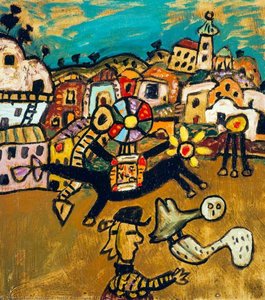 Village Witch (Opus O.1263)1994
19
 Magic Casket1997 · Art
20
 Celtic Landscape (Dreamscape)1996 · The Pier Arts Centre
21
 Magic Landscape (Opus O.1337)1996
22
 The Alchemist's Mirror No.1 (Opus 1357)1997
23
 Cosmic Signals I2000
24
 Cosmic Signals No.72000
25
 The Golden Palace1999
26
 Magician's Mirror No.22000 · The Mercer Art Gallery
27
 Serpent's Idea of a Horse2000
28
 The Magician's Mirror No.3 (Opus 1450)2000
29
 Without Devices2004 · Pembroke College Oxford Jcr Art Collection
30
 Around and Around in the PinkNational Gallery of Canada
31
 Kaleidoscope for a Parrot
32
 Prize for a Serpent
33
 Flowers on a TableThe Fleming Collection
34Prophet in a Tree, 1963Fitzwilliam College
35
 Double MonumentRobinson College
36
 Hallucination with Monster and Cock
The 8 museums that hold the most of the paintings on this page.
| Museum | City | Works by Alan Davie | Paintings from this list |
|---|---|---|---|
 The Pier Arts Centre |
Stromness | 2 | Symbols in a Landscape, Celtic Landscape (Dreamscape) |
 University of Hertfordshire |
North Hatley | 1 | Hopi Studies No.32, Opus 0.1173 |
 Art |
Edinburgh | 1 | Magic Casket |
 The Mercer Art Gallery |
Harrogate | 1 | Magician's Mirror No.2 |
 Pembroke College Oxford Jcr Art Collection |
Oxford | 1 | Without Devices |
 National Gallery of Canada |
Ottawa | 1 | Around and Around in the Pink |
 The Fleming Collection |
London | 1 | Flowers on a Table |
 Fitzwilliam College |
Cambridge | 1 | Prophet in a Tree, 1963 |
Pick a decade to see the original that defines it.


Woman Arranging Flowers (1945). Untitled Abstract and Self Portrait with Brushes (1937) come next.
25 years old: Woman Arranging Flowers dates from 1945, and Alan Davie was born in 1920.
Woman Arranging Flowers, Untitled Abstract, Self Portrait with Brushes, The Saint, Entrance to a Paradise, Jingling Space, Ram Grip, Piggy Chain, Joy Bag No. 1 and Entrance For A Red Temple No. 4. The ranking above gives each one's year and museum.
Our catalog holds 36 works by Alan Davie, dated from 1937 to 2004.
Mostly in The Pier Arts Centre (Stromness), University of Hertfordshire (North Hatley) and Art (Edinburgh). The museum table above lists them all.
In 1990s: 10 of the 36 works on this page were made then, Hopi Studies No.32, Opus 0.1173 among them.
On this page, the earliest is Self Portrait with Brushes (1937) and the latest Without Devices (2004).
Abstract expressionism, judging by the originals on this page.
Symbols in a Landscape and Celtic Landscape (Dreamscape): the The Pier Arts Centre, Stromness holds 2 of the works on this page.