Portrait of Thomas Wijck

The 80 Most Famous Thomas Wijck Paintings, Each One of a Kind

Updated November 2026 · ranked by our popularity score (searches, visits and orders for each work) · 89 works by Thomas Wijck in our catalogue

In short

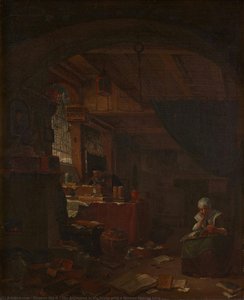
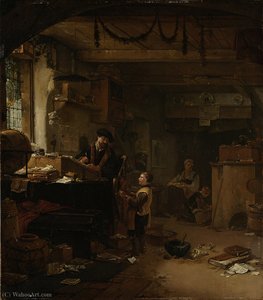
St Anthony, Archbishop of Florence (1654) is the Thomas Wijck painting that draws the most eyes; the original belongs to the Nationalmuseum, Stockholm. After it, the eye goes to Interior of a Dutch Farm Cottage (1654) and The Alchemist (1650). Among the 89 works of Thomas Wijck in our catalog, these 80 are the most famous, each a unique original presented with its year, its museum and the reason it endures.

1616 – 1677, Beverwijk Dutch golden age Most works: Bavarian State Painting Collections

Top 10 paintings by Thomas Wijck, through the gallery's eye

1
St Anthony, Archbishop of Florence (1654) by Thomas Wijck

St Anthony, Archbishop of Florence

1654 · Oil · Nationalmuseum, Stockholm

The saint stands within a frame of heavy, arched architecture. He is a pillar of white and black, his monastic habit catching a sharp, directional light from the upper left. This light carves the folds of his robes and illuminates a face set with solemn authority. In one hand, he holds a tall processional cross; in the other, a scale. The metal of the scale catches the light, a small…

2
Interior of a Dutch Farm Cottage (1654) by Thomas Wijck

Interior of a Dutch Farm Cottage

1654 · Oil · Statens Museum For Kunst, Copenhagen

In this 1654 work, we find ourselves drawn into the hushed, dim atmosphere of a rustic farm cottage. The composition is anchored by a heavy, dark architectural archway in the foreground, which acts as a threshold, inviting us to peer into a private, domestic world. A soft, directional light enters from a window on the left, casting a gentle glow across the scene. This light catches the subtle textures of…

3
The Alchemist (1650) by Thomas Wijck

The Alchemist

1650 · Oil · Mauritshuis, The Hague

The Alchemist is a detailed 17th-century genre painting that captures a cluttered workshop filled with a sense of intense scholarly focus. The composition is densely packed, utilizing a deep, shadowed interior that directs the viewer's eye toward a light source entering from a window on the left. The color palette is dominated by earthy tones, such as ochres and browns, which are sharply interrupted by the vibrant, saturated red of…

4
The Tinker (1654) by Thomas Wijck

The Tinker

1654 · Oil On Canvas · Statens Museum For Kunst, Copenhagen

The Tinker is a genre painting by the Dutch artist Thomas Wijck. Created about 1654, the work depicts a man engaged in his manual trade within a workshop setting. The subject matter focuses on the specific activities of a laborer, providing a view into the daily existence of a traveling repairman. This depiction of a craftsman at work places the figure within the tradition of seventeenth-century Dutch genre scenes.

5
Almsgiving (1660) by Thomas Wijck

Almsgiving

1660 · Oil On Canvas · Philadelphia Museum of Art, Philadelphia

Almsgiving is a somber and atmospheric genre painting from 1660 that depicts a scene of charity within an old European setting. The composition is framed by a large, dark architectural archway in the foreground, which creates a sense of depth and directs the viewer's eye toward the central group of figures. The subject matter focuses on the interaction between people in a moment of social welfare, evoking themes of piety,…

6
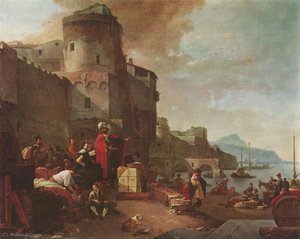
Capriccio of a Fort by the Sea, with Orientals and an Antique Statue (1673) by Thomas Wijck

Capriccio of a Fort by the Sea, with Orientals and an Antique Statue

1673 · Oil On Canvas · National Trust, Thames

To gaze upon this magnificent Capriccio of a Fort by the Sea is to step directly into a sun-drenched moment plucked from the heart of the Dutch Golden Age. Thomas Wyck’s masterful oil painting, dated 1673, transports us to a vibrant, almost theatrical harbor scene where the solidity of classical architecture meets the ephemeral energy of human endeavor. It is more than just a depiction of a port; it is…

7
Woman at Her Sewing Table (1655) by Thomas Wijck

Woman at Her Sewing Table

1655 · Oil On Canvas · Städel Museum, Frankfurt

In this intimate scene from 1655, we find ourselves drawn into a private, domestic moment. A woman sits at her sewing table, her attention entirely consumed by the needlework in her hands. The composition is tightly framed, pulling the viewer into the stillness of her world. Light enters from an unseen source to the left, washing over the bright white of her linen collar and the fabric she works upon,…

8
View of the Bay of Naples with Orientals and an Antique Statue (1673) by Thomas Wijck

View of the Bay of Naples with Orientals and an Antique Statue

1673 · Oil On Canvas · National Trust, Thames

Gaze upon this exquisite vision of the Bay of Naples, a scene that transports the viewer directly to an era of opulent leisure and artistic contemplation. The composition is alive with the gentle murmur of activity—the distant sails catching the sun, the figures gathered along the shore engaging in moments of quiet enjoyment. It is more than just a depiction of a beautiful vista; it is an immersion into a…

9
A rustic interior (1654) by Thomas Wijck

A rustic interior

1654 · Oil On Panel · Museum Boijmans Van Beuningen, Rotterdam

The air inside this room feels heavy and still, thick with the scent of woodsmoke and old stone. A low, heavy ceiling presses down upon the scene, creating a sense of profound intimacy that wraps around the figures like a shroud. Light enters from a single, unseen source to the left, slicing through the gloom to catch the bright white of a woman's headscarf. This sudden brightness pulls the eye…

10
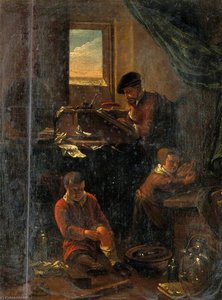
An Alchemist in His Studio (1600) by Thomas Wijck

An Alchemist in His Studio

1600 · Oil · Science History Institute, Philadelphia

A soft, warm light spills across a cluttered desk, illuminating an old man lost in the silent labor of thought. He sits hunched over a book, his eyes tracing lines of text that perhaps hold the secrets of the universe. The room feels heavy with the scent of old parchment and the stillness of a life dedicated to study. Around him, the tools of his obsession are scattered like fragments…

Thomas Wijck's famous paintings, numbers 11 to 80

11Harbor Scene (1646) by Thomas WijckHarbor Scene1646 · Bavarian State Painting Collections 12An Alchemist (1646) by Thomas WijckAn Alchemist1646 · Bavarian State Painting Collections 13Italian Landscape with Figures at a Fountain among Antique Ruins (1647) by Thomas WijckItalian Landscape with Figures at a Fountain among Antique Ruins1647 · Städel Museum 14man reading in his laboratory (1641) by Thomas Wijckman reading in his laboratory1641 15Southern Sea-Harbour with architecture; tradesmen (1641) by Thomas WijckSouthern Sea-Harbour with architecture; tradesmen1641 16Morra-Players (1640) by Thomas WijckMorra-Players1640 · Academy of Fine Arts Vienna 17On the Gulf of Naples (1650) by Thomas WijckOn the Gulf of Naples1650 · Bavarian State Painting Collections 18Interior with Two Men and a Woman with a Baby (1656) by Thomas WijckInterior with Two Men and a Woman with a Baby1656 19Merchants with commodities in a Levante Harbour (1660) by Thomas WijckMerchants with commodities in a Levante Harbour1660 · Musée Fabre 20Painting (1656) by Thomas WijckPainting1656 · National Museum of Art, Architecture and Design 21The Gipsy Woman Telling the Soldiers their Fortunes (1660) by Thomas WijckThe Gipsy Woman Telling the Soldiers their Fortunes1660 · Statens Museum For Kunst 22The Yard of an Italian Tavern (1654) by Thomas WijckThe Yard of an Italian Tavern1654 · Statens Museum For Kunst 23The Weaver at Work in his Home (1654) by Thomas WijckThe Weaver at Work in his Home1654 · Statens Museum For Kunst 24A scholar in his Study (1660) by Thomas WijckA scholar in his Study1660 · Hallwyl Museum 25Alchemist in his laboratory (1650) by Thomas WijckAlchemist in his laboratory1650 · Staatliches Museum Schwerin 26An alchemist's workshop (1654) by Thomas WijckAn alchemist's workshop1654 · Gemäldegalerie 27The Alchemist in his Study with a Woman Making Lace (1660) by Thomas WijckThe Alchemist in his Study with a Woman Making Lace1660 · Science History Institute 28An Alchemist in his Laboratory (1654) by Thomas WijckAn Alchemist in his Laboratory1654 · Statens Museum For Kunst 29An Alchemist and His Family (1660) by Thomas WijckAn Alchemist and His Family1660 · Science History Institute 30Landscape with Arch Bridge (1646) by Thomas WijckLandscape with Arch Bridge1646 · Bavarian State Painting Collections 31Italian street scene by Thomas WijckItalian street scene 32Alchemist by Thomas WijckAlchemistRijksmuseum 33Mountain Monastery (1646) by Thomas WijckMountain Monastery1646 · Bavarian State Painting Collections 34Rock Landscape (1646) by Thomas WijckRock Landscape1646 · Bavarian State Painting Collections 35At the Seaport (1646) by Thomas WijckAt the Seaport1646 · Bavarian State Painting Collections 36Vegetable Market (1646) by Thomas WijckVegetable Market1646 · Bavarian State Painting Collections 37Italian Harbor with Fortifications and Staffage (1641) by Thomas WijckItalian Harbor with Fortifications and Staffage1641 38Italian Coastal Landscape (1640) by Thomas WijckItalian Coastal Landscape1640 39Interior of a Cave (1640) by Thomas WijckInterior of a Cave1640 40Apple Seller at a City Gate (1654) by Thomas WijckApple Seller at a City Gate1654 · National Museum in Wrocław 41A washerwoman and children by a river before a walled bridge (1654) by Thomas WijckA washerwoman and children by a river before a walled bridge1654 · Wallraf-Richartz-Museum 42Figures in the Courtyard of a House (1660) by Thomas WijckFigures in the Courtyard of a House1660 · Fairfax House 43An Alchemist at Work, with a Mother by a Cradle Beyond (1650) by Thomas WijckAn Alchemist at Work, with a Mother by a Cradle Beyond1650 · Science History Institute 44View of port of Ripa Grande. (1670) by Thomas WijckView of port of Ripa Grande.1670 · Musée Fabre 45A View of the Forum (1674) by Thomas WijckA View of the Forum1674 · National Trust 46An Alchemist in His Laboratory (1673) by Thomas WijckAn Alchemist in His Laboratory1673 · National Trust 47Capriccio of a Seaport with Orientals, Ruins, and an Antique Statue (1673) by Thomas WijckCapriccio of a Seaport with Orientals, Ruins, and an Antique Statue1673 · National Trust 48An Alchemist in His Laboratory, with an Assistant (1673) by Thomas WijckAn Alchemist in His Laboratory, with an Assistant1673 · National Trust 49Italian Courtyard (1677) by Thomas WijckItalian Courtyard1677 · Dulwich Picture Gallery 50Landscape with Bay (1646) by Thomas WijckLandscape with Bay1646 · Bavarian State Painting Collections 51Old Building by Thomas WijckOld BuildingKunsthistorisches Museum 52Interior of a Weaver's Cottage by Thomas WijckInterior of a Weaver's CottageNational Gallery of Ireland 53landscape with fountain and fig. by Thomas Wijcklandscape with fountain and fig. 54horsemen resting before an inn by Thomas Wijckhorsemen resting before an inn 55Figures outside a tavern with a woman sewing, travellers on a bridge beyond by Thomas WijckFigures outside a tavern with a woman sewing, travellers on a bridge beyond 56Whitehall and St James's Park, London by Thomas WijckWhitehall and St James's Park, London 57Capriccio of a Roman Ruins with Orientals, a Fountain and an Antique Statue by Thomas WijckCapriccio of a Roman Ruins with Orientals, a Fountain and an Antique StatueNational Trust 58An Alchemist by Thomas WijckAn AlchemistHermitage Museum 59Dancing couple + many people at ruins by Thomas WijckDancing couple + many people at ruins 60A church interior by Thomas WijckA church interior 61Washerwomen at the Foot of the Torre delle Milizie, Rome by Thomas WijckWasherwomen at the Foot of the Torre delle Milizie, Rome 62Italian port by Thomas WijckItalian port 63Levantijnse haven by Thomas WijckLevantijnse havenRijksmuseum 64Southern Landscape by Thomas WijckSouthern Landscape 65Washerwomen in a yard. by Thomas WijckWasherwomen in a yard.National Museum in Warsaw 66The Alchemist by Thomas WijckThe AlchemistFitzwilliam College 67Riders by Italianate ruins with a seaport beyond by Thomas WijckRiders by Italianate ruins with a seaport beyond 68Italian Street Scene by Thomas WijckItalian Street SceneThe Ashmolean Museum of Art And Archaeology 69Spinning farmer by Thomas WijckSpinning farmerRijksmuseum 70View of the Thames at Westminster on Lord Mayor's Day by Thomas WijckView of the Thames at Westminster on Lord Mayor's Day 71The Poor Being Fed at a Monastery by Thomas WijckThe Poor Being Fed at a Monastery 72The Wreckers, Stormy Coast Scene with Tower by Thomas WijckThe Wreckers, Stormy Coast Scene with Tower 73A Philosopher in His Study, with Two Children by Thomas WijckA Philosopher in His Study, with Two Children 74Interior with an Alchemist by Thomas WijckInterior with an Alchemist 75Interior with an Alchemist Making a Gesture of Surprise, and a Female Assistant by Thomas WijckInterior with an Alchemist Making a Gesture of Surprise, and a Female Assistant 76Interior with an Alchemist Examining a Bowl Brought by a Boy by Thomas WijckInterior with an Alchemist Examining a Bowl Brought by a Boy 77Interior with an Alchemist Studying a Book, His Assistant Pouring Liquid into a Bowl by Thomas WijckInterior with an Alchemist Studying a Book, His Assistant Pouring Liquid into a Bowl 78Interior with an Alchemist Seated at a Table, Looking out of the Picture by Thomas WijckInterior with an Alchemist Seated at a Table, Looking out of the Picture 79Interior with an Alchemist Seated at a Table, Looking out of the Picture by Thomas WijckInterior with an Alchemist Seated at a Table, Looking out of the Picture 80Kitchen interior by Thomas WijckKitchen interiorFinnish National Gallery

Thomas Wijck's famous paintings, period by period

The subjects that held Thomas Wijck's eye

The four subjects that come back most often in these originals, each with its finest example.

The museums that keep Thomas Wijck's originals

The 8 museums that hold the most of the paintings on this page.

Museum City Works by Thomas Wijck Paintings from this list
Bavarian State Painting Collections, MunichBavarian State Painting Collections Munich 9 Harbor Scene, An Alchemist, On the Gulf of Naples
National Trust, ThamesNational Trust Thames 7 Capriccio of a Fort by the Sea, with Orientals and an Antique Statue, View of the Bay of Naples with Orientals and an Antique Statue, A View of the Forum
Statens Museum For Kunst, CopenhagenStatens Museum For Kunst Copenhagen 6 Interior of a Dutch Farm Cottage, The Tinker, The Gipsy Woman Telling the Soldiers their Fortunes
Science History Institute, PhiladelphiaScience History Institute Philadelphia 4 An Alchemist in His Studio, The Alchemist in his Study with a Woman Making Lace, An Alchemist and His Family
Rijksmuseum, AmsterdamRijksmuseum Amsterdam 3 Alchemist, Levantijnse haven, Spinning farmer
Städel Museum, FrankfurtStädel Museum Frankfurt 2 Woman at Her Sewing Table, Italian Landscape with Figures at a Fountain among Antique Ruins
Musée Fabre, MontpellierMusée Fabre Montpellier 2 Merchants with commodities in a Levante Harbour, View of port of Ripa Grande.
Nationalmuseum, StockholmNationalmuseum Stockholm 1 St Anthony, Archbishop of Florence

Thomas Wijck across the decades: one unique original for each

Works per decade

Pick a decade to see the original that defines it.

Thomas Wijck's paintings: questions for the gallery

What is the single most famous work of Thomas Wijck?Reveal the answer

St Anthony, Archbishop of Florence (1654), Nationalmuseum, Stockholm. Interior of a Dutch Farm Cottage (1654) and The Alchemist (1650) come next.

At what age did Thomas Wijck create St Anthony, Archbishop of Florence?Reveal the answer

38 years old: St Anthony, Archbishop of Florence dates from 1654, and Thomas Wijck was born in 1616.

Which ten paintings by Thomas Wijck are the most famous?Reveal the answer

St Anthony, Archbishop of Florence, Interior of a Dutch Farm Cottage, The Alchemist, The Tinker, Almsgiving, Capriccio of a Fort by the Sea, with Orientals and an Antique Statue, Woman at Her Sewing Table, View of the Bay of Naples with Orientals and an Antique Statue, A rustic interior and An Alchemist in His Studio. The ranking above gives each one's year and museum.

How many works by Thomas Wijck are known?Reveal the answer

Our catalog holds 89 works by Thomas Wijck, dated from 1640 to 1677.

Where can the most famous Thomas Wijck originals be seen?Reveal the answer

Mostly in Bavarian State Painting Collections (Munich), National Trust (Thames) and Statens Museum For Kunst (Copenhagen). The museum table above lists them all.

During which period did Thomas Wijck create the best-known paintings?Reveal the answer

In 1650s: 17 of the 80 works on this page were made then, St Anthony, Archbishop of Florence among them.

Which famous Thomas Wijck painting is the earliest, and which the latest?Reveal the answer

On this page, the earliest is Morra-Players (1640) and the latest Italian Courtyard (1677).

What subjects did Thomas Wijck favour?Reveal the answer

Man (15), Woman (12) and Books (12), across the 80 works on this page.

What materials did Thomas Wijck paint with most?Reveal the answer

Oil, for 25 of the 80 works on this page.

Which movement does the work of Thomas Wijck belong to?Reveal the answer

Dutch golden age and Baroque, judging by the originals on this page.

What Thomas Wijck originals can I see at the Bavarian State Painting Collections?Reveal the answer

Harbor Scene, An Alchemist and On the Gulf of Naples: the Bavarian State Painting Collections, Munich holds 9 of the works on this page.

Thomas Wijck: a portrait of the artist

The Life and Legacy of Thomas Wyck

Born into a lineage of creators, Thomas Wyck emerged as a distinguished figure within the vibrant landscape of Dutch Golden Age painting. His artistic journey began under the watchful eye of his father, from whom he received his foundational training, a beginning that rooted him deeply in the traditions of his craft. This early immersion in the technical nuances of oil painting prepared him for a life of exploration and stylistic evolution. As a painter of both port views and genre scenes, Wyck possessed a unique ability to capture the bustling energy of maritime commerce and the intimate, often mysterious, moments of daily life.

The trajectory of his career was profoundly shaped by his travels through the Mediterranean. While historical records regarding his exact movements are subject to scholarly debate, evidence suggests that by 1640, a painter known as Tommaso fiammingo was active in Rome, a figure many believe to be Wyck himself. This period of Italian influence is palpable in his work; his canvases often breathe with the light and atmosphere of Roman landscapes and the coastal beauty of Naples. In the environs of Naples, he meticulously executed sketches that would later blossom into detailed drawings of coast views, demonstrating a keen eye for the intersection of natural grandeur and human presence.

Mastery of Genre and Maritime Scenes

Wyck’s artistic repertoire was remarkably diverse, ranging from the theatricality of Italianate landscapes to the profound symbolism found in genre paintings. He excelled in creating capriccios—imaginary, often architectural fantasies—such as his depictions of forts by the sea, where classical antiquity meets the lively movement of contemporary maritime life. His ability to populate these scenes with a multitude of figures allowed him to weave complex narratives of trade, leisure, and historical reverence into a single composition.

Beyond the expansive vistas of harbors and bays, Wyck delved into the more shadowed, introspective corners of the human experience. His work An Alchemist serves as a breathtaking example of his skill in capturing intellectual tension. In this piece, the artist uses the setting of a secluded laboratory to explore the blurred boundaries between burgeoning science and ancient mysticism. Through the careful arrangement of objects like clocks, books, and manuscripts, he invites the viewer to contemplate themes of time, perseverance, and the relentless pursuit of hidden knowledge.

Professional Eminence and Lasting Influence

Upon returning to the northern Netherlands in 1642, Wyck established himself as a pillar of the artistic community. His professional standing was solidified through his membership in the Haarlem Guild of St. Luke, an institution where he would eventually rise to the esteemed position of Dean in 1660. This period of his life marked a peak of local influence and recognition, as he became a central figure in the Dutch art scene.

The reach of Wyck's influence extended far beyond the borders of the Netherlands. During the era of the English Restoration, he traveled to England, where his talents were highly sought after. His legacy was furthered by his role as a teacher; his son and pupil, Jan Wyck, became a significant figure in the development of English sporting painting, while his student Jan van der Vaart also carried these traditions to new lands. Through his descendants and pupils, the technical brilliance and atmospheric sensitivity of Thomas Wyck continued to resonate through the centuries, leaving an indelible mark on the history of European painting.