Portrait of Thomas Danby

The 18 Most Famous Thomas Danby Paintings, a Gallery Selection

Updated November 2026 · ranked by our popularity score (searches, visits and orders for each work) · 25 works by Thomas Danby in our catalogue

In short

Of all the originals Thomas Danby left, the most famous is Llyn Cynwch, Dolgellau (1853). Close behind it come River Scene with Weir and Mill (1823) and The Lake of Lucerne (1856). Our catalog holds 25 works by Thomas Danby; the gallery has kept the 18 the world admires most, each shown with its date, its museum and its story.

1818 – 1886, Bristol Romanticism Most works: Bristol Museum - Art Gallery

Thomas Danby's top 10 paintings: the gallery's choice

1
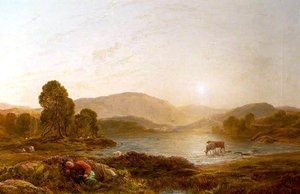
Llyn Cynwch, Dolgellau (1853) by Thomas Danby

Llyn Cynwch, Dolgellau

1853 · Oil On Canvas

The landscape of Dolgellau unfolds through a wide, horizontal composition, centering on the still waters of Llyn Cynwch. In the foreground, a shepherd boy lies asleep amidst the bracken, a quiet detail that suggests the slow passage of time in the Welsh mountains. Near the water's edge, cattle drink from the river, their presence grounding the vastness of the scene in a moment of everyday utility. The mountains rise in…

2
River Scene with Weir and Mill (1823) by Thomas Danby

River Scene with Weir and Mill

1823 · Oil · Bristol Museum - Art Gallery, Bristol

The river moves with a steady, rhythmic weight. A weir breaks the surface, turning the current into a white, frothing lace that spills over the stones. Beside it, a mill sits anchored to the bank, its presence a silent witness to the constant motion of the stream. Trees lean over the water, their branches casting soft shadows across the banks. Small figures are scattered along the edges, mere punctuation marks…

3
The Lake of Lucerne (1856) by Thomas Danby

The Lake of Lucerne

1856 · Oil

The composition centers on a tranquil expanse of water, framed by the rising silhouettes of mountains. Several boats drift across the lake, their presence providing a sense of scale against the vastness of the natural landscape. Near the left edge, a solitary figure stands, observing the scene. The sky above is punctuated by a few birds in flight, adding a subtle sense of movement to the stillness of the water.…

4
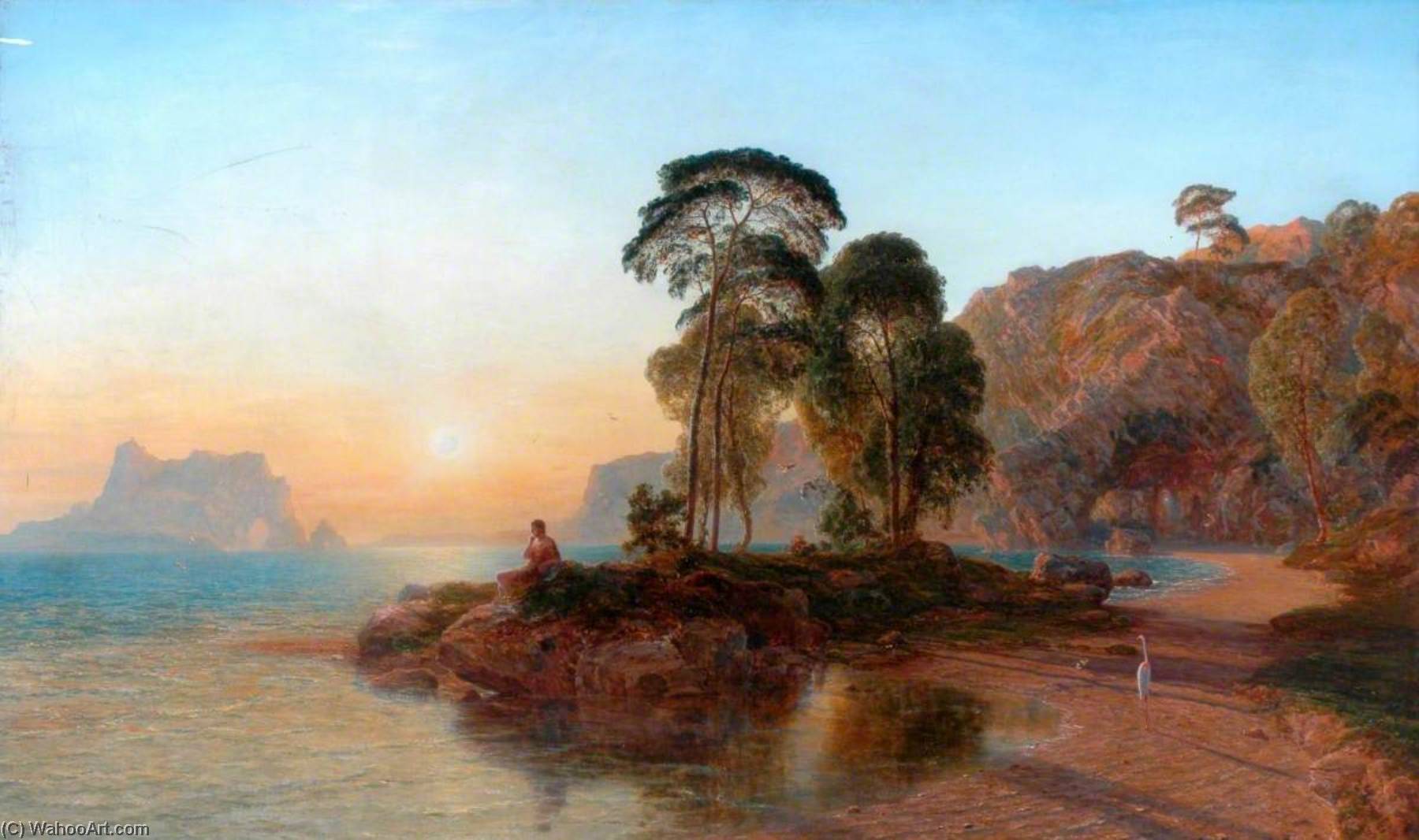
Water Scene (1858) by Thomas Danby

Water Scene

1858 · Oil

A lone figure sits upon a weathered rock, their back turned to the viewer as they gaze toward the distant horizon. The stillness of the scene is profound, broken only by the gentle presence of a boat drifting upon the water's surface. Nearby, two trees frame the composition, their branches reaching out toward the center of the view. In the background, mountains rise with a quiet strength, their peaks softened…

5
The Lake of Lucerne (1856) by Thomas Danby

The Lake of Lucerne

1856 · Oil · Walker Art Gallery, Liverpool

The water lies flat, a mirror for the sky. High above, the mountains rise in silent, heavy shapes, their peaks catching the pale light of a distant sun. A single boat rests upon the surface, a small speck of human presence amidst the vastness of the lake. Nine birds drift through the air, their wings caught in a moment of suspended flight. They are dark silhouettes against the light, moving…

6
The Escape of Mary, Queen of Scots from Loch Leven Castle, 2 May 1568 (1864) by Thomas Danby

The Escape of Mary, Queen of Scots from Loch Leven Castle, 2 May 1568

1864 · Oil On Canvas

In The Escape of Mary, Queen of Scots from Loch Leven Castle, 2 May 1568, Thomas Danby captures a moment of profound tension. The scene depicts the historical flight of Mary, Queen of Scots, as she attempts to flee her confinement in 1568. She is positioned within a boat, accompanied by her child, navigating the waters away from the castle. The composition focuses on this precarious movement, emphasizing the vulnerability…

7
Moel Siabod, Welsh Landscape by Thomas Danby

Moel Siabod, Welsh Landscape

Oil On Canvas · Stirling Smith Art Gallery And Museum, Stirling

This panoramic oil painting depicts a serene landscape scene at dusk or dawn. The composition is broadly horizontal, emphasizing a wide expanse of water that reflects the soft colors of the sky and distant mountains. In the foreground, a small group of cattle is present, adding a touch of human activity to the otherwise untouched wilderness. The scene is characterized by a soft, diffused lighting that creates a tranquil and…

8
A New Bride for the Sea (1865) by Thomas Danby

A New Bride for the Sea

1865 · Oil On Canvas · National Maritime Museum, London

The canvas titled A New Bride for the Sea presents a quiet moment of maritime existence. Painted by Thomas Danby, the work captures a specific intersection of land and tide. It emerged in 1865, a year when the artist presented this coastal vision to the public at the Royal Academy.

9
A Deserted Home (1881) by Thomas Danby

A Deserted Home

1881 · Oil On Canvas · Reading Museum - Town Hall, Reading

A Deserted Home is an oil on canvas work by Thomas Danby. Created in 1881, the painting captures a specific stillness within the landscape. The artist uses the medium to reach for the quietude of the natural world, seeking to stir a sense of feeling through the depiction of a serene and idyllic scene.

The Thomas Danby selection continues, 11 to 18

The subjects that held Thomas Danby's eye

The four subjects that come back most often in these originals, each with its finest example.

The museums that keep Thomas Danby's originals

The 8 museums that hold the most of the paintings on this page.

Museum City Works by Thomas Danby Paintings from this list
Bristol Museum - Art Gallery, BristolBristol Museum - Art Gallery Bristol 1 River Scene with Weir and Mill
Walker Art Gallery, LiverpoolWalker Art Gallery Liverpool 1 The Lake of Lucerne
Stirling Smith Art Gallery And Museum, StirlingStirling Smith Art Gallery And Museum Stirling 1 Moel Siabod, Welsh Landscape
National Maritime Museum, LondonNational Maritime Museum London 1 A New Bride for the Sea
Reading Museum - Town Hall, ReadingReading Museum - Town Hall Reading 1 A Deserted Home
Williamson Art Gallery - Museum, BirkenheadWilliamson Art Gallery - Museum Birkenhead 1 Evening
Birmingham Museums And Art Gallery, BirminghamBirmingham Museums And Art Gallery Birmingham 1 Landscape
Bristol Museum And Art Gallery, BristolBristol Museum And Art Gallery Bristol 1 Dolwyddelan

Thomas Danby decade by decade: the original that defines each

Works per decade

Pick a decade to see the original that defines it.

Collectors' questions about Thomas Danby's paintings

Which work is Thomas Danby most famous for?Reveal the answer

Llyn Cynwch, Dolgellau (1853). River Scene with Weir and Mill (1823) and The Lake of Lucerne (1856) come next.

What age was Thomas Danby when Llyn Cynwch, Dolgellau was made?Reveal the answer

35 years old: Llyn Cynwch, Dolgellau dates from 1853, and Thomas Danby was born in 1818.

What are the ten most famous Thomas Danby paintings?Reveal the answer

Llyn Cynwch, Dolgellau, River Scene with Weir and Mill, The Lake of Lucerne, Water Scene, The Lake of Lucerne, The Escape of Mary, Queen of Scots from Loch Leven Castle, 2 May 1568, Moel Siabod, Welsh Landscape, A New Bride for the Sea, A Deserted Home and Evening. The ranking above gives each one's year and museum.

How many paintings did Thomas Danby leave?Reveal the answer

Our catalog holds 25 works by Thomas Danby, dated from 1853 to 1881.

In which museums do Thomas Danby's masterpieces hang?Reveal the answer

Mostly in Bristol Museum - Art Gallery (Bristol), Walker Art Gallery (Liverpool) and Stirling Smith Art Gallery And Museum (Stirling). The museum table above lists them all.

In which years did Thomas Danby paint the most famous works?Reveal the answer

In 1850s: 4 of the 18 works on this page were made then, Llyn Cynwch, Dolgellau among them.

What are the first and the last famous originals of Thomas Danby?Reveal the answer

On this page, the earliest is Llyn Cynwch, Dolgellau (1853) and the latest A Deserted Home (1881).

Which subjects did Thomas Danby choose most often?Reveal the answer

Water (8), Trees (5) and Landscape (5), across the 18 works on this page.

Which technique did Thomas Danby use most?Reveal the answer

Oil On Canvas, for 9 of the 18 works on this page.

To which art movement does Thomas Danby belong?Reveal the answer

Romanticism, judging by the originals on this page.

Thomas Danby: life and work

A Romantic Vision of the Welsh Landscape

Thomas Danby (1818–1886) stands as a luminous figure in the pantheon of Victorian landscape painting, a master who sought to bridge the gap between the physical reality of nature and the profound depths of human emotion. Born in Bristol into an artistic lineage that commanded respect, Danby was the son of the celebrated painter Francis Danby. This early immersion in a world of dramatic, emotionally charged canvases provided him with a foundational understanding of the power of atmosphere. However, where his father often leaned toward the theatrical and the imaginative, Thomas carved a distinct path, focusing his gaze upon the rugged, serene beauty of the natural world, particularly the evocative terrains of Wales.

His artistic journey was significantly shaped by his formative years in Paris during the 1820s and 30s. It was within the hallowed halls of the Louvre that Danby honed his technical prowess, earning a living by meticulously copying the masters. This period of intense study brought him into a deep, lifelong dialogue with the work of Claude Lorrain. From the French master, Danby adopted a devotion to atmospheric perspective and the use of light to create a sense of sublime grandeur. He did not merely seek to replicate the scenery he encountered; rather, he sought to capture what his contemporaries described as the "inner heart's feeling" of a view, prioritizing the spiritual resonance of a landscape over the mere recording of local facts.

The Spirit of Romanticism and Technical Mastery

As Danby’s career progressed, his work became a testament to the enduring spirit of Romanticism. His compositions often featured the sweeping vistas of the Welsh mountains, such as the majestic Moel Siabod or the tranquil reaches of Llyn Cynwch. In these works, one finds a masterful command of light and tone, whether rendered in the rich, textured layers of oil on canvas or the delicate, translucent washes of his later watercolor mastery. His ability to manipulate light—creating the soft glow of dusk or the diffused, misty atmosphere of a mountain morning—allowed him to imbue even the most pastoral scenes with a sense of quiet contemplation and awe.

The evolution of his technique is particularly evident in his transition toward watercolor painting in his later years. Having achieved significant recognition through exhibitions at the Royal Academy and the British Institution, Danby became an esteemed member of the Society of Painters in Watercolours. This shift allowed him to explore even more subtle gradations of color and light, further refining his ability to evoke the ephemeral qualities of nature. His friendship with Paul Falconer Poole also played a vital role in this development, as the two shared a deep-seated passion for the natural world that informed their respective approaches to landscape.

Legacy and Artistic Significance

The significance of Thomas Danby lies in his ability to transform the landscape into a vessel for emotional truth. He moved away from the purely idealized compositions of the past, instead finding the sublime within the actual, tangible beauty of the British Isles. His legacy is defined by several key contributions to 19th-century art:

  • The Synthesis of Influence: Successfully blending the classical atmospheric techniques of Claude Lorrain with a uniquely British Romantic sensibility.
  • Emotional Depth: Moving beyond mere topographical representation to capture the psychological and spiritual essence of the landscape.
  • Mastery of Medium: Demonstrating exceptional versatility and skill in both the grand scale of oil painting and the intimate precision of watercolor.
  • Cultural Connection: Elevating the Welsh landscape to a subject of profound artistic importance within the Victorian era.

Though he never attained the specific Academy honors he sought, Danby’s impact on the British landscape tradition remains undeniable. His works continue to resonate with viewers, offering a window into a period when art was deeply concerned with the intersection of the natural world and the human soul. Through his eyes, the mountains of Wales are not just geological formations, but enduring monuments to the beauty and mystery of existence.