


1


Updated October 2026 · ranked by our popularity score (searches, visits and orders for each work) · 47 works by Robert Mangold in our catalogue
In short
To the gallery's eye, Robert Mangold's most famous painting is Study for "Attic Series VIII" (1990), whose original hangs in the Buffalo AKG Art Museum, Buffalo. Attic Series VIII (1990) and Untitled from Seven Aquatints (1973) complete the trio every eye recognises. Of the 47 works by Robert Mangold in our catalog, the gallery presents the 45 most famous below, each original with its year, its museum and what makes it unique.


In this 1973 aquatint, we encounter a moment of profound stillness. Robert Mangold moves away from the heavy, gestural energy of his predecessors to find a different kind of power—one found in the precision of geometry and the subtle weight of color. The composition is centered on a large square, which is held within the embrace of a circle. This arrangement creates a sense of balance that feels both intentional…

The viewer encounters Untitled (from Skowhegan Suite), a work that emerges from the quiet, deliberate vision of Robert Mangold. Created in 1992, this piece exists as a vital component of The Skowhegan Suite 1992. It carries the weight of a specific moment in time, captured through the artist's meticulous approach to form and space.

Robert Mangold's "Green Column/Figure," created in 2003, isn’t merely a depiction of form; it’s an invitation to contemplate the relationship between structure and movement, stillness and energy. This deceptively simple work, rendered with graphite or charcoal on paper – likely a print – possesses a profound quietude that belies its underlying dynamism. The piece immediately draws the eye to the stark verticality of the muted green column, a grounding element…



 1/2 V Series (Medium Scale)1969
12
 104″ Perimeter Series1969
13
 1/2 W Series (Medium Scale)1968
14
 Green Distorted Square-Circle1971
15
 Distorted Red Square-Circle1971
16
 Orange Distorted Square-Circle1971
17
 Model for Painting: Circle in and out of a Polygon II1973
18
 Untitled1973
19
 Untitled1973
20
 Untitled1972
21
 Untitled II1972
22
 Two Squares within a Square and Two Triangles1976
23
 A Square Not Totally within a Triangle1975
24
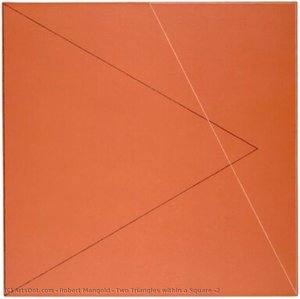 Two Triangles within a Square #21975
25
 Untitled1974
26
 A Triangle within Two Rectangles Violet1977
27
 Four Squares within a Circle1975
28
 Two Triangles within Three Rectangles1978
29
 + Within + (Red, Yellow, Orange)1981
30
 + Within + Painting1983
31
 Grey Irregular Area with a Drawn Ellipse (model)1986
32
 Series of Three1984
33
 Fragments I-VII1998
34
 Red/Gray Zone Painting1998
35
 Curled Figure Study XIX2002 · Whitney Museum of American Art
36
 Curled Figure XVIII (study)2002
37
 Fragment VIII2001
38
 Ring A (Yellow)2010
39
 X Within X Orange1981 · The Phillips Collection
40
 Pages #101989 · MOMA - Museum of Modern Art
41
 Circle In and Out of a Polygon 21973 · Solomon R. Guggenheim Museum
42
 Frieze Study I1994
43
 Untitled from Seven Aquatints
44
 Plane/Figure Series (Double Panel) FBonnefanten Museum
45
 Column Structure VIII2006
The four subjects that come back most often in these originals, each with its finest example.
The 7 museums that hold the most of the paintings on this page.
| Museum | City | Works by Robert Mangold | Paintings from this list |
|---|---|---|---|
 MOMA - Museum of Modern Art |
New York City | 4 | Untitled from Seven Aquatints, Untitled (from Skowhegan Suite), Green Column/Figure |
 Buffalo AKG Art Museum |
Buffalo | 2 | Study for "Attic Series VIII", Attic Series VIII |
 Art Institute of Chicago |
Chicago | 1 | Untitled |
 Whitney Museum of American Art |
New York | 1 | Curled Figure Study XIX |
 The Phillips Collection |
Washington, D.C. | 1 | X Within X Orange |
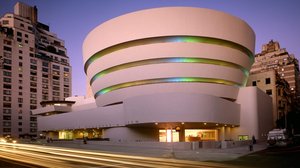 Solomon R. Guggenheim Museum |
New York | 1 | Circle In and Out of a Polygon 2 |
 Bonnefanten Museum |
Maastricht | 1 | Plane/Figure Series (Double Panel) F |
Pick a decade to see the original that defines it.
In this 1973 aquatint, we encounter a moment of profound stillness. Robert Mangold moves away from the heavy, gestural energy of his predecessors to find a different kind of power—one found in the precision of geometry and the subtle weight of color. The composition is centered on a large square, which is held within the embrace of a circle. This arrangement creates a sense of balance that feels both intentional…

Robert Mangold's "Green Column/Figure," created in 2003, isn’t merely a depiction of form; it’s an invitation to contemplate the relationship between structure and movement, stillness and energy. This deceptively simple work, rendered with graphite or charcoal on paper – likely a print – possesses a profound quietude that belies its underlying dynamism. The piece immediately draws the eye to the stark verticality of the muted green column, a grounding element…

Study for "Attic Series VIII" (1990), Buffalo AKG Art Museum, Buffalo. Attic Series VIII (1990) and Untitled from Seven Aquatints (1973) come next.
53 years old: Study for "Attic Series VIII" dates from 1990, and Robert Mangold was born in 1937.
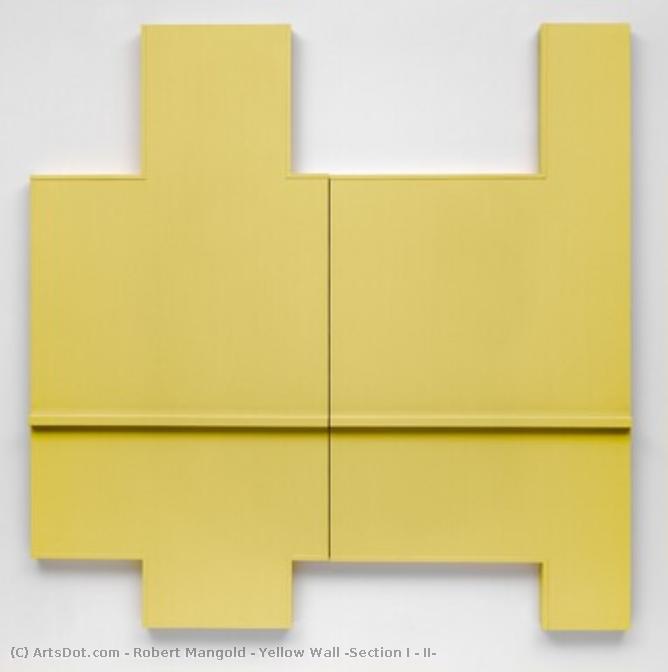
Study for "Attic Series VIII", Attic Series VIII, Untitled from Seven Aquatints, Untitled (from Skowhegan Suite), Green Column/Figure, Untitled, Window Wall Yellow and Tan Sketch, Light - Neutral Area, Yellow Wall (Section I + II) and 1/2 X Series (Medium Scale). The ranking above gives each one's year and museum.
Our catalog holds 47 works by Robert Mangold, dated from 1964 to 2010.
Mostly in MOMA - Museum of Modern Art (New York City), Buffalo AKG Art Museum (Buffalo) and Art Institute of Chicago (Chicago). The museum table above lists them all.
In 1970s: 17 of the 45 works on this page were made then, Untitled from Seven Aquatints among them.
On this page, the earliest is Window Wall Yellow and Tan Sketch (1964) and the latest Ring A (Yellow) (2010).
Geometric abstraction (3), Geometric shapes (2) and Abstract form (2), across the 45 works on this page.
Acrylic On Canvas, for 3 of the 45 works on this page.
Minimalism, judging by the originals on this page.
Untitled from Seven Aquatints, Untitled (from Skowhegan Suite) and Green Column/Figure: the MOMA - Museum of Modern Art, New York City holds 4 of the works on this page.

