Portrait of Paul André

Paul André Paintings: The 48 Most Famous, Through a Gallery's Eye

Updated October 2026 · ranked by our popularity score (searches, visits and orders for each work) · 49 works by Paul André in our catalogue

In short

To the gallery's eye, Paul André's most famous painting is Cedar Piece (1964). Equivalent VIII (1966) and Magnesium-Zinc Plain (1969) complete the trio every eye recognises. Of the 49 works by Paul André in our catalog, the gallery presents the 48 most famous below, each original with its year, its museum and what makes it unique.

1933 – 1983, Montreal Minimalism Most works: THAT'S CONTEMPORARY

The gallery's top 10 Paul André paintings

1
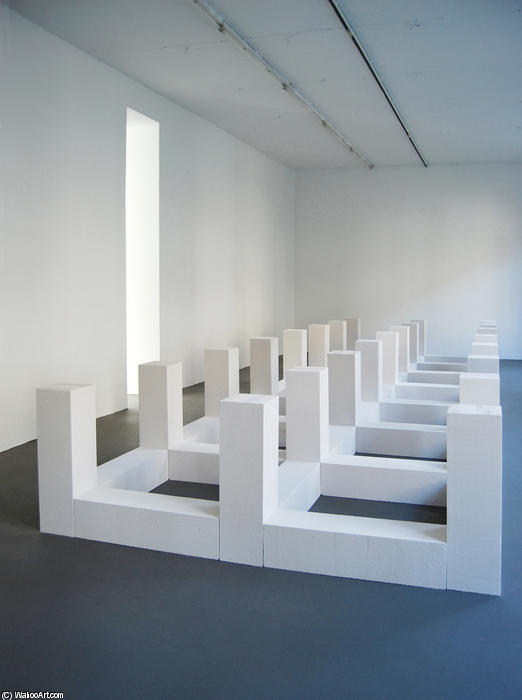
Cedar Piece (1964) by Paul André

Cedar Piece

1964

Introduction to Carl Andre and Minimalism Carl Andre, an American minimalist artist, is renowned for his ordered linear format and grid format sculptures. His works often challenge traditional notions of art by using everyday materials in new ways. One such work is 'Cedar Piece' (1959), a prime example of the Minimalism movement. Minimalism, also known as ABSTRACT EXPRESSIONISM, emerged in the 1960s as a reaction to the Abstract Expressionism and…

2
Equivalent VIII (1966) by Paul André

Equivalent VIII

1966

Introduction to Neo-Minimalism and Carl Andre Neo-Minimalism is a contemporary art movement that emerged in the late 20th century as an evolution of minimalism, which itself began in the 1960s. Minimalism was characterized by geometric forms and industrial materials, while Neo-Minimalism incorporates new elements such as technology and sustainability. One of the most influential artists in this movement is Carl Andre (Carl Andre's page on AllPaintingsStore), an American sculptor known…

Paul André paintings, ranked 11 to 48

Paul André's famous paintings, period by period

The subjects that held Paul André's eye

The four subjects that come back most often in these originals, each with its finest example.

The museums that keep Paul André's originals

The museum that holds the most of the paintings on this page.

Museum City Works by Paul André Paintings from this list
THAT'S CONTEMPORARY, MilanTHAT'S CONTEMPORARY Milan 9 w, w i a t t i, secret his

Paul André, one signature painting per decade

Works per decade

Pick a decade to see the original that defines it.

Paul André's paintings: the gallery answers

Which Paul André painting is the most famous of all?Reveal the answer

Cedar Piece (1964). Equivalent VIII (1966) and Magnesium-Zinc Plain (1969) come next.

How old was Paul André on completing Cedar Piece?Reveal the answer

31 years old: Cedar Piece dates from 1964, and Paul André was born in 1933.

Which are Paul André's top 10 paintings?Reveal the answer

Cedar Piece, Equivalent VIII, Magnesium-Zinc Plain, Passport, w, w i a t t i, secret his, hydrogenheliumlithiumberyliumboroncarbon, Spill (Scatter Piece) and ddddddddddddddddfffffffffffffffffffffffff. The ranking above gives each one's year and museum.

How many works did Paul André create?Reveal the answer

Our catalog holds 49 works by Paul André, dated from 1959 to 1983.

Where do Paul André's most famous originals hang?Reveal the answer

Mostly in THAT'S CONTEMPORARY (Milan). The museum table above lists them all.

When did Paul André create the most famous paintings?Reveal the answer

In 1960s: 16 of the 48 works on this page were made then, Cedar Piece among them.

Which are Paul André's earliest and latest famous works?Reveal the answer

On this page, the earliest is w (1959) and the latest Personal Structures (1983).

Which subjects did Paul André return to most?Reveal the answer

Geometric (3), Contemporary art (3) and Geometric form (3), across the 48 works on this page.

Which movement is Paul André associated with?Reveal the answer

Minimalism, judging by the originals on this page.

Which Paul André originals does the THAT'S CONTEMPORARY hold?Reveal the answer

w, w i a t t i and secret his: the THAT'S CONTEMPORARY, Milan holds 9 of the works on this page.

Paul André: the artist

Carl Andre: A Biography

  • Born: Quincy, Massachusetts (1935)
  • Died: January 24, 2024, New York City
  • Nationality: American

Early Life and Education

  • Carl Andre was born in Quincy, Massachusetts, on September 16, 1935. His father was a master designer of freshwater plumbing for ships.
  • He attended the Quincy public school system and later Phillips Academy in Andover, Massachusetts (1951-1953).
  • During his time at Phillips Academy, he formed a significant friendship with Hollis Frampton, who profoundly influenced Andre's artistic trajectory through discussions about art and introductions to other artists.
  • Andre served in the U.S. Army in North Carolina from 1955 to 1956.
  • He moved to New York City in 1956, where Frampton introduced him to Constantin Brâncuși and Frank Stella, leading to a shared studio space with Stella from 1958 to 1960.

Artistic Development and Minimalism

  • Early Influences: Andre's early work in wood was initially inspired by Brâncuși. Conversations with Frank Stella regarding space and form shifted his artistic direction.
  • "Cut" Sculptures: While sharing a studio with Stella, Andre developed a series of wooden "cut" sculptures like *Radial Arm Saw Cut Sculpture* (1959) and *Maple Spindle Exercise* (1959). Stella famously remarked that the removed pieces were also sculpture.
  • Blue-Collar Experience: From 1960 to 1964, Andre worked as a freight brakeman and conductor for the Pennsylvania Railroad in New Jersey. This experience with manual labor and the ordered nature of rail work significantly influenced his later sculptures and personal style (often dressing in overalls).
  • Poetry and Writing: A period between 1960 and 1965 saw Andre focus primarily on writing, culminating in *12 Dialogues* (published 1980), a collaborative book of poetry and essays with Hollis Frampton.
  • Emergence as a Minimalist: In 1965, he had his first public exhibition at the Tibor de Nagy Gallery. Andre's work became associated with Minimalism, characterized by its emphasis on industrial materials, geometric forms, and spatial relationships. His controversial "Lever" was included in the seminal 1966 show *Primary Structures* at the Jewish Museum.

Major Works and Controversies

  • Notable Sculptures: Andre is recognized for works like *144 Lead Square* (1969), *Twenty-Fifth Steel Cardinal* (1974), *Stone Field Sculpture* (1977, Hartford, CT), and *Lament for the Children* (1976, Long Island City, NY).
  • "Bricks Controversy": In 1972, Britain's Tate Gallery acquired *Equivalent VIII*, an arrangement of firebricks. The piece gained notoriety in 1976 when it was defaced with blue food dye after being featured in the Sunday Times, sparking a major public debate about contemporary art and its accessibility.
  • Representation: Andre was represented by Paula Cooper Gallery (New York), Konrad Fischer Galerie (Düsseldorf & Berlin), Sadie Coles HQ (London), and Yvon Lambert Gallery (Paris).

Personal Life and Legacy

  • Relationship with Ana Mendieta: Andre met artist Ana Mendieta in 1979. They married in 1985, but their relationship ended tragically when Mendieta died after falling from the balcony of Andre's apartment in 1985.
  • Legal Proceedings: Andre was charged with second-degree murder in connection with Mendieta’s death but was acquitted in a bench trial in 1988, a verdict that generated considerable controversy within the art world.
  • Critical Reception: The evolution of critical understanding of Carl Andre's work is documented in *About Carl Andre: Critical Texts Since 1965*, which compiles essays and reviews by influential art historians and critics like Clement Greenberg, Donald Kuspit, Lucy R. Lippard, Robert C. Morgan, Barbara Rose, and Roberta Smith.
  • Death: Carl Andre died on January 24, 2024, in New York City at the age of 88.