Portrait of Louise Moillon

The 25 Most Famous Louise Moillon Paintings, a Gallery Selection

Updated November 2026 · ranked by our popularity score (searches, visits and orders for each work) · 28 works by Louise Moillon in our catalogue

In short

Of all the originals Louise Moillon left, the most famous is Still Life with a Basket of Fruit and a Bunch of Asparagus (1630), in the collection of the Art Institute of Chicago, Chicago. Close behind it come Basket of Apricots (1634) and Dish with plums and grapefruit (1632). Our catalog holds 28 works by Louise Moillon; the gallery has kept the 25 the world admires most, each shown with its date, its museum and its story.

1610 – 1696, Paris Baroque Most works: The Louvre

Louise Moillon's top 10 paintings: the gallery's choice

1
Still Life with a Basket of Fruit and a Bunch of Asparagus (1630) by Louise Moillon

Still Life with a Basket of Fruit and a Bunch of Asparagus

1630 · Oil · Art Institute of Chicago, Chicago

In the quietude of Still Life with a Basket of Fruit and a Bunch of Asparagus, we encounter a moment of profound stillness that transcends the mere depiction of objects. Created circa 1630, this masterpiece by Louise Moillon invites the viewer into a sensory experience where the textures of the natural world are rendered with breathtaking precision. The composition centers upon a wicker basket, its woven structure providing a rustic…

2
Basket of Apricots (1634) by Louise Moillon

Basket of Apricots

1634 · Oil On Canvas · The Louvre, Paris

To gaze upon Louise Moillon’s Basket of Apricots is to step directly into the quiet, sun-dappled intimacy of a French kitchen in the early seventeenth century. This exquisite still life, painted in 1634, transcends a mere depiction of fruit; it is a meditation on abundance, transience, and the profound beauty found in the everyday bounty of nature. Moillon, working during the vibrant yet turbulent Baroque period, captured not just apricots,…

3
Dish with plums and grapefruit (1632) by Louise Moillon

Dish with plums and grapefruit

1632 · Oil On Canvas · Musée Des Beaux, Strasbourg

In this quiet composition titled Dish with plums and grapefruit, we encounter the precise hand of Louise Moillon. Painted in 1632, the work offers a focused study of fruit arranged upon a glass dish. The subject matter is presented with a stillness that invites a closer, more intimate inspection of the natural forms before us.

4
Still Life with Bowl of Curacao Oranges (1634) by Louise Moillon

Still Life with Bowl of Curacao Oranges

1634 · Oil On Canvas · Norton Simon Museum, Pasadena

Still Life with Bowl of Curacao Oranges is an oil on canvas painting by the artist Louise Moillon. This work is dated 1634. The composition focuses on a centered arrangement of citrus fruits, specifically Curaçao oranges and citrons, which are placed within a decorative ceramic bowl. The subject matter is presented against a dark, near-black background that provides a sharp contrast to the fruit and the vessel.

5
Still Life with a Bowl of Strawberries, Basket of Cherries, and Branch of Gooseberries (1631) by Louise Moillon

Still Life with a Bowl of Strawberries, Basket of Cherries, and Branch of Gooseberries

1631 · Oil · Kimbell Art Museum, Fort Worth

This 1631 still life painting presents a detailed arrangement of summer fruits set against a dark, atmospheric background. The composition rests upon a neutral-toned ledge, featuring three distinct groupings. On the left, a shallow ceramic plate overflows with strawberries, their surfaces marked by delicate seeds and soft white highlights. To the right, a woven wicker basket is filled with cherries, while a small sprig of gooseberries occupies the lower right…

6
Apricots in a ceramic bowl, with plums on a stone ledge (1631) by Louise Moillon

Apricots in a ceramic bowl, with plums on a stone ledge

1631 · Oil On Canvas

The light enters from the upper left, casting a soft glow across a scene of profound stillness. A scalloped white ceramic bowl sits at the heart of the arrangement, its smooth, reflective surface catching the light as it overflows with a bounty of apricots. These fruits, rendered in shades of peach, yellow, and rosy pink, appear heavy with juice, their skins possessing a delicate, velvety fuzz that invites the touch.…

7
Still-Life with a Basket of Fruit (1630) by Louise Moillon

Still-Life with a Basket of Fruit

1630 · Oil On Panel

Louise Moillon produced Still-Life with a Basket of Fruit in 1630. This oil on panel work belongs to the Baroque era, a period characterized by a focus on the meticulous observation of the natural world. The composition centers on a variety of fruits arranged within a basket placed upon a table.

8
Still-Life with Cherries, Strawberries and Gooseberries (1630) by Louise Moillon

Still-Life with Cherries, Strawberries and Gooseberries

1630 · Oil · Norton Simon Museum of Art, Pasadena

We are looking at Still-Life with Cherries, Strawberries and Gooseberries, a work by Louise Moillon. Created around 1630, this painting emerged from the artist's early period in Paris, France. Moillon was a significant figure in the French still life tradition during the Baroque era, a time when the genre began to find its own distinct voice away from the grander, more dramatic narratives of the period.

10
Still Life of Citrons and Curaçao Oranges in a White Polylobed Dish (1634) by Louise Moillon

Still Life of Citrons and Curaçao Oranges in a White Polylobed Dish

1634 · Oil On Canvas · Toledo Museum of Art, Toledo

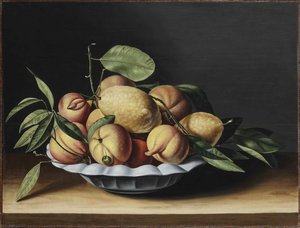
This exquisite still life, measuring 49 x 64 cm, offers a captivating glimpse into the world of Baroque art through the discerning eye of Louise Moillon. Painted in 1634, it’s a testament to her skill and the prevailing artistic trends of the era – a period defined by an intense focus on naturalism, meticulous detail, and a subtle yet profound exploration of symbolism.

The Louise Moillon selection continues, 11 to 25

Louise Moillon's famous paintings, period by period

The subjects that held Louise Moillon's eye

The four subjects that come back most often in these originals, each with its finest example.

The museums that keep Louise Moillon's originals

The 8 museums that hold the most of the paintings on this page.

Museum City Works by Louise Moillon Paintings from this list
The Louvre, ParisThe Louvre Paris 5 Basket of Apricots, The Fruit and Vegetable Costermonger, NATURE MORTE PECHES ET PRUNES
Musée des Augustins, ToulouseMusée des Augustins Toulouse 3 Nature morte aux abricots fruits, Corbeille de prunes et panier de fraises fruits, Still Life with Blackberries
National Museum of Women in the Arts, Washington, D.C.National Museum of Women in the Arts Washington, D.C. 2 Bowl of Lemons and Oranges on a Box of Wood Shavings and Pomegranates, Bowl of Lemons and Oranges on a Box of Wood Shavings and Pomegranates
Art Institute of Chicago, ChicagoArt Institute of Chicago Chicago 1 Still Life with a Basket of Fruit and a Bunch of Asparagus
Musée Des Beaux, StrasbourgMusée Des Beaux Strasbourg 1 Dish with plums and grapefruit
Norton Simon Museum, PasadenaNorton Simon Museum Pasadena 1 Still Life with Bowl of Curacao Oranges
Kimbell Art Museum, Fort WorthKimbell Art Museum Fort Worth 1 Still Life with a Bowl of Strawberries, Basket of Cherries, and Branch of Gooseberries
Norton Simon Museum of Art, PasadenaNorton Simon Museum of Art Pasadena 1 Still-Life with Cherries, Strawberries and Gooseberries

Louise Moillon year by year: the originals that define each

Barely a decade, 1630 to 1637, gave the world every dated Louise Moillon original in this selection: here it is, year by year.

Works per year

Pick a year to see its originals.

Collectors' questions about Louise Moillon's paintings

Which work is Louise Moillon most famous for?Reveal the answer

Still Life with a Basket of Fruit and a Bunch of Asparagus (1630), Art Institute of Chicago, Chicago. Basket of Apricots (1634) and Dish with plums and grapefruit (1632) come next.

What age was Louise Moillon when Still Life with a Basket of Fruit and a Bunch of Asparagus was made?Reveal the answer

20 years old: Still Life with a Basket of Fruit and a Bunch of Asparagus dates from 1630, and Louise Moillon was born in 1610.

What are the ten most famous Louise Moillon paintings?Reveal the answer

Still Life with a Basket of Fruit and a Bunch of Asparagus, Basket of Apricots, Dish with plums and grapefruit, Still Life with Bowl of Curacao Oranges, Still Life with a Bowl of Strawberries, Basket of Cherries, and Branch of Gooseberries, Apricots in a ceramic bowl, with plums on a stone ledge, Still-Life with a Basket of Fruit, Still-Life with Cherries, Strawberries and Gooseberries, Basket with Peaches and Grapes and Still Life of Citrons and Curaçao Oranges in a White Polylobed Dish. The ranking above gives each one's year and museum.

How many paintings did Louise Moillon leave?Reveal the answer

Our catalog holds 28 works by Louise Moillon, dated from 1630 to 1637.

In which museums do Louise Moillon's masterpieces hang?Reveal the answer

Mostly in The Louvre (Paris), Musée des Augustins (Toulouse) and National Museum of Women in the Arts (Washington, D.C.). The museum table above lists them all.

In which years did Louise Moillon paint the most famous works?Reveal the answer

In 1631: 4 of the 25 works on this page were made then, Still Life with a Bowl of Strawberries, Basket of Cherries, and Branch of Gooseberries among them.

What are the first and the last famous originals of Louise Moillon?Reveal the answer

On this page, the earliest is Still Life with a Basket of Fruit and a Bunch of Asparagus (1630) and the latest Still Life with Fruit (1637).

Which subjects did Louise Moillon choose most often?Reveal the answer

Fruit (9), Plums (5) and Oranges (5), across the 25 works on this page.

Which technique did Louise Moillon use most?Reveal the answer

Oil On Canvas, for 9 of the 25 works on this page.

To which art movement does Louise Moillon belong?Reveal the answer

Baroque and Baroque still life, judging by the originals on this page.

Which Louise Moillon works hang at the The Louvre?Reveal the answer

Basket of Apricots, The Fruit and Vegetable Costermonger and NATURE MORTE PECHES ET PRUNES: the The Louvre, Paris holds 5 of the works on this page.

Louise Moillon: life and work

The Quiet Brilliance of Louise Moillon

In the grand, sweeping narratives of the Baroque era, where drama and movement often dominate the canvas, the work of Louise Moillon offers a profound and meditative alternative. Born in Paris in 1610, Moillon emerged from a world shaped by the intense religious and cultural shifts of 17th-century France. Her very lineage tells a story of resilience and artistic heritage; as a descendant of Huguenot refugees from Holland, she was immersed in a tradition that valued the meticulous observation of the natural world. This background provided more than just a family history—it offered a stylistic vocabulary rooted in the Dutch mastery of light, texture, and symbolic realism.

Moillon’s early life was marked by both loss and profound artistic mentorship. The death of her father, the landscape painter and dealer Nicolas Moillon, when she was only ten, could have altered her path, yet her upbringing remained deeply embedded in the arts. Under the guidance of her stepfather, François Garnier, a skilled artist and dealer, she refined a technique that would become her hallmark. Her education was not merely about the application of pigment to canvas, but an immersion into the humanist values of her time, learning to see the divine within the minute details of a ripening fruit or the delicate curve of a petal.

A Mastery of Texture and Light

The true genius of Moillon lies in her ability to transform the mundane into the extraordinary. Her compositions are characterized by a serene stillness, a quietude that invites the viewer to linger and observe. She possessed an almost supernatural ability to capture the tactile qualities of her subjects—the waxy skin of a citron, the soft fuzz of a peach, or the translucent juice of a crushed berry. In works such as Still Life of Citrons and Curaçao Oranges in a White Polylobed Dish, one can sense the cool moisture of the fruit against the hard, glazed surface of the porcelain, creating a sensory experience that transcends the two-dimensional plane.

Her technique was deeply influenced by the naturalistic traditions of the Protestant circles in which she moved. This approach favored clarity and precision over the theatrical shadows of the more flamboyant Baroque masters. Instead, Moillon utilized light to sculpt her subjects, using subtle gradations of tone to create volume and depth. Her palette, while often focused on the vibrant hues of nature, was used with such restraint that each color felt luminous, as if lit from within. This mastery allowed her to bridge the gap between mere botanical illustration and high art, imbuing every piece with a sense of life and vitality.

Legacy and Historical Significance

Throughout her long life, which spanned nearly nine decades, Moillon achieved a level of renown that was rare for female artists of her era. Her ability to secure commissions from prestigious patrons, including members of the royal court, speaks to the undeniable quality and sophistication of her oeuvre. While her work often focused on the intimate scale of still life, its impact was expansive, contributing significantly to the development of the French still-life tradition.

The historical significance of Louise Moillon extends beyond her technical skill; she represents a vital link between the Dutch naturalistic tradition and the burgeoning French aesthetic of the 17th century. Her paintings serve as windows into a lost world of Parisian markets and private gardens, capturing a sense of abundance and ephemeral beauty. Today, her works remain cherished treasures in institutions such as the Louvre, standing as enduring testaments to a life dedicated to finding the extraordinary within the ordinary. Her legacy is found in every brushstroke that celebrates the quiet, breathtaking splendor of the natural world.