Portrait of John Piper

The 75 Most Famous John Piper Paintings, a Gallery Selection

Updated November 2026 · ranked by our popularity score (searches, visits and orders for each work) · 80 works by John Piper in our catalogue

In short

Of all the originals John Piper left, the most famous is Cheltenham, Montpellier Walk (1949), in the collection of the Government Art Collection, London. Close behind it come Shelter Experiments, near Woburn, Bedfordshire (1943) and Entrance to Fonthill (1940). Our catalog holds 80 works by John Piper; the gallery has kept the 75 the world admires most, each shown with its date, its museum and its story.

1903 – 1992, Epsom Most works: Government Art Collection

John Piper's top 10 paintings: the gallery's choice

1
Cheltenham, Montpellier Walk (1949) by John Piper

Cheltenham, Montpellier Walk

1949 · Oil On Canvas · Government Art Collection, London

The artwork titled Cheltenham, Montpellier Walk is a painting by the artist John Piper. Created about 1949, this work focuses on the subject of British cityscape and architecture. The composition centers on the architectural elements found within the Montpellier Walk area of Cheltenham, United Kingdom.

2
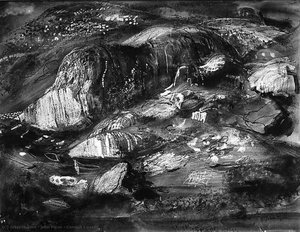
Shelter Experiments, near Woburn, Bedfordshire (1943) by John Piper

Shelter Experiments, near Woburn, Bedfordshire

1943 · Drawing · Imperial War Museums, London

In the hauntingly evocative drawing Shelter Experiments, near Woburn, Bedfordshire, we are transported back to the heavy, uncertain atmosphere of 1943. Created during the height of the Second World War, this piece serves as a profound visual diary of a nation under duress. The composition is dominated by large, imposing stones or pillars in the foreground, which stand like silent sentinels against an encroaching gloom. These structures, likely part of…

3
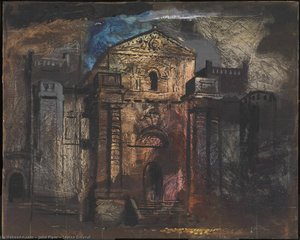
Entrance to Fonthill (1940) by John Piper

Entrance to Fonthill

1940 · Oil On Canvas · The Hepworth Wakefield, Wakefield

Entrance to Fonthill: A Fragmented Vision of Antiquity John Piper’s “Entrance to Fonthill,” completed in 1940, isn't merely a depiction of an architectural ruin; it’s a profound meditation on memory, time, and the crumbling grandeur of civilization. Inspired by William Beckford’s ambitious Fonthill Abbey—a project that epitomized the Romantic fascination with reviving classical ideals—Piper abandons representational accuracy for a powerfully expressive abstraction. The painting captures the essence of the abbey's…

7
The Cottage by Frith Wood, Hampshire (1941) by John Piper

The Cottage by Frith Wood, Hampshire

1941 · Oil On Canvas · Government Art Collection, London

John Piper’s depiction of The Cottage by Frith Wood, Hampshire is more than just a painting; it is an immersion into the very soul of the British landscape. Executed in 1941, this oil on canvas captures a moment suspended in time—a quiet tableau against the backdrop of rural English life. The composition immediately draws the eye to the central dwelling, its white exterior contrasting beautifully with the deep, earthy tones…

8
Composition (1937) by John Piper

Composition

1937 · Oil On Canvas · The Ashmolean Museum of Art And Archaeology, Oxford

The canvas vibrates with a quiet, geometric tension, as if the very bones of the English countryside have been stripped of their skin and rearranged. In this 1937 oil painting, the world does not appear as a collection of trees or stones, but as a rhythmic dance of intersecting planes. Angular rectangles overlap and recede, creating a sense of depth that defies traditional perspective. There is a stillness here, yet…

9
The Tea House at Frogmore (1941) by John Piper

The Tea House at Frogmore

1941 · Oil On Canvas · Royal Collection, London

John Piper’s depiction of The Tea House at Frogmore transports the viewer into a sun-dappled moment of quintessential English repose. This painting is more than just a record of an outing; it is an immersion into a carefully curated atmosphere of community and gentle leisure. One can almost hear the murmur of conversation drifting from beneath those vibrant red roofs, and feel the warmth emanating from the gathering figures. The…

10
Redland Park Congregational Church, Bristol (1940) by John Piper

Redland Park Congregational Church, Bristol

1940 · Oil · Pallant House Gallery, Chichester

The painting depicts the Redland Park Congregational Church in Bristol, rendered in a style that emphasizes the structural weight of the building. The church is constructed from red brick, which provides a warm, earthy base for the composition. A large clock tower rises in the background, its verticality drawing the eye upward toward the sky. On the side of the building, a large stained glass window is visible, flanked by…

The John Piper selection continues, 11 to 75

11Welsh Landscape (1950) by John PiperWelsh Landscape1950 · Wolverhampton Art Gallery 12Coast (1933) by John PiperCoast1933 13Painting (1935) by John PiperPainting1935 14Coast of Pembroke (1938) by John PiperCoast of Pembroke1938 15Black Ground (Screen for the Sea) (1938) by John PiperBlack Ground (Screen for the Sea)1938 16Abstract I (1935) by John PiperAbstract I1935 17String Solo (1934) by John PiperString Solo1934 · River - Rowing Museum 18Abstract Construction (1934) by John PiperAbstract Construction1934 · The Whitworth 19Town from Water Meadows (1938) by John PiperTown from Water Meadows1938 · Laing Art Gallery 20Abstract Composition (1935) by John PiperAbstract Composition1935 · Reading Museum - Town Hall 21Abstract II (1935) by John PiperAbstract II1935 · Arts Council Collection 22Derelict Cottage, Llanthony (1941) by John PiperDerelict Cottage, Llanthony1941 · Leeds Art Gallery 23Beach and Star Fish, Seven Sisters Cliff, Eastbourne (1934) by John PiperBeach and Star Fish, Seven Sisters Cliff, Eastbourne1934 · Jerwood Gallery 24Collage, still life with black head (1933) by John PiperCollage, still life with black head1933 · Te Papa 25Somerset Place, Bath (1942) by John PiperSomerset Place, Bath1942 26Lacock Abbey from the West (1942) by John PiperLacock Abbey from the West1942 27St Mary le Port, Bristol (1940) by John PiperSt Mary le Port, Bristol1940 28Seaton Delaval (1941) by John PiperSeaton Delaval1941 29The Passage to the Control Room at South West Regional Headquarters, Bristol (1940) by John PiperThe Passage to the Control Room at South West Regional Headquarters, Bristol1940 30Autumn at Stourhead (1939) by John PiperAutumn at Stourhead1939 31Coventry Cathedral, 15 November, 1940 (1940) by John PiperCoventry Cathedral, 15 November, 19401940 32Welsh Chapel, Solva, Pembroke (1939) by John PiperWelsh Chapel, Solva, Pembroke1939 · Llyfrgell Genedlaethol Cymru / The National Library of Wales 33Park Place, Henley on Thames, Oxfordshire (1941) by John PiperPark Place, Henley on Thames, Oxfordshire1941 34Ruined Cottage, Tomen y Mur, North Wales (1943) by John PiperRuined Cottage, Tomen y Mur, North Wales1943 35Seaton Delaval (1941) by John PiperSeaton Delaval1941 36Ruined Cottage, Llanthony (1940) by John PiperRuined Cottage, Llanthony1940 37St Mary le Port, Bristol (1940) by John PiperSt Mary le Port, Bristol1940 38Octagonal Church, Hartwell, Buckinghamshire (1939) by John PiperOctagonal Church, Hartwell, Buckinghamshire1939 · Usher Gallery 39Approach to Fonthill (1940) by John PiperApproach to Fonthill1940 · The Whitworth 40Barn at Lewknor, Oxfordshire (1940) by John PiperBarn at Lewknor, Oxfordshire1940 41The Ruined Council Chamber, House of Commons, May 1941 (1941) by John PiperThe Ruined Council Chamber, House of Commons, May 19411941 42Derelict Cottage, Deane, Hampshire (1940) by John PiperDerelict Cottage, Deane, Hampshire1940 · New Walk Museum - Art Gallery 43Church of the Holy Nativity, Knowle, near Bristol (1940) by John PiperChurch of the Holy Nativity, Knowle, near Bristol1940 · Bristol Museum - Art Gallery 44Weathercote Cave (1943) by John PiperWeathercote Cave1943 · Southwark Art Collection 45The Temple Church, Bristol (1940) by John PiperThe Temple Church, Bristol1940 · Bristol Museum - Art Gallery 46Christ Church, Newgate Street, London (1941) by John PiperChrist Church, Newgate Street, London1941 47The Control Room at South West Regional Headquarters, Bristol (1940) by John PiperThe Control Room at South West Regional Headquarters, Bristol1940 48Llanthony Abbey (1941) by John PiperLlanthony Abbey1941 · Llyfrgell Genedlaethol Cymru / The National Library of Wales 49Interior of Coventry Cathedral, 15 November 1940 (1940) by John PiperInterior of Coventry Cathedral, 15 November 19401940 · Herbert Art Gallery - Museum 50Rocky Valley, North Wales (1948) by John PiperRocky Valley, North Wales1948 51The Rise of the Dovey (1944) by John PiperThe Rise of the Dovey1944 52Yarnton Monument (1947) by John PiperYarnton Monument1947 53Stair Hole, Lulworth (1948) by John PiperStair Hole, Lulworth1948 54Castle Howard Temple and Mausoleum (1944) by John PiperCastle Howard Temple and Mausoleum1944 55Dorset Coast Chapman's Pool (1947) by John PiperDorset Coast Chapman's Pool1947 · British Council Collection 56Brighton, Regency Square (1949) by John PiperBrighton, Regency Square1949 · Government Art Collection 57Bath, Composite of Bath Street and Corner of Camden Crescent (1949) by John PiperBath, Composite of Bath Street and Corner of Camden Crescent1949 · Government Art Collection 58Portland Bill (1950) by John PiperPortland Bill1950 59Esnandes Vendee (1957) by John PiperEsnandes Vendee1957 60Radnage Church (1957) by John PiperRadnage Church1957 61The North Terrace and Winchester Tower, Windsor Castle (1941) by John PiperThe North Terrace and Winchester Tower, Windsor Castle1941 · Royal Collection 62Cheltenham, Composite of Houses in Priory Parade and Elsewhere (1949) by John PiperCheltenham, Composite of Houses in Priory Parade and Elsewhere1949 · Government Art Collection 63Covehithe Church (1983) by John PiperCovehithe Church1983 64Moorland Cottages (2004) by John PiperMoorland Cottages2004 · Penlee House Gallery - Museum 65Cornish Coast by John PiperCornish Coast 66Beach with Starfish by John PiperBeach with Starfish 67Sirenie by John PiperSirenie 68Coalport Shropshire by John PiperCoalport Shropshire 69Ruin, Dentdale, Yorkshire by John PiperRuin, Dentdale, Yorkshire 70Ca' d'Oro by John PiperCa' d'Oro 71Portland Foreshore by John PiperPortland Foreshore 72Rievaulx Abbey, North Yorkshire by John PiperRievaulx Abbey, North YorkshireTouchstones Rochdale 73Garn Fawr by John PiperGarn FawrRobinson College 74The Quay, Exeter (1944) by John PiperThe Quay, Exeter1944 · Royal Albert Memorial Museum - Art Gallery 75Mourreze by John PiperMourrezeClare College

John Piper's famous paintings, period by period

The subjects that held John Piper's eye

The four subjects that come back most often in these originals, each with its finest example.

The museums that keep John Piper's originals

The 8 museums that hold the most of the paintings on this page.

Museum City Works by John Piper Paintings from this list
Government Art Collection, LondonGovernment Art Collection London 6 Cheltenham, Montpellier Walk, Bath, Grosvenor Crescent, The Cottage by Frith Wood, Hampshire
Royal Collection, LondonRoyal Collection London 2 The Tea House at Frogmore, The North Terrace and Winchester Tower, Windsor Castle
The Whitworth, ManchesterThe Whitworth Manchester 2 Abstract Construction, Approach to Fonthill
Llyfrgell Genedlaethol Cymru / The National Library of Wales, AberystwythLlyfrgell Genedlaethol Cymru / The National Library of Wales Aberystwyth 2 Welsh Chapel, Solva, Pembroke, Llanthony Abbey
Bristol Museum - Art Gallery, BristolBristol Museum - Art Gallery Bristol 2 Church of the Holy Nativity, Knowle, near Bristol, The Temple Church, Bristol
Imperial War Museums, LondonImperial War Museums London 1 Shelter Experiments, near Woburn, Bedfordshire
The Hepworth Wakefield, WakefieldThe Hepworth Wakefield Wakefield 1 Entrance to Fonthill
The Ashmolean Museum of Art And Archaeology, OxfordThe Ashmolean Museum of Art And Archaeology Oxford 1 Composition

John Piper decade by decade: the original that defines each

Works per decade

Pick a decade to see the original that defines it.

Collectors' questions about John Piper's paintings

Which work is John Piper most famous for?Reveal the answer

Cheltenham, Montpellier Walk (1949), Government Art Collection, London. Shelter Experiments, near Woburn, Bedfordshire (1943) and Entrance to Fonthill (1940) come next.

What age was John Piper when Cheltenham, Montpellier Walk was made?Reveal the answer

46 years old: Cheltenham, Montpellier Walk dates from 1949, and John Piper was born in 1903.

What are the ten most famous John Piper paintings?Reveal the answer

Cheltenham, Montpellier Walk, Shelter Experiments, near Woburn, Bedfordshire, Entrance to Fonthill, A Ruined House, Hampton Gay, Oxfordshire, Portland, Bath, Grosvenor Crescent, The Cottage by Frith Wood, Hampshire, Composition, The Tea House at Frogmore and Redland Park Congregational Church, Bristol. The ranking above gives each one's year and museum.

How many paintings did John Piper leave?Reveal the answer

Our catalog holds 80 works by John Piper, dated from 1933 to 1983.

In which museums do John Piper's masterpieces hang?Reveal the answer

Mostly in Government Art Collection (London), Royal Collection (London) and The Whitworth (Manchester). The museum table above lists them all.

In which years did John Piper paint the most famous works?Reveal the answer

In 1940s: 42 of the 75 works on this page were made then, Cheltenham, Montpellier Walk among them.

What are the first and the last famous originals of John Piper?Reveal the answer

On this page, the earliest is Coast (1933) and the latest Covehithe Church (1983).

Which subjects did John Piper choose most often?Reveal the answer

Architecture (10), Landscape (7) and Coastal landscape (4), across the 75 works on this page.

Which technique did John Piper use most?Reveal the answer

Oil On Canvas, for 7 of the 75 works on this page.

Which John Piper works hang at the Government Art Collection?Reveal the answer

Cheltenham, Montpellier Walk, Bath, Grosvenor Crescent and The Cottage by Frith Wood, Hampshire: the Government Art Collection, London holds 6 of the works on this page.

John Piper: life and work

A Life Immersed in the British Landscape

John Egerton Christmas Piper, born in 1903 in the Surrey countryside near Epsom, was an artist whose life and work became inextricably linked to the spirit of Britain. From his earliest explorations as a child – sketching churches and monuments during bicycle rides through the rolling hills – a deep fascination with the nation’s architectural heritage and natural beauty took root. Though initially enrolled at Epsom College, Piper found its structured environment stifling, preferring instead the freedom of independent observation and artistic expression. His formal training began at Richmond School of Art, followed by a brief period at the Royal College of Art in London, which he left before completing his studies, perhaps sensing that conventional academic routes wouldn’t fully accommodate his burgeoning vision. This early restlessness foreshadowed a career marked by stylistic evolution and an unwavering commitment to personal artistic exploration. Piper's beginnings were steeped in a family of solicitors, yet it was the visual world, not the legal one, that truly captured his imagination.

From Abstraction to a Distinctive British Vision

Piper’s artistic journey began with experimentation in abstraction, influenced by the burgeoning modernist movements of the 1930s and connections forged through groups like the Seven and Five Society. However, he soon embarked on a path that would define his unique contribution to British art: a return to representational painting infused with an intensely personal sensibility. He didn’t simply depict what he saw; he interpreted it through a lens of Romanticism, imbuing landscapes, churches, and ruins with a palpable sense of history, atmosphere, and often, melancholy. His paintings are characterized by expressive brushwork, bold color palettes, and a keen eye for the textures and forms that reveal the essence of his subjects. This wasn’t merely topographical painting; it was an emotional response to place. Piper's versatility extended beyond paint, encompassing tapestry designs, book jackets, screen-prints, photography, fabrics, and ceramics – demonstrating a restless creative energy and a desire to explore diverse artistic mediums. He collaborated extensively with other artists, poets like John Betjeman and Geoffrey Grigson on the celebrated Shell Guides, and craftsmen such as potter Geoffrey Eastop and artist Ben Nicholson, enriching his own work through these cross-disciplinary exchanges.

Wartime Witness: Coventry Cathedral and National Trauma

The outbreak of World War II proved to be a pivotal moment in Piper’s career. Appointed an official war artist, he turned his attention to documenting the devastating impact of bombing raids on Britain's historic buildings. His depictions of bomb-damaged churches, most notably those of Coventry Cathedral following its destruction in 1940, resonated deeply with a nation grappling with loss and resilience. These weren’t detached observations; they were visceral portrayals of trauma, rendered with an urgency and emotional intensity that captured the collective grief of a country at war. The images became iconic symbols of national suffering but also of enduring spirit. Piper's work transcended mere documentation; it served as a powerful testament to the fragility of civilization and the importance of preserving cultural heritage in the face of destruction. His subsequent designs for the stained-glass windows of the rebuilt Coventry Cathedral, unveiled in 1962, were not simply replacements but transformative works that infused the new structure with a sense of hope and renewal.

Legacy and Enduring Influence

John Piper’s contribution to British art extends far beyond his wartime depictions. His lifelong exploration of the British landscape – its churches, ruins, coastal scenes, and rolling hills – helped redefine perceptions of landscape painting and fostered a renewed appreciation for Britain's architectural heritage. He wasn’t simply recording what existed; he was interpreting it through a uniquely personal vision, imbuing it with layers of meaning and emotion. His later years saw him produce numerous limited-edition prints, making his work accessible to a wider audience. Recognized as one of the most important British artists of the 20th century, Piper received the honor of being appointed a Companion of Honour (CH) in 1978, acknowledging his significant contributions to art and culture. Today, his works are held in numerous public collections, including Tate Britain and regional museums across the UK, ensuring that his evocative vision continues to inspire and captivate generations to come. Piper’s legacy lies not only in the beauty of his paintings but also in his ability to capture the essence of a nation – its history, its spirit, and its enduring connection to the land.