Abstract Expressionism · 1935
Abstract Composition (John Piper, 1935)
John Piper (1903–1992) made Abstract Composition. It dates from 1935. It belongs to the Abstract Expressionism movement. It is kept at Reading Museum - Town Hall in Reading, United Kingdom. It measures 59 × 74 cm.
- 1935
- 59 × 74 cm
- Reading Museum - Town Hall

 Preview

 Hand Made Oil Painting
 Send
 Share
 Fact sheet


 Download
 Similars
 X-Ray
 Diaporama
 Q&A

 Stats
Abstract Composition, in brief
- Title
- Abstract Composition
- Artist
- John Piper (1903–1992)
- Artist born in
- Epsom, United Kingdom
- Date
- 1935
- Dimensions
- 59 × 74 cm
- Where to see it
- Reading Museum - Town Hall, Reading, United Kingdom
- Movement
- Abstract Expressionism
- Subject
- abstract, geometric, color blocks, modern art, composition, dynamic
Which museum holds Abstract Composition?
Reading Museum - Town Hall
Reading, United Kingdom
A Tapestry of Time: The Architectural Grandeur of Reading Museum Nestled within the stately, Italianate splendor of the Reading Town Hall, the Reading Museum serves as a profound testament to the enduring spirit of Berkshire’s heritage. To step through its doors is to enter a world where Victorian grandeur meets the pulse of modern discovery. The building itself, a masterpiece of architectural evolution, was shaped by the legendary Alfred Waterhouse, whose vision for the principal facade in 1875 bestowed upon the structure a sense of permanence and civic pride.


High-resolution images of Abstract Composition
Protected by copyright: these files are for personal reference, not a licence to republish.
John Piper, Abstract Composition (1935), Reading Museum - Town Hall.
Questions on Abstract Composition, answered
Where is "Abstract Composition" by John Piper on display today?
"Abstract Composition" by John Piper is on display at the Reading Museum - Town Hall, Reading, United Kingdom. The museum listing refers to the original work, not to reproductions.
In what year was "Abstract Composition" by John Piper created?
"Abstract Composition" by John Piper was created in 1935.
How big is the original "Abstract Composition"?
The recorded dimensions of "Abstract Composition" by John Piper are 59 x 74 cm. Reproductions can be ordered in other sizes while keeping the same proportions.
What is "Abstract Composition" about?
"Abstract Composition" by John Piper depicts: abstract, geometric, color blocks, modern art, composition, dynamic, layered, british art.
Is "Abstract Composition" by John Piper in the public domain?
"Abstract Composition" by John Piper is still protected by copyright. This status governs how the image of the work may be reproduced.
Who created "Abstract Composition"?
"Abstract Composition" was created by John Piper. The information on this page describes John Piper's original work.
What art movement does "Abstract Composition" by John Piper belong to?
"Abstract Composition" by John Piper belongs to the Abstract Expressionism movement. This movement provides the stylistic context of the work.
What stage of John Piper's development does "Abstract Composition" represent?
Within John Piper's career, "Abstract Composition" falls in the Mature Period. The phase helps compare it with the artist's other works.
At what age did John Piper make "Abstract Composition"?
John Piper made "Abstract Composition" at the age of 32. The artist was born in 1903 and the work is dated 1935.
About the artist, John Piper

1903–1992, United Kingdom
John Piper
A Life Immersed in the British LandscapeJohn Egerton Christmas Piper, born in 1903 in the Surrey countryside near Epsom, was an artist whose life and work became inextricably linked to the spirit of Britain. From his earliest explorations as a child – sketching churches and monuments during bicycle rides through the rolling hills – a deep fascination with the nation’s architectural heritage and natural beauty took root. Though initially enrolled at Epsom College, Piper found its structured environment stifling, preferring instead the freedom of independent observation and artistic expression. His formal training began at Richmond School of Art, followed by a brief period at the Royal College of Art in London, which he left before completing his studies, perhaps sensing that conventional academic routes wouldn’t fully accommodate his burgeoning vision.
Also by John Piper
 Cheltenham, Montpellier Walk1949
 Shelter Experiments, near Woburn, Bedfordshire1943
 Entrance to Fonthill1940
 A Ruined House, Hampton Gay, Oxfordshire1941
Essays around Abstract Composition
 Beyond the Brush: The Soul and Process of Contemporary Abstract ArtExplore the profound depths of contemporary abstract art. From Abstract Expressionism to gestural minimalism, discover how texture, color, …
 Abstract Expressionism vs. Pop Art: A Comparison of Two American MovementsCompare the visceral brushstrokes of Abstract Expressionism with the bold irony of Pop Art. Master the history of these two iconic movement…
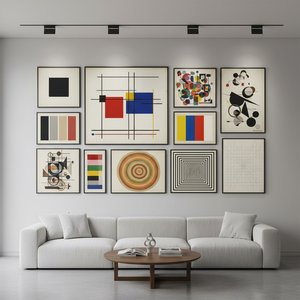 Geometric Abstraction's 10 Defining Masterpieces | Art for Your Home - OriginalUniqueArtExplore 10 defining masterpieces of Geometric Abstraction! Discover Kandinsky, Mondrian & Malevich’s iconic works. Find museum-quality art …