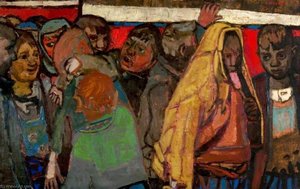
Portrait of Joan Eardley

The 45 Most Famous Joan Eardley Paintings, a Gallery Selection

Updated November 2026 · ranked by our popularity score (searches, visits and orders for each work) · 45 works by Joan Eardley in our catalogue

In short

Of all the originals Joan Eardley left, the most famous is Salmon Nets on the Shore. Close behind it come Rowan Tree and Catterline in Winter (1961). Our catalog holds 45 works by Joan Eardley; the gallery has kept the 45 the world admires most, each shown with its date, its museum and its story.

1921 – 1963, Warnham Impressionism Most works: The Fleming Collection

Joan Eardley's top 10 paintings: the gallery's choice

The Joan Eardley selection continues, 11 to 45

The subjects that held Joan Eardley's eye

The four subjects that come back most often in these originals, each with its finest example.

The museums that keep Joan Eardley's originals

The 5 museums that hold the most of the paintings on this page.

Museum City Works by Joan Eardley Paintings from this list
The Fleming Collection, LondonThe Fleming Collection London 3 Winter Sea III, Wild Sea, Field of Barley by the Sea
Herbert Art Gallery - Museum, CoventryHerbert Art Gallery - Museum Coventry 2 Glasgow Boy with a Milk Bottle, Archie Lafferty, Aged 6
The National Trust For Scotland, MayboleThe National Trust For Scotland Maybole 2 Village, Evening, Catterline, Summer Landscape, Catterline
Government Art Collection, LondonGovernment Art Collection London 2 A Carter and His Horse, Boy's Head
Reading Museum - Town Hall, ReadingReading Museum - Town Hall Reading 1 Coastline at Catterline, Stonehaven, Kincardineshire

Joan Eardley decade by decade: the original that defines each

Works per decade

Pick a decade to see the original that defines it.

Collectors' questions about Joan Eardley's paintings

Which work is Joan Eardley most famous for?Reveal the answer

Salmon Nets on the Shore. Rowan Tree and Catterline in Winter (1961) come next.

What are the ten most famous Joan Eardley paintings?Reveal the answer

Salmon Nets on the Shore, Rowan Tree, Catterline in Winter, Catterline, Breaking Wave, Little Girl with a Squint, Joan Eardley (1921–1963), Artist, Cornfields, September, Glasgow Boy with a Milk Bottle and Seascape. The ranking above gives each one's year and museum.

How many paintings did Joan Eardley leave?Reveal the answer

Our catalog holds 45 works by Joan Eardley, dated from 1943 to 1963.

In which museums do Joan Eardley's masterpieces hang?Reveal the answer

Mostly in The Fleming Collection (London), Herbert Art Gallery - Museum (Coventry) and The National Trust For Scotland (Maybole). The museum table above lists them all.

In which years did Joan Eardley paint the most famous works?Reveal the answer

In 1950s: 8 of the 45 works on this page were made then, Seascape among them.

What are the first and the last famous originals of Joan Eardley?Reveal the answer

On this page, the earliest is Joan Eardley (1921–1963), Artist (1943) and the latest Setting Sun over Fields (1963).

Which subjects did Joan Eardley choose most often?Reveal the answer

Coastal landscape (2), Childhood (2) and Landscape (2), across the 45 works on this page.

Which technique did Joan Eardley use most?Reveal the answer

Acrylic On Canvas, for 2 of the 45 works on this page.

To which art movement does Joan Eardley belong?Reveal the answer

Impressionism, judging by the originals on this page.

Which Joan Eardley works hang at the The Fleming Collection?Reveal the answer

Winter Sea III, Wild Sea and Field of Barley by the Sea: the The Fleming Collection, London holds 3 of the works on this page.

Joan Eardley: life and work

A Life Etched in Paint: The World of Joan Eardley

Joan Kathleen Harding Eardley, a name synonymous with the raw beauty of Scotland and the poignant realities of post-war life, remains one of Britain’s most compelling artists. Born in 1921 in Sussex to parents grappling with the lingering shadows of the First World War – her father suffering from shell shock – Eardley's early years were marked by a sense of instability that perhaps fostered within her a deep empathy for those living on the fringes of society. This sensitivity would become a defining characteristic of her artistic vision. Her family’s move to Glasgow in 1939 proved pivotal, leading her to enroll at the Glasgow School of Art, where she honed her skills under Hugh Adam Crawford and absorbed the vibrant legacy of the Scottish Colourists. Though briefly diverted into teacher training, Eardley's spirit yearned for creative expression, finding a temporary outlet as a joiner’s apprentice – a practical pursuit that nonetheless allowed space for artistic exploration.

From Italian Renaissance to Glasgow Streets

Eardley’s artistic journey was one of constant evolution, shaped by diverse influences and a restless spirit. A scholarship in 1948 provided the opportunity to travel through Italy, an experience that profoundly impacted her understanding of form and humanity. Immersed in the works of Renaissance masters like Giotto and Masaccio, she developed a fascination with sculptural figures and a humanist approach to portraying the human condition. This foundation would later inform her groundbreaking depictions of Glasgow’s Townhead district. Returning to Scotland, Eardley turned her attention to the lives of children living in poverty, capturing their resilience and vulnerability with an unflinching honesty that was both compassionate and remarkably direct. These weren't sentimental portrayals; they were powerful statements about social realities, rendered in charcoal and paint with a visceral energy. Her work during this period stands as a significant contribution to British social realism, offering a glimpse into a world often overlooked or ignored.

The Call of Catterline: A Landscape Transformed

In the late 1950s, Eardley’s artistic focus shifted dramatically with her move to Catterline, a small fishing village on Scotland's northeast coast. This marked a turning point towards landscapes and seascapes, where she sought to capture the untamed beauty of the coastal environment. The change wasn’t merely geographical; it was stylistic as well. Eardley embraced bolder techniques, experimenting with impasto – applying paint thickly to create texture – and incorporating natural materials like sand and newspaper directly into her compositions. This tactile approach reflected a desire to connect more deeply with the physical world, imbuing her canvases with a sense of immediacy and raw energy. Her later works demonstrate an increasing abstraction, yet they remained firmly grounded in observation, conveying not just what she *saw*, but how it *felt* to be present in that landscape. The sea became a recurring motif, its power and unpredictability mirroring the emotional intensity of her work.

Legacy and Enduring Influence

Tragically, Joan Eardley’s artistic career was cut short by breast cancer in 1963 at the age of just forty-two. Despite her relatively brief life, she left behind a substantial body of work that continues to resonate with audiences today. Her portraits of Glasgow street children are particularly valued for their unflinching portrayal of poverty and resilience, offering a powerful social commentary that remains relevant even now. She is rightfully recognized as one of Scotland’s most important 20th-century artists, bridging the gap between realism and abstraction while capturing the spirit of her time with unparalleled sensitivity and skill. Her influence can be seen in subsequent generations of Scottish painters who have sought to explore themes of social justice and the beauty of the natural world. Her work has been widely exhibited across the UK and internationally, solidifying her place in art history as a visionary artist whose voice continues to speak volumes long after her passing. Eardley’s legacy is not simply one of artistic achievement; it's a testament to the power of empathy, observation, and the enduring human spirit.

Key Influences & Artistic Style

  • Scottish Colourists: The vibrant palette and expressive brushwork of artists like Samuel John Peploe and Francis Cadell provided an early foundation for Eardley’s artistic development.
  • Italian Renaissance Art: Her travels to Italy exposed her to the humanist ideals and sculptural qualities found in works by Giotto and Masaccio, impacting her portrayal of figures.
  • European Abstract Expressionism & Tachisme: While resisting complete abstraction, Eardley was aware of contemporary European art movements like Tachisme, which influenced her bolder use of color and texture.
  • Style: Eardley’s style is characterized by a blend of realism and expressionism. She captured the essence of her subjects—whether children or landscapes—with an immediacy and emotional depth that transcended mere representation. Her later works show a move towards greater abstraction, but always grounded in observation.