Portrait of Jamini Roy

The 19 Most Famous Jamini Roy Paintings, a Gallery Selection

Updated November 2026 · ranked by our popularity score (searches, visits and orders for each work) · 20 works by Jamini Roy in our catalogue

In short

Of all the originals Jamini Roy left, the most famous is Mother and Child (1920), in the collection of the National Gallery of Modern Art, New Delhi. Close behind it come Untitled and Cat and Lobster (1900). Our catalog holds 20 works by Jamini Roy; the gallery has kept the 19 the world admires most, each shown with its date, its museum and its story.

1887 – 1972, Beliatore Most works: National Gallery of Modern Art

Jamini Roy's top 10 paintings: the gallery's choice

1
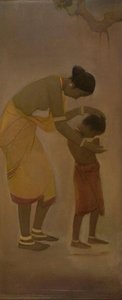
Mother and Child (1920) by Jamini Roy

Mother and Child

1920 · Painting · National Gallery of Modern Art, New Delhi

To stand before Jamini Roy's depiction of Mother and Child is to step across the threshold of colonial influence and into the vibrant, deeply rooted heart of Bengal’s cultural soul. This painting is far more than a mere portrait; it is an eloquent testament to cultural resilience. While Roy initially honed his craft mastering the techniques of European Academic realism at the Government School of Art in Calcutta, the very…

2
Untitled by Jamini Roy

Untitled

Tempera · Kerala Museum, Kochi

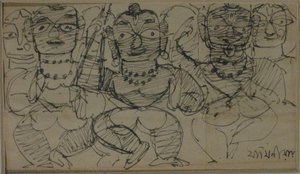
In the quiet intimacy of this untitled masterpiece by Jamini Roy, we are invited into a sacred moment captured through the rhythmic pulse of Bengali folk art. The painting presents a tender, stylized depiction of Hindu deities, widely identified as Shiva and Parvati, nestled within a vibrant rectangular frame. There is an immediate, visceral warmth to the composition; the figures emerge from a brilliant red background adorned with delicate white…

3
Cat and Lobster (1900) by Jamini Roy

Cat and Lobster

In the captivating realm of Indian modernism, few works resonate with as much playful charm and cultural defiance as Jamini Nath Roy’s Cat and Lobster. This masterpiece serves as a profound testament to an artist who dared to turn his back on the polished traditions of European Academic Realism to embrace the raw, rhythmic soul of Bengal. The painting presents a striking, stylized feline, rendered with bold, and sweeping lines…

9
Fawn by Jamini Roy

Fawn

Tempera · Fukuoka Asian Art Museum, Fukuoka

In the vibrant tapestry of early 20th-century Indian modernism, few works capture the soul of the subcontinent as intimately as Jamini Roy’s Fawn. This captivating piece serves as a window into a period of profound cultural reclamation, where artists sought to move away from Western academic traditions and return to the rhythmic, ancestral heartbeat of India. At first glance, the viewer is greeted by a striking, stylized deer that commands…

The Jamini Roy selection continues, 11 to 19

The subjects that held Jamini Roy's eye

The four subjects that come back most often in these originals, each with its finest example.

The museums that keep Jamini Roy's originals

The 5 museums that hold the most of the paintings on this page.

Museum City Works by Jamini Roy Paintings from this list
National Gallery of Modern Art, New DelhiNational Gallery of Modern Art New Delhi 12 Mother and Child, Cat and Lobster, Christ
Kerala Museum, KochiKerala Museum Kochi 3 Untitled, Untitled, Untitled
Museum of Art, San DiegoMuseum of Art San Diego 1 Boating
Fukuoka Asian Art Museum, FukuokaFukuoka Asian Art Museum Fukuoka 1 Fawn
Victoria Memorial Hall, CalcuttaVictoria Memorial Hall Calcutta 1 Rabindranath Tagore

Jamini Roy year by year: the originals that define each

From 1900 to 1920, Jamini Roy worked for 21 years: the selection follows that long career year by year, through its finest originals.

Works per year

Pick a year to see its originals.

Collectors' questions about Jamini Roy's paintings

Which work is Jamini Roy most famous for?Reveal the answer

Mother and Child (1920), National Gallery of Modern Art, New Delhi. Untitled and Cat and Lobster (1900) come next.

What age was Jamini Roy when Mother and Child was made?Reveal the answer

33 years old: Mother and Child dates from 1920, and Jamini Roy was born in 1887.

What are the ten most famous Jamini Roy paintings?Reveal the answer

Mother and Child, Untitled, Cat and Lobster, Boating, Christ, Sketch, Sketch No. 4, Sketches, Fawn and Untitled. The ranking above gives each one's year and museum.

How many paintings did Jamini Roy leave?Reveal the answer

Our catalog holds 20 works by Jamini Roy, dated from 1900 to 1920.

In which museums do Jamini Roy's masterpieces hang?Reveal the answer

Mostly in National Gallery of Modern Art (New Delhi), Kerala Museum (Kochi) and Museum of Art (San Diego). The museum table above lists them all.

In which years did Jamini Roy paint the most famous works?Reveal the answer

In 1920: 2 of the 19 works on this page were made then, Mother and Child among them.

What are the first and the last famous originals of Jamini Roy?Reveal the answer

On this page, the earliest is Cat and Lobster (1900) and the latest Mother and Child (1920).

Which subjects did Jamini Roy choose most often?Reveal the answer

Indian folk art (2), Figurative painting (2) and Indian art (2), across the 19 works on this page.

Which technique did Jamini Roy use most?Reveal the answer

Tempera, for 2 of the 19 works on this page.

Which Jamini Roy works hang at the National Gallery of Modern Art?Reveal the answer

Mother and Child, Cat and Lobster and Christ: the National Gallery of Modern Art, New Delhi holds 12 of the works on this page.

Jamini Roy: life and work

The Soul of Bengal: The Life and Legacy of Jamini Roy

In the vibrant tapestry of Indian modernism, few names resonate with as much cultural authenticity and rhythmic grace as Jamini Roy. Born on April 11, 1887, in the serene landscape of Belaitore, West Bengal, Roy emerged not merely as a painter, but as a visionary who sought to reclaim the artistic identity of his nation. His journey began in a moderately prosperous household where an innate appreciation for aesthetics laid the groundwork for a life dedicated to the brush. Moving to Kolkata at the tender age of sixteen to study at the Government College of Art, he entered a world of academic rigor under the tutelage of the legendary Abanindranath Tagore. While his early training immersed him in the sophisticated traditions of the Bengal School, Roy’s true destiny lay far from the polished salons of the elite; it was found in the raw, pulsing energy of the streets and the timeless simplicity of folk traditions.

The evolution of Roy's style represents one of the most profound transformations in twentieth-century art. Initially influenced by European modernism and the academic realism taught in colonial institutions, he eventually underwent a radical aesthetic rebellion. He turned his gaze away from Western conventions, finding a deeper truth in the Kalighat paintings—a vibrant form of folk art native to the Bengal region. This departure was not merely a stylistic choice but a spiritual homecoming. By embracing the flat planes, bold outlines, and earthy palettes characteristic of rural craftsmanship, he stripped away unnecessary ornamentation to reveal the essential spirit of his subjects. His work became a celebration of the common man, the village life, and the mythological narratives that form the heartbeat of Indian culture.

A Mastery of Form and Color

To gaze upon a Jamini Roy masterpiece is to witness a masterful command over simplicity and rhythm. His technique was defined by a deliberate rejection of three-dimensional illusionism in favor of a striking, two-dimensional flatness that echoed the ancient murals of India. He utilized a palette of bold, saturated colors—deep ochres, brilliant vermillions, and stark blacks—that gave his figures an almost sculptural presence on the canvas. His brushwork, though seemingly simple, possessed an incredible fluidity, capturing the movement of a dancer or the quiet dignity of a peasant with equal prowess.

The themes within his oeuvre are as diverse as they are evocative:

  • Portraiture: In works such as Portrait of a Young Girl, Roy demonstrated an uncanny ability to capture the soulful essence of his subjects through minimalist lines.
  • Mythology and Folklore: He breathed new life into ancient legends, translating complex deities and folk tales into accessible, rhythmic compositions.
  • Rural Life: His depictions of Santhal tribes and village scenes served as a poignant tribute to the enduring strength of India's rural heartland.
  • The Artist’s Reflection: Works like Painter and his Model highlight his introspective exploration of the creative process itself.

Honors, Achievements, and Eternal Influence

The significance of Jamini Roy’s contribution to the global art canon cannot be overstated. His commitment to preserving and elevating indigenous aesthetics earned him the Padma Bhushan in 1954, one of India's highest civilian honors, recognizing his role in shaping a national artistic identity. As a fellow of the prestigious Lalit Kala Akademi, he stood at the forefront of a movement that bridged the gap between ancient tradition and modern expression.

Roy’s legacy continues to ripple through the halls of contemporary art. By proving that modernism did not require a mimicry of Western trends, he empowered generations of Indian artists to look inward toward their own cultural heritage for inspiration. Today, his paintings reside in esteemed institutions such as the National Museum of Korea and various prestigious collections worldwide, serving as a permanent testament to a man who found the universal within the local. His life remains a profound lesson in the power of authenticity, reminding us that true innovation often begins with a return to one's roots.