Portrait of Herbert James Draper

Herbert James Draper Paintings: The 92 Most Famous, Through a Gallery's Eye

Updated November 2026 · ranked by our popularity score (searches, visits and orders for each work) · 96 works by Herbert James Draper in our catalogue

In short

To the gallery's eye, Herbert James Draper's most famous painting is The Lament For Icarus, whose original hangs in the Tate Britain, London. The Pearls Of Aphrodite and Study Of Florence Bird complete the trio every eye recognises. Of the 96 works by Herbert James Draper in our catalog, the gallery presents the 92 most famous below, each original with its year, its museum and what makes it unique.

1863 – 1920, London Neoclassicism Most works: Manchester Art Gallery

The gallery's top 10 Herbert James Draper paintings

1
The Lament For Icarus by Herbert James Draper

The Lament For Icarus

Oil · Tate Britain, London

In the realm of Neoclassical painting, few works capture the intersection of mythic grandeur and raw human vulnerability as poignantly as Herbert James Draper’s The Lament For Icarus. This evocative masterpiece serves as a window into the heart of Greek mythology, transporting the viewer to a moment of profound loss. The canvas unfolds with a dramatic narrative: the fallen Icarus, a victim of his own hubris and the melting wax…

2
The Pearls Of Aphrodite by Herbert James Draper

The Pearls Of Aphrodite

Oil

In The Pearls Of Aphrodite by Herbert James Draper, the air feels heavy with the salt of a blue lake and the presence of the divine. The Greek goddess Venus occupies the center of this lively scene, her form radiating a quiet power that draws every eye. Around her, a gathering of nine people creates a sense of movement and devotion. Several naked women surround the goddess, their bodies positioned…

3
Study Of Florence Bird by Herbert James Draper

Study Of Florence Bird

Charcoal

The charcoal drawing known as Study Of Florence Bird emerges from the hand of Herbert James Draper. This work captures a singular moment of grace, frozen in the delicate interplay of light and shadow. Draper, an English Neoclassicist painter, brings a profound sense of anatomical precision to this study, treating the human form with the same reverence one might accord to classical sculpture. The figure exists in a state of…

4
Study Of Winifred Green by Herbert James Draper

Study Of Winifred Green

Charcoal

The drawing titled Study Of Winifred Green emerges from the hand of the English Neoclassicist painter Herbert James Draper. This piece exists as a focused study for a portrait of Winifred Green, capturing a quiet moment of preparation. The subject gazes slightly downward, her features caught in a delicate arrangement of light and shadow that suggests a fleeting, private instance of reflection.

5
Mourning for Icarus by Herbert James Draper

Mourning for Icarus

Oil

Mourning for Icarus is a painting by the English Neoclassicist Herbert James Draper. The artist was born in London in 1863 and died in London in 1920. His work often focuses on mythological themes drawn from ancient Greek stories, utilizing a style characterized by idealized forms and graceful compositions.

6
Ulysses And The Sirens - by Herbert James Draper

Ulysses And The Sirens -

Oil

The oil painting titled Ulysses And The Sirens - was executed by the artist Herbert James Draper in 1909. This work depicts a specific episode from Homer's Odyssey, focusing on the encounter between the hero and the mythical creatures of the sea. The composition centers on the figure of Ulysses, who is shown tied to the mast of his vessel. Surrounding the boat are the Sirens, represented here as mermaids…

7
Clyties Of The Mist by Herbert James Draper

Clyties Of The Mist

Oil

is a painting by the English Neoclassicist Herbert James Draper. The canvas captures a moment of metamorphosis, a stillness caught within the movement of a mythic transformation. Draper, born in London, United Kingdom, brought a specific clarity to the human form that defined his contribution to the era's aesthetic. His brushwork seeks the light of a fading sun, tracing the edges of a figure lost to the landscape.

8
The Capture by Herbert James Draper

The Capture

Oil

Herbert James Draper, an English Neoclassicist painter born in London in 1863, created The Capture. His practice was defined by a deep engagement with classical tradition and the idealized human form. This work reflects the aesthetic sensibilities of the late Victorian and Edwardian eras, a period during which Draper established himself as a significant voice in British art.

9
For Saint Dorothea's Day by Herbert James Draper

For Saint Dorothea's Day

Oil

The painting For Saint Dorothea's Day emerges from the brush of Herbert James Draper, an artist whose life unfolded within the bustling energy of London, United Kingdom. Born in 1863, Draper carries the spirit of a city caught between industrial progress and a deep longing for classical ideals. His hands move with a precision that suggests a life spent observing the subtle interplay of light and form, a skill honed…

Herbert James Draper paintings, ranked 11 to 92

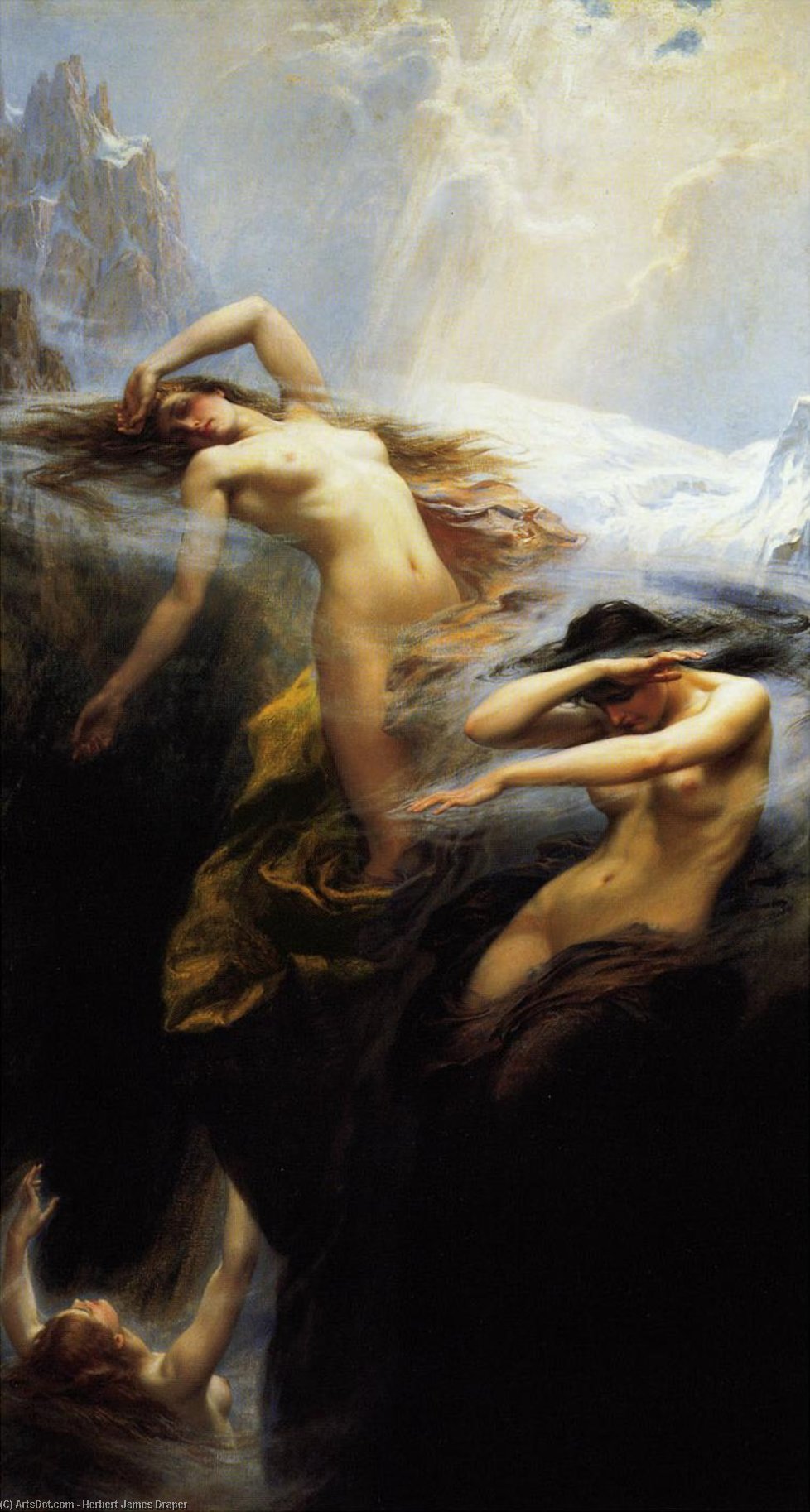
11Calypso's Isle by Herbert James DraperCalypso's IsleManchester Art Gallery 12lancelot ^ guinevere by Herbert James Draperlancelot ^ guinevere 13The Kelpie - by Herbert James DraperThe Kelpie - 14The Ebb by Herbert James DraperThe Ebb 15Ulysses And The Sirens by Herbert James DraperUlysses And The Sirens 16Young boy seated by a fountain by Herbert James DraperYoung boy seated by a fountain 17Study For The Gates Of Dawn by Herbert James DraperStudy For The Gates Of Dawn 18Studies For Icarus by Herbert James DraperStudies For Icarus 19Study For The Sea Maiden by Herbert James DraperStudy For The Sea Maiden 20Study Of Florence Bird - by Herbert James DraperStudy Of Florence Bird - 21Tristan and Isolde steel engraving by Herbert James DraperTristan and Isolde steel engraving 22Studies For Halcyone by Herbert James DraperStudies For Halcyone 23Study For Clyties Of The Mist - by Herbert James DraperStudy For Clyties Of The Mist - 24untitled (4388) by Herbert James Draperuntitled (4388) 25Study For Icarus by Herbert James DraperStudy For Icarus 26Halcyone by Herbert James DraperHalcyone 27Study For The Pearls Of Aphrodite by Herbert James DraperStudy For The Pearls Of Aphrodite 28Study For Rower In Ulysses by Herbert James DraperStudy For Rower In Ulysses 29Study Of Jessie Morris by Herbert James DraperStudy Of Jessie Morris 30Oil Study by Herbert James DraperOil Study 31A Young Girl By A Pool by Herbert James DraperA Young Girl By A Pool 32Study Of Janet Fletcher by Herbert James DraperStudy Of Janet Fletcher 33Study For Clyties Of The Mist by Herbert James DraperStudy For Clyties Of The Mist 34Art And The Jade - by Herbert James DraperArt And The Jade - 35Lieutenant General Sir William Edmund Franklyn by Herbert James DraperLieutenant General Sir William Edmund Franklyn 36Ariadne by Herbert James DraperAriadne 37Portrait of John F Kennedy by Herbert James DraperPortrait of John F Kennedy 38Study For The Vintage Morn by Herbert James DraperStudy For The Vintage Morn 39Mrs E. Milton by Herbert James DraperMrs E. Milton 40Scene In Hall Of A Highland Chieftain In The by Herbert James DraperScene In Hall Of A Highland Chieftain In The 41The steering oar by Herbert James DraperThe steering oar 42Study For The Sea Maiden Composition by Herbert James DraperStudy For The Sea Maiden Composition 43untitled (380) by Herbert James Draperuntitled (380) 44flying fish by Herbert James Draperflying fish 45The Water Nymph by Herbert James DraperThe Water Nymph 46Study For Icarus - by Herbert James DraperStudy For Icarus - 47Bather by Herbert James DraperBather 48The Mother Of George P. Holt by Herbert James DraperThe Mother Of George P. Holt 49Study for Calypso by Herbert James DraperStudy for Calypso 50Study For Flying Fish by Herbert James DraperStudy For Flying Fish 51Prince Charles appeals to Cameron of Lochiel by Herbert James DraperPrince Charles appeals to Cameron of Lochiel 52Figure with a Laurel Wreath by Herbert James DraperFigure with a Laurel Wreath 53Flying Fish by Herbert James DraperFlying Fish 54The Sea Maiden by Herbert James DraperThe Sea Maiden 55Study For The Golden Rays by Herbert James DraperStudy For The Golden Rays 56Art And The Jade by Herbert James DraperArt And The Jade 57the golden fleece by Herbert James Draperthe golden fleece 58The Vintage Morn by Herbert James DraperThe Vintage Morn 59Lieutenant J. W. Forrest by Herbert James DraperLieutenant J. W. Forrest 60Study For Day And The Dawnstar by Herbert James DraperStudy For Day And The Dawnstar 61Calypso's Isle - by Herbert James DraperCalypso's Isle - 62Wrath of the Sea God by Herbert James DraperWrath of the Sea God 63Spirit Of The Fountain by Herbert James DraperSpirit Of The Fountain 64Sir Frederick Taylor, Md, Physician To Guy's Hospital by Herbert James DraperSir Frederick Taylor, Md, Physician To Guy's Hospital 65Pot pourri by Herbert James DraperPot pourri 66the golden flecce by Herbert James Draperthe golden flecce 67Sea Melodies by Herbert James DraperSea Melodies 68Tristan And Isolde by Herbert James DraperTristan And Isolde 69The water nymph by Herbert James DraperThe water nymph 70Lamia by Herbert James DraperLamia 71The Kelpie by Herbert James DraperThe Kelpie 72Miss Barbara De Selincourt by Herbert James DraperMiss Barbara De Selincourt 73Teddy, Son Of Lieutenant Bwg Oates by Herbert James DraperTeddy, Son Of Lieutenant Bwg Oates 74The Golden Fleece by Herbert James DraperThe Golden Fleece 75Ulysses And The Sirens - by Herbert James DraperUlysses And The Sirens - 76Tristan And Iseult by Herbert James DraperTristan And Iseult 77Study For 'the Foam Sprite' - by Herbert James DraperStudy For 'the Foam Sprite' -Art Gallery of South Australia 78Halcyone by Herbert James DraperHalcyone 79Lieutenant Colonel Ninian Crichton-stewart by Herbert James DraperLieutenant Colonel Ninian Crichton-stewart 80Day and the Dawnstar by Herbert James DraperDay and the Dawnstar 81Ariadne Deserted By Theseus by Herbert James DraperAriadne Deserted By Theseus 82Study For Juno's Cloak In Prospero by Herbert James DraperStudy For Juno's Cloak In Prospero 83Prospero Summoning Nymphs And Deities by Herbert James DraperProspero Summoning Nymphs And Deities 84By Summer Seas by Herbert James DraperBy Summer SeasRussell-Cotes Art Gallery - Museum 85Study of Florrie Bird for a water nymph in - Prospero Summoning Nymphs and Deities- by Herbert James DraperStudy of Florrie Bird for a water nymph in - Prospero Summoning Nymphs and Deities- 86waterbaby by Herbert James DraperwaterbabyManchester Art Gallery 87Study For 'the Foam Sprite' by Herbert James DraperStudy For 'the Foam Sprite' 88Ida Draper by Herbert James DraperIda Draper 89Head Study For The Sea Maiden by Herbert James DraperHead Study For The Sea Maiden 90Naiad's Pool by Herbert James DraperNaiad's Pool 91Midsummer Eve by Herbert James DraperMidsummer Eve 92Ulysses and the Sirens by Herbert James DraperUlysses and the SirensFerens Art Gallery

Herbert James Draper's famous paintings, period by period

The subjects that held Herbert James Draper's eye

The four subjects that come back most often in these originals, each with its finest example.

The museums that keep Herbert James Draper's originals

The 5 museums that hold the most of the paintings on this page.

Museum City Works by Herbert James Draper Paintings from this list
Manchester Art Gallery, ManchesterManchester Art Gallery Manchester 2 Calypso's Isle, waterbaby
Tate Britain, LondonTate Britain London 1 The Lament For Icarus
Art Gallery of South Australia, AdelaideArt Gallery of South Australia Adelaide 1 Study For 'the Foam Sprite' -
Russell-Cotes Art Gallery - Museum, BournemouthRussell-Cotes Art Gallery - Museum Bournemouth 1 By Summer Seas
Ferens Art Gallery, Kingston upon HullFerens Art Gallery Kingston upon Hull 1 Ulysses and the Sirens

Herbert James Draper's paintings: the gallery answers

Which Herbert James Draper painting is the most famous of all?Reveal the answer

The Lament For Icarus, Tate Britain, London. The Pearls Of Aphrodite and Study Of Florence Bird come next.

Which are Herbert James Draper's top 10 paintings?Reveal the answer

The Lament For Icarus, The Pearls Of Aphrodite, Study Of Florence Bird, Study Of Winifred Green, Mourning for Icarus, Ulysses And The Sirens -, Clyties Of The Mist, The Capture, For Saint Dorothea's Day and In The Studio. The ranking above gives each one's year and museum.

How many works did Herbert James Draper create?Reveal the answer

Our catalog holds 96 works by Herbert James Draper.

Where do Herbert James Draper's most famous originals hang?Reveal the answer

Mostly in Manchester Art Gallery (Manchester), Tate Britain (London) and Art Gallery of South Australia (Adelaide). The museum table above lists them all.

Which subjects did Herbert James Draper return to most?Reveal the answer

Woman (9), Mythology (7) and Water (6), across the 92 works on this page.

Which medium did Herbert James Draper work in most?Reveal the answer

Oil, for 7 of the 92 works on this page.

Which movement is Herbert James Draper associated with?Reveal the answer

Neoclassicism, judging by the originals on this page.

Which Herbert James Draper originals does the Manchester Art Gallery hold?Reveal the answer

Calypso's Isle and waterbaby: the Manchester Art Gallery, Manchester holds 2 of the works on this page.

Herbert James Draper: the artist

A Life Immersed in Myth and Beauty

Herbert James Draper, a name resonating with the echoes of Victorian and Edwardian artistry, was born in London in 1863, a city brimming with both industrial progress and a fervent revival of classical ideals. The son of a fruit merchant, his path diverged from commerce towards the realm of aesthetic expression. His early education at Bruce Castle School provided a foundation, but it was within the hallowed halls of the Royal Academy Schools that Draper’s artistic destiny began to unfold. He demonstrated an immediate aptitude and ambition, qualities recognized in 1889 when he secured both the prestigious Royal Academy Gold Medal and a Travelling Studentship. This invaluable opportunity propelled him on formative journeys through Rome and Paris between 1888 and 1892, experiences that indelibly shaped his artistic sensibility. These European sojourns weren’t merely geographical shifts; they were immersions into the heart of classical tradition, fostering an appreciation for idealized form and graceful composition that would become hallmarks of his style.

The Rise of a Neoclassical Vision

Draper's artistic maturity blossomed around 1894, marking a distinct shift in focus towards mythological narratives drawn from the rich tapestry of ancient Greek stories. He wasn’t simply illustrating myths; he was reimagining them through a distinctly personal lens. His style is often categorized as Neoclassical, and rightly so—a profound reverence for classical art and sculpture permeates his work. Yet, to label him solely as a classicist would be an oversimplification. Draper skillfully integrated elements of the Aesthetic movement, prioritizing beauty and sensual appeal with a delicate touch. This fusion created a unique aesthetic that captivated audiences during his lifetime. The Lament for Icarus, completed in 1898, stands as a testament to this burgeoning talent. The painting garnered significant acclaim, culminating in a gold medal at the Exposition Universelle in Paris in 1900 and subsequent acquisition by the Tate Gallery. This success solidified his reputation and signaled the arrival of a major artistic voice. Other notable works from this period include Ulysses and the Sirens (1909), The Kelpie (1903), and Ariadne, each demonstrating his mastery of form, composition, and evocative storytelling. Beyond canvas, Draper also lent his talents to decorative projects, notably contributing to the ceiling decoration of Drapers' Hall in London, showcasing his versatility as an artist.

Themes of Sensuality and Mythological Allure

A recurring motif within Draper’s oeuvre is the depiction of female figures—often embodying both beauty and a subtle undercurrent of danger. His women are not merely passive subjects; they possess a captivating allure, sometimes bordering on the predatory, as seen in works like The Gates of Dawn (1899) and The Water Nixie (1908). These paintings explore themes of temptation, desire, and the power dynamics inherent in mythological encounters. He wasn’t afraid to imbue his figures with a sensuality that was both celebrated and slightly unsettling, reflecting the complex attitudes towards femininity prevalent during the Victorian and Edwardian eras. Draper's ability to capture the fluidity of form and the luminosity of skin contributed significantly to the captivating quality of these works. His technique involved meticulous attention to detail, creating surfaces that seem to shimmer with life.

Recognition, Transition, and Legacy

Draper enjoyed considerable fame during his lifetime, regularly exhibiting at the Royal Academy from 1890 onwards and becoming a sought-after portrait painter among London’s elite. Despite this success, he never achieved membership or associateship within the Royal Academy—a curious omission given his talent and popularity. As artistic tastes evolved in the early 20th century, with mythological scenes falling somewhat out of favor, Draper gradually shifted his focus towards portraiture, adapting to the changing demands of the art market. He passed away in 1920 at the age of 56 from arteriosclerosis, leaving behind a body of work that would experience periods of both acclaim and relative obscurity. In recent years, however, there has been a notable resurgence of interest in Draper’s paintings. The sale of The Sea Maiden in 2010 sparked debate about the ethics of selling artworks to address financial difficulties, but also brought renewed attention to his artistic achievements. Simon Toll’s comprehensive study remains the definitive modern analysis of his work, providing a valuable catalogue of his drawings and paintings. Draper's legacy lies in his unique ability to synthesize classical influences with Victorian sensibilities, creating works that are both aesthetically pleasing and deeply evocative of mythological narratives. His contribution to British art during a period of significant change deserves continued recognition and appreciation.

A Lasting Impression

  • Influences: Classical sculpture, the Aesthetic movement, Greek mythology.
  • Key Characteristics: Neoclassical style, idealized forms, graceful compositions, sensual depictions of female figures, mythological themes.
  • Major Works: The Lament for Icarus, Ulysses and the Sirens, The Kelpie, Ariadne, The Gates of Dawn, The Water Nixie.
  • Historical Significance: A prominent figure in British art during the Victorian and Edwardian periods, bridging classical tradition with modern sensibilities. His work reflects the cultural anxieties and aesthetic preferences of his time.