Portrait of Henry Scott Tuke

The 100 Most Famous Henry Scott Tuke Paintings, a Gallery Selection

Updated November 2026 · ranked by our popularity score (searches, visits and orders for each work) · 204 works by Henry Scott Tuke in our catalogue

In short

Of all the originals Henry Scott Tuke left, the most famous is The Critics (1927). Close behind it come Morning splendour (1921) and Summer Dreams (sketch). Our catalog holds 204 works by Henry Scott Tuke; the gallery has kept the 100 the world admires most, each shown with its date, its museum and its story.

1858 – 1929, York Impressionism Most works: Royal Cornwall Polytechnic Society

Henry Scott Tuke's top 10 paintings: the gallery's choice

1
The Critics (1927) by Henry Scott Tuke

The Critics

1927 · Oil

In this 1927 work, we find ourselves on the shores of Falmouth, caught in a quiet, luminous afternoon. The scene is one of profound stillness, where the heat of the sun seems to settle heavily upon the sand. Two young men recline on the beach, their backs to us, anchored by the sheer weight of their relaxation. They gaze toward the horizon, lost in a shared moment of repose. From…

2
Morning splendour (1921) by Henry Scott Tuke

Morning splendour

1921 · Oil On Canvas

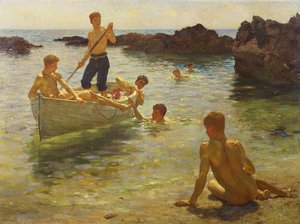
“Morning Splendour,” painted in 1921 by the esteemed English artist Henry Scott Tuke, is a captivating depiction of youthful exuberance and seaside tranquility. This artwork transports viewers to a sun-drenched coastal scene where figures engage in leisurely activities – swimming, rowing, and simply enjoying the warmth of the morning light. More than just a picturesque view, "Morning Splendour" embodies Tuke's signature style and offers a window into early 20th-century British…

3
Summer Dreams (sketch) by Henry Scott Tuke

Summer Dreams (sketch)

Oil On Panel

Summer Dreams (sketch) is an oil on panel work by Henry Scott Tuke. This piece is categorized as a sketch, capturing a specific moment of repose. The artist, Henry Scott Tuke, was a British painter known for his figurative works and his ability to render the human form within natural settings.

4
Nude Boy on Rocks (1907) by Henry Scott Tuke

Nude Boy on Rocks

1907 · Oil On Canvas

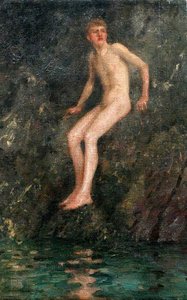
Nude Boy on Rocks is an oil on canvas painting created by Henry Scott Tuke in 1907. The work depicts a single nude boy positioned upon rocks situated within a body of water. The subject is seated in a natural setting, appearing to look toward something located off-camera. This posture leaves the figure exposed to the elements of the coastal environment.

5
Green and Gold (1920) by Henry Scott Tuke

Green and Gold

1920 · Oil On Canvas

In the gentle embrace of Henry Scott Tuke’s 1920 masterpiece, "Green and Gold," the viewer is invited to step away from the frantic pace of modern life and into a realm of profound stillness. The painting presents a scene of quiet contemplation, centered around a solitary figure seated upon rugged rocks at the water's edge. With his back turned toward us, the man becomes an avatar for the viewer’s own…

6
Reefing the Mainsail (sketch) (1903) by Henry Scott Tuke

Reefing the Mainsail (sketch)

1903 · Oil

The sea is never still, and here, the water churns in restless, muted blues and browns. A small fishing boat tosses upon the waves, caught in a moment of heavy labor under a thick, overcast sky. Onboard, a fisherman and a young boy move with the rhythmic necessity of those who live by the tides. They are focused on the task at hand, perhaps repairing equipment or securing the vessel…

7
Under the Western Sun (1917) by Henry Scott Tuke

Under the Western Sun

1917 · Oil

Under the Western Sun is a painting by Henry Scott Tuke, created in 1917. The work captures a quiet moment on a beach near the ocean, where the light of the early 20th century settles upon the shore. Two naked men occupy the scene, their forms grounded by the salt and the sand. One man stands while holding a towel, while the other is seated nearby. They exist in a…

8
Nude Boy (1881) by Henry Scott Tuke

Nude Boy

1881 · Oil

Henry Scott Tuke produced Nude Boy in 1881. This work emerged during a period when the artist was traveling through Italy, a journey that followed his formal training at the Slade School of Art in London. The piece reflects the early development of his technical approach to the human form and natural light.

9
Dinner Time Ambrose Rouffignac in the Sail Loft (1883) by Henry Scott Tuke

Dinner Time Ambrose Rouffignac in the Sail Loft

1883 · Oil · Penlee House, Penzance

The oil painting titled Dinner Time Ambrose Rouffignac in the Sail Loft was created by the artist Henry Scott Tuke. This work dates to 1883. The subject of the piece is a young boy positioned within a maritime setting. He is dressed in a blue sweater and brown pants, seated upon a wooden bench. The boy holds a small object in his hands while looking toward the viewer.

10
A Holiday (1914) by Henry Scott Tuke

A Holiday

1914 · Watercolor

Created in 1914, A Holiday is a watercolour by Henry Scott Tuke. This work captures a sense of serenity within a seaside setting, focusing on the quietude of the coast. Through his delicate application of the medium, Tuke explores the subtle nuances of light and the natural environment.

The Henry Scott Tuke selection continues, 11 to 100

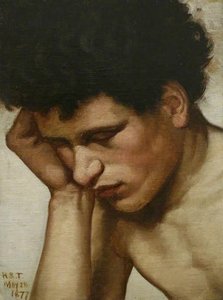
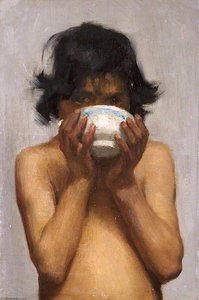
11Looking Out To Sea (1885) by Henry Scott TukeLooking Out To Sea1885 12Julie of Nantes (sketch) (1884) by Henry Scott TukeJulie of Nantes (sketch)1884 13The Bathing Cove by Henry Scott TukeThe Bathing Cove 14In Tow (1893) by Henry Scott TukeIn Tow1893 15Colin Goodwyn (1903) by Henry Scott TukeColin Goodwyn1903 16Steering the Punt (1909) by Henry Scott TukeSteering the Punt1909 17A Bathing Group (1914) by Henry Scott TukeA Bathing Group1914 · Royal Academy of Arts 18Noonday Heat (1902) by Henry Scott TukeNoonday Heat1902 19Gleaming waters (1910) by Henry Scott TukeGleaming waters1910 20In the meadow (1906) by Henry Scott TukeIn the meadow1906 21On the Dunes (1906) by Henry Scott TukeOn the Dunes1906 22Portrait of Charlie Mitchell (1909) by Henry Scott TukePortrait of Charlie Mitchell1909 23Return from fishing (1907) by Henry Scott TukeReturn from fishing1907 24A Holiday (1921) by Henry Scott TukeA Holiday1921 25Lyndon Lodge by Henry Scott TukeLyndon Lodge 26Lord Ronald Sutherland Gower (1897) by Henry Scott TukeLord Ronald Sutherland Gower1897 · National Portrait Gallery 27Portrait of a Young Man with Open Collar (1885) by Henry Scott TukePortrait of a Young Man with Open Collar1885 · Yale Center for British Art 28The silk gown (also known as Portrait of Maria Tuke Sainsbury) (1885) by Henry Scott TukeThe silk gown (also known as Portrait of Maria Tuke Sainsbury)1885 29Sailors playing cards (1890) by Henry Scott TukeSailors playing cards1890 · Bavarian State Painting Collections 30The bathers (1889) by Henry Scott TukeThe bathers1889 · Leeds Art Gallery 31The Steering Lesson (1892) by Henry Scott TukeThe Steering Lesson1892 32William J. Martin (1890) by Henry Scott TukeWilliam J. Martin1890 33The Lighthouse by Henry Scott TukeThe Lighthouse 34Two-Funnelled Steamer (1895) by Henry Scott TukeTwo-Funnelled Steamer1895 35Study for „August Blue“ (1893) by Henry Scott TukeStudy for „August Blue“1893 36The sun worshipper (In the morning sun) (1904) by Henry Scott TukeThe sun worshipper (In the morning sun)1904 · Dublin City Gallery The Hugh Lane 37Keeping her off (1900) by Henry Scott TukeKeeping her off1900 38Stowing the headsails (1914) by Henry Scott TukeStowing the headsails1914 39A Cadet (possibly T. E. Lawrence) at Newporth Beach, near Falmouth (1921) by Henry Scott TukeA Cadet (possibly T. E. Lawrence) at Newporth Beach, near Falmouth1921 · Clouds Hill 40Companions (1924) by Henry Scott TukeCompanions1924 · Auckland Art Gallery Toi o Tāmaki 41Lovers of the Sun (1923) by Henry Scott TukeLovers of the Sun1923 42Windjammers lying at their moorings by Henry Scott TukeWindjammers lying at their moorings 43A sailor's yarn (1887) by Henry Scott TukeA sailor's yarn1887 · Art Gallery of New South Wales 44Mrs Florence Humphris (1892) by Henry Scott TukeMrs Florence Humphris1892 · Tate Gallery 45The Fisherman by Henry Scott TukeThe Fisherman 46Hermes at The Pool (sketch) (1900) by Henry Scott TukeHermes at The Pool (sketch)1900 · Royal Cornwall Polytechnic Society 47From the Lido by Henry Scott TukeFrom the Lido 48Tobacco Caye. Brit. Honduras by Henry Scott TukeTobacco Caye. Brit. Honduras 49Charlie Mitchell by Henry Scott TukeCharlie Mitchell 50Grey and Green by Henry Scott TukeGrey and Green 51Venetian Sails by Henry Scott TukeVenetian Sails 52The Bather by Henry Scott TukeThe Bather 53Portrait of a Youth (1877) by Henry Scott TukePortrait of a Youth1877 54Italian Landscape (1881) by Henry Scott TukeItalian Landscape1881 55A Morning Gossip (1885) by Henry Scott TukeA Morning Gossip1885 56Fisher Boys, Falmouth (1885) by Henry Scott TukeFisher Boys, Falmouth1885 57George Stacey Gibson (1880) by Henry Scott TukeGeorge Stacey Gibson1880 58Portrait of an Italian Youth (1881) by Henry Scott TukePortrait of an Italian Youth1881 59Self Portrait (1881) by Henry Scott TukeSelf Portrait1881 60George Stacey Gibson (1880) by Henry Scott TukeGeorge Stacey Gibson1880 61Elizabeth Gibson, née Tuke (1880) by Henry Scott TukeElizabeth Gibson, née Tuke1880 62The Misses Santley (1880) by Henry Scott TukeThe Misses Santley1880 · Йоркський художній музей 63The Good Samaritan (1879) by Henry Scott TukeThe Good Samaritan1879 64James Paterson, Artist (1883) by Henry Scott TukeJames Paterson, Artist1883 65Drinking (1881) by Henry Scott TukeDrinking1881 66Nude Italian Boy (1881) by Henry Scott TukeNude Italian Boy1881 67Liz (1884) by Henry Scott TukeLiz1884 68Ship Builders (1883) by Henry Scott TukeShip Builders1883 69Our Jack (1886) by Henry Scott TukeOur Jack1886 70Going aloft (1886) by Henry Scott TukeGoing aloft1886 71Carnations (1890) by Henry Scott TukeCarnations1890 72The Old Sea Dog (1888) by Henry Scott TukeThe Old Sea Dog1888 73William J. Martin (1890) by Henry Scott TukeWilliam J. Martin1890 74William J. Martin (1890) by Henry Scott TukeWilliam J. Martin1890 75Jack Rolling (1887) by Henry Scott TukeJack Rolling1887 76Denny Mending a Sail (1890) by Henry Scott TukeDenny Mending a Sail1890 77Rounding the Manacle Buoy (1888) by Henry Scott TukeRounding the Manacle Buoy1888 78Jack Rolling (1888) by Henry Scott TukeJack Rolling1888 79Georgie and Richard (1889) by Henry Scott TukeGeorgie and Richard1889 80Taking a Spell (1886) by Henry Scott TukeTaking a Spell1886 81A Corfu Garden (study) (1892) by Henry Scott TukeA Corfu Garden (study)1892 82The Look Out (1886) by Henry Scott TukeThe Look Out1886 83Jack Rolling (1887) by Henry Scott TukeJack Rolling1887 · Royal Cornwall Polytechnic Society 84The Look Out (1886) by Henry Scott TukeThe Look Out1886 85The Message (1890) by Henry Scott TukeThe Message1890 86Head of a Boy (1890) by Henry Scott TukeHead of a Boy1890 87The Missionary Boat (1894) by Henry Scott TukeThe Missionary Boat1894 88William Hayler Bishop (1898) by Henry Scott TukeWilliam Hayler Bishop1898 89Miss Muriel Lubbock (1898) by Henry Scott TukeMiss Muriel Lubbock1898 90Two Children on Deck (1894) by Henry Scott TukeTwo Children on Deck1894 91Tying the sail (1901) by Henry Scott TukeTying the sail1901 92Seascape with Sailing Craft (1904) by Henry Scott TukeSeascape with Sailing Craft1904 93Esther Maria Tuke (sketch) (1903) by Henry Scott TukeEsther Maria Tuke (sketch)1903 94Sketch for 'The Three Companions' (1904) by Henry Scott TukeSketch for 'The Three Companions'1904 95French Barque in Falmouth Bay (1902) by Henry Scott TukeFrench Barque in Falmouth Bay1902 96The Run Home (1902) by Henry Scott TukeThe Run Home1902 97William Hawk (1905) by Henry Scott TukeWilliam Hawk1905 98Sketch for 'Summer Evening' (1900) by Henry Scott TukeSketch for 'Summer Evening'1900 99Portrait of Georgia Fouracre (1900) by Henry Scott TukePortrait of Georgia Fouracre1900 100Sleeping Sailor (1905) by Henry Scott TukeSleeping Sailor1905

Henry Scott Tuke's famous paintings, period by period

The subjects that held Henry Scott Tuke's eye

The four subjects that come back most often in these originals, each with its finest example.

The museums that keep Henry Scott Tuke's originals

The 8 museums that hold the most of the paintings on this page.

Museum City Works by Henry Scott Tuke Paintings from this list
Royal Cornwall Polytechnic Society, FalmouthRoyal Cornwall Polytechnic Society Falmouth 4 Hermes at The Pool (sketch), Jack Rolling
Royal Academy of Arts, LondonRoyal Academy of Arts London 2 A Bathing Group
Penlee House, PenzancePenlee House Penzance 1 Dinner Time Ambrose Rouffignac in the Sail Loft
National Portrait Gallery, LondonNational Portrait Gallery London 1 Lord Ronald Sutherland Gower
Yale Center for British Art, New HavenYale Center for British Art New Haven 1 Portrait of a Young Man with Open Collar
Bavarian State Painting Collections, MunichBavarian State Painting Collections Munich 1 Sailors playing cards
Leeds Art Gallery, LeedsLeeds Art Gallery Leeds 1 The bathers
Dublin City Gallery The Hugh Lane, DublinDublin City Gallery The Hugh Lane Dublin 1 The sun worshipper (In the morning sun)

Henry Scott Tuke decade by decade: the original that defines each

Works per decade

Pick a decade to see the original that defines it.

Collectors' questions about Henry Scott Tuke's paintings

Which work is Henry Scott Tuke most famous for?Reveal the answer

The Critics (1927). Morning splendour (1921) and Summer Dreams (sketch) come next.

What age was Henry Scott Tuke when The Critics was made?Reveal the answer

69 years old: The Critics dates from 1927, and Henry Scott Tuke was born in 1858.

What are the ten most famous Henry Scott Tuke paintings?Reveal the answer

The Critics, Morning splendour, Summer Dreams (sketch), Nude Boy on Rocks, Green and Gold, Reefing the Mainsail (sketch), Under the Western Sun, Nude Boy, Dinner Time Ambrose Rouffignac in the Sail Loft and A Holiday. The ranking above gives each one's year and museum.

How many paintings did Henry Scott Tuke leave?Reveal the answer

Our catalog holds 204 works by Henry Scott Tuke, dated from 1877 to 1927.

In which museums do Henry Scott Tuke's masterpieces hang?Reveal the answer

Mostly in Royal Cornwall Polytechnic Society (Falmouth), Royal Academy of Arts (London) and Penlee House (Penzance). The museum table above lists them all.

In which years did Henry Scott Tuke paint the most famous works?Reveal the answer

In 1880s: 33 of the 100 works on this page were made then, Nude Boy among them.

What are the first and the last famous originals of Henry Scott Tuke?Reveal the answer

On this page, the earliest is Portrait of a Youth (1877) and the latest The Critics (1927).

Which subjects did Henry Scott Tuke choose most often?Reveal the answer

Water (21), Boat (17) and Man (17), across the 100 works on this page.

Which technique did Henry Scott Tuke use most?Reveal the answer

Oil On Canvas, for 17 of the 100 works on this page.

To which art movement does Henry Scott Tuke belong?Reveal the answer

Impressionism, judging by the originals on this page.

Which Henry Scott Tuke works hang at the Royal Cornwall Polytechnic Society?Reveal the answer

Hermes at The Pool (sketch) and Jack Rolling: the Royal Cornwall Polytechnic Society, Falmouth holds 2 of the works on this page.

Henry Scott Tuke: life and work

Early Life, Family and Training

Henry Scott Tuke was born on June 12, 1858, in Lawrence Street, York. He grew up within a prominent Quaker family. His father, Daniel Hack Tuke, worked as a medical doctor with a specialty in psychiatry. From a young age, Henry Scott Tuke was encouraged to pick up a brush and explore drawing and painting. These early inclinations shaped his path long before he reached formal training.

In 1874, the move to London brought him to the Slade School of Art. He studied there under the guidance of Alphonse Legros and Sir Edward Poynter. His time at the Slade was marked by a steady development of his technical skills. By 1877, he had won a scholarship. This achievement allowed him to continue his training at the Slade and eventually travel to Italy in 1880.

Artistic Development in Paris and Italy

After his initial training in London, Tuke moved toward the continent, traveling to Italy between 1880 and 1881. This period of study provided a foundation before he arrived in Paris in 1881. He remained in the French capital until 1883, a time when the atmosphere of the city began to shape his approach to light and outdoor painting. During these years, he studied under the French history painter Jean-Paul Laurens.

While living in Paris, Tuke encountered Jules Bastien-Lepage. It was this meeting that encouraged him to take his easel outside and practice en plein air. This shift toward painting directly from nature changed how he observed the world. He also crossed paths with the American painter John Singer Sargent during his time in the city. These encounters and the lessons learned in the studios of Paris helped refine his technique and his understanding of how light interacts with its subject.

Life and Work in Newlyn and Falmouth

After his time in France, Tuke moved toward the Cornish coast to join the Newlyn School. This group of artists preferred the directness of plein air painting, seeking to capture the atmosphere of the coast as it happened. By 1885, he had settled in the fishing port of Falmouth. The light and the local customs of the village became the backdrop for his daily life. He even purchased a fishing boat and converted it into a studio, a space where he could work away from the traditional constraints of a land-based room.

The sea was a constant presence in his life. In Falmouth, he was introduced to the habit of nude sea bathing, a practice he maintained well into his old age. This connection to the water and the physical reality of the coast shaped his surroundings. He lived among the fishermen and the salt air, finding a sense of place in the rugged landscape of Cornwall.

Technique and Artistic Style

Tuke’s hand moved with a specific kind of dual purpose. He blended the loose, light-seeking brushwork of Impressionism with the disciplined, structured foundations of academic technique. This approach allowed him to capture the way sunlight hits skin or water without losing the solid form of his subjects. He was a figurative painter who understood the weight of the human body, yet he often sought to dissolve that weight into the atmosphere of the outdoors. His time in Paris taught him the value of painting en plein air, a habit that defined his later years in Cornwall.

His eye was not limited to the canvas. As a photographer, he possessed a keen understanding of light and composition that informed his paintings. This technical precision extended to his maritime work. He was an established maritime artist, capable of rendering the specific textures of sailing ships and the movement of the sea. Whether he was focusing on the anatomy of a young man or the rigging of a vessel, his work remained grounded in a direct observation of the physical world.

The way he handled color often mirrored the shifting conditions of the coast. He looked for the truth in natural light, often working in the open air to catch the specific clarity of a summer afternoon. This focus on light and the human form became his primary way of seeing.

Key Works and Subject Matter

Tuke’s gaze often settled on the human form in its most natural state. He spent much of his time painting nude boys and young men, frequently placing them within the rugged, unhurried landscapes of the coast. These figures are rarely posed for a formal portrait; instead, they are seen swimming or fishing, sometimes alone and sometimes in small groups. Many of these subjects appear on boats or along the shoreline, their skin catching the light of the open air.

His work often captures a sense of quiet activity. You might find a young man mid-swim or a group of sailors resting near the water. The focus remains on the interaction between the body and the elements—the salt, the sun, and the sea. One of his most recognized paintings, August Blue (about 1893–94), shows this preoccupation with light and the youthful form in a way that defined much of his output.

Where to See the Works Today

To find his paintings, one often looks to the major institutions in London. The Tate Gallery holds several of his pieces, while the National Portrait Gallery contains his portraits. These collections offer a way to see how he captured the light on skin and the movement of the sea through his specific lens.

In Cornwall, his presence is felt through local collections that reflect his connection to the coast. Penlee House in Penzance holds works that speak to his time in the region. You can also find his art within the Royal Cornwall Polytechnic Society in Falmouth. These locations keep his studies of the human form and maritime life close to the environments that inspired them.