A Chronicler of the Vanishing West: The Life and Art of Frederic Remington
Frederic Sackrider Remington, born in Canton, New York, on October 4, 1861, wasn’t a product of the Wild West he so vividly depicted; rather, he was an Easterner who forged his artistic identity through fascination and dedicated study. His lineage hinted at a life far removed from dusty trails and cavalry charges – French Basque ancestry mingled with staunchly Republican New England roots, a father who was a Civil War colonel and newspaper editor, and connections to the famed Remington Arms dynasty through distant cousins. Yet, it was an early exposure to military themes, coupled with a restless spirit and a keen eye for storytelling, that set him on a path toward becoming arguably the most recognizable artist of the American West. His childhood moved to Bloomington, Illinois, then back to Canton and finally Ogdensburg, New York, but his imagination remained captivated by tales of frontier life. Though initially steered towards a military education at Vermont Episcopal Institute, Remington’s true calling lay not in following orders, but in observing and interpreting the world around him through art. A brief stint at Yale University confirmed this; football and sketching held far more appeal than formal academic pursuits.From Illustrator to Painter: Forging an Artistic Vision
Remington’s artistic journey began not with grand canvases, but with ink and paper. His first published work, a cartoon for the *Yale Courant*, signaled an early aptitude for capturing action and narrative. A pivotal trip to Montana in 1881 ignited his lifelong obsession with the West. This wasn't merely a tourist’s gaze; Remington sought to immerse himself in the culture, observing cowboys, Native Americans, and the landscape itself. He initially attempted ranching and mining ventures, but these proved unsuccessful, freeing him to fully dedicate himself to art. Returning East, he quickly established himself as an illustrator for magazines like *Harper's Weekly* and *Collier’s*, his dynamic depictions of Western scenes captivating a national audience hungry for stories of the frontier. These illustrations weren’t simply reportage; they were infused with drama, energy, and a romanticized vision of the West that resonated deeply with the public imagination. It was through this work that Remington honed his skills in composition, capturing movement, and conveying emotion – qualities that would later define his paintings. He received minimal formal training beyond some drawing classes at Yale and a short period at the Art Students League, developing instead a distinctive style characterized by energetic brushwork, bold colors, and a focus on realism blended with dramatic flair.Capturing a Vanishing World: Themes and Style
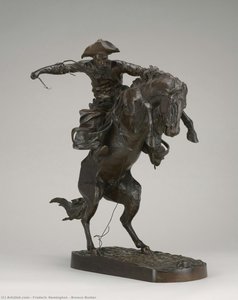
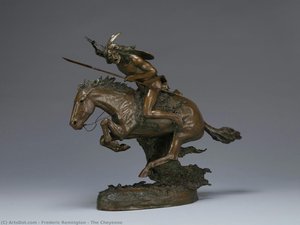
Remington’s art is inextricably linked to a specific moment in American history – the twilight of the Old West. His canvases are populated by iconic figures: rugged cowboys driving cattle, stoic Native Americans facing displacement, and U.S. Cavalry soldiers engaged in both heroic battles and tragic conflicts. He didn't shy away from depicting the harsh realities of frontier life, but his work often leans towards a romanticized portrayal, emphasizing courage, adventure, and the clash of cultures. His paintings aren’t simply historical documents; they are evocative narratives that explore themes of heroism, loss, and the inevitable march of progress. Remington's style evolved over time, moving from tighter, more academic renderings to looser, more expressive brushwork. He was a master of capturing movement – horses galloping across the plains, cowboys wrestling steers, soldiers charging into battle. He often employed quick sketches and photographs as reference material, but his art always transcended mere imitation, imbued with his own unique vision and emotional intensity. Notable works like *My Ranch*, *Waiting in the Moonlight*, *Ridden Down* (1905), and *The Long-Horn Cattle Sign* (1908) exemplify his ability to capture both the grandeur and the vulnerability of the American West.Legacy and Enduring Influence
Frederic Remington died unexpectedly in 1909 at the age of 48, leaving behind a vast body of work that continues to captivate audiences today. His impact on Western art is undeniable; he didn’t just depict the West, he helped *define* it for generations of Americans. He established a visual language for the frontier – an iconography of cowboys, Indians, and cavalrymen that became deeply ingrained in popular culture.- His work inspired countless other artists, including N.C. Wyeth and Zane Grey.
- The Frederic Remington Art Museum in Ogdensburg, New York, stands as a testament to his enduring legacy, preserving an extensive collection of his paintings, sculptures, and archival materials.
- His art continues to be exhibited in major museums across the country, including the Metropolitan Museum of Art and the Amon Carter Museum of American Art.
Questions & Answers
Where is Frederic Remington from?
Frederic Remington was born in United States.
Is there a timeline of Frederic Remington's works?
A timeline of Frederic Remington's works exists: the artist's Artwork Timeline page orders the artworks by creation date.
What colors did Frederic Remington use most often?
The color profile of Frederic Remington's work is shown on the artist's Palette Genome page.
Is there a complete list of Frederic Remington's artworks?
Every work by Frederic Remington on this website can be browsed from the artist's All Artworks page.