Portrait of Frederic Remington

The 100 Most Famous Frederic Remington Paintings, a Gallery Selection

Updated November 2026 · ranked by our popularity score (searches, visits and orders for each work) · 346 works by Frederic Remington in our catalogue

In short

Of all the originals Frederic Remington left, the most famous is The Old Stage-Coach of the Plains (1901), in the collection of the Amon Carter Museum of American Art, Fort Worth. Close behind it come Coming Through the Rye (1902) and The Broncho Buster (1895). Our catalog holds 346 works by Frederic Remington; the gallery has kept the 100 the world admires most, each shown with its date, its museum and its story.

1861 – 1909, Canton Most works: Amon Carter Museum of American Art

Frederic Remington's top 10 paintings: the gallery's choice

1
The Old Stage-Coach of the Plains (1901) by Frederic Remington

The Old Stage-Coach of the Plains

1901 · Oil On Canvas · Amon Carter Museum of American Art, Fort Worth

In the quiet, silvered shadows of the American West, Frederic Remington’s 1901 masterpiece, The Old Stage-Coach of the Plains, breathes life into a vanishing era. This is not merely a painting of a journey; it is an immersive nocturnal experience that captures the very heartbeat of the frontier. As the eye meets the canvas, one is immediately transported to a desolate, moonlit landscape where the struggle for progress is etched…

2
Coming Through the Rye (1902) by Frederic Remington

Coming Through the Rye

1902 · Bronze · Amon Carter Museum of American Art, Fort Worth

In the heart of Frederic Remington’s prolific career lies a masterpiece that transcends mere sculpture to become a visceral embodiment of the American West. "Coming Through the Rye," created in 1902, is far more than a depiction of movement; it is a testament to courage, resilience, and the relentless pursuit of survival against a formidable landscape. As viewers encounter this bronze work, they are immediately swept into a pivotal scene…

3
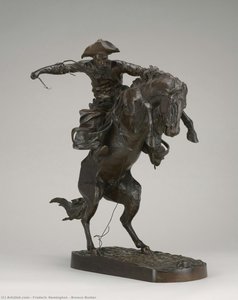
The Broncho Buster (1895) by Frederic Remington

The Broncho Buster

1895 · Bronze · Amon Carter Museum of American Art, Fort Worth

In the heart of the American frontier, where the dust of the plains meets the unyielding spirit of the pioneer, lies the essence of Frederic Remington’s most enduring masterpiece, The Broncho Buster. Sculpted in 1895 and brought to life through the medium of bronze, this work is far more than a mere depiction of a rodeo event; it is a visceral capture of a fleeting moment of pure, unadulterated struggle.…

4
The Trooper (1891) by Frederic Remington

The Trooper

1891 · Oil On Canvas

To gaze upon Frederic Remington's "The Trooper" is not merely to observe a painting; it is to step directly into the heart of the American West at the turn of the twentieth century. This oil on canvas, executed in 1891, captures a moment suspended between action and reflection—a tableau vivant brimming with untamed energy. The scene unfolds under an imagined vast sky, depicting a lone rider astride his powerful horse…

5
The Charge of the Rough Riders (1898) by Frederic Remington

The Charge of the Rough Riders

1898 · Acrylic On Canvas · Frederic Remington Art Museum, Ogdensburg

Frederic Remington’s “The Charge of the Rough Riders” isn't merely a depiction of a pivotal moment in American history; it’s an immersive experience rendered in oil on canvas, capturing the raw energy and determination of Theodore Roosevelt’s expedition to Cuba during the Spanish-American War. Painted in 1898, this artwork transcends simple chronology, becoming a testament to Remington's masterful ability to translate observation into emotive visual storytelling.

6
Hunter’s Supper by Frederic Remington

Hunter’s Supper

Oil On Canvas · National Cowboy - Western Heritage Museum, Оклахома-Сити

To gaze upon Frederic Remington's depiction of Hunter’s Supper is to be instantly transported across the vast, untamed expanse of the American West. This painting is far more than a mere record of men gathered after a day of pursuit; it is an immersion into the very essence of masculine fellowship and survival under the immense canvas of the wilderness. The central focus, naturally, is the campfire—a beacon of flickering…

7
Fight for the Waterhole (1903) by Frederic Remington

Fight for the Waterhole

1903 · Oil On Canvas · Museum of Fine Arts, Houston

We are looking at Fight for the Waterhole, a work by Frederic Remington. Created in 1903, this painting captures a moment of intense struggle within the American West. The scene depicts cowboys and cattle gathered around a small water source, a vital necessity in such an arid landscape. It is a depiction of conflict, centered on the desperate need for a scarce resource.

8
Trooper of the Plains (1909) by Frederic Remington

Trooper of the Plains

1909 · Sculpture Bronze · Frederic Remington Art Museum, Ogdensburg

Frederic Remington’s “Trooper of the Plains,” captured in this evocative black and white photograph, isn’t merely a depiction of a cowboy on horseback; it’s a potent distillation of the American West itself – a vanishing world rendered with breathtaking realism and imbued with a profound sense of adventure. Created in 1909, during a pivotal moment in the nation's fascination with its frontier heritage, this sculpture, and now faithfully reproduced, embodies…

9
The Grass Fire (1908) by Frederic Remington

The Grass Fire

1908 · Acrylic On Canvas · Amon Carter Museum of American Art, Fort Worth

Frederic Remington's "The Grass Fire," painted in 1908, is more than just a depiction of Native Americans on horseback; it’s a poignant snapshot of a vanishing era and a testament to an artist’s profound engagement with the American West. Measuring 101 x 68 cm, this artwork captures a moment of raw energy and quiet resilience as a group of riders navigate a landscape consumed by wildfire – a visual metaphor…

10
The Broncho Buster (1905) by Frederic Remington

The Broncho Buster

1905 · Bronze · Amon Carter Museum of American Art, Fort Worth

In the pantheon of American iconography, few images possess the raw, kinetic energy found in Frederic Remington’s The Broncho Buster. Created at the height of the late nineteenth century, this masterful bronze sculpture serves as a visceral window into the soul of the American West. It is not merely a depiction of a rider and a horse; it is a frozen moment of high-stakes drama, capturing the precise second where…

The Frederic Remington selection continues, 11 to 100

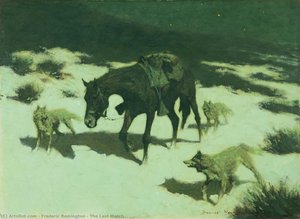
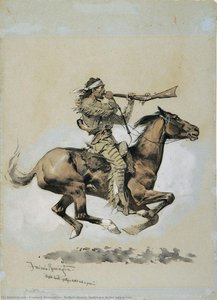
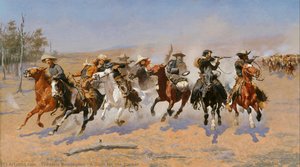
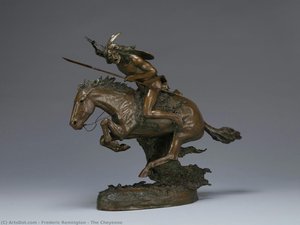
11The Grass Fire (1908) by Frederic RemingtonThe Grass Fire1908 · Amon Carter Museum of American Art 12Historians of the Tribe (1890) by Frederic RemingtonHistorians of the Tribe1890 · Art Institute of Chicago 13The Bronco Buster (1895) by Frederic RemingtonThe Bronco Buster1895 · Grohmann Museum 14Coming Through the Rye (1902) by Frederic RemingtonComing Through the Rye1902 · Frederic Remington Art Museum 15The Stampede (1910) by Frederic RemingtonThe Stampede1910 · Frederic Remington Art Museum 16The Broncho Buster (1895) by Frederic RemingtonThe Broncho Buster1895 · Frederic Remington Art Museum 17The Broncho Buster (1910) by Frederic RemingtonThe Broncho Buster1910 · Metropolitan Museum of Art 18Through the Smoke Sprang the Daring Soldier (1897) by Frederic RemingtonThrough the Smoke Sprang the Daring Soldier1897 · Amon Carter Museum of American Art 19The Wicked Pony (1898) by Frederic RemingtonThe Wicked Pony1898 · Amon Carter Museum of American Art 20Cavalry in an Arizona Sand-Storm (1889) by Frederic RemingtonCavalry in an Arizona Sand-Storm1889 · Amon Carter Museum of American Art 21The Long-Horn Cattle Sign (1908) by Frederic RemingtonThe Long-Horn Cattle Sign1908 · Amon Carter Museum of American Art 22Bronco Buster (1895) by Frederic RemingtonBronco Buster1895 · Sagamore Hill National Historic Site 23The Parley (1903) by Frederic RemingtonThe Parley1903 · Thyssen-Bornemisza Museum 24The Broncho Buster (1895) by Frederic RemingtonThe Broncho Buster1895 · Amon Carter Museum of American Art 25The Rattlesnake (1905) by Frederic RemingtonThe Rattlesnake1905 · Amon Carter Museum of American Art 26Trooper of the Plains 1868 (1909) by Frederic RemingtonTrooper of the Plains 18681909 · Amon Carter Museum of American Art 27The Rattlesnake (1908) by Frederic RemingtonThe Rattlesnake1908 · Amon Carter Museum of American Art 28The Fall of the Cowboy (1895) by Frederic RemingtonThe Fall of the Cowboy1895 · Amon Carter Museum of American Art 29The Last March (1906) by Frederic RemingtonThe Last March1906 · Frederic Remington Art Museum 30The Smoke Signal (1908) by Frederic RemingtonThe Smoke Signal1908 · Amon Carter Museum of American Art 31Eph on the Trail (1880) by Frederic RemingtonEph on the Trail1880 · Frederic Remington Art Museum 32Fight for the Water Hole (1903) by Frederic RemingtonFight for the Water Hole1903 · Museum of Fine Arts 33Aiding a Comrade (1890) by Frederic RemingtonAiding a Comrade1890 · Museum of Fine Arts 34The Pursuit (1896) by Frederic RemingtonThe Pursuit1896 · Virginia Museum of Fine Arts 35Cavalryman of the Line, Mexico (1889) by Frederic RemingtonCavalryman of the Line, Mexico1889 · Amon Carter Museum of American Art 36An Indian Trapper (1889) by Frederic RemingtonAn Indian Trapper1889 · Amon Carter Museum of American Art 37Buffalo Hunter Spitting a Bullet into a Gun (1892) by Frederic RemingtonBuffalo Hunter Spitting a Bullet into a Gun1892 · Frederic Remington Art Museum 38A Reconnaissance (1902) by Frederic RemingtonA Reconnaissance1902 · Amon Carter Museum of American Art 39The Wounded Bunkie (1896) by Frederic RemingtonThe Wounded Bunkie1896 · Amon Carter Museum of American Art 40The Cowboy (1902) by Frederic RemingtonThe Cowboy1902 · Amon Carter Museum of American Art 41The Bronco Buster by Frederic RemingtonThe Bronco Busterde Young Museum 42A Dash for the Timber (1889) by Frederic RemingtonA Dash for the Timber1889 · Amon Carter Museum of American Art 43Modern Comanche (1890) by Frederic RemingtonModern Comanche1890 44Mounted Cowboy in Chaps with Race Horse (1908) by Frederic RemingtonMounted Cowboy in Chaps with Race Horse1908 45A Dash for the Timber (1889) by Frederic RemingtonA Dash for the Timber1889 · Amon Carter Museum of American Art 46Ridden Down (1905) by Frederic RemingtonRidden Down1905 · Amon Carter Museum of American Art 47The Old Stage Coach of the Plains (1901) by Frederic RemingtonThe Old Stage Coach of the Plains1901 · Amon Carter Museum of American Art 48Moose Head (1889) by Frederic RemingtonMoose Head1889 · Frederic Remington Art Museum 49The Cheyenne (1901) by Frederic RemingtonThe Cheyenne1901 · Denver Art Museum 50He Lay Where He Had Been Jerked, Still as a Log (also known as Jerked Down) (1893) by Frederic RemingtonHe Lay Where He Had Been Jerked, Still as a Log (also known as Jerked Down)1893 51Bronco Buster by Frederic RemingtonBronco BusterThe Baltimore Museum of Art 52Crow Indians Firing into the Agency (1887) by Frederic RemingtonCrow Indians Firing into the Agency1887 · Amon Carter Museum of American Art 53The Stampede (1909) by Frederic RemingtonThe Stampede1909 · Amon Carter Museum of American Art 54Studio at Ingleneuk (1907) by Frederic RemingtonStudio at Ingleneuk1907 · Frederic Remington Art Museum 55Untitled (posssibly The Cigarette) (1908) by Frederic RemingtonUntitled (posssibly The Cigarette)1908 · Frederic Remington Art Museum 56A Comanche (1888) by Frederic RemingtonA Comanche1888 · Frederic Remington Art Museum 57The Cheyenne (1906) by Frederic RemingtonThe Cheyenne1906 · Frederic Remington Art Museum 58Polo cast no. 2 (1904) by Frederic RemingtonPolo cast no. 21904 · Frederic Remington Art Museum 59Ridden Down (1906) by Frederic RemingtonRidden Down1906 · Amon Carter Museum of American Art 60Hasty Intrenchment Drill In the United States Army (1896) by Frederic RemingtonHasty Intrenchment Drill In the United States Army1896 · Briscoe Western Art Museum 61A Cavalryman (1892) by Frederic RemingtonA Cavalryman1892 · Amon Carter Museum of American Art 62Packing and Paddling in the Adirondacks (1880) by Frederic RemingtonPacking and Paddling in the Adirondacks1880 · Frederic Remington Art Museum 63His First Lesson (1903) by Frederic RemingtonHis First Lesson1903 · Amon Carter Museum of American Art 64A Hunting Outfit (1880) by Frederic RemingtonA Hunting Outfit1880 · Frederic Remington Art Museum 65The Mountain Man (1903) by Frederic RemingtonThe Mountain Man1903 · Amon Carter Museum of American Art 66A Cavalryman's Breakfast on the Plains (1892) by Frederic RemingtonA Cavalryman's Breakfast on the Plains1892 · Amon Carter Museum of American Art 67The Infantry Soldier (1901) by Frederic RemingtonThe Infantry Soldier1901 · Amon Carter Museum of American Art 68The Last of His Race (also known as Vanishing American) (1908) by Frederic RemingtonThe Last of His Race (also known as Vanishing American)1908 · Yale University Art Gallery 69I Will Tell the White Man (1900) by Frederic RemingtonI Will Tell the White Man1900 · Art Institute of Chicago 70By Putting a Carbine Bullet Through Its Brain (1887) by Frederic RemingtonBy Putting a Carbine Bullet Through Its Brain1887 · Amon Carter Museum of American Art 71Lieutenant Casey Commandant of Cheyenne Scouts (1890) by Frederic RemingtonLieutenant Casey Commandant of Cheyenne Scouts1890 · Frederic Remington Art Museum 72The Fall of the Cowboy (1895) by Frederic RemingtonThe Fall of the Cowboy1895 · Amon Carter Museum of American Art 73Pony Tracks in the Buffalo Trails (1904) by Frederic RemingtonPony Tracks in the Buffalo Trails1904 · Amon Carter Museum of American Art 74Guard of the Whiskey Trader (1906) by Frederic RemingtonGuard of the Whiskey Trader1906 75Ninth Cavalry Colored Troops on Washing Duty in the Golf (1898) by Frederic RemingtonNinth Cavalry Colored Troops on Washing Duty in the Golf1898 · Frederic Remington Art Museum 76The Cowboy (1902) by Frederic RemingtonThe Cowboy1902 · Amon Carter Museum of American Art 77an appeal for justice by Frederic Remingtonan appeal for justice 78A Pack Train (1909) by Frederic RemingtonA Pack Train1909 79One of the Boys (1887) by Frederic RemingtonOne of the Boys1887 · Frederic Remington Art Museum 80The Cheyenne Type by Frederic RemingtonThe Cheyenne Type 81Unhorsed by Frederic RemingtonUnhorsed 82Against the Sunset by Frederic RemingtonAgainst the Sunset 83Paddling the Wounded British Officer (1897) by Frederic RemingtonPaddling the Wounded British Officer1897 · Art Institute of Chicago 84dragon (1847) by Frederic Remingtondragon1847 85a scout (1868) by Frederic Remingtona scout1868 86Touchdown, Yale vs. Princeton, Thanksgiving Day, Nov. 27, 1890, Yale 32, Princeton 0 (1890) by Frederic RemingtonTouchdown, Yale vs. Princeton, Thanksgiving Day, Nov. 27, 1890, Yale 32, Princeton 01890 · Yale University Art Gallery 87Roasting the Christmas Beef in a Cavalry Camp (1892) by Frederic RemingtonRoasting the Christmas Beef in a Cavalry Camp1892 · Yale University Art Gallery 88A Texas Pony (1889) by Frederic RemingtonA Texas Pony1889 · Yale University Art Gallery 89Scouts Climbing a Mountain (1891) by Frederic RemingtonScouts Climbing a Mountain1891 · Museum of Fine Arts 90The Lookout (1887) by Frederic RemingtonThe Lookout1887 · Museum of Fine Arts 91Pueblo Indian Village (1889) by Frederic RemingtonPueblo Indian Village1889 · Museum of Fine Arts 92Mexican Infantry "On the March" (1890) by Frederic RemingtonMexican Infantry "On the March"1890 · Museum of Fine Arts 93The Advance Guard (1888) by Frederic RemingtonThe Advance Guard1888 · Smithsonian American Art Museum 94A Mexican Vaquero (1890) by Frederic RemingtonA Mexican Vaquero1890 · Art Institute of Chicago 95The Mexican Major (1889) by Frederic RemingtonThe Mexican Major1889 · Art Institute of Chicago 96Mounted Indian Scout (1891) by Frederic RemingtonMounted Indian Scout1891 · Cincinnati Art Museum 97Tom Kicked Away the Stirrups and Grasped the Low Branch of a Live Oak Tree (1888) by Frederic RemingtonTom Kicked Away the Stirrups and Grasped the Low Branch of a Live Oak Tree1888 98Cavalry in an Arizona Sandstorm (1889) by Frederic RemingtonCavalry in an Arizona Sandstorm1889 99The Moose Hunt (1890) by Frederic RemingtonThe Moose Hunt1890 100Mandan Initiation Ceremony (the Sundance) (1888) by Frederic RemingtonMandan Initiation Ceremony (the Sundance)1888

Frederic Remington's famous paintings, period by period

The subjects that held Frederic Remington's eye

The four subjects that come back most often in these originals, each with its finest example.

The museums that keep Frederic Remington's originals

The 8 museums that hold the most of the paintings on this page.

Museum City Works by Frederic Remington Paintings from this list
Amon Carter Museum of American Art, Fort WorthAmon Carter Museum of American Art Fort Worth 45 The Old Stage-Coach of the Plains, Coming Through the Rye, The Broncho Buster
Frederic Remington Art Museum, OgdensburgFrederic Remington Art Museum Ogdensburg 43 The Charge of the Rough Riders, Trooper of the Plains, Coming Through the Rye
Museum of Fine Arts, HoustonMuseum of Fine Arts Houston 31 Fight for the Waterhole, Fight for the Water Hole, Aiding a Comrade
Art Institute of Chicago, ChicagoArt Institute of Chicago Chicago 16 Historians of the Tribe, I Will Tell the White Man, Paddling the Wounded British Officer
Yale University Art Gallery, New HavenYale University Art Gallery New Haven 5 Touchdown, Yale vs. Princeton, Thanksgiving Day, Nov. 27, 1890, Yale 32, Princeton 0, Roasting the Christmas Beef in a Cavalry Camp, A Texas Pony
Metropolitan Museum of Art, New YorkMetropolitan Museum of Art New York 6 The Broncho Buster
National Cowboy - Western Heritage Museum, Оклахома-СитиNational Cowboy - Western Heritage Museum Оклахома-Сити 2 Hunter’s Supper
Thyssen-Bornemisza Museum, MadridThyssen-Bornemisza Museum Madrid 2 The Parley

Frederic Remington decade by decade: the original that defines each

Works per decade

Pick a decade to see the original that defines it.

Collectors' questions about Frederic Remington's paintings

Which work is Frederic Remington most famous for?Reveal the answer

The Old Stage-Coach of the Plains (1901), Amon Carter Museum of American Art, Fort Worth. Coming Through the Rye (1902) and The Broncho Buster (1895) come next.

What age was Frederic Remington when The Old Stage-Coach of the Plains was made?Reveal the answer

40 years old: The Old Stage-Coach of the Plains dates from 1901, and Frederic Remington was born in 1861.

What are the ten most famous Frederic Remington paintings?Reveal the answer

The Old Stage-Coach of the Plains, Coming Through the Rye, The Broncho Buster, The Trooper, The Charge of the Rough Riders, Hunter’s Supper, Fight for the Waterhole, Trooper of the Plains, The Grass Fire and The Broncho Buster. The ranking above gives each one's year and museum.

How many paintings did Frederic Remington leave?Reveal the answer

Our catalog holds 346 works by Frederic Remington, dated from 1880 to 1909.

In which museums do Frederic Remington's masterpieces hang?Reveal the answer

Mostly in Amon Carter Museum of American Art (Fort Worth), Frederic Remington Art Museum (Ogdensburg) and Museum of Fine Arts (Houston). The museum table above lists them all.

In which years did Frederic Remington paint the most famous works?Reveal the answer

In 1900s: 37 of the 100 works on this page were made then, The Old Stage-Coach of the Plains among them.

What are the first and the last famous originals of Frederic Remington?Reveal the answer

On this page, the earliest is Eph on the Trail (1880) and the latest Trooper of the Plains (1909).

Which subjects did Frederic Remington choose most often?Reveal the answer

American west (33), Horseback riding (24) and Cowboy (21), across the 100 works on this page.

Which technique did Frederic Remington use most?Reveal the answer

Oil On Canvas, for 52 of the 100 works on this page.

Which Frederic Remington works hang at the Amon Carter Museum of American Art?Reveal the answer

The Old Stage-Coach of the Plains, Coming Through the Rye and The Broncho Buster: the Amon Carter Museum of American Art, Fort Worth holds 37 of the works on this page.

Frederic Remington: life and work

A Chronicler of the Vanishing West: The Life and Art of Frederic Remington

Frederic Sackrider Remington, born in Canton, New York, on October 4, 1861, wasn’t a product of the Wild West he so vividly depicted; rather, he was an Easterner who forged his artistic identity through fascination and dedicated study. His lineage hinted at a life far removed from dusty trails and cavalry charges – French Basque ancestry mingled with staunchly Republican New England roots, a father who was a Civil War colonel and newspaper editor, and connections to the famed Remington Arms dynasty through distant cousins. Yet, it was an early exposure to military themes, coupled with a restless spirit and a keen eye for storytelling, that set him on a path toward becoming arguably the most recognizable artist of the American West. His childhood moved to Bloomington, Illinois, then back to Canton and finally Ogdensburg, New York, but his imagination remained captivated by tales of frontier life. Though initially steered towards a military education at Vermont Episcopal Institute, Remington’s true calling lay not in following orders, but in observing and interpreting the world around him through art. A brief stint at Yale University confirmed this; football and sketching held far more appeal than formal academic pursuits.

From Illustrator to Painter: Forging an Artistic Vision

Remington’s artistic journey began not with grand canvases, but with ink and paper. His first published work, a cartoon for the *Yale Courant*, signaled an early aptitude for capturing action and narrative. A pivotal trip to Montana in 1881 ignited his lifelong obsession with the West. This wasn't merely a tourist’s gaze; Remington sought to immerse himself in the culture, observing cowboys, Native Americans, and the landscape itself. He initially attempted ranching and mining ventures, but these proved unsuccessful, freeing him to fully dedicate himself to art. Returning East, he quickly established himself as an illustrator for magazines like *Harper's Weekly* and *Collier’s*, his dynamic depictions of Western scenes captivating a national audience hungry for stories of the frontier. These illustrations weren’t simply reportage; they were infused with drama, energy, and a romanticized vision of the West that resonated deeply with the public imagination. It was through this work that Remington honed his skills in composition, capturing movement, and conveying emotion – qualities that would later define his paintings. He received minimal formal training beyond some drawing classes at Yale and a short period at the Art Students League, developing instead a distinctive style characterized by energetic brushwork, bold colors, and a focus on realism blended with dramatic flair.

Capturing a Vanishing World: Themes and Style

Remington’s art is inextricably linked to a specific moment in American history – the twilight of the Old West. His canvases are populated by iconic figures: rugged cowboys driving cattle, stoic Native Americans facing displacement, and U.S. Cavalry soldiers engaged in both heroic battles and tragic conflicts. He didn't shy away from depicting the harsh realities of frontier life, but his work often leans towards a romanticized portrayal, emphasizing courage, adventure, and the clash of cultures. His paintings aren’t simply historical documents; they are evocative narratives that explore themes of heroism, loss, and the inevitable march of progress. Remington's style evolved over time, moving from tighter, more academic renderings to looser, more expressive brushwork. He was a master of capturing movement – horses galloping across the plains, cowboys wrestling steers, soldiers charging into battle. He often employed quick sketches and photographs as reference material, but his art always transcended mere imitation, imbued with his own unique vision and emotional intensity. Notable works like *My Ranch*, *Waiting in the Moonlight*, *Ridden Down* (1905), and *The Long-Horn Cattle Sign* (1908) exemplify his ability to capture both the grandeur and the vulnerability of the American West.

Legacy and Enduring Influence

Frederic Remington died unexpectedly in 1909 at the age of 48, leaving behind a vast body of work that continues to captivate audiences today. His impact on Western art is undeniable; he didn’t just depict the West, he helped *define* it for generations of Americans. He established a visual language for the frontier – an iconography of cowboys, Indians, and cavalrymen that became deeply ingrained in popular culture. Remington’s depictions, while sometimes criticized for their romanticized portrayal of the West, offer a valuable glimpse into a pivotal era in American history. He captured not just what *was*, but also what people *believed* about the West – its myths, its legends, and its enduring appeal. He remains a powerful symbol of the American spirit—a chronicler of a vanishing world who transformed it into an enduring artistic legacy.