Portrait of Edgar Herbert Thomas

The 42 Most Famous Edgar Herbert Thomas Paintings, a Gallery Selection

Updated November 2026 · ranked by our popularity score (searches, visits and orders for each work) · 42 works by Edgar Herbert Thomas in our catalogue

In short

Of all the originals Edgar Herbert Thomas left, the most famous is Canal (1893). Close behind it come Winter Sunlight on Glamorgan Canal, Cardiff (1908) and Flowers in a Dark Vase (1929). Our catalog holds 42 works by Edgar Herbert Thomas; the gallery has kept the 42 the world admires most, each shown with its date, its museum and its story.

1862 – 1936 Impressionism

Edgar Herbert Thomas's top 10 paintings: the gallery's choice

1
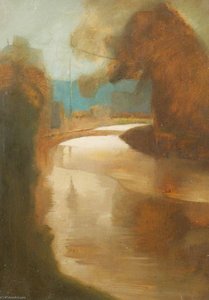
Canal (1893) by Edgar Herbert Thomas

Canal

1893 · Oil On Canvas

The scene unfolds in "Canal," a work painted by Edgar Herbert Thomas in 1893. This oil on canvas captures a quiet moment along a waterway, where the stillness of the air seems to weigh upon the surface of the water. The painting invites a close look at a world caught in a soft, hazy light, where the boundaries between the sky, the trees, and the canal begin to blur into…

2
Winter Sunlight on Glamorgan Canal, Cardiff (1908) by Edgar Herbert Thomas

Winter Sunlight on Glamorgan Canal, Cardiff

1908 · Oil

The stillness of a Welsh winter settles over the Glamorgan Canal. In this 1908 oil on cardboard, the waterway becomes a mirror for the pale, low-angled sun. Trees line the banks, their forms softened by the season, framing a scene of profound tranquility. Several boats rest upon the water, their presence adding a sense of human scale to the natural landscape. The composition captures a specific, fleeting moment where the…

3
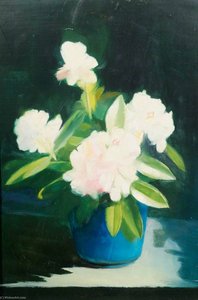
Flowers in a Dark Vase (1929) by Edgar Herbert Thomas

Flowers in a Dark Vase

1929 · Oil

The artwork Flowers in a Dark Vase, created in 1929, presents a vibrant floral arrangement set against a somber backdrop. The composition features a collection of blooms held within a black vase, which is positioned upon a table. The arrangement is characterized by a variety of colors and textures, specifically highlighting at least five pink roses of varying sizes and shapes, alongside two red orchids.

The Edgar Herbert Thomas selection continues, 11 to 42

Edgar Herbert Thomas's famous paintings, period by period

The subjects that held Edgar Herbert Thomas's eye

The four subjects that come back most often in these originals, each with its finest example.

Edgar Herbert Thomas decade by decade: the original that defines each

Works per decade

Pick a decade to see the original that defines it.

Collectors' questions about Edgar Herbert Thomas's paintings

Which work is Edgar Herbert Thomas most famous for?Reveal the answer

Canal (1893). Winter Sunlight on Glamorgan Canal, Cardiff (1908) and Flowers in a Dark Vase (1929) come next.

What age was Edgar Herbert Thomas when Canal was made?Reveal the answer

31 years old: Canal dates from 1893, and Edgar Herbert Thomas was born in 1862.

What are the ten most famous Edgar Herbert Thomas paintings?Reveal the answer

Canal, Winter Sunlight on Glamorgan Canal, Cardiff, Flowers in a Dark Vase, Teresa, The Swell of Hope, Nude Figure, Spring Awakening Old Winter from Her Sleep, Head of a Child, Morning The Glamorgan Canal and Study of a Girl's Head. The ranking above gives each one's year and museum.

How many paintings did Edgar Herbert Thomas leave?Reveal the answer

Our catalog holds 42 works by Edgar Herbert Thomas, dated from 1893 to 1929.

In which years did Edgar Herbert Thomas paint the most famous works?Reveal the answer

In 1900s: 5 of the 42 works on this page were made then, Winter Sunlight on Glamorgan Canal, Cardiff among them.

What are the first and the last famous originals of Edgar Herbert Thomas?Reveal the answer

On this page, the earliest is Canal (1893) and the latest Flowers in a Dark Vase (1929).

Which subjects did Edgar Herbert Thomas choose most often?Reveal the answer

Canal (2), Boats (2) and Trees (2), across the 42 works on this page.

Which technique did Edgar Herbert Thomas use most?Reveal the answer

Oil, for 2 of the 42 works on this page.

To which art movement does Edgar Herbert Thomas belong?Reveal the answer

Impressionism, judging by the originals on this page.

Edgar Herbert Thomas: life and work

Early Life and Artistic Beginnings

Edgar Herbert Thomas, born in Narberth, Pembrokeshire, Wales in 1862, emerged as a painter deeply attuned to the romantic spirit of his era. While initially embarking on a career as an illustrator for ‘The Western Mail’ in 1880, it was his inherent talent for capturing atmosphere and detail that ultimately steered him towards fine art. This early experience honed his observational skills and provided a foundation for the meticulous brushwork that would become a hallmark of his style. Though born in Wales, Thomas's artistic journey led him to Austria, where he found both inspiration and a burgeoning career depicting the majestic landscapes and refined society of 19th-century Europe.

A Master of Landscape and Portraiture

Thomas quickly established himself as an artist capable of rendering both the grandeur of nature and the nuanced character of his subjects. His landscapes, often featuring the breathtaking vistas of the Alps, are not merely depictions of scenery but evocative portrayals of mood and emotion. He possessed a remarkable ability to capture the play of light and shadow, imbuing his scenes with a sense of serenity and timeless beauty. Simultaneously, Thomas excelled in portraiture, capturing the spirit and social standing of his sitters with an impressive degree of realism and sensitivity. His portraits weren’t simply likenesses; they were windows into the lives and personalities of those he painted.

Influences and Artistic Development

The artistic currents of Thomas's time profoundly shaped his work. He absorbed elements from Romanticism, evident in his dramatic compositions and emotional intensity, and hints of Symbolism can be detected in the subtle narratives woven into some of his pieces. The influence of artists like Gustave Doré, renowned for his detailed engravings and atmospheric scenes, is also apparent in Thomas’s meticulous approach to detail and mastery of light and shadow. Over time, his style evolved from a more traditional realism towards an Impressionistic sensibility, particularly noticeable in his forest scenes where brushstrokes become looser and more expressive.

Major Achievements and Notable Works

While a comprehensive catalogue raisonné remains elusive, several works stand as testaments to Thomas’s skill. ‘Landscape’ (1921), with its serene depiction of a forested scene, exemplifies his Impressionistic leanings and masterful use of color. His studies of the nude form, such as “Study of the Nude”, demonstrate his technical prowess and understanding of anatomy. Though less widely known today, paintings like "The Last Supper" and "The Death of Emperor Franz Joseph" suggest a broader range of subject matter and an engagement with historical themes. These works, alongside numerous portraits, cemented his reputation among collectors and art enthusiasts of the period.

Historical Significance and Legacy

Edgar Herbert Thomas occupies a unique position in the artistic landscape of the late 19th and early 20th centuries. He represents a bridge between traditional academic painting and the emerging modern styles. His detailed brushwork, atmospheric compositions, and evocative portrayals of European life offer a valuable glimpse into a bygone era. While not as celebrated as some of his contemporaries, Thomas’s work continues to resonate with those who appreciate the beauty of classical art and the enduring power of landscape and portraiture. Today, reproductions of his paintings allow a wider audience to experience the timeless elegance and emotional depth that define his artistic legacy.