Portrait of Daniel Garber

The 63 Most Famous Daniel Garber Paintings, a Gallery Selection

Updated October 2026 · ranked by our popularity score (searches, visits and orders for each work) · 66 works by Daniel Garber in our catalogue

In short

Of all the originals Daniel Garber left, the most famous is Springtime In The Village. Close behind it come South Room - Green Street (1920) and Tanis Garber (1914). Our catalog holds 66 works by Daniel Garber; the gallery has kept the 63 the world admires most, each shown with its date, its museum and its story.

1880 – 1958, North Manchester Impressionism Most works: James A. Michener Art Museum

Daniel Garber's top 10 paintings: the gallery's choice

1
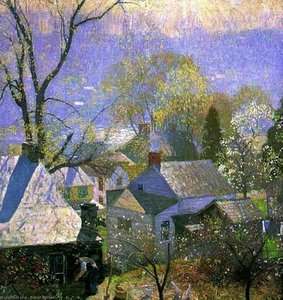
Springtime In The Village by Daniel Garber

Springtime In The Village

Oil On Canvas

In "Springtime In The Village" by Daniel Garber, the composition centers on a tranquil village scene set within a rural or semi-rural environment. In the foreground, two figures are positioned on a path, appearing to be engaged in conversation. This path is bordered by a variety of trees and shrubs. The figures are rendered with soft definitions that allow them to blend into the surrounding landscape. Their attire suggests traditional…

2
South Room - Green Street (1920) by Daniel Garber

South Room - Green Street

1920

Backlit from sunlight pouring in through a tall window, a girl with waist-length, golden hair stands reading looking at a sheet of paper in profile, facing a person sitting in a chair in front of the window in the corner of the room in this vertical painting. Both people seem to have light skin though their faces are obscured by shadow. The window on the wall opposite us is to…

The Daniel Garber selection continues, 11 to 63

The subjects that held Daniel Garber's eye

The four subjects that come back most often in these originals, each with its finest example.

The museums that keep Daniel Garber's originals

The 8 museums that hold the most of the paintings on this page.

Museum City Works by Daniel Garber Paintings from this list
James A. Michener Art Museum, DoylestownJames A. Michener Art Museum Doylestown 2 A Wooded Watershed, Little Girl Knitting
Payne Gallery, Bethlehem, PennsylvaniaPayne Gallery Bethlehem, Pennsylvania 1 Lone Tree
Pennsylvania Academy of Fine Arts, PhiladelphiaPennsylvania Academy of Fine Arts Philadelphia 1 Quarry
Cincinnati Art Museum, CincinnatiCincinnati Art Museum Cincinnati 1 Hawk's Nest
Nationalmuseum, StockholmNationalmuseum Stockholm 1 Reading -
Indianapolis Museum of Art, IndianapolisIndianapolis Museum of Art Indianapolis 1 Quarry At Byram
Smithsonian American Art Museum, Washington, D.C.Smithsonian American Art Museum Washington, D.C. 1 Tohickon
Detroit Institute of Arts, DetroitDetroit Institute of Arts Detroit 1 Trees

Daniel Garber decade by decade: the original that defines each

Works per decade

Pick a decade to see the original that defines it.

Collectors' questions about Daniel Garber's paintings

Which work is Daniel Garber most famous for?Reveal the answer

Springtime In The Village. South Room - Green Street (1920) and Tanis Garber (1914) come next.

What are the ten most famous Daniel Garber paintings?Reveal the answer

Springtime In The Village, South Room - Green Street, Tanis Garber, Lone Tree, Fisherman's Hut, The Letter, Springtime Byrum, New Hope, Old Man And The Pipe and Quarry. The ranking above gives each one's year and museum.

How many paintings did Daniel Garber leave?Reveal the answer

Our catalog holds 66 works by Daniel Garber, dated from 1914 to 1943.

In which museums do Daniel Garber's masterpieces hang?Reveal the answer

Mostly in James A. Michener Art Museum (Doylestown), Payne Gallery (Bethlehem, Pennsylvania) and Pennsylvania Academy of Fine Arts (Philadelphia). The museum table above lists them all.

In which years did Daniel Garber paint the most famous works?Reveal the answer

In 1910s: 2 of the 63 works on this page were made then, Tanis Garber among them.

What are the first and the last famous originals of Daniel Garber?Reveal the answer

On this page, the earliest is Tanis Garber (1914) and the latest Lone Tree (1943).

Which subjects did Daniel Garber choose most often?Reveal the answer

American art (6), Landscape (6) and Tranquility (4), across the 63 works on this page.

To which art movement does Daniel Garber belong?Reveal the answer

Impressionism, judging by the originals on this page.

Which Daniel Garber works hang at the James A. Michener Art Museum?Reveal the answer

A Wooded Watershed and Little Girl Knitting: the James A. Michener Art Museum, Doylestown holds 2 of the works on this page.

Daniel Garber: life and work

The Luminous Legacy of Daniel Garber

In the quiet, sun-drenched landscapes of the Delaware River valley, there exists a particular quality of light that seems to transcend the mere physical world, touching upon something eternal. This is the realm mastered by Daniel Garber, a titan of the American Impressionist movement and a defining voice of the New Hope School. Born in North Manchester, Indiana, in 1880, Garber would eventually become one of the most revered chroniclers of the Pennsylvania countryside, weaving together the delicate textures of nature with a profound sense of atmospheric serenity. His work does not merely depict a scene; it captures a moment of stillness, where the interplay of shadow and radiance invites the viewer into a meditative communion with the earth.

Garber’s artistic evolution was shaped by a rigorous academic foundation and an adventurous spirit. After his initial studies at the Cincinnati Art Academy, he moved to the prestigious Pennsylvania Academy of Fine Arts (PAFA), where he studied from 1899 to 1905. It was during this formative period that he met and married Mary Franklin, a fellow artist who would become his lifelong companion and collaborator. Together, they embarked on a transformative European expedition, an odyssey that exposed Garber to the masters of light and the burgeoning Impressionist techniques sweeping the continent. This exposure to plein air painting—the practice of working directly in the open air—became the heartbeat of his methodology, allowing him to translate the fleeting nuances of weather and light onto canvas with unparalleled sensitivity.

Mastery of Light and the New Hope Spirit

Upon returning to America in 1907, Garber settled in Cuttalossa within Solebury Township, a location that would serve as his primary muse. Here, amidst the rolling hills and riverbanks of Bucks County, he found the perfect stage for his Impressionist vision. His technique was characterized by a remarkable ability to balance meticulous detail with broad, luminous strokes. While many Impressionists focused on the dissolution of form, Garber maintained a certain structural integrity, using tonal gradation to create depth and a sense of tangible presence. Whether he was capturing the expansive vistas of the Delaware River or the intimate, quietude of interior scenes, his brushwork possessed a rhythmic grace that celebrated the organic beauty of his surroundings.

The breadth of Garber’s artistic output was as diverse as the landscapes he loved. His repertoire included:

  • Expansive Landscapes: Renowned for their ability to capture the shimmering reflections on water and the soft, hazy atmosphere of early morning light.
  • Detailed Etchings: Demonstrating a precise, graphic mastery that highlighted the intricate textures of the natural world.
  • Figurative Interiors: Quiet, contemplative scenes that brought a human element to his explorations of light and domestic space.

A Lifetime of Influence and Achievement

Garber’s impact on the American art landscape extended far beyond the borders of Pennsylvania. His talent earned him significant international recognition, most notably at the 1915 Panama-Pacific International Exposition, where he was awarded a prestigious gold medal. This triumph, coupled with his election to the National Academy of Design in 1913, solidified his status as a leading figure in American fine art. However, perhaps his most enduring contribution to the arts was his role as an educator. For over forty years, Garber served on the faculty of the Pennsylvania Academy of Fine Arts, where his dedication to teaching helped shape the vision and technique of countless generations of aspiring painters.

As a cornerstone of the New Hope School, Daniel Garber’s work remains a testament to the enduring power of the American landscape. His ability to find the extraordinary within the ordinary—to see the divine in a sunlit meadow or a river mist—continues to resonate with collectors and historians alike. Today, his masterpieces reside in major museums, serving as luminous windows into a period of American art defined by grace, light, and an unwavering reverence for the natural world.